
Specs are compiled from manufacturer listings and verified buyer reviews and can change over time — please confirm the key details on the product page before buying.
Your boxwoods are the backbone of your garden — crisp hedges, tidy foundation plantings, that classic formal look. But keeping them a deep, even green without yellowing or stalled growth takes the right nutrition, not just any bag of fertilizer. The wrong formula can burn roots or fail to correct the specific deficiencies boxwoods struggle with most.
I’m Rikta — the founder and writer behind Lawn Gear Lab. This guide is built by comparing the manufacturers’ published specifications and the patterns across verified customer reviews, so you get each pick’s real strengths and trade-offs instead of marketing spin.
Here is the honest breakdown of the best fertilizer for boxwood plants available right now — each one compared against real owner experience and the specific needs of these evergreen shrubs, so you can pick the one that matches your garden’s demands.
Our Picks at a Glance
How To Choose The Best Fertilizer For Boxwood Plants
Choosing a boxwood fertilizer depends on two big questions: how fast do you want results, and how much effort do you want to put into application? The right answer depends on your plant’s current condition — a stressed, yellow shrub needs a quicker intervention than a healthy hedge you just want to maintain.
Granular vs. Liquid — The Pacing Decision
Granular fertilizers (the small pellets you sprinkle around the base) release nutrients slowly over several weeks or months. They are the traditional choice for larger garden beds because a single spring application carries the plant through the season. Liquids, on the other hand, are absorbed into the soil within days and show visible results — greener leaves, new growth — much faster. The trade-off is that liquids require you to mix and apply every few weeks during the growing season.
The NPK Ratio and What It Means for Boxwoods
A boxwood’s ideal diet leans slightly higher in potassium and magnesium than a generic all-purpose plant food. The NPK number (for example, 4-3-4 or 13-3-13) tells you the proportion of nitrogen, phosphorus, and potassium. For boxwoods you want a balanced or slightly higher potassium number, plus added sulfur, to keep the foliage dense and deep green. A ratio that is too heavy in nitrogen (the first number) will push floppy, sappy growth that attracts pests.
Size Considerations — What a Bag Actually Covers
One of the biggest buying mistakes is underestimating how far a bag goes. An 8-pound granular bag feeds a row of several mature shrubs for a full season, while a 1-pound bag of professional formula may only cover 100 square feet — about eight to ten medium boxwoods. Check the coverage number, not just the bag weight, to avoid running out halfway through the job.
Quick Comparison
| Model | Best For | NPK Ratio | Item Weight | Form | Amazon |
|---|---|---|---|---|---|
| Espoma Organic Holly-Tone (Pack of 2)★ Best Overall | Acid-loving shrubs, long-term health | 4-3-4 | 4 lb per bag | Granules | Amazon |
| Espoma Organic Evergreen-Tone | Large evergreen beds, season-long feed | 4-3-4 | 8 lb | Granules | Amazon |
| TPS Nutrients Boxwood Fertilizer | Quick green-up, stressed plants | Not listed | 32 fl oz | Liquid | Amazon |
| TOPBUXUS Boxwood Turbo Grow | Targeted boxwood boost, small areas | 13-3-13 | 1 lb | Granules | Amazon |
In‑Depth Reviews
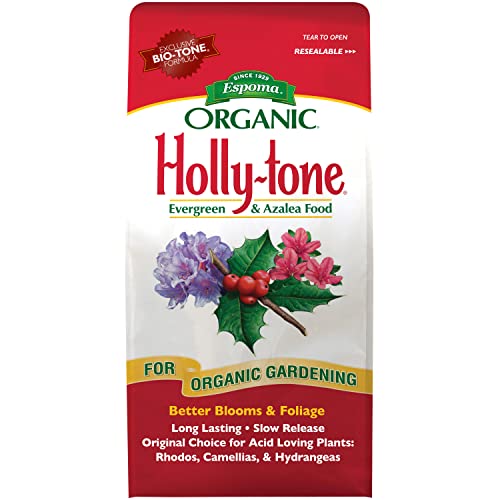
1. Espoma Organic Holly-Tone 4-3-4 Evergreen & Azalea Plant Food (Pack of 2)
Our pick — over 4.5★ from 700+ verified ratings; the strongest balance of quality and price.
Two 4-pound bags of the original organic feed that keeps acid-lovers thriving for months.
This is the product gardeners reach for when they want one bag that works across their whole foundation planting — azaleas, hydrangeas, blueberries, and yes, boxwoods. The 4-3-4 NPK ratio, with 5% sulfur blended in, is designed to lower soil pH slowly, which is exactly what boxwoods need to prevent those telltale yellow leaves. Because it is granular and requires zero mixing, you simply sprinkle it around the drip line (the area under the outermost branches) and water it in. The crowd gives this a strong vote of confidence: the pack contains two separate 4-pound bags, so you get a full year’s supply for a moderate-sized hedge in one order.
The plant benefits are what owners praise most — buyers report that this fertilizer keeps trees and shrubs healthy through the whole season, delivering dark green foliage and larger blooms on flowering shrubs. The organic Bio-tone formula (a proprietary blend of beneficial microbes according to the maker) breaks down gradually, so you are feeding the soil microbes as well as the plant. A minor note: some owners mention a strong smell from the bag for a day or two after application, though it fades after watering. The pack of two makes this roughly 8 pounds total, compared to the 8-pound single-bag Evergreen-Tone below, but the Holly-Tone is explicitly formulated for a broader range of acid lovers.
What drives the results
- Proven 4-3-4 analysis with added sulfur targets the root cause of yellow boxwood leaves
- Two 4-pound bags give you double the volume of the single-bag Evergreen-Tone option
- Certified for organic gardening — no synthetic chemicals or toxic ingredients
- Ready-to-use granules with no measuring or mixing required
What to know before buying
- Strong organic odor for the first day or two after application
- Effect on hydrangea color change is slower than some gardeners expect
Grab this for: the gardener who wants a single, organic, no-mix feeding solution for boxwoods and all their other acid-loving shrubs — two bags cover a lot of ground.
Think twice if: you need an instant green-up for a plant that is already yellowing, because granules take weeks to break down and deliver nutrients.
2. Espoma Organic Evergreen-Tone 4-3-4 Natural & Organic Fertilizer (8 lb. Bag)

An 8-pound juggernaut of slow-release nutrition built for whole-evergreen beds, not just a single shrub.
Where the Holly-Tone is a generalist for all acid lovers, this Evergreen-Tone is the specialist for needle-leaf and broadleaf evergreens — pine, fir, spruce, juniper, and of course boxwoods. The bag is massive at 8 pounds, versus the 1-pound TOPBUXUS product, meaning you can feed a long hedge or an entire row of foundation shrubs from one bag without restocking. The NPK ratio is identical at 4-3-4 with 5% sulfur, but the application timing is key: Espoma recommends feeding in early spring and again in late fall for established plants, aligning perfectly with the two growth spurts boxwoods have each year.
Buyers describe seeing a visible difference in days, not months — one report mentions plants that were fed just before fall “thrived well into November,” and that everything grew “so much stronger” the following spring. The consensus among owners is that the quality and effectiveness are the main reasons to choose this over cheaper brands. Like the Holly-Tone, it has a strong odor straight from the bag, but that is the smell of active organic matter working. A single bag covers more than double the area of the Holly-Tone twin-pack, making this the clear choice for larger properties or for gardeners who hate buying fertilizer twice in a season.
Why it stands out
- 8-pound bag is the biggest single-unit option here — at 8 pounds versus the 1-lb TOPBUXUS product
- Customers note noticeable growth and stronger spring green-up after just one fall application
- Approved for organic production, with Bio-tone microbes that improve long-term soil health
- Simple sprinkle-and-water application with no measuring cups or sprayers needed
One honest caveat
- The natural odor is strong and lingers near the application area until the granules dissolve
- Not the best pick if you have just a single small boxwood and want to avoid excess product
Best suited for: the serious gardener with multiple evergreens or a long hedge who wants to buy one bag and not think about feeding again for the whole year.
Not the right fit for: someone treating a single potted boxwood or a very small planting — the 8-pound bag is more than you need and will last many seasons.
3. TPS Nutrients Boxwood Fertilizer – Liquid Plant Food, 32 oz
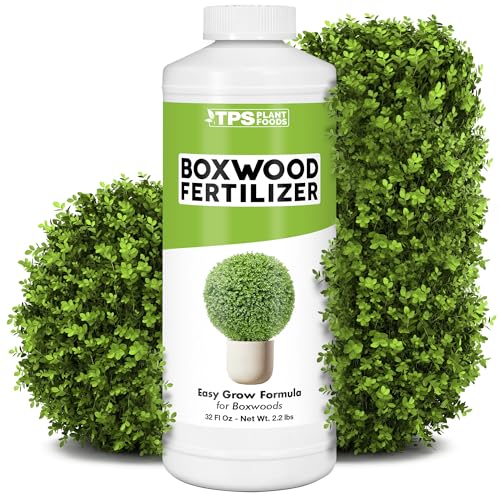
A 32-ounce liquid that turns dull orange leaves brilliant green in a week or less.
When your boxwoods are looking sad — yellow, orange-tinged, or simply not growing — you do not want to wait for granules to break down in the soil. This liquid formula from TPS Nutrients is absorbed by the roots within hours, and reviewers point out seeing the difference in days. One buyer tracked the transformation: leaves went from “dull orange” to “brilliant green” after only one week of use, and a set of 35-year-old boxwoods that were struggling showed new positive growth. That is the defining strength of a liquid — speed of action that granular fertilizers simply cannot match.
The bottle is 32 fluid ounces, which is on the smaller side compared to the 4-pound and 8-pound granular bags, but because it is a concentrated liquid you mix it with water before applying. Growth is the #1 thing owners praise about this product. For gardeners who prefer a targeted, response-driven approach to feeding, this is the most direct tool. The trade-off is that liquids need to be reapplied every few weeks during the growing season, rather than the twice-a-year schedule of granules. If you have a large hedge, the bottle may only cover a few applications before you need a refill.
The speed advantage
- Visible results in as little as one week — leaves turn deep green from a stressed yellow-orange state
- Liquid form is absorbed directly by roots, bypassing the slow soil breakdown of granules
- Owners describe it reviving even 35-year-old boxwoods that had stopped growing
- Simple to apply with a watering can or hose-end sprayer
What holds it back
- Needs repeat applications every few weeks during the growing season, not a one-and-done feed
- The bottle size is modest — some owners say they wished it was larger for the cost
Reach for this if: your boxwoods are currently stressed, yellow, or stalled and you need to turn them around fast before winter or a big event.
Look elsewhere if: you prefer a low-maintenance approach — liquids require consistent scheduling to maintain results all season.
4. TOPBUXUS Boxwood Turbo Grow – Professional Boxwood Fertilizer, 1 lb.

A high-potency 13-3-13 granular formula packed with magnesium and sulfur, specifically for boxwoods.
This is the only product in the lineup that is formulated exclusively for boxwoods, and the NPK ratio tells that story: 13-3-13, which is much higher in potassium than the 4-3-4 Espoma products, plus 2.5% magnesium and 9.0% sulfur. That potassium and magnesium combination directly supports the deep green leaf color and dense growth pattern boxwoods are known for. The 1-pound bag covers 100 square feet, making it a precise tool for a targeted number of shrubs rather than a whole landscape.
Owners who have tried everything else report that the Turbo Grow brought boxwoods “back to life” after winter bronzing and transplant shock. Growth is the top-mentioned positive aspect by a wide margin. However, the feedback is more mixed than the Espoma picks — some buyers saw no visible improvement after a month, and the color results are split between “lush green” and “yellow tinge.” At 1 pound, this bag is 1 pound versus the Espoma Evergreen-Tone 8-pound bag, so you are paying for concentration and specificity rather than bulk. For a small planting of eight or so boxwoods, that precision is an advantage. For a long hedge, the bag runs out too fast.
The targeted advantage
- NPK of 13-3-13 with extra magnesium (2.5%) and sulfur (9.0%) is engineered specifically for boxwood nutrition
- Granules are absorbed directly by roots for fast action on stressed plants
- Buyers with winter-damaged boxwoods report successful recovery after spring application
- Very easy to apply — just scatter the granules around the base and water them in
Where it falls short
- The 1-pound bag is small — covers only 100 sq. ft., which is about 8–10 medium boxwoods
- Results are inconsistent for some: a minority of buyers saw no leaf improvement after a month
Grab it if: you have a small boxwood planting (under a dozen shrubs) and want a formula made specifically for them, not a general acid-lover feed.
skip it if: you are feeding a long hedge or multiple garden beds — you will run out of the 1-pound bag before you finish the first row.
Understanding the Specs
NPK Ratio — The Three Numbers That Matter
Every fertilizer bag displays three numbers separated by dashes, like 4-3-4 or 13-3-13. The first is nitrogen, which drives leaf and stem growth; the second is phosphorus, which supports root and flower development; the third is potassium, which strengthens overall plant health and disease resistance. For boxwoods you generally want a balanced or slightly potassium-heavy ratio, because they are slow-growing evergreens that need steady support rather than a rush of nitrogen that creates weak, floppy growth.
Sulfur and Magnesium — The Anti-Yellowing Duo
Boxwoods are prone to chlorosis — the yellowing of leaves caused by a soil pH that is too alkaline or a deficiency in micronutrients. Sulfur naturally lowers soil pH, making it easier for the plant to absorb iron and other nutrients, while magnesium is a core component of chlorophyll, the molecule that makes leaves green. A boxwood fertilizer that includes both, like the Espoma products (5% sulfur) and the TOPBUXUS (2.5% magnesium, 9.0% sulfur), directly targets this problem at the source.
FAQ
When is the best time to fertilize boxwood plants?
Can I use a general all-purpose fertilizer on boxwoods?
How do I apply granular fertilizer to my boxwoods?
Is liquid or granular fertilizer better for boxwoods?
Why are my boxwood leaves turning yellow after fertilizing?
How much fertilizer does a single boxwood shrub need?
Can I over-fertilize my boxwood plants?
Do boxwoods need a special acid-loving fertilizer?
What does the sulfur in boxwood fertilizer actually do?
Will boxwood fertilizer help with winter burn recovery?
Final Thoughts: The Verdict
For most gardeners, the fertilizer for boxwood plants that covers the most ground with the least effort is the Espoma Organic Evergreen-Tone — the 8-pound bag feeds a row of evergreens all season with just two applications, and the positive owner feedback on effectiveness and quality makes it a reliable heavyweight. If you are managing a small boxwood planting or want the fastest possible correction of yellow leaves, the TPS Nutrients Boxwood Liquid turns plants around in a week. And for the precision-focused gardener who wants a formula engineered exclusively for boxwoods, the TOPBUXUS Turbo Grow delivers the highest NPK ratio and extra magnesium in a small, targeted 1-pound bag.
How We Picked
We do not accept paid placement. Every pick is matched to a real buyer and a real use-case; we do not hands-on test units.
Sources & Methodology
Specifications: manufacturer listings and product documentation. Review insights: verified customer reviews, as of July 2026. Pricing: not shown on this page (it changes often); check the current price via the retailer link.
As an Amazon Associate, Lawn Gear Lab earns from qualifying purchases. This does not affect which products we feature.