
Specs are compiled from manufacturer listings and verified buyer reviews and can change over time — please confirm the key details on the product page before buying.
Throwing down a roll of black fabric sounds simple, but the wrong garden weed barrier turns a weekend project into a season-long headache — frayed edges, water pooling, and weeds pushing through by midsummer. The real trick is finding the one that blocks sunlight, lets rain soak through, and actually stays put without shredding apart under a layer of mulch or gravel. This guide breaks down six very different contenders, from long-haul commercial-grade rolls to budget-friendly multi-packs, so you can match the fabric to the job.
I’m Rikta — the founder and writer behind Lawn Gear Lab. This guide is built by comparing the manufacturers’ published specifications and the patterns across verified customer reviews, so you get each pick’s real strengths and trade-offs instead of marketing spin.
You want a garden weed barrier that stops weeds without trapping water or falling apart in the sun. The three things that matter most are thickness (measured in ounces per square yard), how fast water drains through, and whether the fabric can handle sunlight and people walking on it.
Our Picks at a Glance

How To Choose The Best Garden Weed Barrier
Landscape fabric is sold by density — measured in ounces per square yard (oz) — and construction method (woven vs. non-woven). A heavier fabric (5 oz or more) stands up to foot traffic and sharp rocks, while lighter 3 oz rolls work fine under bark mulch in a flower bed. You also need to check permeability: if water can’t pass through, your soil gets choked and roots suffer. And always look for UV treatment on the label — that is what keeps the fabric from cracking apart after a few months in direct sun.
Weight and Thickness — The Ounce Rule
The first number serious gardeners check is the fabric’s weight. A 3.2 oz barrier is the standard for most residential beds and pathways — it blocks light but still lets air and water move through. Jump to a 5 oz fabric, and you get a commercial-grade layer that shrugs off wheelbarrow traffic and stones. Lighter fabric saves money; heavier fabric saves replacement labor.
Woven vs Non-Woven Construction
Woven fabric is made of polypropylene strands pressed together in a grid pattern — it is tough and tear-resistant, ideal for driveways and gravel paths. Non-woven fabric looks and feels more like felt; it lets water pass very freely and is often used under raised beds and in vegetable gardens where drainage matters most. Some premium rolls combine both layers for the best of both worlds.
UV Resistance and Lifespan
Sunlight breaks down untreated fabric fast — within a season or two, it can start flaking and losing strength. A good barrier is either UV-treated (stabilized against sun damage) or designed to be fully covered with mulch, stone, or bark. If any part of the fabric will be exposed to direct light, UV protection is non-negotiable. Several brands now claim an installed lifespan of 5 to 12 years depending on sun exposure.
Quick Comparison
| Model | Best For | Weight | Dimensions | Construction | Amazon |
|---|---|---|---|---|---|
| VIVOSUN 3ft x 50ft★ Best Overall | Heavy-duty garden beds | 5 oz | 3 ft x 50 ft | Dual-Layer (Woven + Non-Woven) | Amazon |
| GRASSCLUB 5×10 ft 3-PackBudget Champion | Budget bed or pathway | Not listed | 5 ft x 10 ft (3 sheets) | Woven | Amazon |
| Winisok 4ft x 100ft | Large-area coverage on a budget | 3.2 oz | 4 ft x 100 ft | Woven Polypropylene | Amazon |
| UWIOFF 4ft x 100ft | Vegetable garden and flower beds | 3.2 oz PE Fabric | 4 ft x 100 ft | Non-Woven (PE Fabric) | Amazon |
| GreatBuddy 4ft x 100ft | Pathways and orchards | 3.2 oz | 4 ft x 100 ft | Woven Polypropylene | Amazon |
| Dewitt 3ft x 100ft | Long-term permanent installation | 3 oz Non-Woven | 3 ft x 100 ft | Non-Woven (Hydrophilic Treated) | Amazon |
In‑Depth Reviews
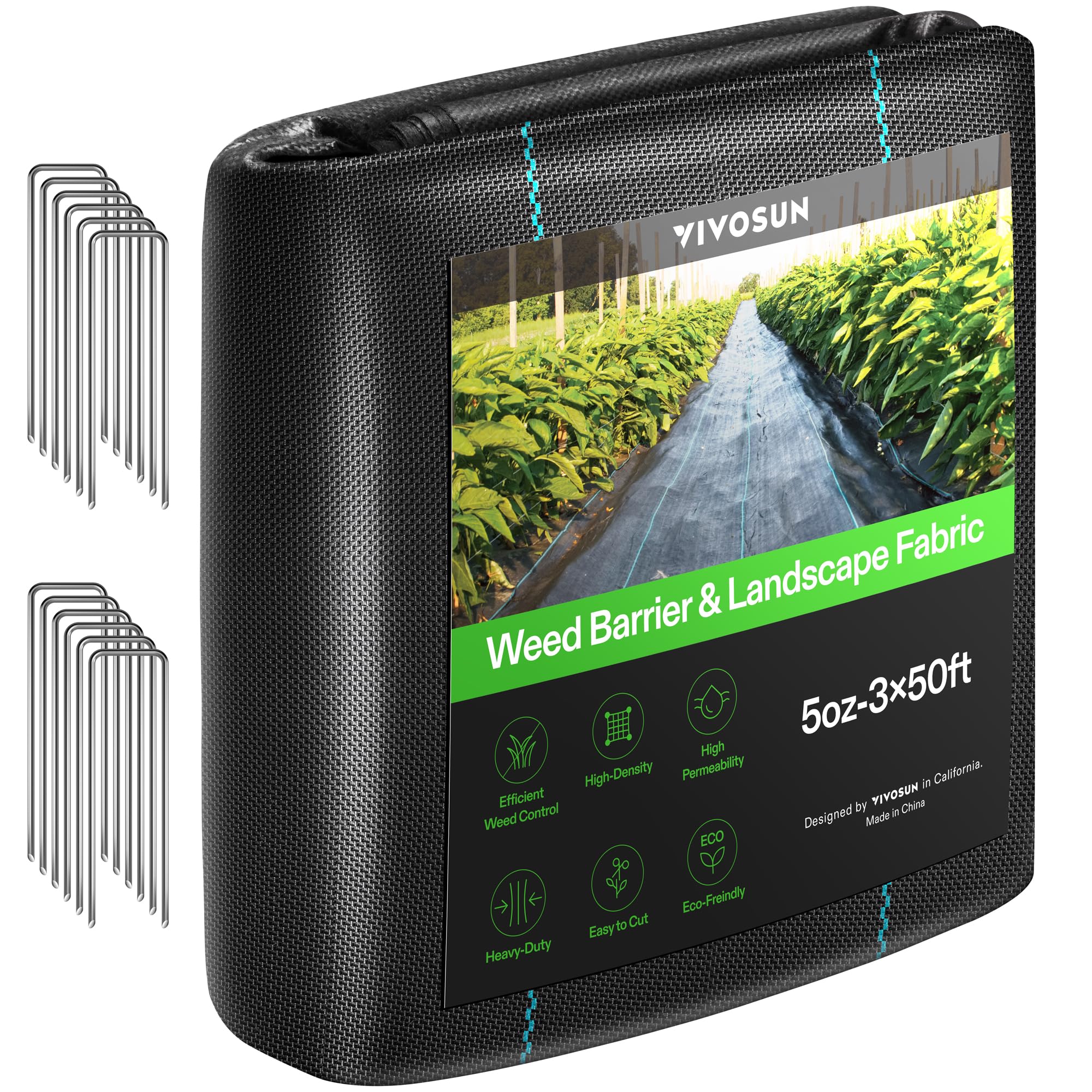
1. VIVOSUN Premium Weed Barrier Landscape Fabric Heavy Duty 3ftx50ft
Our pick — over 4.5★ from 900+ verified ratings; the strongest balance of quality and price.
The 5-ounce workhorse that takes daily foot traffic without tearing.
If you are covering a garden bed or path that you actually walk on every day, this is the barrier that holds up. The standout feature here is the 5 oz dual-layer construction — a woven layer bonded to a non-woven felt layer through a needle-punching process. That pairing gives it unusual strength: buyers report that it “works great around garden beds, we walk on everyday holding up great,” which is exactly the real-world abuse test most lighter fabrics fail within weeks.
At 3 ft wide by 50 ft long, the roll is manageable for a single person to drag across a bed. The woven layer has small holes that let water drain, while the non-woven side draws moisture through using molecular attraction — the maker claims this permeability is six times higher than standard woven ground covers. Green line guides run every foot so you can space plants evenly without measuring. The crowd favorite here outpaces most: nearly a thousand ratings at 4.6 stars place it as the highest-scoring pick on this list.
The cut edges fray less than typical fabric because of the bonded construction. You can cut it with scissors, lay it down, and pin it without worrying about the edge unraveling mid-season. It is also machine-washable — a quirky bonus if you ever want to reuse a section after a project.
Standout trait: The VIVOSUN’s dual-layer 5 oz fabric is heavier than the 3.2 oz standard on most barriers here. The roll weighs 5.19 pounds, while the Winisok (which covers twice the area) weighs 7.59 pounds — so you get denser protection per square inch with the VIVOSUN.
Reach for this if: you need a walking-on-it-daily barrier for garden beds, stone walkways, or play areas where lighter fabrics disintegrate.
Look elsewhere if: you are covering a huge area on a tight budget — the 50-ft length costs less upfront than a 100-ft roll, but you pay more per foot than the bulk-value picks.
2. GRASSCLUB 5 x 10 Feet 3 Pack Weed Barrier Fabric
Three pre-cut sheets for small beds and pathway patches.
This is the pick when you don’t need a 100-ft roll. You get three 5×10 ft sheets of woven fabric — each one a manageable size for a single flower bed or a short gravel path. Owners mention it is “sturdy, thick, easy to install, great value” and that it works well for its intended use. The multi-pack format is handy if you have several separate beds or want to stagger installation without unrolling a giant sheet all at once.
The woven construction allows a slow exchange of air, water, and nutrients while blocking light. It is designed to inhibit weed growth first, with permeability as a secondary benefit — not as free-flowing as non-woven fabrics, but adequate for most ornamental beds. Some owners found the material not as heavy-duty as expected, with a few mentioning it broke apart during unfolding. That inconsistency means you should handle the sheets gently during install, especially on rough ground.
Value angle: At roughly half the price of a 100-ft roll from the premium brands, this three-pack gives you 150 total square feet for small-project coverage. The pack measures 12.99 x 10.63 x 2.76 inches, making it a very compact package versus the 10 x 2 x 2.7-inch roll of the Winisok — easier to store in a shed.
Best for: contained flower beds, small vegetable patches, or anyone who wants pre-cut sheets instead of wrestling with a roll.
Think twice if: you need a heavy-duty fabric for sharp gravel or daily foot traffic — some owners found it shreddy under strain.
3. Winisok 4FT x 100FT Weed Barrier Landscape Fabric, 3.2oz

Big coverage at a low per-foot cost, with a tidy dual-roll format.
The Winisok comes as two 50-foot sheets rather than one giant roll, which makes it noticeably easier to handle — you unfold each sheet, lay it down, and overlap the edges. At 3.2 oz, it sits at the standard residential weight: thick enough to block most weeds but light enough to cut with household scissors. Buyers confirm the fabric is “strong, but the water still gets through,” which is the exact balance you want for a vegetable garden or flower bed. The maker claims a lifespan of more than five years thanks to the tightly woven polypropylene construction.
Buyers praise the fabric’s toughness for the price, but thickness gets mixed reviews — some say it is not as beefy as they expected. Several customers note that cutting it creates frayed edges that shed plastic fibers into the soil. Experienced owners recommend using a very sharp blade and not dragging the cut edge across bare dirt. The roll measures 10 x 2 x 2.7 inches, compact enough to store in a garage corner.
Value read: At 400 sq ft per roll, the Winisok covers more area per dollar than most picks here. The lower per-foot price means you need to handle the frayed edges carefully — but a sharp blade solves that.
Grab this for: covering large vegetable beds or orchard rows where fabric cost matters and you don’t mind a little extra care with cutting.
skip it if: fraying edges drive you crazy — the UWIOFF below handles cuts differently.
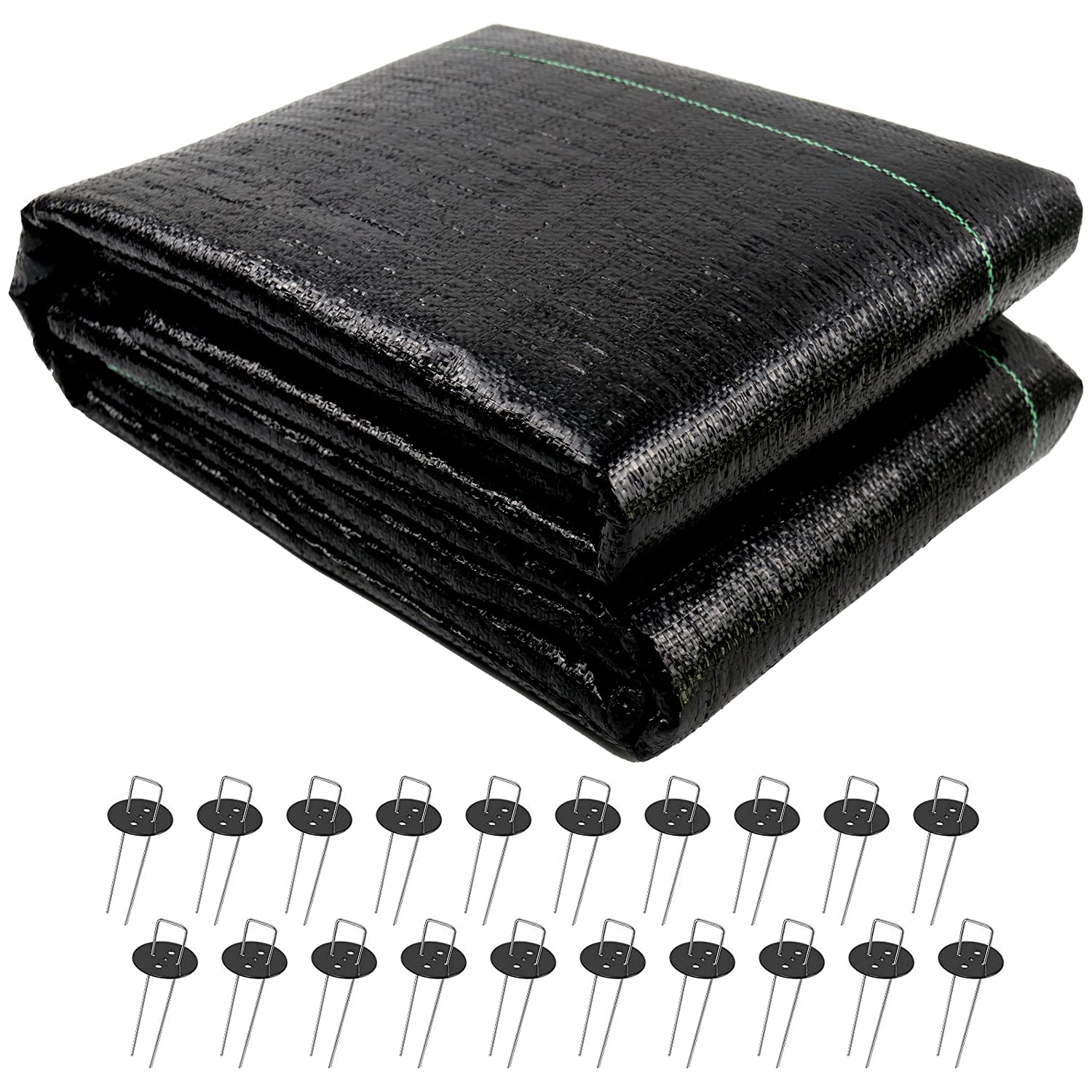
4. UWIOFF 4ft x 100ft Garden Weed Barrier Landscape Fabric
A flexible PE fabric that resists UV rays and cuts cleanly.
Unlike the Winisok (made from polypropylene, or PP), the UWIOFF uses polyethylene (PE) fabric, which the maker says is more flexible and resists aging better. At 3.2 oz, it is the same density as the Winisok, but the different material makes it less prone to shredding when cut. Some owners still report fraying, and one tip suggests burning the cut edge with a torch to seal it. The fabric is UV-resistant, so it can handle partial sunlight without crumbling — useful if your mulch layer is thin or patchy.
Buyers consistently praise its effectiveness in flower beds and under stone, with one noting it “stands up to daily foot traffic” while letting water seeping through quickly. The green alignment stripes run along the fabric to help with straight cuts and plant spacing. A few owners mention that the 100-ft length can be “cumbersome to start,” but the general consensus is that once pinned, it stays flat and delivers weed-free beds.
Smart detail: The PE construction is inherently more flexible than PP, so the UWIOFF conforms better to uneven ground and curves. It also packs at 7.34 pounds for the 400 sq ft roll — a mere 0.25 pounds lighter than the Winisok despite being the same size.
Ideal for: flower beds, vegetable gardens, and any spot where you want a fabric that bends around contours without fraying like crazy.
Not for: projects where you must cut many holes — the edges will still need sealing or taping.
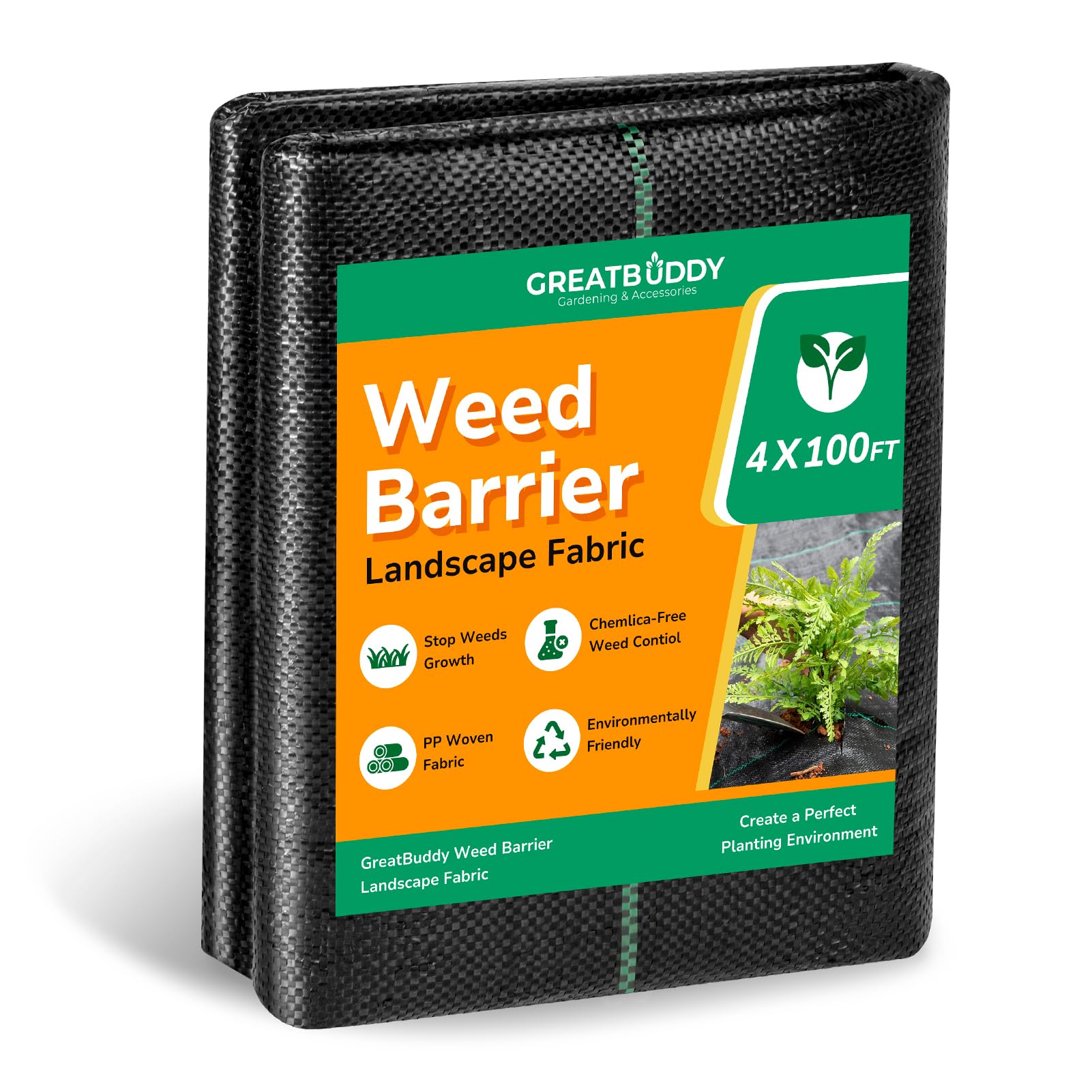
5. GreatBuddy 4FT x 100FT Weed Barrier Landscape Fabric Heavy Duty
Standard 3.2 oz woven fabric that over-delivers on price versus big-box brands.
The GreatBuddy fabric is a textbook 3.2 oz woven polypropylene mat — same weight and material as the Winisok, but a fraction lighter at 7.19 pounds for the roll. Buyers describe it as “heavy duty” and note it “beat all the stores on price.” The fabric is designed for general landscaped areas: gardens, pathways, orchards, and under shrubbery. It blocks sunlight to suppress weeds while letting air and water circulate for root health. Surface green lines run the length of the fabric to guide straight cuts.
The thing that wins people over is effectiveness — owners praise it for suppressing weeds in berry patches and flower beds. Some found it shreds slightly when cut with a utility knife, though careful handling keeps that in check. The mixed durability feedback from the broader review set suggests that while it handles a season of weather fine, it is not built for heavy machinery or constant foot traffic. It works best when covered with a layer of mulch or gravel that absorbs the wear.
Where it sits: At 3.2 oz woven, it is the same weight class as the Winisok and UWIOFF but slightly lighter in total roll weight (7.19 lbs vs 7.59 lbs), meaning slightly less dense fabric per square foot.
Pick this for: mulched flower beds, pathways, and orchard rows where you want a proven woven barrier at a strong price.
Consider alternatives if: you need a fabric that handles heavy foot traffic or sharp aggregate without tearing.
6. Dewitt 3-Foot by 100-Foot Non Woven 12-Year Landscape Fabric 12YR3100

The 12-year fabric that outlasts everything else on this list.
Dewitt takes a different approach. Instead of a heavy woven mat, this is a 3 oz non-woven fabric made from polypropylene — it feels more like a thick, durable felt than a screen. The non-woven construction is treated with a hydrophilic coating that actively pulls water through, so your soil stays hydrated even under a full coverage. The maker adds UV stabilization to slow degradation from sunlight, and the design prevents unraveling when cut — a real advantage over woven fabrics that fray at every snip. One reviewer noted it was “still effective after 3 years under pea gravel and a fire pit area” in Florida swamp conditions, which is a tough endurance test.
Buyers widely agree the Dewitt is a “good quality” fabric that lets water pass while blocking weeds. Its measured durability handles tree roots and ground movement without tearing, and it is easy to cut and fit around odd-shaped beds. At 3 ft wide instead of 4 ft, you get 300 total square feet per roll — less area than the 4-ft options, but owners trust this fabric to stay in the ground for well over a decade. The thicker non-woven fibers also let less light through than a standard woven sheet of the same weight.
Key insight: The Dewitt weighs 3 oz — lighter than the 3.2 oz competitors — but its non-woven felt construction blocks more light per ounce than woven fabric. Because the fibers are randomly layered rather than aligned in a grid, less light finds a straight path through.
Invest in this for: permanent installations under patios, walkways, and flower beds where you never want to dig the fabric up again.
pass on it if: you need wider 4-ft coverage or a budget-friendly roll for a temporary garden that might get tilled next year.
Understanding the Specs
Fabric Weight (Ounces per Square Yard)
This is the single most important number for a weed barrier. A 3 oz to 3.2 oz fabric is the standard for most residential beds — it is thick enough to block sunlight but light enough to cut with scissors. A 5 oz fabric is commercial-grade and shrugs off foot traffic, wheelbarrows, and sharp gravel. Lighter fabrics save money; heavier fabrics save you from replacing the barrier in a year or two. Always check this number on the listing; if it is missing, the fabric is almost certainly below 3 oz and will struggle to block light long-term.
Woven vs Non-Woven
Woven fabric (the most common type) is made from polypropylene strands crisscrossed like a basket. It is tough, tear-resistant, and handles heavy loads well, but water flows through the gaps between weave lines. Non-woven fabric looks and feels like felt — fibers are bonded together randomly, which blocks more light and lets water absorb through the whole surface rather than just the gaps. Non-woven is usually preferred for vegetable gardens and areas where drainage is critical, while woven stands up better to gravel and foot traffic.
FAQ
Should I put the fabric shiny side up or down?
Will a garden weed barrier stop all weeds forever?
How do I install weed barrier fabric correctly?
Can I just lay weed barrier without staples?
How long does landscape fabric last in the ground?
Is there a difference between landscape fabric and weed barrier cloth?
Will water pool on top of weed barrier fabric?
Can I use weed barrier under artificial grass?
Do I need to remove old weed barrier before laying new fabric?
Final Thoughts: The Verdict
If you want one dependable pick, the garden weed barrier winner is the VIVOSUN Premium Weed Barrier because its 5 oz dual-layer build handles foot traffic and water flow better than any other pick here, backed by the highest satisfaction rating overall. If you want maximum coverage for your dollar without sacrificing quality, grab the Winisok 4 ft x 100 ft — it covers 400 sq ft at a 3.2 oz weight that keeps weeds at bay for years. And for a permanent, never-replace-it installation, the Dewitt 12-Year Fabric is the one to reach for, with a non-woven build that blocks more light and lasts longer than any consumer-grade polypropylene sheet.
How We Picked
We do not accept paid placement. Every pick is matched to a real buyer and a real use-case; we do not hands-on test units.
Sources & Methodology
Specifications: manufacturer listings and product documentation. Review insights: verified customer reviews, as of July 2026. Pricing: not shown on this page (it changes often); check the current price via the retailer link.
As an Amazon Associate, Lawn Gear Lab earns from qualifying purchases. This does not affect which products we feature.