
Specs are compiled from manufacturer listings and verified buyer reviews and can change over time — please confirm the key details on the product page before buying.
Killing your plants with kindness? Overwatering is the number one cause of houseplant failure, and your finger alone isn’t a reliable gauge. A simple garden moisture meter takes the guesswork out of watering, telling you exactly when the soil deep in the pot is dry, moist, or wet — so you water only when your plant actually needs it.
I’m Rikta — the founder and writer behind Lawn Gear Lab. This guide is built by comparing the manufacturers’ published specifications and the patterns across verified customer reviews, so you get each pick’s real strengths and trade-offs instead of marketing spin.
Whether you’re tending a fiddle-leaf fig indoors or managing a raised bed outdoors, the right garden moisture meter will save your plants from thirst and drowning alike — with every reading grounded in real owner experience.
Our Picks at a Glance

How To Choose The Best Garden Moisture Meter
A moisture meter is a simple tool, but picking the wrong one can leave you guessing again. Here are the three things to look for before you click “add to cart.”
Probe Length Reaches the Root Zone
Surface soil can look bone-dry while the root zone is still damp. A short probe only tells you about the top inch. For deep pots, raised beds, or outdoor gardens, you want a probe that’s at least 5–7 inches long so you get a reading from where the roots actually live.
Single Probe vs. Multiple Probes
A single-probe meter causes less damage to delicate root systems when you push it in and pull it out. Double or triple probes can be more stable in hard soil, but they bring up more dirt and can nick roots. For houseplants with small root balls, a single probe is usually the safer bet.
Stick-and-Read vs. Leave-In Design
Most meters are “test-and-remove” — you insert them, take a reading, and pull them out within a few minutes. Leaving one in the soil for hours can corrode the metal tip. A newer style, the “leave-in” sensor, lives in the pot and changes color to signal dryness. The trade-off is that these need their wicks replaced every 6–9 months.
Quick Comparison
| Model | Best For | Probe Length | Functions | Reading Speed | Amazon |
|---|---|---|---|---|---|
| XLUX Long Probe★ Best Overall | Deep pots & large plants | 5.5 inches longer than standard | Moisture only | Immediate | Amazon |
| Sustee AquameterLeave-in Design | Continuous leave-in monitoring | 7.09 inches | Moisture only (color-change) | Continuous | Amazon |
| XLUX 2-Pack Orange | Best value 2-pack for indoor/outdoor | Standard | Moisture only | Immediate (1 second) | Amazon |
| HSLGOVE 7-in-1 | Full-spectrum soil analysis | 6.8 inches | Moisture, pH, fertility, light, soil temp, air temp/humidity | 3–5 minutes (LCD) | Amazon |
| Soil Moisture 4-in-1 | pH and sunlight monitoring | 2.5–3 inch insertion depth | Moisture, pH, fertility, sunlight | Immediate | Amazon |
| Tennedriv 2-Pack | Budget-friendly houseplant set | Standard | Moisture only | Immediate | Amazon |
| Maxsolve 3-in-1 2-Pack | Bundle for indoor & outdoor use | Standard | Moisture, light, pH | Quick | Amazon |
In‑Depth Reviews
1. XLUX Long Probe Deep Use Soil Moisture Meter
Our pick — 4.5★ from 14,500+ verified ratings; the strongest balance of quality and price.
The long-reach champion that reads moisture where roots actually grow.
This is the meter owners turn to when short probes keep giving them false signals. The probe is 5.5 inches (14 cm) longer than regular styles, so it measures moisture at the bottom of deep flower pots where overwatering damage actually starts. The single-probe design causes less damage to plant roots compared to double probes, and when you pull it out, it doesn’t drag up much soil.
The large dial is split into three colored zones with ten scales — you see at a glance whether the soil is dry, moist, or wet. The reading is immediate: insert the probe and the needle moves without any waiting. Do not leave it in the soil for more than 5 minutes, as the metal tip will gradually corrode. Buyers report it completely removes the guesswork around both overwatering and underwatering, and that it’s a “very useful tool” across indoor pots and outdoor raised beds.
Functionality earns the loudest praise among owners — over 1,000 mentions — followed closely by accuracy (682 mentions). The recurring tip from users is to store it in a box when not in use, which keeps the probe clean and prevents accidental corrosion. It’s a crowd favorite with strong ratings across nearly 15,000 owners, and it edges out the 2-pack versions in precision for those who need only one reliable tool.
What wins people over
- Extra-long probe reaches deep into large pots and raised beds
- Instant readings — no waiting or batteries needed
- Single probe is gentler on delicate root systems
- Clear dial with colored zones makes it beginner-friendly
Know before you buy
- Cannot be left in the soil or corrosion will damage the tip
- Not suitable for testing water or very hard soil
- Only measures moisture — no pH, light, or fertility functions
Reach for this if: you have deep pots, outdoor raised beds, or large houseplants where surface-level checking has failed you.
Look elsewhere if: you want a leave-in sensor that lives in the pot, or a multi-function meter that also tests pH and sunlight.
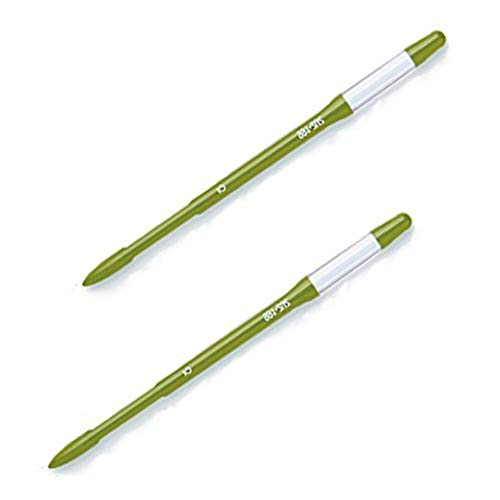
2. Sustee Aquameter (2 Green, Medium)
The set-and-forget sensor that changes color when your plant is thirsty.
This is a different take on the moisture meter — one that stays in the pot permanently. Unlike the test-and-remove meters that need to be pulled out after every reading, the Sustee Aquameter lives in the soil and continuously monitors moisture at root level. Each stick changes color based on soil moisture: white means the plant needs water, blue means it has been watered. No dials, no batteries, no wiping down a probe after use.
The set includes two refillable sticks designed for pot sizes of 3.5, 4, 5, and 6 inches. Each stick lasts about 6–9 months, and the replacement core is refillable so you aren’t throwing the whole unit away. The design was developed in collaboration with Tokyo University of Agriculture, and owners consistently call it a “wonderful invention” that helped them stop alternating between overwatering and underwatering. The trade-off is that the color changes are somewhat analog — lighter blue to darker blue — and a few owners find the shift subtle, especially in low light.
Best for forgetful plant parents: You insert it once and check the color at a glance — no routine testing needed. The reliability is the top praised aspect (25 mentions), and owners love that it keeps delicate roots undisturbed.
Not if you need instant precision: The color display is mixed in accuracy for some users, and the wicks need periodic replacement. If you want a digital readout or multiple soil measurements, this isn’t the tool.
Grab it for: a hands-off, continuous moisture check for standard-sized potted houseplants, especially if you tend to overwater.
Pass on it if: you need pH, light, or fertility readings, or if you prefer a numeric dial over a color indicator.
3. XLUX Upgraded Soil Moisture Meter, 2 Pack (Orange)
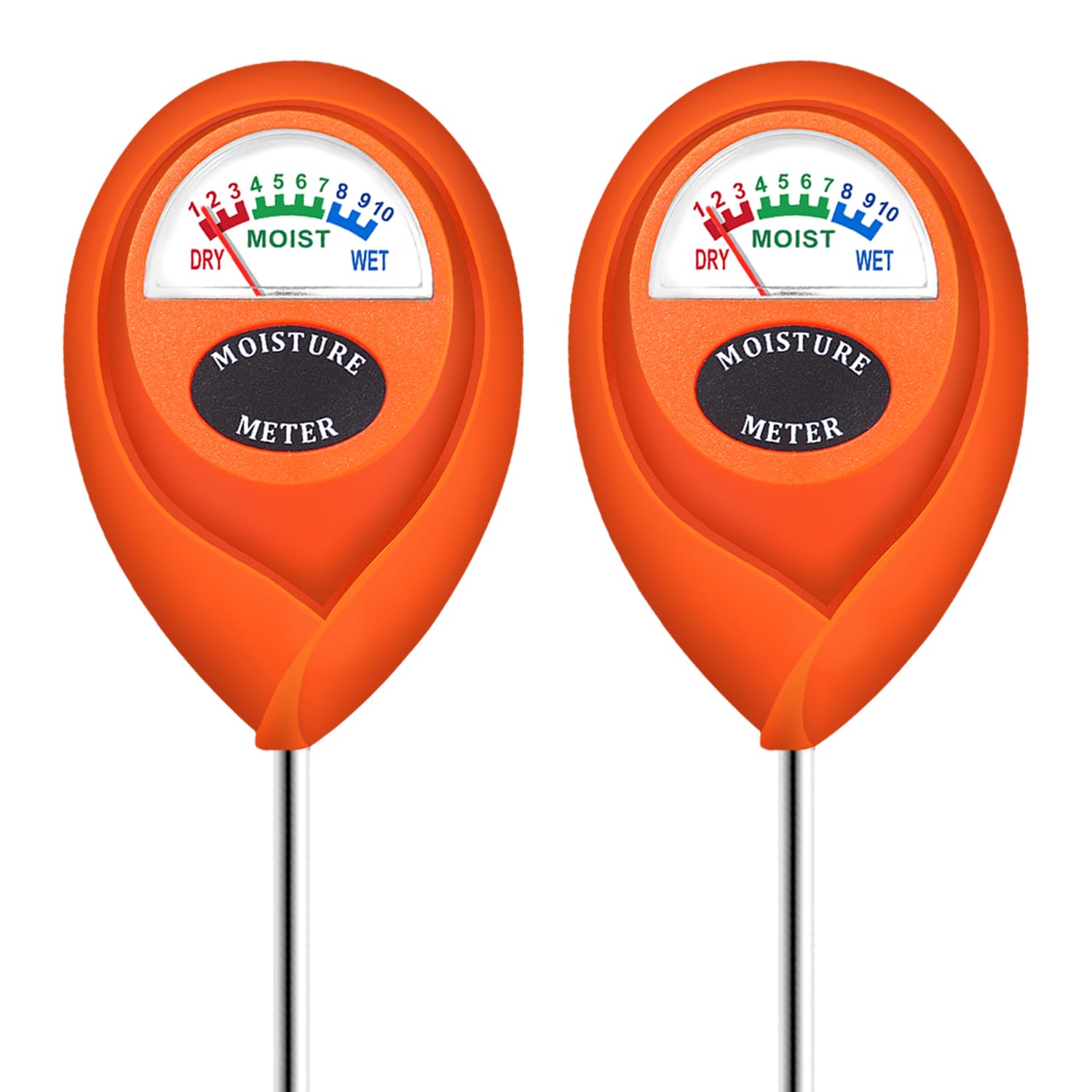
Two accurate meters for the price of one — ideal for multi-plant households.
This is the same reliable XLUX platform as the top pick, but in a two-pack that lets you keep one indoors and one in the garden without buying twice. The reading is nearly instant — owners mention it takes literally one second to show the moisture level. The large dial is split into three zones (dry, moist, wet) with ten scales, and the single-probe design is gentler on roots than double-probe alternatives.
The same precautions apply: don’t leave it in the soil for more than 5 minutes, avoid testing hard soil or water, and wipe the probe clean after each use. Some owners note the meter is fragile if dropped — a hard fall can disconnect the probe, causing a permanent “dry” reading. But among the huge owner community (over 70,000 ratings), the overwhelming story is that it is a simple, stable, and accurate meter that prevents overwatering. “This gadget is amazing,” one owner reports. “It literally takes 1 second to read the moisture in the soil!”
Why it’s a crowd favorite
- Two meters for the price of one — great value for indoor + outdoor use
- Nearly instant readings, no batteries needed
- Easy-to-read display with three colored zones
- Single probe is less invasive for root systems
The honest trade-off
- Fragile — dropping it can permanently damage the probe connection
- Only measures moisture; no pH or light functions
- Cannot be left in soil long-term
Perfect for: anyone managing multiple houseplants plus a garden who wants a dedicated meter for each location without overspending.
skip it if: you need a single high-accuracy unit for just one large pot — the single-pack XLUX with the longer probe may serve you better.
4. HSLGOVE 7-in-One Soil Test Kit
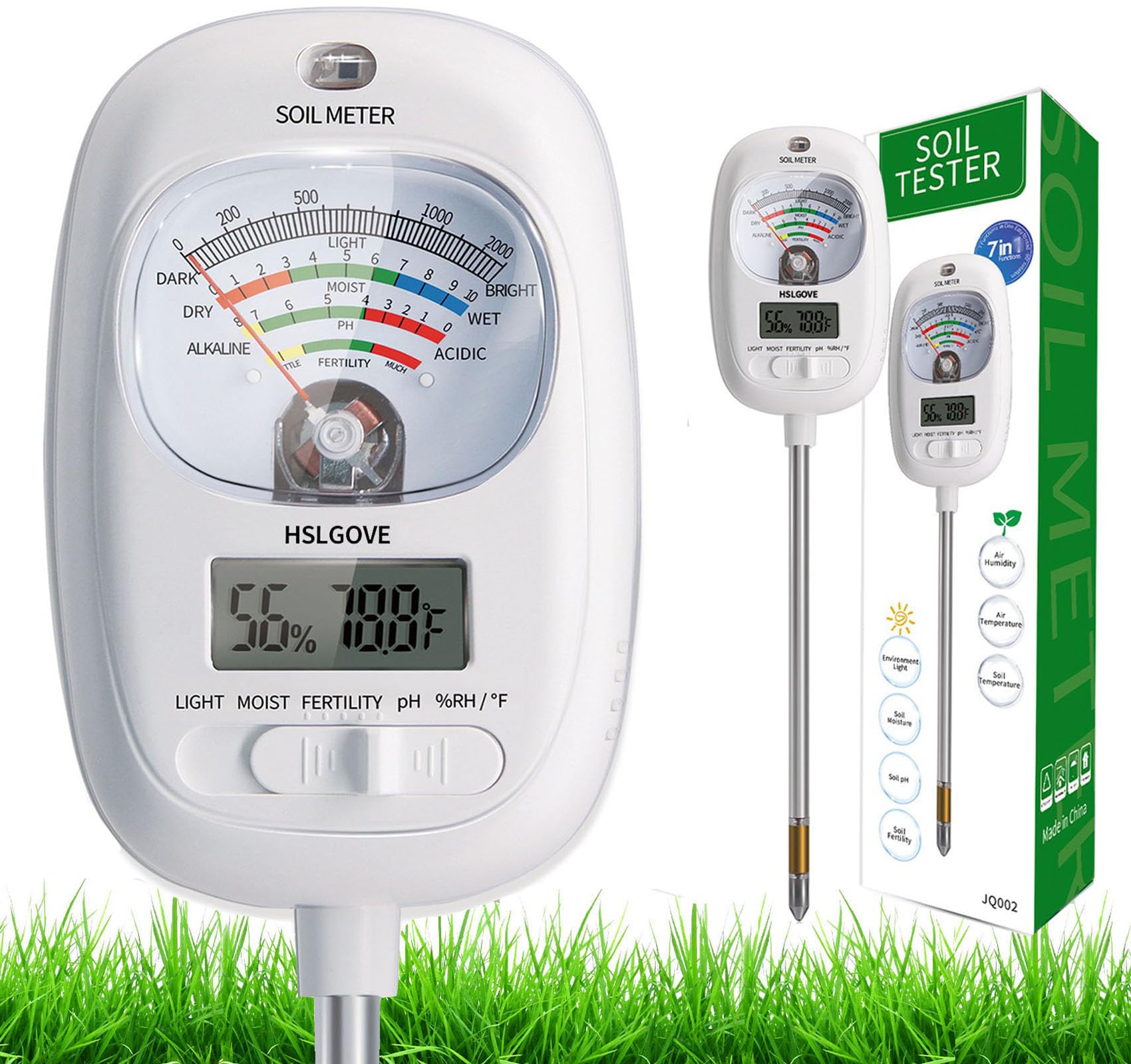
The full-lab-in-one tool that measures moisture, pH, fertility, temperature, and air humidity.
This is the most comprehensive meter on the list, combining an analog dial for moisture/pH/fertility/light with a digital LCD screen that displays soil temperature, air temperature, and air humidity. The 6.8-inch probe is made of three different metals for better conductivity and durability, and the single-probe design minimizes root disturbance. You simply insert the probe more than 3 inches into the soil, switch the function button, and read the results in 3–5 minutes.
Owners praise the dual-screen design for being easy to read and intuitive. The LCD screen (which requires batteries — three of them, and you need to replace/install them each time) shows soil temp and air temp/humidity, while the analog dial handles moisture, pH, fertility, and sunlight. The top mentioned aspect is functionality (52 mentions), and ease of use follows closely (39 mentions). One owner sums it up: “I needed this a long time ago.” The catch is the battery requirement and the 3–5 minute wait for LCD readings, which is slower than the instant-read analog meters. Also, do not test liquids — this is strictly for soil.
what separates it
- Measures 7 parameters including soil temp, air temp, and humidity
- Dual-screen design with analog dial plus LCD digital readout
- Sturdy 6.8-inch probe with three-metal construction
- Great for scientific seedling cultivation and detailed soil analysis
Consider this before buying
- Requires 3 batteries for the LCD screen (analog runs without)
- LCD readings take 3–5 minutes — not instant like analog-only meters
- Not for testing liquids or very hard soil
Get it if: you want a single device to check moisture, pH, fertility, temperature, and light — a true all-in-one for serious gardeners and seed starters.
Pass if: you only need a moisture check and don’t want to deal with batteries or a wait time for digital readings.
5. Soil Moisture Meter for Plants, 4-in-1 Soil Tester
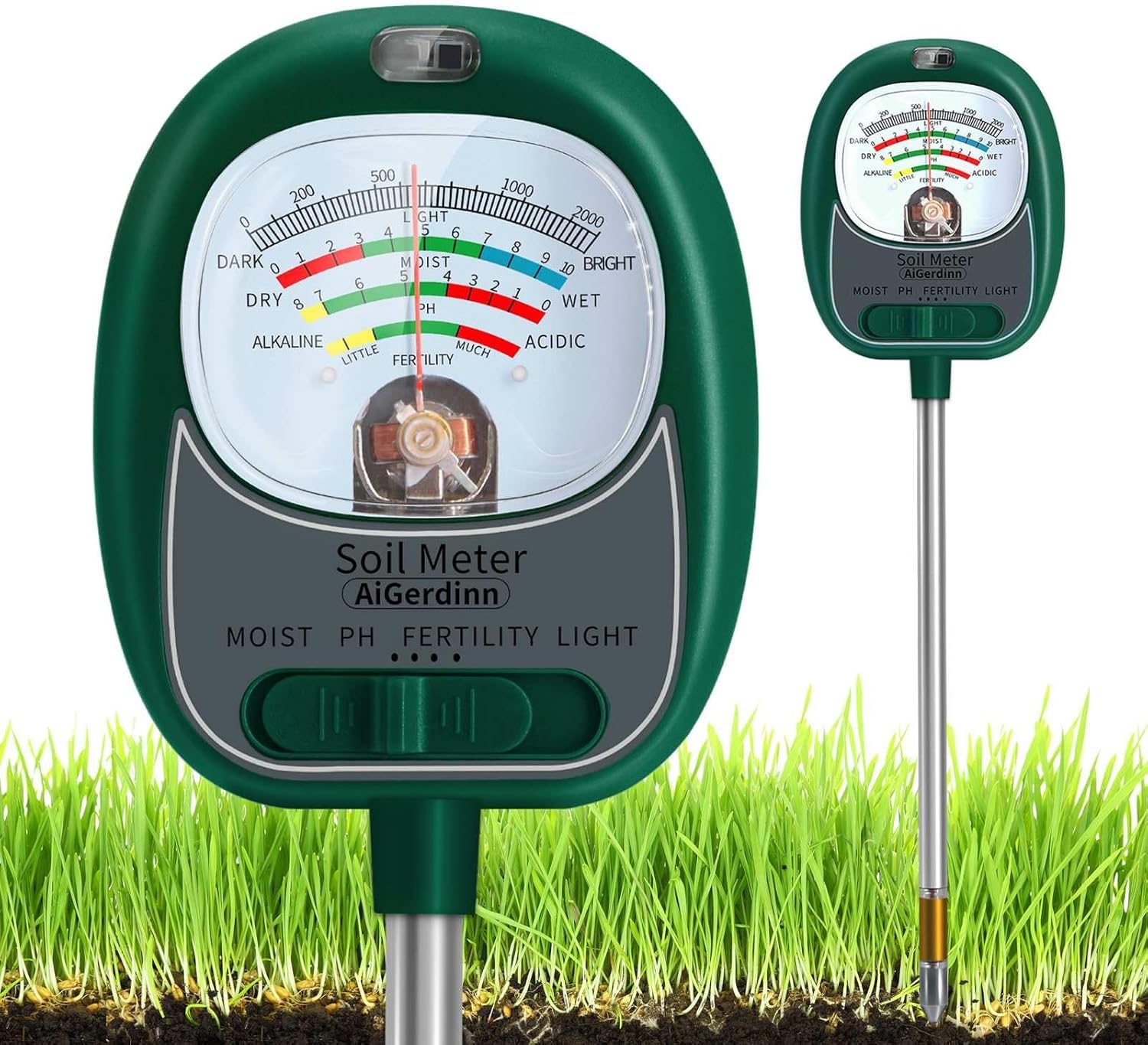
Four measurements from one probe — moisture, pH, fertility, and sunlight in one unit.
You get four readings from one probe without needing batteries — this 4-in-1 tester measures soil moisture, pH level, nutrients/fertility, and sunlight intensity. Its patented 1.95-inch oversized dial is larger than traditional hygrometers (moisture meters), so it is easy to read for both younger and older gardeners. You simply insert the meter into soil 2.5–3 inches deep and read the results immediately, with no batteries required. It is a good middle-ground pick if you want more than just a moisture reading but do not need the full 7-parameter kit.
The instructions ask you to moisture the soil before testing and to compact the surrounding soil around the probe. Do not test water, slurry soil, red clay soil, hard soil, or plant ash, and never test while watering. Despite these precautions, owners find it strong, sturdy, and well made, with large, clear results. The most frequent praise is for its ease of use and how it removes the guesswork around watering and fertilizing. “This 4-in-1 multi-function soil meter works great and helpful,” notes one owner. “It helps to quickly check the moisture, pH, sunlight and fertility levels of my plants.”
What stands out: The oversized dial is genuinely easier to read than smaller meters, and the 4-in-1 functionality replaces separate pH strips and light meters. It’s also battery-free, which removes one point of failure.
Worth noting: The insertion depth is capped at 2.5–3 inches, which is shorter than the XLUX long probe — so for very deep pots, it may not reach the bottom moisture zone. Some owners are still “getting used to it” after a short time, so there’s a slight learning curve.
Best for: gardeners who want moisture, pH, fertility, and light all in one battery-free tool for shallow-to-medium pots.
Not ideal for: very deep containers or raised beds where a longer probe is needed to reach the root zone.
6. Tennedriv Green 2 Pack Soil Moisture Meter

An adorable, battery-free 2-pack that charms as much as it measures.
This is the most visually distinct meter on the list — each probe sports a cute ladybug design on the dial. But it’s not just about looks. The meter is lightweight yet sturdy enough to penetrate mildly firm soil, and it gives instant consistent readings without batteries. Just stick it into the soil, read the large gauge, and wipe it clean with a paper towel after use. Do not leave it in the soil or stick it into a cup of water, which can ruin the probe.
The package dimensions (11.34 x 2.6 x 1.93 inches) make it fairly compact. Owners say it is “simple to use and doesn’t require batteries or charging.” Functionality gets the most praise (48 mentions), followed by appearance (37 mentions). However, moisture measurement accuracy gets a mixed verdict (15 mentions, marked as mixed). One owner reports that after a while the meter stopped reading correctly, leading to overwatering. “These worked for a while but then stopped,” they wrote. “The tip of one looked like it was degrading.” Most owners have a positive experience, but this is a budget set where durability over months is less certain than pricier options. pass on it if you need long-term reliability for daily use — the cheaper build may degrade faster than a more expensive model like the [Other Pick].
Fun and functional
- Cute ladybug design — a conversation starter on your plant shelf
- 2-pack is great for separating indoor and outdoor plants
- No batteries, instant readings, easy to clean
- Sturdy enough for mildly firm soil
Be aware
- Mixed reviews on long-term accuracy — some units stop reading correctly
- Probe tip may degrade over time with repeated use
- Not the most precise option for serious gardeners
A fun starter set for: new plant owners who want something inexpensive and cute for basic indoor moisture checks — and are okay with replacing them after a few months if needed.
Better to skip if: you need reliable, long-term accuracy for a large collection or valuable plants — the XLUX or Sustee will serve you better.
7. Maxsolve 3-in-1 Soil Tester, 2 Pack

Three functions, two meters, one very friendly price — for the pragmatic planter.
This 2-pack gives you three measurement functions per unit — moisture, light, and pH testing — all without batteries. Simply insert the sensor probe into the soil and get an instant reading. It’s a plug-and-play design: no setup, no charging, no calibration. The meters are compact and portable with product dimensions of 2.37 x 1.3 x 10.24 inches, making them easy to store in a drawer or gardening apron.
The manufacturer is clear: this is for soil testing only and cannot be used for water testing. Reviews are split. Many owners love the simplicity — “Easy to use. Love the three measurement settings” — and find the accuracy “pretty good” for the price. But a significant minority call the light meter useless and report that readings are off. “Useless!! Do not trust these things,” reads one harsh review. “Cheap isn’t always a deal when the product is terrible.” This is the most budget-conscious choice on the list, and it shows in the mixed consistency. For a casual gardener with a few houseplants who isn’t relying on pinpoint accuracy, it’s a fine starter tool. For anyone who needs reliable data to save a struggling plant, the bump up to the XLUX or HSLGOVE is worth it.
Where it fits: This is the cheapest way to get a 2-pack of 3-function meters. It’s great for gifting to a new plant owner or keeping one in the car for the community garden plot.
Where it falls short: The light meter is widely reported as non-functional, and overall unit-to-unit consistency is shaky. Treat this as a convenience tool, not a precision instrument.
Consider it for: a budget-friendly way to get two meters for indoor and outdoor use, with basic moisture and pH checking as the main value.
it’s not for you if: accuracy matters to you — especially for sensitive plants — or if you need a reliable light reading for placement decisions.
Understanding the Specs
Probe Length
The length of the metal probe determines how deep into the soil you can measure. A short probe (2–3 inches) only reads the surface layer, which dries out faster than the root zone. A longer probe (5–7 inches) reaches the deep moisture where roots actually live, making it essential for large pots, raised beds, and outdoor gardens. The XLUX Long Probe is 5.5 inches longer than standard styles, giving it a clear advantage for deep containers.
Single vs. Multi-Function
A single-function meter only measures moisture. A multi-function meter adds pH, fertility, sunlight, and sometimes temperature. Multi-function meters save you from buying separate test kits, but they introduce more variables — some functions (like the light meter on budget models) are less reliable than others. For most houseplant owners, a dedicated moisture-only meter is more accurate. For serious gardeners, a 4-in-1 or 7-in-1 unit replaces several tools at once.
Analog Dial vs. Digital Display
Analog meters use a needle and a printed scale — they require no batteries and respond instantly. Digital displays (LCD) can show additional data like soil temperature and air humidity, but they need batteries and often take 3–5 minutes to stabilize. The HSLGOVE 7-in-1 combines both: an analog dial for moisture/pH/fertility/light and a digital screen for temperature and humidity. The trade-off is battery management versus instant read.
Test-and-Remove vs. Leave-In
Most meters are “test-and-remove” — you insert, read, and pull out within 5 minutes to prevent corrosion. “Leave-in” sensors like the Sustee Aquameter live in the soil permanently and change color (white = dry, blue = wet) to signal when to water. Leave-in sensors are low-maintenance but need a wick replacement every 6–9 months. Test-and-remove meters last indefinitely if wiped clean and stored dry, but they require you to remember to test regularly.
FAQ
Can I leave a moisture meter in the soil all the time?
Why does my moisture meter give different readings in different spots?
Can I use a garden moisture meter for testing water or other liquids?
How deep should I insert the probe for an accurate reading?
Why does my analog meter always show “dry” even when I just watered?
How long does a moisture meter usually last?
What is the difference between a single-probe and double-probe meter?
Do I need a meter that also measures pH and light?
What should I do if my moisture meter stops working?
Can I use an indoor houseplant moisture meter in my outdoor garden?
Final Thoughts: The Verdict
If you want one dependable pick, the garden moisture meter winner is the XLUX Long Probe because it reaches deep enough for large pots and raised beds, reads instantly, and has the strongest accuracy reputation among owners. If you want a continuous set-and-forget sensor, grab the Sustee Aquameter. And for full-spectrum soil analysis covering pH, fertility, sunlight, and temperature, the HSLGOVE 7-in-1 is the one to reach for.
How We Picked
We do not accept paid placement. Every pick is matched to a real buyer and a real use-case; we do not hands-on test units.
Sources & Methodology
Specifications: manufacturer listings and product documentation. Review insights: verified customer reviews, as of July 2026. Pricing: not shown on this page (it changes often); check the current price via the retailer link.
As an Amazon Associate, Lawn Gear Lab earns from qualifying purchases. This does not affect which products we feature.