
Specs are compiled from manufacturer listings and verified buyer reviews and can change over time — please confirm the key details on the product page before buying.
Nobody wants to guess whether the soil is dry or the roots are rotting inside an opaque pot — especially when you are juggling dozens of seedlings in a greenhouse. The right pot eliminates guesswork and supports healthy growth from seedling to transplant. This guide ranks top picks by sturdiness, drainage, transparency, and bulk value.
I’m Rikta — the founder and writer behind Lawn Gear Lab. This guide is built by comparing the manufacturers’ published specifications and the patterns across verified customer reviews, so you get each pick’s real strengths and trade-offs instead of marketing spin.
Whether you are starting seeds, rooting cuttings, or potting up perennials, finding the best greenhouse plant pots depends on knowing which plastic holds up, which sizes fit your trays, and which drains well enough to prevent root rot (when roots die from too much water) before it starts.
Our Picks at a Glance


How To Choose The Best Greenhouse Plant Pots
Greenhouse pots must drain fast, endure reuse, and offer root visibility. These factors separate durable workhorses from pots that crack after one season.
Transparency — See the Roots, Not Guess
Clear pots let you spot root development, soil moisture levels, and early signs of root rot without disturbing the plant. Transparency is the top advantage of greenhouse pots, driving many top sellers to offer clear options.
Drainage Design — More Than Just a Hole
A few small holes may not be enough. The best pots have multiple drainage holes or a raised center base that lifts the bottom off the tray, allowing air to circulate underneath. This prevents waterlogging (when soil stays too wet and drowns roots) — the number one killer of seedlings — and keeps the root zone breathing.
Material Thickness and Flexibility
Thin, flimsy plastic tears when you try to pop out a root-bound plant (a plant with roots tangled in a tight circle), and it may not survive a second season. Thicker pots cost a little more but hold their shape, resist cracking in temperature swings, and bend enough to release the root ball (the mass of roots and soil) without damage — a feature that pays off every time you transplant.
Quick Comparison
| Model | Best For | Sizes Included | Drainage Holes | Material | Amazon |
|---|---|---|---|---|---|
| homenote 30-Pack Clear★ Best Overall | Best Overall | 3, 4, 5 in (10 each) | Multiple + raised base | Clear PP plastic | Amazon |
| June Fox Square 60-PackTray-Friendly | Tray-Compatible | 3.3 in square (60) | 8 recessed holes | Flexible plastic | Amazon |
| SwinDuck 10-Pack with Saucers | Premium Look | 6 in round (10) | Multiple | UV-resistant plastic | Amazon |
| RooTrimmer 30-Pack Clear Variety | Versatile Sizing | 3, 4, 5, 6, 7 in (6 each) | Multiple | Flexible durable plastic | Amazon |
| GREENPARA Transparent with Saucers | Thick Build | 4, 5, 6, 7, 8 in | Unique drainage design | Polypropylene (PP) | Amazon |
| Niiiice 60-Pack 1 Gallon | Budget Bulk | 1 gallon (60) | Bottom holes | Soft thin plastic | Amazon |
| OJYUDD 60-Pack 1 Gallon | Value Bulk | 1 gallon (60) | 16 small holes | Soft thin plastic | Amazon |
In‑Depth Reviews
1. homenote Nursery Pots 30 Pack, 3/4/5 Inch Clear
Our pick — over 4.5★ from 850+ verified ratings; the strongest balance of quality and price.
The clear winner — a 30-pack that hits the balance of sturdiness, transparency, and drainage.
You can check root health and soil moisture without digging because each pot is made from clear PP plastic (polypropylene, a rigid plastic that resists cracking). Buyers mention sturdiness more than any other trait — 125 people call it out — and you feel it the moment you pick one up. The plastic is thick enough to reuse season after season. Each pot has multiple drainage holes plus a raised middle base that lifts the bottom off the tray, so air moves underneath and water never sits stagnant — a setup that helps prevent root rot.
You get 30 pots divided evenly among three sizes (ten 3-inch, ten 4-inch, and ten 5-inch), plus 20 plant labels — though owners note there are ten fewer labels than pots, which is a minor shortfall for a pack this well-priced. The 0.85-kilogram total weight means they are light enough to move around the greenhouse in one trip. The homenote set offers better size variety than the June Fox Square pots (which only come in one size), making it the more flexible starter pack.
Why Owners Love Them
- Genuinely sturdy plastic that survives multiple seasons
- Clear walls let you check root health and soil moisture at a glance
- Three sizes in one pack cover seedlings, cuttings, and small houseplants
The Honest Trade-off
- No pots larger than 5 inches — you will need a separate run for 8-inch and up
This is the one for you if: you want the highest-rated starter pack that balances visibility, durability, and size variety in a single box.
You will want the GREENPARA instead if: you need pots bigger than 5 inches; this set maxes out at the small-to-medium range.
2. June Fox Square Nursery Pots 3.3 Inches, 60-Pack
The square shape packs 18 pots into a single 1020 tray — space efficiency at its best.
If you own standard 1020 propagation trays (trays that measure about 10 by 20 inches), these 3.3-inch square pots fit perfectly: 18 of them fit in one flat without wasted air gaps between round walls. Buyers highlight durability as the top trait — 99 reviewers do — and the flexible plastic bends just enough to squeeze out a root ball without tearing, yet bounces back to its shape for the next season. The package includes 60 pots and 60 waterproof plant labels, so you can label every seedling without running short.
The design includes eight recessed drainage holes (eight depressions at the bottom that let water escape) that sit slightly inside the bottom rather than protruding, which keeps the pots stable on the tray and still lets water drain. A few owners mention an initial “ashtray” smell when the pots are fresh out of the pack, but it fades quickly when aired outdoors. As one buyer puts it: these pots are “very sturdy and fit perfect in a 10 x 10 seedling tray” — and at 3 pounds for the full set, they are light enough to move in bulk yet dense enough to feel substantial in the hand.
Square advantage: no wasted tray space — 18 pots per flat vs. roughly 12 round pots of the same diameter.
The catch: the pots are only 3.3 inches, so this is strictly a starter size; you will need to pot up to 4- or 5-inch containers as roots fill out.
Best for: greenhouse growers who use standard 1020 trays and want maximum density per flat.
Buy the homenote set instead if: you need single-inch size variety or want pots over 4 inches — this is a one-size, square-only set.
3. SwinDuck 10 Pack 6 Inch Plant Pots with Drainage and Saucers

The matte-white pot that looks as good on a windowsill as it works in the greenhouse.
You get 6-inch pots with matching saucers (trays underneath to catch water), which makes this set unusual in this guide — most nursery pots are sold bare. The UV-resistant plastic (treated to resist sun damage) holds up against sunlight on a greenhouse shelf, and the matte finish does not show water spots the way glossy pots do. At 6 x 6 x 5 inches, each pot provides enough room for a single mature herb or a small houseplant, and the multiple drainage holes paired with the saucer catch runoff without letting the pot sit in a puddle.
Buyers praise quality most — 73 single it out — and the plastic feels noticeably thicker than the standard nursery liner. Owners say they are “cute, perfect size, thick and not flimsy” and use them “constantly for my plants in my house and my greenhouse.” A few note that the drainage holes are slightly large, causing some soil fallout when repotting, but a coffee filter or a layer of pebbles at the bottom solves that. The stackable shape means ten pots take up very little storage space when not in use.
Why this stands out: the saucers make this a move-in-ready pot — no need to buy drip trays separately. The white matte finish keeps the greenhouse looking clean and organized.
The one note: you get only 10 pots in this pack, so it is better for finishing plants than for bulk seed-starting operations.
Reach for these if: you want a finished look with a saucer and UV protection, ideal for plants that will live on a greenhouse shelf or move indoors.
Grab the Niiiice or OJYUDD bulk packs instead if: you are starting hundreds of seeds — the 10-count pack is too small for a big propagation run.
4. RooTrimmer 30 Pack Clear Nursery Pots, 3/4/5/6/7 Inch
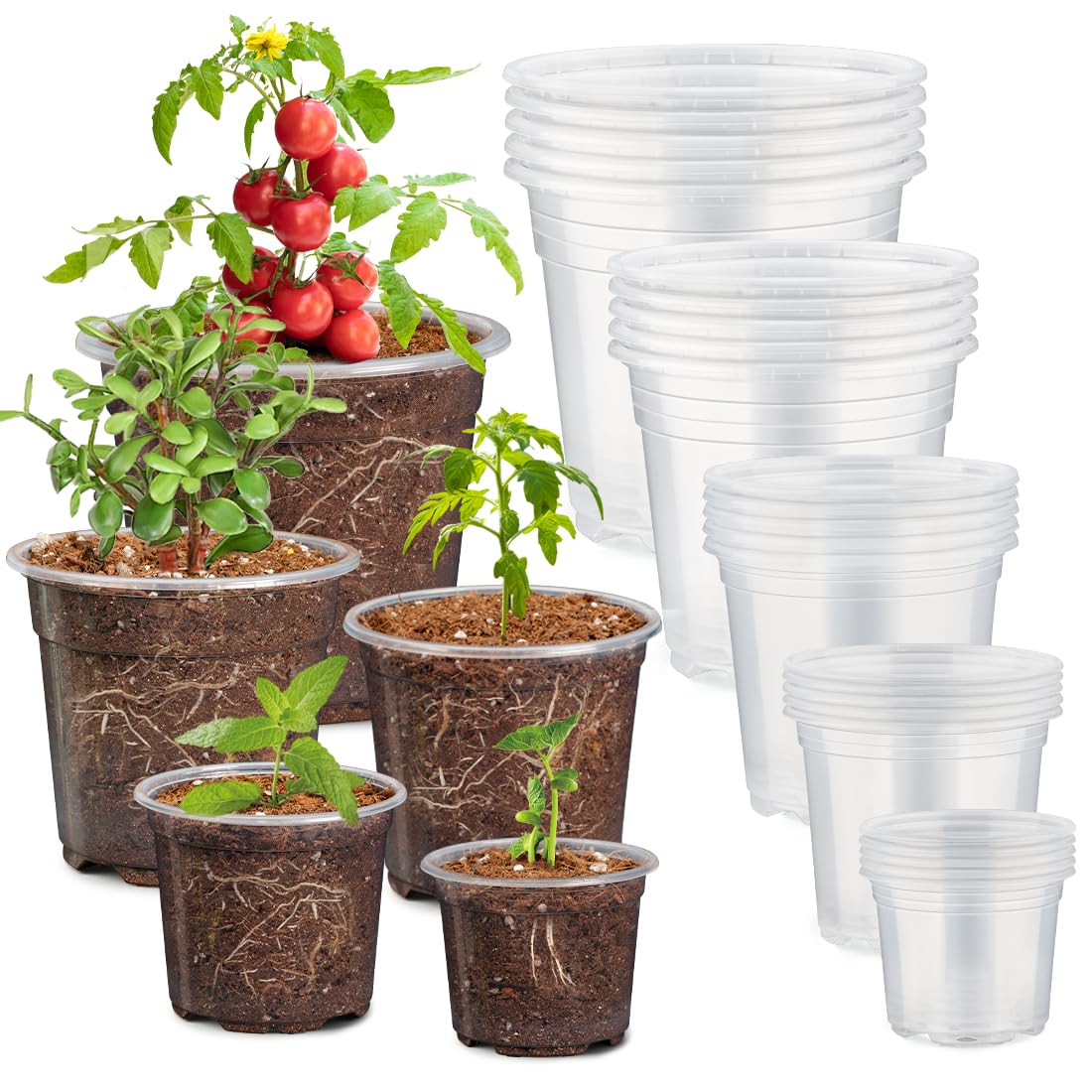
Five sizes in one pack — from 3-inch seedling cups to 7-inch grow pots — so you never reach for the wrong container.
This variety pack covers the widest size range of any clear pot set in this guide, giving you six pots of each size from 3 inches up to 7 inches. That means you can start cuttings in the smallest cups and pot up through the sizes without switching brands. The transparent walls let you watch roots develop and see exactly when the soil needs watering — owners call the clear drainage holes “good size” and say the material “does not break easily” even after repeated use.
Quality and sturdiness are the top two customer praises (49 and 47 mentions respectively), and the flexible plastic bends without cracking. The total weight is just 250 grams (about half a pound), which makes the full set feel light — but some owners wish the plastic were a touch thicker for heavy, top-heavy plants. Compared to the homenote set (which stops at 5 inches), this one offers the larger 6-inch and 7-inch sizes for plants that need more room to grow.
Size coverage: this pack spans 3, 4, 5, 6, and 7 inches, which is more range than the homenote set (which stops at 5 inches).
The trade-off: the plastic is lighter than premium picks like the GREENPARA — fine for most greenhouse use, but not as rigid under heavy wet soil.
Best for: hobbyists who hate buying separate packs for every pot size — this is a one-box solution for seedlings through medium plants.
Buy the GREENPARA instead if: sturdiness is your top priority; the plastic is functional but not the thickest on this list.
5. GREENPARA Transparent Plastic Pots with Saucers, 4/5/6/7/8 Inch

The thickest polypropylene construction in this guide — a pot that feels built to last.
GREENPARA uses polypropylene (PP, a dense plastic that stays rigid) rather than standard soft plastic, and that difference is immediately obvious: the walls are thicker, the rim does not flex when you lift a wet pot, and there is no chemical odor even when new. Each pot comes with a matching saucer, and the clear walls let you monitor root growth and soil dryness without disturbing the plant. The pack includes five sizes (4, 5, 6, 7, and 8 inches), covering everything from a succulent to a medium snake plant.
Quality leads the feedback with 60 mentions, followed closely by sturdiness at 43. Owners say the pots are “thicker than the average liners” and that the solid construction makes them “easy to pull out of the decorative pot for weekly bottom watering.” The sole recurring point of debate is value — some feel the per-pot cost is higher than standard nursery pots, though most agree the thicker material justifies the premium. Root visibility is the third most-praised feature, with buyers describing how they can “see when the soil is dry and the status of the roots” at a glance.
Build difference: polypropylene is denser and more rigid than the PE (polyethylene) or soft plastic used in most budget nursery pots — it is less likely to deform in hot greenhouse conditions.
The honest note: a few owners call the price “a little expensive” compared to thin disposables, but the multi-season reusability offsets the upfront cost over time.
Choose this if: you want the strongest, most rigid clear pot with a saucer — ideal for bottom-watering (filling the saucer so soil pulls water up through the drainage holes) and long-term reuse.
Grab the Niiiice or OJYUDD bulk packs instead if: you are on a tight bulk budget and need 60+ disposable pots for a single season of seedlings.
6. Niiiice 60-Pack 1 Gallon Flexible Plastic Nursery Pots

Sixty 1-gallon pots for the grower who needs quantity more than premium thickness.
If you are potting up dozens of perennials, shrubs, or apple saplings in one go, this 60-pack gives you the volume at a low per-pot cost. The dimensions are 6 inches high with a 6.5-inch opening, which the manufacturer labels as “1 gallon” — but buyers quickly point out these are trade gallons (a nursery term for roughly three-quarters of a true gallon), meaning they hold roughly three-quarters of a true gallon. The soft thin plastic is lightweight (1.16 kilograms for the full box) and compresses easily for storage, but it is definitely on the flexible side.
Quality gets 21 positive mentions, and owners say the pots are “much sturdier than I expected” for the price point. The thin walls are a deliberate trade-off: they make transplanting easy because you can squeeze the sides to pop out the root ball, but the plastic is not built for years of rough handling. Size gets mixed feedback (19 mentions), split between owners who find the 6.5-inch diameter perfect for their plants and those disappointed it is not a full gallon. The raised rim makes stacking and handling smooth, and the bottom drainage holes do their job without clogging.
The volume play: at 60 pots plus 10 plant labels, this is among the most generous counts in the guide for the price tier.
Size reality: treat these as roughly 3/4-gallon containers — if you need a true gallon, look at the OJYUDD set next, which uses different dimensions.
Reach for this if: you need a big batch of temporary pots for a single season of transplanting — the low cost and easy root release are the strengths.
Buy the homenote or GREENPARA options instead if: you want thick, multi-year pots or true 1-gallon capacity.
7. OJYUDD 60 Pack 1 Gallon Flexible Plant Nursery Pots
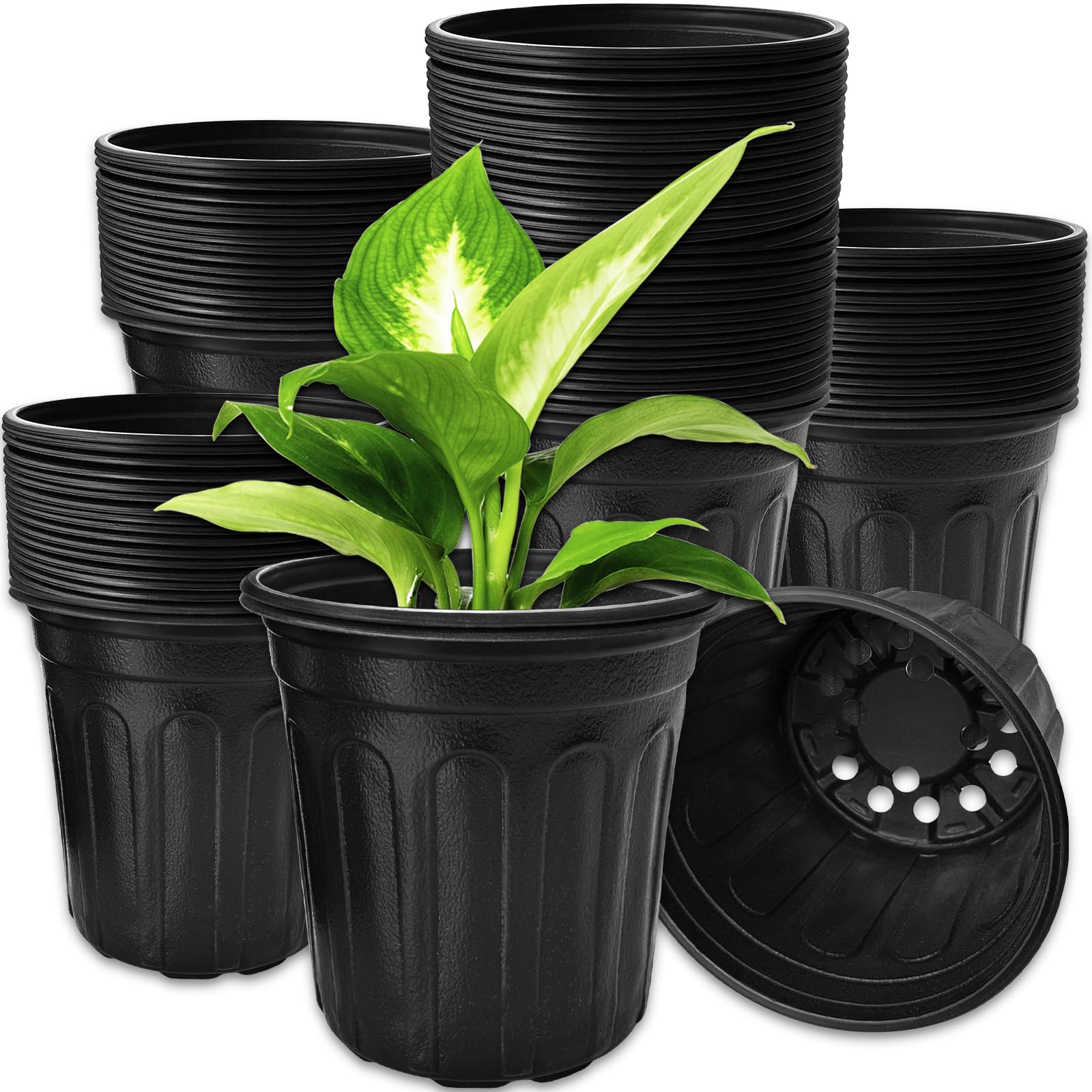
A gallon-sized bulk pack with 16 drainage holes — more breathing room for the root zone.
The OJYUDD set matches the Niiiice pack in count (60 pots) and nominal capacity (1 gallon), but it uses a slightly taller profile: 6.7 inches high with a 6.5-inch opening and a 5.1-inch bottom diameter. The standout feature is the 16 small drainage holes arranged neatly at the bottom, which is notably more than most budget pots offer and helps prevent water from pooling even in dense potting mix. The soft thin plastic is designed for flexibility — you can compress the walls to release a root ball without tearing the pot.
Owners say the pots are “great for transplanting” and “held up well during moves,” though they caution that the plastic is “super thin” — this is not a pot you want to carry heavy wet soil around by the rim for months. The black finish is simple and does not show algae growth the way clear pots would. Size feedback is mixed, with some finding the 1-gallon claim generous and others satisfied with the actual volume for starting dahlias, shrubs, and berry bushes. At 1.22 kilograms for the full 60-pack, the weight is negligible in shipping and storage. Compared to the Niiiice pack, the extra drainage holes (16 vs. bottom holes) give you better protection against overwatering.
Drainage edge: 16 holes per pot vs. the 4-8 holes on most competing budget packs — a meaningful difference if you tend to overwater.
The compromise: the thin walls that make transplanting easy also mean the pots have a limited lifespan; expect one or two seasons of regular use before they start to fatigue.
Pick this if: you want a budget bulk pack with excellent drainage for a season of potting up shrubs, perennials, or vegetables.
Go with the GREENPARA or homenote options instead if: you need thick, rigid pots that will survive multiple seasons in a commercial greenhouse setting — those last longer.
Understanding the Specs
PP vs. Soft Plastic
Polypropylene (PP, a dense plastic) is a denser, more rigid plastic that resists deformation under heat and stays flexible without cracking. Soft plastic (often PE, or polyethylene, or recycled mix) is lighter and cheaper but tends to thin out after repeated bending. PP is worth the premium if you plan to reuse pots over multiple seasons; soft plastic is fine for a single batch of seedlings that you transplant into the ground.
Trade Gallon vs. True Gallon
A “trade gallon” in the nursery industry is roughly 3/4 of a real U.S. gallon — it is a conventional term, not a precise measurement. A true 1-gallon pot holds about 1.0 gallons of soil. When a listing says “1 gallon” but the dimensions are around 6.5 x 6.5 inches, it is almost certainly a trade gallon. If exact capacity matters for your growing schedule, check the product dimensions rather than relying on the label.
FAQ
How many pots fit in a standard 1020 tray?
Can I reuse these plastic nursery pots?
What size pot should I use for starting seeds?
Do clear pots cause algae growth?
Are these pots safe for food plants like herbs and vegetables?
Why do some pots have a raised center base?
How many drainage holes are enough?
What does UV-resistant mean for greenhouse pots?
Can I use these pots for bottom watering?
How do I remove a plant without damaging the pot?
Final Thoughts: The Verdict
If you want one dependable pick, the best greenhouse plant pots winner is the homenote 30-Pack Clear because it delivers the best all-around balance of sturdiness, transparency, drainage, and size variety — backed by a 4.8-star crowd consensus that calls them the most reliable clear pot on the market. If you run standard 1020 trays and want to pack every inch of bench space, the June Fox Square 60-Pack is the square-shaped efficiency king. And for the grower who wants the thickest, most durable construction with included saucers, the GREENPARA Transparent Set is the long-term investment that holds its shape season after season. Pick the one that matches your tray setup and your reuse philosophy, and you will have the right pot for every greenhouse task.
How We Picked
We do not accept paid placement. Every pick is matched to a real buyer and a real use-case; we do not hands-on test units.
Sources & Methodology
Specifications: manufacturer listings and product documentation. Review insights: verified customer reviews, as of July 2026. Pricing: not shown on this page (it changes often); check the current price via the retailer link.
As an Amazon Associate, Lawn Gear Lab earns from qualifying purchases. This does not affect which products we feature.