
Specs are compiled from manufacturer listings and verified buyer reviews and can change over time — please confirm the key details on the product page before buying.
Pond fertilizer sounds simple, but get the wrong one and you are not feeding your lilies — you are feeding a toxic algae bloom that stresses your fish. The trick is matching the nitrogen-and-phosphorus balance (the NPK ratio on the bag) to your pond’s specific job: a bloom for fish health, or root-and-bloom nutrition for potted water plants. This guide covers three proven formulas that work with fish, not against them.
I’m Rikta — the founder and writer behind Lawn Gear Lab. This guide is built by comparing the manufacturers’ published specifications and the patterns across verified customer reviews, so you get each pick’s real strengths and trade-offs instead of marketing spin.
Whether you are feeding a 1-acre lake or a small patio water garden, getting the right fish pond fertilizer keeps your aquatic plants lush and your fish safe — without turning your water into a swamp.
Our Picks at a Glance

How To Choose The Best Fish Pond Fertilizer
Choosing the wrong pond fertilizer is not just a waste of money — it can turn your clear water green with bad algae or even kill your fish. Stick with formulas explicitly labeled as fish-safe and designed for aquatic use. The biggest mistake beginners make is grabbing a high-nitrogen lawn fertilizer, which leaches ammonia into the water and can be lethal to koi and goldfish.
NPK Ratio — What Those Three Numbers Mean For Your Pond
To feed your pond the right way, you need to understand the three numbers on a fertilizer label — like “12-48-08” or “10-14-8.” The first number is nitrogen (N), which drives leafy growth; the second is phosphorus (P), which fuels root development and blooms; the third is potassium (K), which supports overall plant health. For a fish pond, a higher phosphorus number (like the 48 in the 12-48-08 formula) encourages the right kind of phytoplankton bloom that shades out stringy weeds and feeds your baitfish. For potted water lilies and lotus in a decorative pond, a more balanced 10-14-8 ratio works beautifully.
Granular vs Tablet — Match The Format To Your Setup
Granular fertilizers are broadcast by hand over the surface of large ponds and lakes — they dissolve in the top couple feet of the water column and feed the entire ecosystem. Tablets, on the other hand, are pressed directly into the soil of a submerged pot, delivering nutrients right at the root zone of a lily or lotus without clouding the rest of the water. Tablets are made for decorative water gardens; granules are made for acre-plus fish ponds.
Fish Safety Is Non-Negotiable
Not all aquatic fertilizers are safe for fish. Look for a product that explicitly states it is safe for koi, goldfish, frogs, and snails. A fish-safe formula uses a slower-release nutrient profile that does not spike ammonia or nitrite levels. Even with a safe product, avoid overdosing — too much phosphorus in a warm pond can trigger a blue-green algae bloom that produces toxins harmful to fish and pets.
Quick Comparison
| Model | Best For | NPK Ratio | Form | Unit Count | Amazon |
|---|---|---|---|---|---|
| BioLogic Perfect Pond Plus★ Best Overall | Large ponds & lakes | 12-48-08 | Granules | 5 Pounds | Amazon |
| CrystalClear Thrive | Potted water lilies & lotus | 10-14-8 | Tablets | 60 Tablets | Amazon |
| Chalily Aquatic Plant Fertilizer | Large water gardens | 10-14-8 | Tablets | 300 Tablets | Amazon |
In‑Depth Reviews
1. BioLogic Perfect Pond Plus, Granular (5 lb)
Our pick — over 4.5★ from 200+ verified ratings; the strongest balance of quality and price.
The heavy lifter for acre-sized ponds that delivers fast, visible phytoplankton bloom.
If you have a pond measured in surface acres rather than gallons, this 5-pound bag of granules is your play. The NPK ratio of 12-48-08 is built around a heavy phosphorus punch (the 48) that pushes the water toward a healthy olive-green phytoplankton bloom — the kind that shades out bottom-rooted weeds and feeds your fish directly. The granules dissolve in the top two feet of the water column, so you broadcast it by hand: 5 pounds covers a full acre.
Buyers report a common refrain: “Two treatments and already see the changes.” They also appreciate that just one annual application in spring sets the pond up for the season. The crowd favorite aspect by far is effectiveness — it works, and owners say it works fast. The only nuance is that you need the right conditions: a northern pond with naturally infertile water gets the best results, and careful dosing is required to avoid tipping into toxic blue-green algae. Overdosing risks that, and the instructions are specific about 2-week intervals early in the season, then monthly through October.
What wins people over is the simplicity of a single 5-pound broadcast that handles a whole acre. And the product’s fish-safety pedigree is strong — owners mention their fish and lake ecosystems stay healthy season after season. This is not a tablet for a patio tub; it is real pond management for serious acreage.
What Owners Rave About
- Produces visible phytoplankton bloom in days to weeks — buyers call it fast-acting.
- Single 5-pound bag covers a full surface acre, lowering cost per treatment.
- Encourages healthier fish by adding micronutrients to the natural food chain.
Know Before You Buy
- Granules can harden in storage if moisture gets in — effective but lumpy; break lumps before use.
- Not the right pick for a small decorative water garden with potted plants; that is tablet territory.
- Requires careful timing — late February to early March start, then monthly through October.
Reach for it: If you have a pond measured in acres and want a proven, broadcast-friendly fertilizer that builds the right plankton bloom for fish health — this is the crowd-tested winner.
Think twice if: Your situation is a small backyard water garden with potted lilies. Granules dissipate across the whole pond, missing the root zone that potted plants need.
2. CrystalClear Thrive Pond Plant Food Tablets (60 Count)
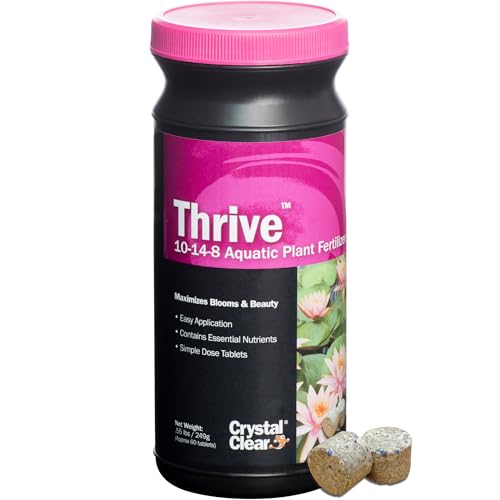
The targeted root-zone tablet that turned lethargic water lilies into bloom machines.
This is the opposite approach from the granular BioLogic above: instead of feeding the whole water column, CrystalClear Thrive is a 10-14-8 pressed tablet you shove directly into the aquatic potting soil of a lily or lotus pot. The result is pinpoint nutrition for the plant with almost zero impact on the surrounding water column. At 0.73 pounds for 60 tablets, the package is light, but customers note it packs real punch — “our pond plants were suffering,” notes one review. “We bought this fertilizer and the plants are VERY happy now.”
The balance here is a 10-14-8 NPK ratio that leans moderately toward phosphorus for root and bloom development without overwhelming the pond with nitrogen. The instruction is simple: use 1-2 tablets per gallon of soil, push it in every 2-4 weeks when the water temperature is above 75°F. For a larger water lily, use 1-2 tablets; for a lotus, use 4 tablets. It beats the Chalily on portability and powder resistance — the tablets hold their shape better out of the package. Still, the package reportedly looks larger than its contents, and some reviewers point out dust in the bottle that can create a brief foam on the pond surface. The foam is harmless, but worth knowing.
Buyers rave about how fast the response is: “I fed my water lilies this product and about a week later I started to see blooms.” Plant health gets positive marks from 18 owners, and the value-for-money aspect is strong — 30 tablets can cover a whole summer for a small pond.
Best Bits
- Delivers visible new blooms within a week when used correctly with warm water (above 75°F).
- Explicitly fish-safe — safe for koi, goldfish, frogs, and snails.
- Root-zone delivery means the nutrients stay with the plant, not the algae.
Watch For
- Dust content in the bottle can cause mild, temporary foam on the pond surface.
- Container size is larger than the contents — a packaging quirk some owners note.
- Only 60 tablets per bottle; a large water garden with multiple lilies and lotus will go through them.
Best pick for: The water-lily fanatic who wants blooms, not just green leaves, and needs a fish-safe tablet that stays put at the root zone.
Consider elsewise if: Tablet dust bothers your pond’s clarity or you need 300 tablets to last an entire season — the Chalily below gives you five times the quantity for a different price bracket.
3. Chalily Aquatic Plant Fertilizer Tablets (300 Count)
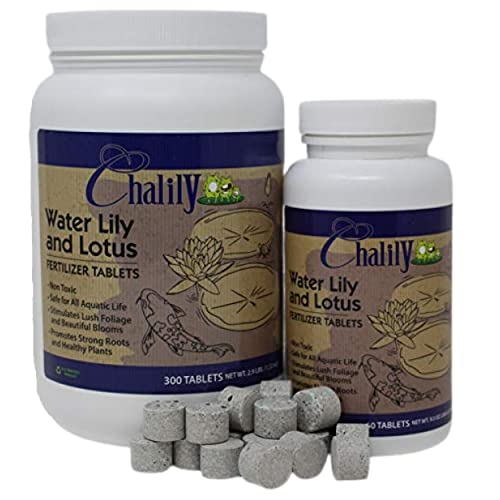
The bulk buy for big water gardens that keeps bloom cycles fed all year.
With 300 tablets in the bottle, the Chalily Aquatic Plant Fertilizer offers a massive 5x unit-count advantage over the CrystalClear Thrive. If you have a pond dense with water lilies, lotus, and marginal plants, this is the low-maintenance quantity that lasts a full growing season without a reorder. The NPK ratio is the same 10-14-8 as the CrystalClear, so the nutrient profile is nearly identical — but the delivery and durability differ.
The buyer consensus is that effectiveness is the top attribute: “Within a day or two we saw new growth from our lily pads,” the review pages sum it up. However, a significant durability note runs through the reviews — many tablets arrive partially disintegrated into powder. One owner reports “the many cubes disintegrated and we have a bowl of powder that we are not sure how to use.” The manufacturer notes this in listing text as a mixed feedback point. The dust does not reduce the effectiveness of the remaining intact tablets, but it means you cannot trust every unit to hold its shape. That contrasts with the CrystalClear, where the tablet integrity is a point of praise. Bloom growth gets positive marks from 5 owners, and the effectiveness attribute anchors the product’s strongest praise.
For the owner of a serious lotus-and-lily collection, the sheer volume makes up for the powder nuisance. Press the intact tablets into the root zone twice monthly (the 1st and the 15th, per the brand’s recommendation), and expect bigger pads and more consistent blooms across the season.
What Shines
- 300 tablets provide enough fertilizer for a large water garden for an entire growing season.
- Same balanced 10-14-8 NPK ratio as the CrystalClear, proven for water lily and lotus performance.
- Fish-safe — explicitly safe for all aquatic life in the pond.
Honest Flaw
- A significant portion of tablets disintegrate into powder before use, making dosing the loose powder a guessing game.
- Powder can also cloud the water briefly if you try to press it into the substrate.
- The upfront cost is higher, though the per-tablet price is lower than the CrystalClear.
Go here if: You need a season’s supply of lily-and-lotus tablets in one order and can work around some powder — the volume of intact tabs is still large.
Look elsewhere if: Tablet integrity is your top need — the CrystalClear Thrive tablets arrive fully intact and dust-free, which may matter more for precise dosing in a small pond.
Understanding the Specs
NPK Ratio Explained
The three numbers on a fertilizer bag stand for Nitrogen (N), Phosphorus (P), and Potassium (K). Nitrogen fuels leaf and stem growth — too much of it in a pond feeds algae, not your plants. Phosphorus is the bloom driver: it supports root development and flower production. For a fish pond, a high phosphorus ratio like the 48 in the 12-48-08 BioLogic formula encourages the right phytoplankton bloom. For potted aquatic plants, a more balanced ratio like 10-14-8 gives the plant enough phosphorus for blooms without overloading the pond water.
Granular vs Tablet
Granular fertilizer is broadcast over the pond surface and dissolves into the top couple of feet of water. This is the right choice for large ponds measured in acres, where the goal is to feed the entire ecosystem — the fish, the plankton, and the overall water biology. Tablets, by contrast, are pressed into the soil of a submerged pot. They deliver nutrients directly to the root zone of a single plant, so they are ideal for decorative water gardens with lilies and lotus. Tablets keep the nutrients away from floating algae and reduce the risk of turning the water green.
Fish Safety Labeling
Not every product labeled “aquatic” is automatically fish-safe. A proper fish-pond fertilizer will make an explicit claim like “safe for fish, koi, goldfish, frogs, and other aquatic life.” The CrystalClear Thrive and Chalily tablets both carry that language. The BioLogic granular product also states it is “healthy for the fish and lake ecosystem” in buyer reports. If a fertilizer lacks any mention of fish safety, do not use it in a pond with live fish. Standard garden fertilizers contain ammonia or urea that can spike pH and kill fish within hours.
Application Timing And Temperature
For tablet fertilizers, water temperature matters. The plant’s metabolism slows below about 75°F, so feeding a lily when the water is cold is wasteful — the plant is not actively growing. CrystalClear explicitly recommends starting when water temperatures are above 75°F and feeding every 2-4 weeks. For granular pond fertilizers, the season starts much earlier — late February or early March in most climates — because the goal is to establish a phytoplankton bloom before the string algae gets a foothold. The schedule is aggressive at first (every 2 weeks for a month), then eases to monthly through October.
FAQ
Can I use regular lawn fertilizer in my fish pond?
How do I know if my pond needs fertilizing?
What happens if I use too much pond fertilizer?
How often should I fertilize my water lilies?
Do I need to remove my fish before adding fertilizer?
How many tablets does a lotus need compared to a water lily?
Can the granular fertilizer be used in a small backyard pond?
What is the difference between a phytoplankton bloom and an algae bloom?
Will the fertilizer tablets kill my snails or frogs?
What should I do if my fertilizer tablets arrive as dust or powder?
Final Thoughts: The Verdict
For most buyers, the fish pond fertilizer winner is the BioLogic Perfect Pond Plus because it is the only option built for a full acre — a single 5-pound broadcast with a phosphorus-heavy 12-48-08 ratio that establishes the healthy plankton base your fish need. If you have a decorative water garden and want targeted root-zone feeding with reliable tablet integrity, grab the CrystalClear Thrive. And if you have a large collection of lilies and lotus and want 300 tablets to carry you through the season without reordering, the Chalily Aquatic Plant Fertilizer is the one to reach for — just work around the occasional powder.
How We Picked
We do not accept paid placement. Every pick is matched to a real buyer and a real use-case; we do not hands-on test units.
Sources & Methodology
Specifications: manufacturer listings and product documentation. Review insights: verified customer reviews, as of July 2026. Pricing: not shown on this page (it changes often); check the current price via the retailer link.
As an Amazon Associate, Lawn Gear Lab earns from qualifying purchases. This does not affect which products we feature.