
Specs are compiled from manufacturer listings and verified buyer reviews and can change over time — please confirm the key details on the product page before buying.
Your azalea looks green and healthy but still won’t bloom. That usually means the soil is not acidic enough for it to take in the nutrients it needs to flower. The nitrogen-phosphorus-potassium (NPK) ratio (the three numbers on the bag) and whether the fertilizer actually lowers your soil’s pH can make or break your plant’s performance. Here are six specific acidic fertilizers for azaleas, compared by their NPK numbers, how much you get, and what real buyers report about blooms and root health.
I’m Rikta — the founder and writer behind Lawn Gear Lab. This guide is built by comparing the manufacturers’ published specifications and the patterns across verified customer reviews, so you get each pick’s real strengths and trade-offs instead of marketing spin.
These five products range from a powder you mix and feed every 7 days to organic granules you scatter twice a year. After comparing feed schedules, coverage, and buyer experience, the best acidic fertilizer for azaleas for you depends on whether you prefer a weekly liquid routine or a set-and-forget granule.
Our Picks at a Glance


How To Choose The Best Acidic Fertilizer For Azaleas
Azaleas need a soil pH (a measure of acidity) between 4.5 and 6.0 to absorb iron and other nutrients. If your soil is neutral or alkaline (pH above 7.0), the plant looks chlorotic (yellow between the leaf veins) and refuses to flower. The right fertilizer does two jobs: it supplies the NPK nutrients and it helps acidify the root zone.
NPK Ratio and What It Means for Blooms
The three numbers tell you the percentage of nitrogen (N, for leafy growth), phosphorus (P, for flowers and roots), and potassium (K, for overall health) by weight. For azaleas, you want a higher middle number (phosphorus) to encourage flower bud formation. A ratio like 4-3-4 provides balanced leafy growth and bloom support, while an 8-4-8 pushes more energy toward the flower display with extra potassium for root strength.
Organic vs. Synthetic Release Schedules
Granular organic fertilizers (like those containing seabird guano or shrimp meal) release nutrients slowly as soil microbes break them down. They typically require two applications per year. Water-soluble synthetics (like the Miracle-Gro powder) feed instantly and need reapplication every 7-14 days, which gives you precise control but demands a consistent schedule.
Sulfur Content for pH Adjustment
Some fertilizers contain elemental sulfur, which soil bacteria oxidize into sulfuric acid, effectively lowering the pH. A product with 5% sulfur can maintain acidity over one growing season. If your soil is already very acidic, a sulfur-free formula that just maintains nutrient levels might be a better fit.
Quick Comparison
| Model | Best For | NPK Ratio | Item Form | Item Weight | Amazon |
|---|---|---|---|---|---|
| Miracle-Gro Water Soluble★ Best Overall | Fast feeding, frequent schedule | — | Powder | 5 Pounds | Check Price |
| Dr. Earth Acid LoversPremium Organic | Non-GMO organic, pet-safe garden | — | Granules | 16 Ounces | Check Price |
| Fertilome Azalea, Camellia, Rhododendron Food | Phosphorus-heavy bloom boosting | 9-15-13 | Granules | 4 Pounds | Check Price |
| GARDENWISE 8-4-8 | Iron-rich slow release, three feeds/year | 8-4-8 | Granules | 0.96 Kilograms | Check Price |
| Espoma Organic Holly-Tone | Classic organic, two-bag value | 4-3-4 | Granules | 4 Pounds | Check Price |
| True Organic Azalea, Camellia & Rhododendron Food | Large garden coverage, heavy sulfur | 5-4-3 | Granules | 12 Pounds | Check Price |
In‑Depth Reviews
1. Miracle-Gro Water Soluble Azalea, Camellia, Rhododendron Plant Food, 5 lb.
Our pick — over 4.5★ from 600+ verified ratings; the strongest balance of quality and price.
The fast-acting powder that turns a watering can into a bloom machine every two weeks.
This water-soluble powder feeds your azalea the moment it hits the soil. You mix it with water — 1:144 for indoor plants or 1:18 for outdoor beds — and pour it around the root zone every 7-14 days. Because it feeds instantly rather than slowly breaking down, you can correct a nutrient shortage or push a shy azalea into flower in the same season. With 5 pounds per bag (a total of 80 ounces), it feeds many plants before you need to reorder. The formula is designed to not burn leaves when used as directed. Owners mention that a single season of weekly feeding turns pale green leaves into deep, waxy green and triggers noticeably larger bloom clusters on established shrubs.
If you have a handful of azaleas in pots or a small garden bed and you enjoy the ritual of mixing and watering every weekend, this gives you the most control over feeding intensity. The trade-off is the schedule — miss two weeks and the plants do not get a slow-release safety net beneath the soil.
What Runs on Schedule
- Works for indoor and outdoor acid-loving plants
- Won’t harm other plants or burn foliage when used as directed
- Covers a large area with a single 5 lb bag
Where the Catch Lies
- Requires mixing every application (not a scatter-and-forget granule)
- Needs reapplication every 7-14 days during growing season
Who it fits: Gardeners who want visible results fast and are ready to water every week with a mixed solution.
Who might skip it: Anyone who wants a one-time spring application to last the season — you need a slow-release granule instead.
2. Dr. Earth Acid Lovers Azalea, Camellia, Rhododendron & Maple Fertilizer 1 lb
The certified organic granule that brings pet-safe, Non-GMO standards to your flower bed.
Dr. Earth makes the only Non-GMO Project Verified fertilizer in the U.S., according to the brand, and it is handcrafted from human and feed grade ingredients with no synthetic chemicals or GMO-infested chicken manure. The 1-pound bag of granules is enriched with multi-minerals, proteins, carbohydrates, humic acids, and trace elements meant to feed the soil biology as much as the plant. If you have dogs that dig or kids who play in the mulch, the line “People & Pet Safe” is a key point here.
It carries OMRI, OIM, CCOF, and NOP certifications, which means it is fully approved for organic production. Customers note that it smells more like garden soil than chemical fertilizer, and a single application seems to green up azaleas within a couple of weeks without pushing fast weak growth. The 16-ounce item weight is light compared to some competitors, but this is a dense concentrate — a little covers a medium bed.
Where it falls short of the Espoma or True Organic options is unit count versus coverage. At 16 ounces (1 lb), it is the smallest package in this group, so you need more bags for a large garden. Stick with this one if your priority is the cleanest organic ingredients and you are tending a small to medium bed.
What It Brings
- Non-GMO Project Verified and OMRI-listed organic
- Safe around pets and children when used as directed
- Multi-mineral and humic acid blend supports soil health
What It Lacks
- 16-ounce bag covers less area than the 4 lb or 12 lb options
- No specific NPK or sulfur percentage listed on the standard label
Grab it for: A small organic garden where ingredient purity and pet safety matter more than maximum bag size.
Look past it if: You need to cover a large border of mature azaleas — you will run out of granules before you finish the bed.
3. Fertilome Azalea, Camellia, Rhododendron Food 9-15-13 (4 lbs.)

The highest-phosphorus granule that directs all its energy into setting flower buds.
This Fertilome formula has an NPK ratio of 9-15-13 — the highest phosphorus number in this lineup by a meaningful margin. Phosphorus (the middle number) is what drives flower development, so this is the pick for an azalea that grows lots of leaves but puts out only a handful of blooms. The 4-pound bag also creates an acid-growing condition that helps azaleas, camellias, and gardenias thrive in soil that is not naturally acidic enough.
Application is straightforward: use 1/4 to 1/2 cup for plants 1 to 5 feet tall, and 3/4 to 1-1/4 cups for plants 6 to 12 feet tall. You feed in very early spring, again after blooming, and again in the fall. This three-feed rhythm sits between the weekly Miracle-Gro schedule and the twice-yearly organic granules. Reviewers point out that it noticeably deepens the green within two weeks and then pushes a heavier set of flower buds than they got from a balanced all-purpose fertilizer.
The one thing to watch for is nitrogen burn if you over-apply on small plants. At 9% nitrogen, it is higher than the 4-3-4 Espoma, so stick to the 1/4 cup minimum for young shrubs under 2 feet. For a mature azalea that just needs a flower push, this is your best bet.
Why It Works
- Highest phosphorus (15%) for maximum bloom production
- Contains 13% soluble potash for root and stem strength
- Three feedings per year is a manageable schedule
One Careful Point
- 9% nitrogen means it can burn young or small plants if applied more than the 1/4 cup minimum
Reach for this if: Your azalea gets enough leafy growth each year but sets few flower buds — the 15% phosphorus is the direct fix.
skip it if: You want a single annual application; this one requires three feedings (spring, after bloom, fall).
4. GARDENWISE 8-4-8 Acidic Fertilizer
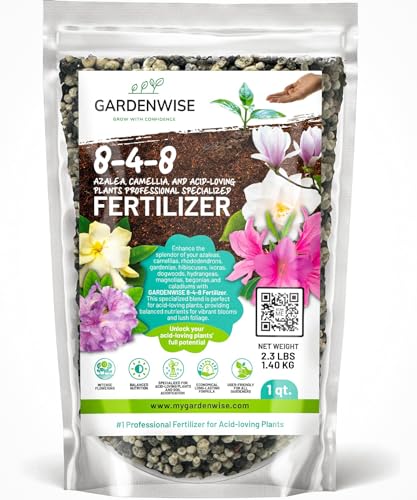
The iron-enriched slow-release granule that only needs three feeds all year.
GARDENWISE packs this 8-4-8 formula with magnesium, iron, and manganese specifically to prevent chlorosis (that yellowing between leaf veins that happens when azaleas cannot absorb iron from alkaline soil). It also contains live bacterial microbes from a refined bio-solid process, which means it feeds the soil microbiology while it acidifies. The 32-ounce bag covers a full bed and is designed to require just three feedings per year.
At 8-4-8, the nitrogen and potassium are both relatively high, so it supports both green leaf production and overall root hardiness. The 32-ounce unit count sits between the small Dr. Earth bag (16 oz) and the larger Espoma/True Organic bags. The iron content is the standout feature here — shoppers say that yellowing azaleas regained their dark green color within three weeks of a single application. The bio-solid production process heats, dries, and prills the material to strip toxins and heavy metals, so it is safe even though it is a byproduct of wastewater treatment.
Another advantage over the water-soluble options is the slow-release granule format. You scatter it, mix it lightly into the topsoil, water it in, and you are done for months. If you hate the weekly mixing routine of the Miracle-Gro, this is a much more hands-off approach that still delivers a custom acid-loving blend.
The Strong Points
- Enriched with iron, magnesium, and manganese to fight chlorosis
- Contains live bacterial microbes for soil health
- Only three feedings per year are required
What to Consider
- 32-ounce bag is smaller than the 4 lb or 12 lb competitors
- Bio-solid origin may not appeal to every organic gardener
Best for: Azaleas showing yellow leaves with green veins — the added iron and manganese directly address iron chlorosis.
Not for you if: You prefer a strictly plant-based or mined organic fertilizer with no recycled bio-solids.
5. Espoma Organic Holly-Tone 4-3-4 Evergreen & Azalea Plant Food; 4 lb. (Pack of 2)
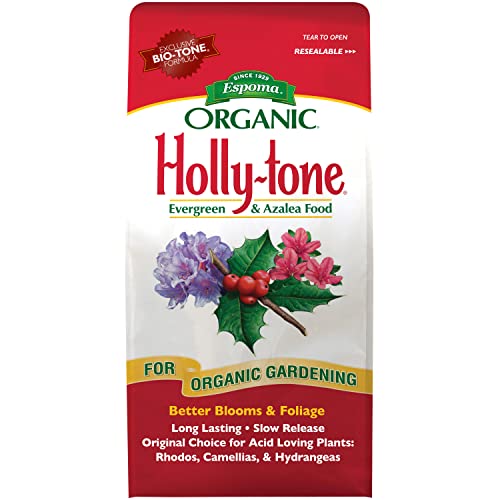
The original organic acid fertilizer, now with a two-bag pack for larger beds.
Holly-tone has been in production since 1929, and it remains the benchmark organic option for acid-loving plants. This pack gives you two 4-pound bags (128 ounces total), whereas the GARDENWISE is a 32.0-ounce bag — you cover significantly more ground for one purchase. The formula uses a 4-3-4 NPK ratio with 5% sulfur for continued soil acidification, and it is enhanced with Espoma’s exclusive Bio-tone microbes.
Application is spring and fall only — no summer feeding required. You scatter the granules around the drip line of the plant, water them in, and the natural organics break down slowly over the season. The 4-3-4 ratio is lower in nitrogen than the Fertilome 9-15-13 or the GARDENWISE 8-4-8, which makes it safer for young plants and less likely to push weak leafy growth. Buyers consistently mention that it is the easiest fertilizer to use because there is no mixing, no measuring cup drama, and the results are reliable even on first-time azalea owners.
The main trade-off is the pace. Because it is slow-release and organic, you will not see the overnight greening that the Miracle-Gro water-soluble powder provides. If you are okay waiting two to three weeks for visible results and you want a long-lived soil amendment rather than a quick fix, this two-pack is the most economical path for medium-to-large borders.
What Works
- 128 ounces total across two bags — substantial coverage for the price
- Contains 5% sulfur for natural soil pH reduction
- No mixing required; scatter and water
The Slow Side
- Organic breakdown means slower visible results than synthetic water-soluble options
Who it suits: The organic gardener covering a medium-to-large bed who wants a classic, set-it-and-water-it product applied only in spring and fall.
Not the right pick for: Someone who wants a quick, visible greening within a few days — the organics take time to break down in the soil.
6. True Organic Azalea, Camellia & Rhododendron Food – 12lb Bag
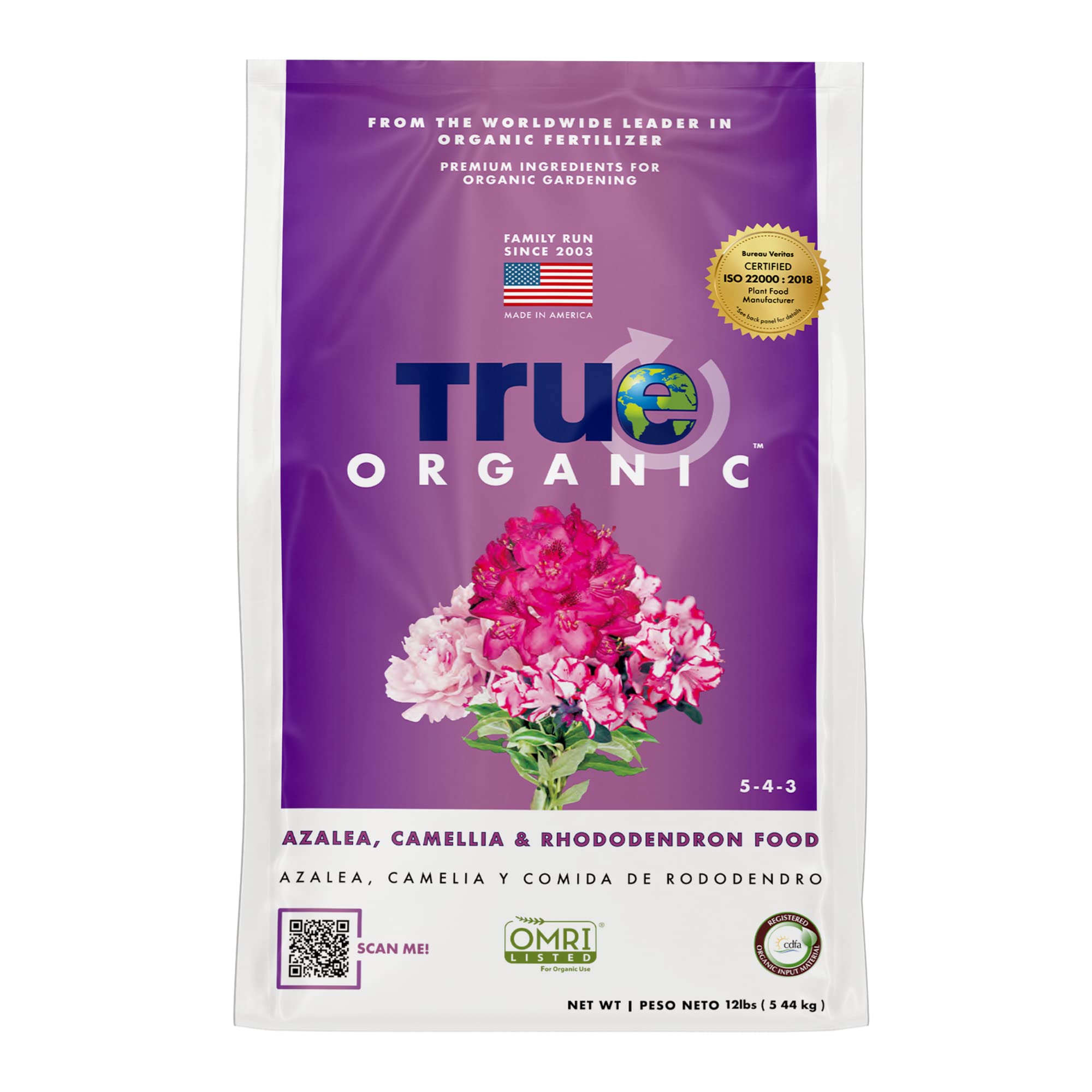
The heaviest bag in the lineup, covering 261 square feet with a single spring application.
The 12-pound bag from True Organic covers up to 261 square feet, which is a 3x weight gap compared to the Espoma Holly-Tone’s 4-pound bag. That means you can treat a large border or several mature shrubs without buying multiple bags. It uses a 5-4-3 NPK ratio and contains 5% soil sulfur to actively lower pH while feeding.
The ingredient list is unique among these picks: seabird guano, shrimp and crab shell meal, and other organic inputs. These provide a slow, natural release of nutrients and trace minerals that improve soil structure over time. The 5-4-3 ratio keeps nitrogen moderate (lower than the Fertilome 9-15-13) while putting phosphorus at 4% — enough to support blooms without risking the soft growth that high-nitrogen formulas sometimes cause. Reviewers regularly mention that a single spring application carried their azaleas through the entire growing season with no additional feeding.
The downside is bag size and storage. 12 pounds of granules is heavy, and you need a dry place to store the leftovers between spring and fall applications. If you only have a few small azalea plants in containers, this bag far exceeds what you need, and the smaller options (Dr. Earth or GARDENWISE) make more sense.
The Big Advantage
- 12-pound bag covers up to 261 square feet
- Contains 5% sulfur and seabird guano for natural acidification
- Twice-yearly application (spring and fall) is very low maintenance
The Storage Hitch
- 12 pounds requires a large, dry storage space; not ideal for container gardeners
Who this is for: Anyone planting a large shrub border or reconditioning a whole bed — a single bag covers 261 sq. ft. and lasts the season.
Reconsider if: You tend a few small azaleas in pots; the 12 lb bag is more than you need and will take a long time to use up.
Understanding the Specs
NPK Ratio
The three hyphenated numbers (e.g., 4-3-4 or 9-15-13) are the percentage of nitrogen (N), phosphorus (P), and potassium (K) by weight in the bag. Nitrogen drives leafy, green growth. Phosphorus encourages root development and flower bud formation. Potassium supports overall cell function and disease resistance. For azaleas, you generally want the middle number (phosphorus) to be equal to or higher than the first number unless you are trying to push extra leafy size.
Slow-Release vs. Water-Soluble
Slow-release granules (like Espoma Holly-Tone or True Organic) are coated in organic materials that soil microbes must break down. They release nutrients gradually over weeks or months and typically need two to three applications per year. Water-soluble powders (like the Miracle-Gro) dissolve instantly in water and deliver nutrients to the roots within hours. They require mixing and more frequent application (every 7-14 days) but give you tighter control over the feeding schedule.
FAQ
Can I use regular all-purpose fertilizer on azaleas?
How often should I fertilize my azaleas?
Is 5% sulfur in the fertilizer enough to lower soil pH?
Can I use acidic fertilizer on hydrangeas and blueberries too?
Will a high-nitrogen fertilizer hurt my azalea blooms?
How do I know if my azalea needs more acidic soil?
Can I mix different acidic fertilizers together?
Should I water the soil before or after applying granular fertilizer?
How long does organic granular fertilizer last in the bag?
Is it safe to fertilize azaleas when they are blooming?
Final Thoughts: The Verdict
For most buyers, the best acidic fertilizer for azaleas is the Espoma Organic Holly-Tone because its 4-3-4 ratio with 5% sulfur is safe for young plants, requires no mixing, and covers a medium-to-large bed across two spring-and-fall applications. If you want a bloom-boosting phosphorus kick for a reluctant flower set, grab the Fertilome 9-15-13. And for the largest garden bed where you need a 261-square-foot coverage from a single bag, the True Organic Azalea Food is the most efficient heavy lifter.
How We Picked
We do not accept paid placement. Every pick is matched to a real buyer and a real use-case; we do not hands-on test units.
Sources & Methodology
Specifications: manufacturer listings and product documentation. Review insights: verified customer reviews, as of July 2026. Pricing: not shown on this page (it changes often); check the current price via the retailer link.
As an Amazon Associate, Lawn Gear Lab earns from qualifying purchases. This does not affect which products we feature.