
Specs are compiled from manufacturer listings and verified buyer reviews and can change over time — please confirm the key details on the product page before buying.
If your boxwoods look pale, yellow, or just not as full and dense as you want, the problem often starts below the soil. Boxwoods are acid-loving evergreens that need a steady, slow supply of nutrients matched to their shallow, fibrous root system — not a standard all-purpose fertilizer that can burn them or push weak, leggy growth. The right pick delivers deep green color without the guesswork.
I’m Rikta — the founder and writer behind Lawn Gear Lab. This guide is built by comparing the manufacturers’ published specifications and the patterns across verified customer reviews, so you get each pick’s real strengths and trade-offs instead of marketing spin.
We break down seven options that hit different balance points — from slow-release spikes you set twice a year to liquid feed for a quick green-up — so you can find the right fertilizer for boxwoods without sifting through every bag on the shelf.
Our Picks at a Glance

How To Choose The Best Fertilizer For Boxwoods
Boxwoods are shallow-rooted, acid-loving evergreens that need a gentle, balanced feed. The wrong formula pushes weak growth or burns roots. Focus on these four specs to get it right the first time.
N-P-K Ratio — Aim for Higher Middle Number
The three numbers on the bag — Nitrogen (N) for leaf growth, Phosphorus (P) for roots, and Potassium (K) for overall health — tell the story. Boxwoods need a moderate nitrogen count (the first number) to avoid pushing tender growth that winter kills, but a higher middle number (phosphorus) helps roots stay strong. Look for a ratio around 16-4-4 or a more balanced 4-3-4 if you want organic slow release. Skip anything with a first number above 20 without checking that it is formulated for shrubs.
Slow-Release vs Quick-Release
Boxwoods prefer consistent feeding, not a one-time nitrogen blast. Slow-release spikes feed for up to 90 days and prevent root burn. Granular formulas with organic ingredients break down with soil microbes. Liquid feeds give a fast green-up but need more frequent application — every 2 to 4 weeks during the growing season.
Form — Spikes, Granules, or Liquid
Spikes are the easiest option for most home gardeners — you push them into the soil around the drip line twice a year. Granules need measuring and watering in. Liquid requires mixing with water and a sprayer or watering can. Choose based on how much hands-on time you want. Spikes work best for a “set it and water it” routine.
Acid-Loving Plant Food
Boxwoods thrive in slightly acidic soil (pH 6.0-6.5). A fertilizer that includes sulfur or other acidifying sources helps maintain that pH range, which keeps the roots able to absorb iron and manganese. Without it, leaves turn yellow even if you feed them. Look for a product labeled for acid-loving plants or evergreens.
Quick Comparison
| Model | Best For | N-P-K Ratio | Form | Weight | Amazon |
|---|---|---|---|---|---|
| Jobe’s Slow Release Spikes★ Best Overall | Best Overall Convenience | 16-4-4 | Spikes | 12 oz | Amazon |
| Espoma Organic Holly-ToneAlso Great | Premium All-Season Feeding | 4-3-4 | Granules | 36 lb | Amazon |
| Espoma Organic Evergreen-Tone | Organic Broadleaf Evergreens | 4-3-4 | Granules | 18 lb | Amazon |
| Miracle-Gro Tree & Shrub Spikes | Quick Two-Pack Value | — | Spikes | 24 Count | Amazon |
| Nelson Acid Loving Plant Food | Blooms & Root Recovery | 9-13-11 | Granules | 2 lb | Amazon |
| Boxwood Fertilizer Liquid | Fast Green-Up | 1 | Liquid | 32 oz | Amazon |
| Jobe’s Evergreen Spikes | Budget Slow-Release | 13-3-4 | Spikes | 12 oz | Amazon |
In‑Depth Reviews
1. Jobe’s Slow Release Tree and Shrub Fertilizer Spikes 16-4-4
Our pick — over 4.5★ from 11,000+ verified ratings; the strongest balance of quality and price.
No measuring, mixing, or cleanup — these 16-4-4 spikes feed boxwood roots directly underground.
This is the easiest option for boxwoods on the list. Each spike is pre-measured with a 16-4-4 N-P-K ratio, so you skip the measuring cup entirely. You push them into the soil around the drip line of your boxwoods twice a year — once in early spring and once in late fall. The spikes release nutrients slowly, preventing the root burn that happens with surface-applied granular or liquid fertilizers.
Buyers compare them directly to untreated shrubs on the same street, noting that the untreated trees and shrubs were “definitely smaller in both height and circumference.” One reviewer used Jobe’s for 20 years and reported consistently healthier trees. At 12 ounces for the package of 15 spikes, it is a lighter box than the premium granular bags. The spikes also avoid the runoff and smell issues of granular or liquid feeds.
Compared to the Jobe’s Evergreen Spike (13-3-4), this tree and shrub version has a higher first number (16 vs 13) which means more nitrogen for leaf growth — better if your boxwoods are struggling with pale color rather than just needing maintenance.
low-maintenance advantage
- No measuring, mixing, or cleanup — just push in and water
- Slow release prevents root burn even in hot weather
- 16-4-4 ratio targets green leaves and root health
One thing to watch
- Hard ground makes driving spikes difficult — soak soil first or wait for rain
Smart buy for: Anyone who wants the simplest feeding routine — push in spikes twice a year and get consistent results without thinking about it.
Not ideal if: Your soil is rock-hard clay; you may need to pre-soak the ground to get spikes in without bending them.
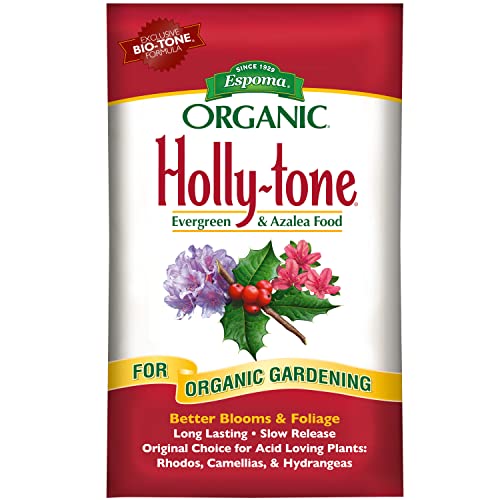
2. Espoma Organic Holly-Tone 4-3-4
This 36-pound bag of organic granules feeds boxwoods spring and fall without burning roots, making it the best overall for most yards.
This is the one-bag solution for all your acid-loving plants. The 4-3-4 N-P-K ratio is gentle enough for boxwoods with their sensitive shallow roots, and the 5% sulfur keeps soil pH in the balance (pH 6.0-6.5) so roots can actually absorb nutrients. Buyers report using it on azaleas, magnolias, and hydrangeas with the same results — deeper green leaves and more blooms. One reviewer noted buying it “every year” for consistent results. The 36 lb bag covers a yard full of shrubs, and it costs less per pound than Espoma’s own 18 lb Evergreen-Tone bag.
The trade-off is application: you have to measure, scatter, and water in the granules, which takes more time than hammering in a spike. It is registered as an organic input material, per reviewers, making it a good fit if you avoid synthetic fertilizers. Espoma has specialized in organic plant food since 1929.
For a different approach with faster setup, consider the Jobe’s 16-4-4 spikes — they skip the measuring entirely. But for broad, long-term coverage on price per pound, this Holly-Tone wins.
Why it earns top pick
- 36-pound bag lasts multiple seasons for most yards
- Certified organic with Bio-tone microbes for slow release
- 5% sulfur keeps soil acidic for boxwoods
The honest downsides
- Granules need measuring and watering in — not as instant as spikes
- Strong manure smell for a day after application
Reach for this if: You want one premium organic product to feed all your evergreens, azaleas, and boxwoods through spring and fall without buying separate bags.
Look elsewhere if: You want a quick no-mix solution you can set in the ground in under a minute — spikes are faster.
3. Espoma Organic Evergreen-Tone 4-3-4

An 18-pound bag of organic 4-3-4 granules that greens up broadleaf evergreens in a couple of weeks — lighter than the 36 lb Holly-Tone.
This is Espoma’s dedicated evergreen formula, and it is a solid middle-ground pick if you want the organic benefits of the Holly-Tone but do not need a 36-pound bag. The 4-3-4 ratio is almost identical to the Holly-Tone, and it also includes 5% sulfur for soil acidification. It is designed for needle-leaf evergreens (pine, fir, spruce) and broadleaf evergreens (azaleas, rhododendrons, camellias) — boxwoods fall into that broadleaf group.
Buyers consistently report visible results within two weeks — one buyer mentioned it made evergreens “bright green just after a couple of weeks.” Another noted a strong barnyard smell from the chicken manure base, which is typical for organic fertilizers. It is approved for organic gardening and is made by Espoma, a company with a long track record since 1929.
The 18-pound bag is lighter and easier to handle than the 36-pound Holly-Tone, but you get fewer applications per bag. For a yard with a dozen boxwoods and a few other shrubs, this is usually the right size. Stick with the larger 36 lb Holly-Tone if you have a large property with many acid-loving plants — it costs less per pound.
Organic, no-mix feeding
- 4-3-4 ratio with Bio-tone for slow, gentle feeding
- Easy to spread and water in — no measuring beyond the cup
- Effective on both broadleaf and needle-leaf evergreens
Fair warning
- Smaller bag means more trips to the garden center for larger yards
- Manure smell lingers for a day after application
Grab this if: You want organic, slow-release granules for a medium-sized yard with boxwoods and other evergreens — and you do not need a 36-pound bag.
Pass if: You prefer spikes for the convenience of not measuring anything.
4. Miracle-Gro Tree & Shrub Plant Food Spikes (24 Count)
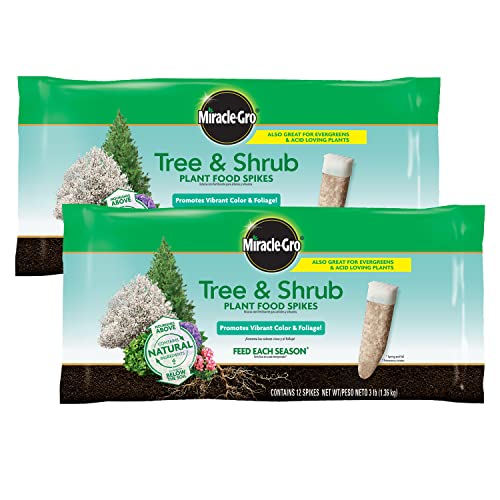
A two-pack of 12 spikes each — one box for spring, one for fall — with a rubber cap for hammering them into the ground.
Miracle-Gro is a household name, and these spikes are designed to be as simple as possible — hammer them into the ground around the drip line of your boxwoods and let them feed for a full season. The 24-count two-pack covers a good number of shrubs for a full year (12 spikes in spring, 12 in fall). They are formulated for evergreens and acid-loving plants, so boxwoods fit right in the target range.
Buyers highlight the rubber cap that comes with them to protect the spike head while hammering — though one owner reported their pack did not include the cap, so it is worth checking the box before you start. Others say the spikes are bigger than expected and turn dark after being exposed to air, so it is best to install them the same day you open the bag. Reviews mention they help “pencil hollies” and other evergreen shrubs look great.
Compared to the Jobe’s spikes, these are slightly more expensive per spike, but you get 24 total between two packages. The advantage is a 2-pack that splits naturally into spring and fall applications. If you already use other Miracle-Gro products, this fits into the same routine. The Jobe’s 16-4-4 spikes give a better per-spike cost for a larger number of plants.
What stands out
- Two separate packs make it easy to save one for fall feeding
- Includes a rubber hammer cap for easier installation
- Formulated for acid-loving plants, including boxwoods
Check before buying
- Some packs have been missing the rubber hammer cap
- Spikes expand and darken in air, so use them quickly
Pick this if: You want a familiar brand and the convenience of a 2-pack that splits into spring and fall applications for a medium number of shrubs.
skip it if: You need a lower per-spike cost — the Jobe’s spikes offer a better price per spike for a larger number of plants.
5. Nelson Acid Loving Plant Food NutriStar 9-13-11

A 2-pound bag of 9-13-11 granules, heavy on phosphorus for root strength, that owners mention revived cold-damaged plants within a week.
This pick has a different balance than the others. The 9-13-11 N-P-K ratio is higher in the middle number (phosphorus) than any other product here, which directly supports root development and flowering. For boxwoods, stronger roots mean better drought tolerance and faster recovery from stress like winter damage or transplant shock. It also contains 3.2% iron from three different sources, which helps deepen leaf color without pushing excessive top growth.
Customers note dramatic results with stressed plants. One customer observed it “revived cold-damaged plants within a week” — the same plants that were lost came back and bloomed that same season. The Nelson formula includes cottonseed meal (20%) for slow release, plus four acidifying sources to keep pH in the right range for boxwoods. It is a 2-pound bag, which is small compared to the Espoma options, so it suits smaller yards or targeted feeding of specific struggling plants.
The downside is the 2-pound size. It works out to a higher cost per pound than the big bags of Espoma or even the granular Evergreen-Tone. For a few boxwoods that need a boost from cold damage, the targeted nutrition may be worth the premium. It is also formulated for azaleas, camellias, and gardenias, so it works year-round for a mixed bed.
Targeted rescue formula
- High phosphorus (13) and iron (3.2%) for root strength and dark leaves
- Revived cold-damaged plants in under a week, per buyers
- Multiple acidifying sources keep soil pH stable
The trade-offs
- Small 2-pound bag covers a limited area
- Higher price per pound than larger granular options
Best for: Gardeners with a few boxwoods that look stressed, pale, or winter-damaged — this is the root-recovery specialist.
Not for: Large plantings where the per-pound cost matters more than targeted nutrition.
6. Boxwood Fertilizer – Liquid Plant Food by TPS Nutrients
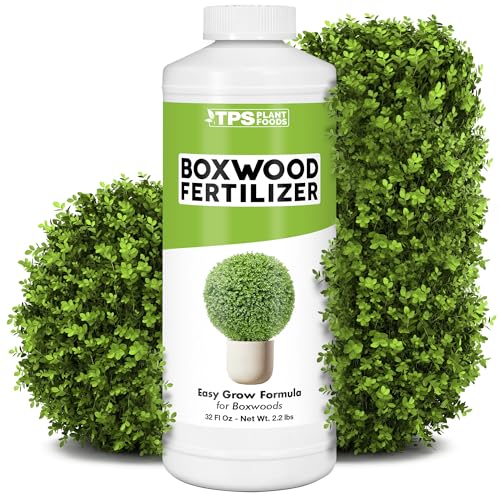
This liquid formula is the only product specifically labeled for boxwoods here — it turns yellow shrubs deep green in 3-4 weeks, per buyers.
This is the fastest-acting option on the list. The liquid form delivers nutrients directly to the root zone immediately after watering in, which is helpful if your boxwoods are already pale or yellow and you need a quick correction. The mixing ratio is 1 — meaning one capful per gallon of water, applied to the soil around the base of the shrub. It is made in the USA by TPS Nutrients.
Reviewers point out visible change in “3-4 weeks” — one user highlighted “our plants were yellowish and they are looking much better” since starting. Another called it “boxwood crack” in a glowing review that noted how quickly the shrubs went from sad-looking to “lush, vigorous, and almost offensively healthy.” The liquid format also gives you control over how much each shrub gets, which is helpful if you have a mix of plant sizes.
The catch is the cost and the frequency. At 32 fluid ounces, and with reviews noting the same formula appears to be used across multiple plant labels (boxwood, juniper, arborvitae), you are paying a premium for the “boxwood” name on the bottle. You will need to reapply every 2-4 weeks through the growing season for continuous results. Compare that to the Jobe’s spikes or Espoma granules that feed for months with one application.
Fast-acting rescue
- Shows visible green-up in 3-4 weeks, based on buyer reports
- Easy to apply — mix with water and pour around the base
- Formulated specifically for boxwoods (alongside other evergreens)
Not a low-maintenance
- Needs reapplication every few weeks versus twice a year for spikes
- Premium cost-per-ounce compared to granular or spike options
Grab this if: Your boxwoods are already pale or yellow and you want the fastest possible green-up in a few weeks — and you do not mind reapplying.
pass on it if: You want a low-maintenance, twice-a-year feeding routine and your boxwoods are generally healthy.
7. Jobe’s 01661 Evergreen Fertilizer Spikes 13-3-4

A 12-ounce box of 15 spikes with a 13-3-4 ratio — the lowest cost per spike on the list for the same twice-a-year convenience.
This is the budget-friendly version of the Jobe’s slow-release spike system. It has a 13-3-4 N-P-K ratio specifically formulated for evergreens, including boxwoods, and feeds for up to 90 days per application — the same twice-a-year schedule (spring and fall) as the higher-end Jobe’s spikes. A 16-ounce box of 15 spikes comes at a lower price than the general tree and shrub version, making it the most affordable spike option on this list.
Shoppers say it perks up bushes quickly. One reviewer compared aloe growth: with solid plant food spikes, their aloe grew noticeably faster (two years of growth compared to an expected 5-7 years). Another noted that the spikes kept their “green giants” looking bigger and more beautiful every year. The main note from buyers is that the spikes can be hard to drive into dry or compacted soil — they recommend soaking the ground first or waiting for rain before installation.
Compared to the Jobe’s 16-4-4 tree and shrub spikes, this formulation has less nitrogen (13 vs 16) and the same low phosphorus (3 vs 4). The lower nitrogen means it is gentler on established boxwoods that do not need a heavy growth push, but it is not the best pick if your shrubs need a rapid color recovery.
Budget-smart feeding
- Lowest cost per spike on the list
- Slow-release for up to 90 days, applied twice a year
- Specifically formulated for evergreens
One limitation
- 13-3-4 has less nitrogen than the 16-4-4 version — slower green-up for yellow boxwoods
Pick this if: You have a smaller budget for fertilizer but still want the convenience of slow-release spikes, and your boxwoods are already healthy — not in need of a quick color rescue.
Choose the 16-4-4 Jobe’s spikes instead if: Your boxwoods are pale and need a stronger nitrogen push for green color.
Understanding the Specs
N-P-K Ratio
The three numbers on a fertilizer label (like 16-4-4 or 9-13-11) stand for the percentage of Nitrogen, Phosphorus, and Potassium in the mix. Nitrogen (the first number) drives green leaf growth. Phosphorus (the middle number) supports roots and flowers. Potassium (the last number) strengthens overall plant health. For boxwoods, a moderate first number (10-16 range) avoids pushing too much tender growth that winter kills, while a balanced middle number supports the root system.
Slow-Release vs Quick-Release
Slow-release fertilizers like spikes or organic granules break down over weeks or months with soil moisture and microbes. They feed steadily and rarely burn roots. Quick-release fertilizers like liquid feeds supply nutrients immediately but need reapplication every 2-4 weeks. For boxwoods, slow-release is generally the safer choice because their shallow roots are sensitive to nitrogen spikes that can cause leaf burn or root damage.
FAQ
What is the best N-P-K ratio for boxwoods?
Should I use liquid or spike fertilizer for boxwoods?
How often should I fertilize my boxwoods?
Can I use a general all-purpose fertilizer on boxwoods?
How many spikes do I need per boxwood shrub?
What does the 5% sulfur in Espoma Holly-Tone do?
Is organic fertilizer better for boxwoods than synthetic?
Will boxwood fertilizer also work on azaleas and other evergreens?
What should I do if my boxwoods turn yellow after fertilizing?
How do I apply granular fertilizer to boxwoods?
Final Thoughts: The Verdict
Across the board, the right fertilizer for boxwoods is the Espoma Organic Holly-Tone because the 36-pound bag, 4-3-4 ratio, and 5% sulfur handle all your acid-loving plants through spring and fall with one organic product. If you want the convenience of no-mix, twice-a-year feeding, grab the Jobe’s Slow Release Spikes with their 16-4-4 ratio. And for a quick green-up on yellow boxwoods, the Boxwood Fertilizer Liquid by TPS Nutrients shows visible results in 3-4 weeks.
How We Picked
We do not accept paid placement. Every pick is matched to a real buyer and a real use-case; we do not hands-on test units.
Sources & Methodology
Specifications: manufacturer listings and product documentation. Review insights: verified customer reviews, as of July 2026. Pricing: not shown on this page (it changes often); check the current price via the retailer link.
As an Amazon Associate, Lawn Gear Lab earns from qualifying purchases. This does not affect which products we feature.