
Specs are compiled from manufacturer listings and verified buyer reviews and can change over time — please confirm the key details on the product page before buying.
The moment you spot black spots climbing your rose canes or a white powder dusting the leaves, your first question is simple: what actually stops this and gets my roses healthy again without resorting to harsh chemistry that feels risky around kids or pets? The answer depends on picking a treatment that matches your specific problem — black spot, powdery mildew, rust, or blight — and then applying it at the right time, in the right way. This guide lines up seven proven options, from biological fungicides that boost the plant’s own defenses to oils that smother disease spores on contact, so you can pick the one that fits your garden and your comfort level.
I’m Rikta — the founder and writer behind Lawn Gear Lab. This guide is built by comparing the manufacturers’ published specifications and the patterns across verified customer reviews, so you get each pick’s real strengths and trade-offs instead of marketing spin.
Each of these products has been used by real rose growers to treat specific diseases, and this guide walks you through how they performed, what they are best at, and where they fall short so you can choose the right diseased roses treatment with confidence.
Our Picks at a Glance

How To Choose The Best Diseased Roses Treatment
Choosing the right treatment depends on matching the product to the specific disease you see, your gardening style, and if you want a prevent-now or cure-now approach. Here are the key factors to weigh.
Identify the disease first
Black spot shows as round black patches with fringed edges on leaves. Powdery mildew looks like a fine white dust. Rust appears as orange pustules on leaf undersides. Each product targets a different set of diseases — using the wrong one wastes time and leaves your roses vulnerable. Most products list exactly which diseases they control on the label.
Contact vs systemic action
A contact fungicide sits on the leaf surface and kills spores on arrival. It needs thorough coverage and reapplication after rain. A systemic or biofungicide (like Bonide Revitalize) gets absorbed into the plant’s tissue or triggers an immune response inside the plant, offering longer protection that rain cannot wash away so easily. For established infections, a contact treatment works fast. For ongoing prevention, a systemic option is more convenient.
Organic vs synthetic formulation
Organic treatments — like citric acid, mineral oil, copper soap, or beneficial bacteria — break down without leaving toxic residue, so you can spray right up to the day of harvest on nearby fruits and vegetables. Synthetic fungicides like Captan are powerful but carry more stringent safety precautions. Your comfort level and whether you share the garden with pets or edible plants should steer this choice.
Quick Comparison
| Model | Best For | Active Ingredient | Form | Volume | Amazon |
|---|---|---|---|---|---|
| Earth’s Ally Disease Control★ Best Overall | Versatile organic prevention | Citric Acid | Concentrate | 32 oz | Amazon |
| Bonide Revitalize BiofungicideSystemic Defender | Systemic immune-boosting control | Bacillus amyloliquefaciens | Concentrate | 16 oz | Amazon |
| Monterey Complete Disease Control | Broad-spectrum biofungicide | Bacillus amyloliquefaciens | Concentrate | 16 oz | Amazon |
| Bonide All Seasons Spray Oil | Year-round disease & insect control | Mineral Oil | Ready-to-Spray | 32 oz | Amazon |
| Neudorff Copper Fungicide | Fast-acting spot treatment | Copper Soap | Ready-to-Use | 16 oz | Amazon |
| Southern Ag Bio Fungicide | Hydroponic & root rot control | Bacillus amyloliquefaciens | Spray | 8 oz | Amazon |
| Southern Ag Captan Fungicide | Powerful synthetic fruit tree protection | Captan | Powder | 8 oz | Amazon |
In‑Depth Reviews
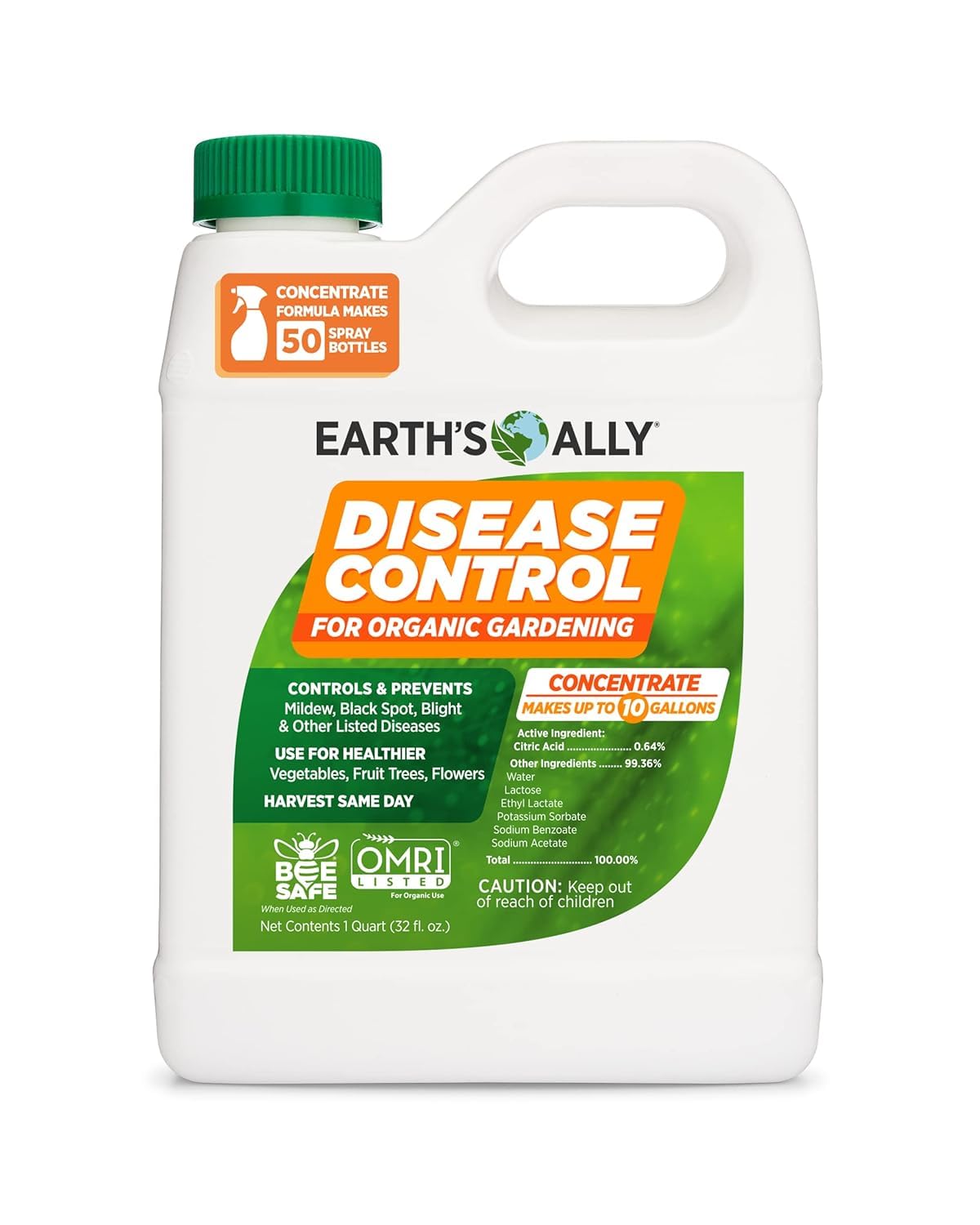
1. Earth’s Ally Disease Control Concentrate
Our pick — 4.5★ from 950+ verified ratings; the strongest balance of quality and price.
Citric acid fights six rose diseases and leaves no harsh residue.
This is the one to reach for when you want broad protection without worrying about what you are putting on your plants. Earth’s Ally Disease Control uses citric acid as its active ingredient — a simple food-grade compound (a weak acid that kills fungi by changing leaf pH) that tackles powdery mildew, downy mildew, blight, canker, black spot, and leaf spot all in one bottle. It is a concentrate, so you mix 6 tablespoons per gallon of water, and that single 32-ounce container makes 10 gallons of spray, which is far more economical than buying pre-mixed bottles. The 2.3-pound bottle goes a long way in a standard rose garden, and since it is OMRI Listed, you can use it on edible plants right up until harvest day without leaving harmful residues. This makes it a better all-rounder than the Neudorff Copper Fungicide (16 oz ready-to-use) because you get far more spray per dollar.
Buyers report that it saved a dying Palo Verde tree diagnosed with root fungus — two deep soil applications at 3 feet revived it within a week, mixed with phosphorus fertilizer. Another reviewer called it “awesome stuff,” noting how little concentrate is needed to treat a full gallon. Because it is a contact fungicide (it kills spores only where it lands), you need to cover every leaf surface, especially the undersides, and reapply after heavy rain. Unlike the oil-based Bonide All Seasons, Earth’s Ally leaves no sticky film on leaves, so your roses keep their natural shine.
Why it stands out
- Treats six different rose diseases in one formula
- Concentrate makes 10 gallons — huge value compared to the ready-to-use Neudorff (16 oz) and the 8 oz Southern Ag
- Safe for people, pets, and the environment
A real limitation
- Requires thorough leaf coverage for contact action
- Only one reviewer shared a detailed success story
Best for: Gardeners who want one all-in-one disease treatment that is organic, concentrated, and covers the most common rose ailments without harsh residue.
Reach for this if: You prefer a natural formula that is OMRI Listed and works on both roses and your vegetable garden.
2. Bonide Revitalize Biofungicide Concentrate
A biofungicide (a fungicide made from living beneficial bacteria) that strengthens roses from the inside out.
Bonide Revitalize works differently than most treatments on this list. Instead of just coating the leaf surface, it triggers the plant’s own immune response to fight off diseases like black spot, blight, anthracnose, and powdery mildew. You can apply it as a foliar spray or as a soil drench — making it especially valuable when the disease has already hit the roots or lower stems where sprays cannot reach. It is approved for organic gardening and can be used up until the day of harvest. At 16 ounces, this concentrate is smaller than the Earth’s Ally (32 oz), but you only need a small amount per gallon, and buyers specifically note its effectiveness as a soil drench.
One reviewer shared their experience with fire blight on mature pear trees: “After using this for about a month & applying every 3-4 days as a soil drench,” the trees began showing new leaves and no more black leaves. Another buyer noted it is the “best option to treat fungal problems on houseplants.” Where the Earth’s Ally is a contact spray, Revitalize’s systemic action gives you longer-lasting internal protection that rain cannot easily wash away. The trade-off is that you need to apply it for a month to see full results — it is not an overnight cure. In this way, it is the opposite of the fast-acting Neudorff Copper Fungicide.
What makes it different
- Systemic action that protects the whole plant from within
- Works as both a foliar spray and a soil drench
- Effective against fire blight and septoria leaf spot
One drawback
- Requires multiple applications over a month for full effect
Pick this for: Serious rose growers who want internal disease prevention, especially for deep-root problems that surface sprays cannot fix.
Look elsewhere if: You need to knock down an active disease outbreak in a single day.
3. Monterey Complete Disease Control
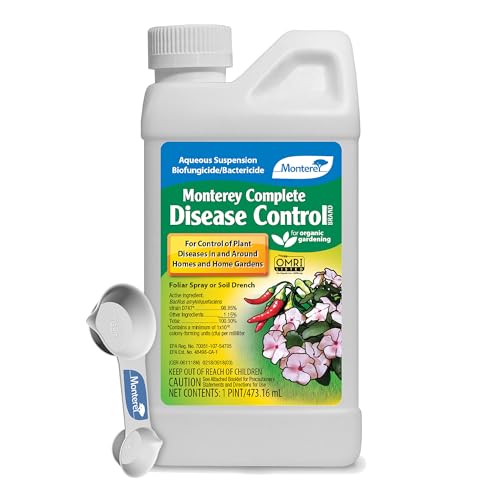
A biofungicide (a fungicide made from beneficial bacteria) that colonizes root hairs to block disease at the source.
Monterey Complete Disease Control is another Bacillus amyloliquefaciens (a beneficial soil bacterium) biofungicide, but it packs a unique advantage: it colonizes the root hairs of plants, helping to prevent disease-causing fungi and bacteria from ever establishing a foothold in the root zone. This makes it particularly valuable for roses planted in damp or poorly drained soil where root diseases thrive. It controls a long list of problems including powdery mildews, rust, leaf blight, brown rot, leaf spots, anthracnose, and gray mold. The 16-ounce bottle is a concentrate that you mix with water and apply as a spray or soil drench. The bundle includes a measuring spoon, which is a small but practical bonus. Compared to the Bonide Revitalize, this one emphasizes root-level protection rather than just foliar immune boosting.
Buyers with heavy rain in the south call this their “favorite fungicide,” noting they have used it for three years straight on tomatoes — a good sign for rose growers in humid climates. Another reviewer praised it for peach leaf curl in the San Francisco Bay area, saying it requires multiple spring applications when leaves emerge. Unlike the Bonide Revitalize, Monterey specifically touts root hair colonization, which gives roses an extra layer of underground protection that makes it a stronger preventative choice for high-risk gardens.
Key strength
- Colonizes root hairs for below-ground disease prevention
- Effective against both fungal and bacterial diseases
- Bundled with a measuring spoon for easy mixing
Consider this
- Controls but does not eliminate existing outbreaks
- Owners mention it slows disease rather than stopping it cold
Ideal for: Gardeners with heavy rain or humid conditions who want a biological preventative that protects roots as well as leaves.
Not the quick fix for: A raging disease outbreak where a contact kill is needed immediately.
4. Bonide All Seasons Horticultural & Dormant Spray Oil

Mineral oil smothers disease spores and insects through every season.
Bonide All Seasons is a 3-in-1 product that controls insects, mites, and fungal diseases using mineral oil. Unlike the biofungicides above that work through bacterial action, this one physically smothers spores and pests on contact. It can be used at the dormant stage, green tip stage, delayed dormant stage, and during the growing season — making it among the most versatile single products in the guide. The 32-ounce bottle is a ready-to-spray formula that attaches to your garden hose, though several buyers advise using it with a pump sprayer instead for better cost control and coverage.
Customers note that the “mineral oil effectively treated 25ft Spanish Broom without chemicals,” though they noted it requires thorough pre-wetting for absorption. Another reviewer said it “killed the rose disease and shined my leaves too.” One honest review pointed out that the hose-end sprayer is poorly calibrated and wasteful — so you are better off pouring it into a pump sprayer. At 32 ounces, it is the same volume as the Earth’s Ally, but unlike that concentrate, this is ready-to-spray so you cannot dilute it further. Its strength is that it works against both disease and bugs in one pass, which the pure fungicides in this guide do not offer.
what separates it
- Works as an insect killer, mite killer, and disease control all at once
- Usable in every season from dormant to growing stage
- Leaves no toxic residues, approved for organic gardening
One catch
- The included hose-end sprayer is inaccurate and wastes product
Best suited for: Rose growers dealing with both fungal disease and insect pests who want one product to handle both all year long.
A better pick than: The Neudorff Copper Fungicide if you also have aphids or scale, since this oil smothers both.
5. Neudorff Plant Fungicide Spray, Copper Soap Fungicide

Copper soap delivers visible results on black spot by the next day.
Neudorff Copper Fungicide is a ready-to-use spray that uses copper soap — a low-concentration copper formulation that decomposes into soluble copper and fatty acid, both of which plants and microbes can use. It targets black spot, powdery mildew, rust, leaf spot, downy mildew, fruit rot, late blight, and peach leaf curl. Because it is ready-to-use, you do not mix anything; you just spray it directly on affected leaves. The 16-ounce bottle is smaller than the 32-ounce Bonide All Seasons, but for small rose gardens or quick spot treatments, the convenience is worth the trade-off.
Reviewers point out it “works immediately on black spot, powdery mildew, red blotch” and note the blue dye helps you see where you have sprayed. One reviewer warned it “worked a little too well” on hostas — burning the leaves — so you need to be careful which plants you spray. Unlike the biofungicides from Bonide or Monterey, this is a contact product with no systemic protection, so you have to reapply every 7 to 10 days and after rain. The copper soap is milder than the synthetic Captan, making it a good middle-ground for organic gardeners who want a fast-acting option for spot-treating bad patches.
Why grab this
- Works immediately on black spot, powdery mildew, and red blotch
- Ready-to-use spray with blue dye for coverage visibility
- No mixing required, ideal for quick spot treatments
Weight to consider
- At 1 pound (which is the 16 oz bottle weight), it is less than half the weight of Earth’s Ally (2.3 pounds)
- Can burn sensitive plants like hostas if over-applied
Grab this for: Immediate, no-mix treatment of visible disease spots on roses, especially when you spot black spot or powdery mildew appearing on a few canes.
skip it if: You have a large rose garden or need to treat sensitive foliage nearby.
6. Southern Ag Garden Friendly Bio Fungicide Organic

A tiny 8-ounce bottle of concentrated bacteria (98.85% pure) that stops root rot cold.
Southern Ag Garden Friendly Bio Fungicide is a concentrated liquid containing 98.85% Bacillus amyloliquefaciens strain D747 — a beneficial bacterium that colonizes roots and outcompetes harmful fungi and bacteria. While its primary use case in reviews is hydroponic systems and root rot, it works just as well in soil as a preventative drench for roses battling root-level fungal issues. The 8-ounce bottle is significantly smaller than the 32-ounce Bonide All Seasons (a 4.0x gap in liquid volume), but because it is so concentrated, a little goes a very long way. Shoppers say using as little as 2 ml per five gallon tank in hydroponic setups.
One reviewer called it “small but mighty,” noting it “greatly helped with root rot” and kept roots “awfully clean.” Another said it works as a precise equivalent to Hydroguard at a fraction of the cost. Unlike the Monterey Complete Disease Control, which also uses Bacillus amyloliquefaciens, this product is specifically formulated for root-zone applications and lacks the foliar spray emphasis. For roses specifically, this is best used as a soil drench at the first sign of root stress or yellowing leaves caused by root disease. The high bacterial concentration means it works fast, but the small bottle runs out quickly if you are treating many plants.
What works well
- 98.85% pure beneficial bacteria — extremely concentrated
- Effective against root rot and algae in hydroponic systems
- Cost-effective per dose compared to similar products
One thing to know
- At 8 oz, this bottle has one-quarter the volume of the 32 oz Earth’s Ally
- Best for root-zone use, not designed as a foliar spray for leaf diseases
Perfect for: Hydroponic rose growers or anyone dealing with root rot who wants a potent, concentrated bacterial solution.
Not the first choice for: Standard foliar rose diseases like black spot or powdery mildew on leaves.
7. Southern Ag Captan Fungicide

The synthetic powder (a man-made chemical fungicide) that fruit tree growers rely on for tough rot.
Southern Ag Captan Fungicide is the only synthetic chemical fungicide in this lineup, and it is also the only one in powder form. It specifically controls Botrytis rot (a gray mold fungus) and is heavily used by fruit tree growers — especially on cherries, peaches, and other stone fruits — for diseases like brown rot and yellow leaf mold. The 8-ounce white bottle may look unassuming, but buyers consistently rate it highly for serious fungal problems that organic options struggle to contain. Its powder form means you mix it with water and spray it on, similar to a concentrate, but the active ingredient (Captan) is a synthetic fungicide with a long track record.
Buyers with a Montmorency tart cherry tree report it “does a terrific job helping us control the fungus” of yellow leaf mold, with the key benefit being the lower cost per treatment on Amazon. Another reviewer fighting peach mummy brown rot said this product “kept away most of the peach mummy brown rot that I experienced last year” when applied according to the seasonal instructions. One review noted it is “hard to get,” suggesting availability can be spotty. Unlike all the organic options above, Captan carries safety warnings about skin, eye, and inhalation risks, and it should be used with protective gear. This is the most powerful, but also the most caution-demanding, option in the guide.
Its main advantage
- Highly effective against tough fungal rots like Botrytis and brown rot
- Powder form is easy to store and mix as needed
- Proven track record with stone fruit growers
Important to know
- Synthetic fungicide with health warnings for skin and inhalation
- Availability may be inconsistent
Reserve this for: Serious fruit tree fungal issues like brown rot or Botrytis that have not responded to organic treatments.
Look elsewhere if: You prefer organic gardening or are treating tender rose foliage near edible crops.
Understanding the Specs
Active Ingredient & Action Type
This is the heart of any treatment. Citric acid (Earth’s Ally) kills fungi on contact by altering pH. Mineral oil (Bonide All Seasons) smothers spores and insects physically. Copper soap (Neudorff) releases copper ions that disrupt fungal cell walls. Bacillus amyloliquefaciens (Bonide Revitalize, Monterey, Southern Ag) is a beneficial bacterium that outcompetes pathogens and boosts plant immunity. Captan (Southern Ag) is a broad-spectrum synthetic fungicide that blocks spore germination. Matching the active ingredient to your disease is the most critical step.
Form: Concentrate vs Ready-to-Use vs Powder
A concentrate like Earth’s Ally or Bonide Revitalize requires mixing with water, giving you more spray volume per ounce and better long-term value. Ready-to-use sprays like Neudorff Copper are grab-and-go convenient for small gardens but run out faster. The Southern Ag Captan is a powder you mix fresh, which keeps storage stable but requires more handling. The Bonide All Seasons is a ready-to-spray oil that attaches to a hose — fast but harder to control application rate.
FAQ
How do I tell if my roses have black spot or something else?
Can I use these treatments on edible fruits and vegetables near my roses?
How often do I need to reapply these products?
What is the difference between a contact fungicide and a systemic fungicide?
Will these treatments also kill insects and mites on my roses?
Why would I choose a biofungicide over a copper spray or oil?
Can I use these as a soil drench instead of foliar spray?
How do I store these products properly?
What is the best time of day to spray my roses?
How do I know if the disease is gone or just dormant?
Final Thoughts: The Verdict
Across the board, the diseased roses treatment winner is the Earth’s Ally Disease Control Concentrate because it combines broad-spectrum coverage of six rose diseases with an OMRI Listed organic formula that is safe for the whole garden. If you want systemic internal protection that keeps working between sprays, grab the Bonide Revitalize Biofungicide. And for year-round pest-and-disease control in a single product, the standout is the Bonide All Seasons Horticultural & Dormant Spray Oil.
How We Picked
We do not accept paid placement. Every pick is matched to a real buyer and a real use-case; we do not hands-on test units.
Sources & Methodology
Specifications: manufacturer listings and product documentation. Review insights: verified customer reviews, as of July 2026. Pricing: not shown on this page (it changes often); check the current price via the retailer link.
As an Amazon Associate, Lawn Gear Lab earns from qualifying purchases. This does not affect which products we feature.