
Specs are compiled from manufacturer listings and verified buyer reviews and can change over time — please confirm the key details on the product page before buying.
Getting your spruce trees to show that deep, rich green color is not complicated — the right mix of nutrients makes the difference. A fertilizer that gently acidifies your soil (lowers pH toward the 5.5–6.5 range spruce trees prefer) while feeding the roots steadily is what works for spruce, fir, and other evergreens.
I’m Rikta — the founder and writer behind Lawn Gear Lab. This guide is built by comparing the manufacturers’ published specifications and the patterns across verified customer reviews, so you get each pick’s real strengths and trade-offs instead of marketing spin.
These six products represent the best choices for a fertilizer for spruce trees today, matched to different yard sizes and tree needs.
Our Picks at a Glance

How To Choose The Best Fertilizer For Spruce Trees
Picking the right fertilizer starts with understanding what a spruce tree actually needs. The goal is to encourage dense, green needles and a strong root system without pushing weak, fast growth.
Understand the NPK Ratio
Every fertilizer has three numbers on the bag (like 4-3-4 or 12-3-3). The first is nitrogen (N), which drives the green color in needles. The second is phosphorus (P), which supports root development. The third is potassium (K), which helps the tree handle stress and disease. For spruce trees, the nitrogen number is usually the highest or equal to the others.
Granules, Spikes, or Liquid
Granular fertilizers, like the ones from Espoma, are sprinkled on the soil and break down slowly. Spikes, like the SimplyGro or Old Farmer’s Almanac options, are hammered into the ground and release food directly at the roots. Liquid fertilizers provide a faster hit of nutrients but need more frequent applications. The best choice depends on how much effort you want to put in each season.
Acidifying vs. Neutral
Spruce trees prefer slightly acidic soil (pH between 5.5 and 6.5). Some fertilizers include sulfur or other acidifying agents to lower the soil pH. That helps the tree absorb nutrients more efficiently, leading to better color and growth. If you do not know your soil pH, an acidifying fertilizer is a safer bet for evergreens.
Quick Comparison
| Model | Best For | NPK Ratio | Form | Weight | Amazon |
|---|---|---|---|---|---|
| Espoma Holly-Tone★ Best Overall | Acid-Loving Plants | 4-3-4 | Granules | 4 lb each (pack of 2) | Amazon |
| Espoma Evergreen-ToneAlso Great | Organic Focus | 4-3-4 | Granules | 18 lb | Amazon |
| TPS Nutrients Spruce Fertilizer | Direct Spruce Feeding | — | Liquid | 32 fl oz | Amazon |
| SimplyGro Evergreen Spikes | Set and Forget | 12-3-3 | Sticks | 3 lb (12 spikes) | Amazon |
| Old Farmer’s Almanac Spikes | Strong Roots | 10-4-10 | Sticks | 3 lb (12 spikes) | Amazon |
| GARDENWISE 8-4-8 | Soil Acidifying | 8-4-8 | Granules | 2.1 lb (32 oz) | Amazon |
In‑Depth Reviews
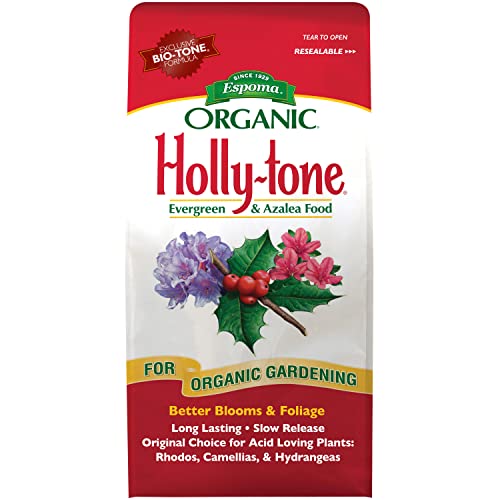
1. Espoma Organic Holly-Tone 4-3-4 (Pack of 2)
Our pick — over 4.5★ from 700+ verified ratings; the strongest balance of quality and price.
The smaller bag size makes it easy to carry around the yard and test on a few trees before committing to a larger bag.
This is the same 4-3-4 NPK formula as the Evergreen-Tone, but sold as a two-pack of 4-pound bags. It is designed for all acid-loving plants, so it works perfectly on spruce, azaleas, rhododendrons, and hydrangeas alike. The granules contain 5% sulfur to help acidify the soil (lower pH) around your trees. One reviewer noted using it to re-establish a transplanted azalea, noting that “it’s only been one season but the plant is doing well and seems to thrive.”
The biggest difference from the Evergreen-Tone is the total volume. At a combined 8 pounds, this pack is lighter and more portable than the 18-pound bag, making it a good entry point. You still get the same Bio-tone organic formula and the same two-feedings-per-year schedule (spring and fall). Because it is the same brand, you can mix and match depending on whether you are feeding a large spruce or a row of flowering shrubs.
Reviewers consistently call it a “good product and reasonable compared to other brands.” One long-time user says they have been using it on all types of shrubs and evergreens for years with great results.
Why grab this: You want the same organic formula as the top pick but in a lighter, more manageable bag — ideal for smaller yards or for trying it on a few trees first.
The trade-off: If you have a large acreage with many spruce trees, the 18-pound Evergreen-Tone bag is more economical per pound.
Best for: small-to-medium yards where portability matters and less product waste is a priority.
skip it if: you need a single heavy-duty bag for a long run of evergreens.
2. Espoma Organic Evergreen-Tone 4-3-4
The 18-pound workhorse covers a full yard without you needing to measure or mix anything — just sprinkle and water.
Grab this bag when you want organic feeding for every spruce, pine, fir, and juniper on your property. Its 4-3-4 NPK ratio (4% nitrogen for needle color, 3% phosphorus for roots, 4% potassium for overall health) is exactly what evergreens need to stay dense and green. It also contains 5% sulfur, which gently lowers your soil’s pH over time — crucial for spruce trees that struggle in alkaline soil (above pH 7). Buyers report seeing “vibrant color and abundant growth” after just a couple of weeks.
Unlike the lighter Espoma Holly-Tone (which comes in 4 lb bags), this single 18 lb bag lets you feed larger trees or multiple beds in one go. The granules require no mixing and are approved for organic gardening. You just sprinkle them around the drip line (the outer edge of the canopy) of the tree, then water thoroughly. Apply it twice a year — once in early spring and again in late fall. The slow-release Bio-tone formula feeds steadily for months. One long-time user notes, “I have been using this product for years with consistent results. Don’t use anything else.”
Reviewers do mention the fertilizer has a barnyard smell because it contains chicken and fowl manure. That is normal for a natural product and tells you it is the real thing, not synthetic filler.
The real takeaway: If you have more than a few spruce trees or want a full-season organic solution without reapplying every few weeks, this is the simplest pick.
Who might skip it: If you need a quick liquid application for a single potted spruce, a smaller or liquid option will handle the job with less leftover product to store.
Best for: homeowners with multiple evergreens who want one bag to handle the whole season organically.
Look elsewhere if: you need a fast-acting liquid for a single small tree.
3. TPS Nutrients Spruce Tree Fertilizer (Liquid)
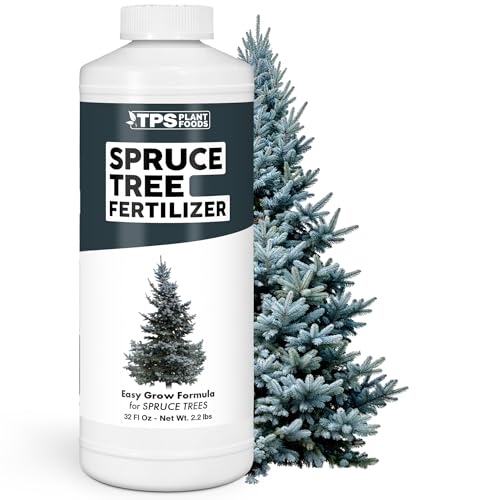
A liquid made specifically for spruce trees — it targets needle color and branch density faster than the granular Espoma options because the nutrients soak in immediately.
This one stands apart because it is specifically formulated for spruce tree growth, not just “acid-loving plants.” The 32-ounce liquid is made by TPS Nutrients and targets fuller branching and improved needle color on blue spruce, Norway spruce, and other varieties. One buyer reports, “My Blue Spruce has filled out since we used the fertilizer (2 times). They say to use it once a month. It looks beautiful.”
Unlike the granular options, the liquid form gives you faster absorption. You mix the concentrate with water (the instructions recommend monthly application) and pour it around the base. This makes it a good choice for stressed trees that need a quick boost, or for potted spruce where spreading granules is difficult. It has a solid 4.6 out of 5 rating from 40 customer reviews.
One three-star reviewer did mention that their tree looked sad after application, showing stress signs like early cone production. That can happen if a tree is already weak or if the soil is very dry. Always water well before and after applying any liquid fertilizer.
The strength: Because it is liquid, it soaks into the root zone fast and is easy to measure for small trees.
The catch: You need to apply it monthly, which is more frequent than the twice-a-year granular schedule.
Grab this for: a single stressed spruce that needs a fast turnaround or for potted spruce trees on a patio.
Consider another if: you want to feed an entire row of trees twice a year and forget about it.
4. SimplyGro Evergreen Tree Fertilizer Spikes (12-3-3)
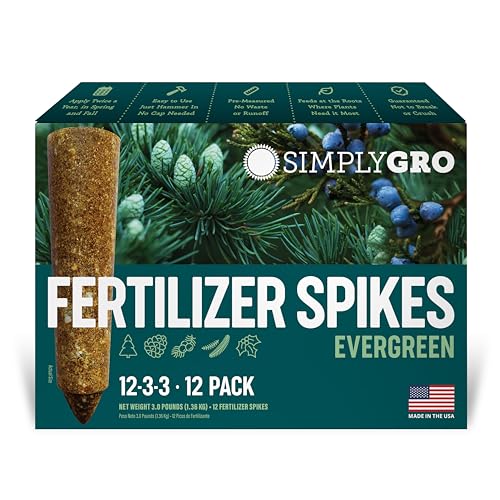
Hammer these patented TruSpikes into the ground once, and they feed your trees continuously for up to three months without any refills or mixing.
If you do not want to measure, mix, or remember a monthly schedule, spikes are your answer. These SimplyGro spikes have a 12-3-3 NPK ratio (12% nitrogen is high, which pushes strong green color on evergreens, pines, and firs). You hammer each 5-inch spike into the soil around the drip line (the canopy’s outer edge), and it releases nutrition slowly for up to 3 months. Apply twice a year — once in spring, once in fall — and you are done.
One buyer with sandy soil says the spikes “keep nitrogen in the soil” even after dozens of waterings, which is impressive compared to granular fertilizers that wash out. The nitrogen here is much higher than in the Espoma Evergreen-Tone (12% vs 4%). Another reviewer reports that a dozen nearly dead pine trees “came back to life in a matter of 2 weeks” after using these spikes. The spikes themselves are a solid construction — the brand guarantees they will not break, crush, or smash during installation.
That 12% nitrogen is fine for established trees showing yellowing, but you should not use this on young seedlings or in sandy soil without watering it in well.
The convenience factor: Once hammered in, you can literally forget about fertilizing for the next 90 days.
The extra cost: 12 spikes cost about the same as a large granular bag, but they cover fewer trees if you are spacing them properly.
Perfect for: busy homeowners who want to deeply fertilize a few key trees without hauling buckets every month.
Not ideal for: large farms or dense groves where granular spreading is faster per tree.
5. The Old Farmer’s Almanac Evergreen Spikes (10-4-10)
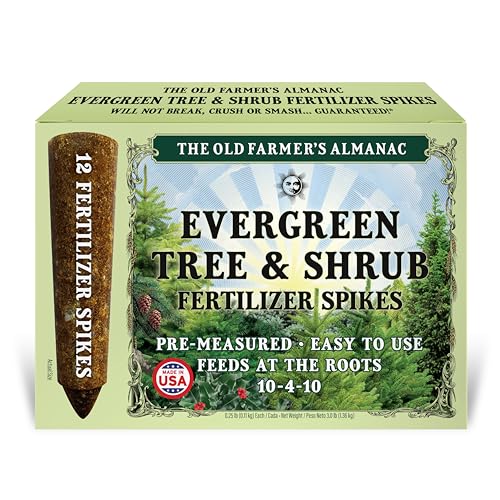
A 10-4-10 formula with added magnesium that targets root strength — it is a better pick than the SimplyGro spikes if your trees face wind, drought, or poor soil.
These spikes use the same patented TruSpike design as the SimplyGro option, meaning you can hammer them into the soil with no cap or special tool needed. The difference is in the NPK ratio. The Old Farmer’s Almanac pack uses 10-4-10 (10% nitrogen, 4% phosphorus, 10% potassium), which puts slightly more emphasis on root and stress resistance compared to the SimplyGro’s high-nitrogen 12-3-3 mix. It also includes 6% magnesium, which is often a hidden deficiency in evergreens that causes needle yellowing.
Owners mention that the spikes are genuinely easy to use — “their claim that you do not need a cap is accurate, you hammer these in the ground at the drip line.” One buyer in a new neighborhood says their trees look “much happier, fuller, and taller than others” after using these spikes regularly in spring and fall. Like the SimplyGro option, these spikes release nutrition slowly for about 90 days.
At 12 spikes per box, you get roughly the same coverage as the SimplyGro. Go with the 10-4-10 if your spruce trees are in dry, windy, or stress-prone spots where root health matters most. Pick the SimplyGro instead if your main goal is to turn yellow needles dark green as fast as possible.
Standout detail: The 6% magnesium addition is unique among these picks and directly addresses a common needle-yellowing issue.
The trade-off: The nitrogen is slightly lower than the SimplyGro spikes (10% vs 12%), so the green-up may be a touch slower on very pale trees.
Reach for this if: your spruce trees face stress from wind, drought, or poor soil and you want to bolster their root system.
Pick the SimplyGro instead if: your main goal is to turn yellow needles dark green as fast as possible.
6. GARDENWISE 8-4-8 Acidic Fertilizer
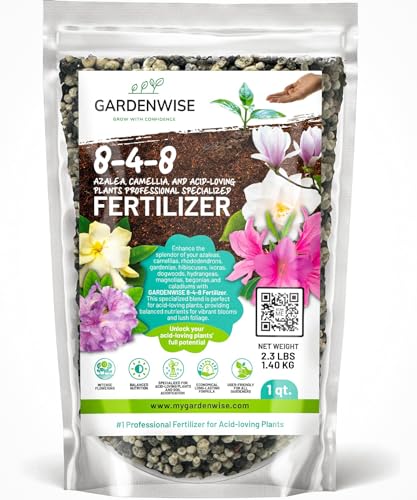
An iron-rich formula that solves chlorosis (yellowing leaves caused by iron lack in alkaline soil) by acidifying the soil and feeding the tree directly.
Spruce trees that look pale or yellow often suffer from chlorosis (a condition where leaves turn yellow due to an iron deficiency). This GARDENWISE 8-4-8 fertilizer is packed with magnesium, iron, and manganese specifically to prevent that problem. It acts as a soil acidifier (it lowers pH), which is critical for spruce, azaleas, and blueberries that struggle in neutral or alkaline soil. One reviewer says their newly planted rhododendron “has doubled in size” after using this product.
The bag is a small 32-ounce pouch (about 2 pounds), which is lighter than the 18-pound Espoma Evergreen-Tone bag. That makes it great for testing a few trees or for a small garden bed. The slow-release granules need to be applied only three times per year, and simply require sprinkling around the base, mixing into the topsoil, and watering. It is a bio-solid formula that includes live bacterial microbes to improve long-term soil health.
Since it is designed for a broad range of acid-loving plants, it works on spruce as well as magnolia trees, gardenias, and hydrangeas. If you have a mixed bed of evergreens and flowering shrubs, this single bag can serve all of them.
The key advantage: The iron and microbial content actively corrects yellowing and builds better soil biology below the surface.
The limitation: The total weight (32 oz) is small, so it covers only a few trees or a small garden area before you need to buy another bag.
Best fit: gardeners who have acidic soil plants in a mixed bed and need a budget-friendly, targeted solution for small spaces.
Skip for larger properties: if you are feeding a row of tall spruce trees, the 18-lb Espoma bag will save you multiple trips to the store.
Understanding the Specs
NPK Ratio
The three numbers on the bag stand for Nitrogen (N), Phosphorus (P), and Potassium (K). Nitrogen drives green needle color and leaf growth. Phosphorus helps root development and flower or cone production. Potassium supports the tree’s ability to handle drought, disease, and temperature swings. For spruce trees, a nitrogen number between 4 and 12 is common, and the ratio is often balanced or nitrogen-heavy.
Slow-Release vs. Fast-Release
Slow-release fertilizers, like the Espoma granules or the hammer-in spikes, break down gradually over weeks or months. This reduces the risk of burning the roots and provides steady nutrition. Fast-release liquid fertilizers, like the TPS Nutrients Spruce Fertilizer, give a quicker boost but require more frequent applications (usually monthly). For spruce trees, slow-release is generally safer, especially if the soil is sandy and nutrients wash through quickly.
FAQ
How often should I fertilize my spruce tree?
When is the best time of year to apply spruce fertilizer?
Do spruce trees like acidic or alkaline soil?
Can I use a general-purpose fertilizer on a spruce tree?
How much fertilizer does a mature spruce tree need?
Are fertilizer spikes better than granules for spruce?
Can I over-fertilize a spruce tree?
What does a magnesium deficiency look like in a spruce tree?
Should I water the fertilizer in?
Can I use organic fertilizer on my spruce?
Final Thoughts: The Verdict
Across the board, the top fertilizer for spruce trees is the Espoma Organic Evergreen-Tone because it provides a large 18-pound organic, slow-release bag that feeds needled evergreens twice a year without any complex steps. If you prefer a no-hassle hammer-and-forget solution for a few key trees, the SimplyGro 12-3-3 Spikes give you three months of continuous feeding per application. And for a targeted liquid fix for a single stressed or potted spruce, the TPS Nutrients Spruce Fertilizer works well with monthly doses.
How We Picked
We do not accept paid placement. Every pick is matched to a real buyer and a real use-case; we do not hands-on test units.
Sources & Methodology
Specifications: manufacturer listings and product documentation. Review insights: verified customer reviews, as of July 2026. Pricing: not shown on this page (it changes often); check the current price via the retailer link.
As an Amazon Associate, Lawn Gear Lab earns from qualifying purchases. This does not affect which products we feature.