
Specs are compiled from manufacturer listings and verified buyer reviews and can change over time — please confirm the key details on the product page before buying.
You want a real explosion of buds that last, not just green leaves. The problem is many organic blends are either too weak to make a difference or so strong they burn your plants. The best organic fertilizer for flowers sits in a balance: it feeds the soil microbes, gives your blooms the exact phosphorus (P) and potassium (K) they need, and releases those nutrients slowly so you do not have to reapply every week.
I’m Rikta — the founder and writer behind Lawn Gear Lab. This guide is built by comparing the manufacturers’ published specifications and the patterns across verified customer reviews, so you get each pick’s real strengths and trade-offs instead of marketing spin.
Choosing the right organic fertilizer for flowers depends on matching the N-P-K ratio and ingredient source to what your specific blooms need most.
Our Picks at a Glance


How To Choose The Best Organic Fertilizer For Flowers
Picking an organic flower fertilizer is not as simple as grabbing the first bag labeled “bloom booster.” You need to match the nutrient ratio to what your flowers actually do with those nutrients.
N-P-K Ratio: The Three Numbers That Matter
The three numbers on the bag (for example, 4-10-7) stand for nitrogen (N), phosphorus (P), and potassium (K). Nitrogen drives leaf and stem growth. Phosphorus is what your flowers need most for bud formation and root development. Potassium strengthens the whole plant against disease and stress. For flowers, you want a higher middle number — the phosphorus — because that is what turns a green plant into a blooming one. A fertilizer like 5-3-3 is better for general feeding, while something like 4-10-7 is a dedicated bloom booster.
Granules vs. Liquids: How It Reaches the Roots
Granular organic fertilizers are the standard for flower beds and borders. You sprinkle them on the soil and water them in, and the microbes in the soil slowly break them down over weeks. This slow-release process means you feed the soil life and the plant at the same time, and you only need to reapply every 4-6 weeks. Liquid organic fertilizers work faster but wash out quickly, so they suit container plants that get watered often. For most flowers in the ground, granules give you longer-lasting results with less effort.
Organic Certification and Ingredient Sources
Not all “organic” labels are equal. Look for the OMRI (Organic Materials Review Institute) seal, which confirms the product meets USDA organic standards. Also check the source ingredients: feather meal, bone meal, blood meal, and alfalfa meal are common. High-quality blends use seabird guano, fish bone meal, or crab and shrimp shell meal, which provide trace minerals that synthetic fertilizers skip. Avoid products that list “bio-solids” (sewage sludge) — they may technically be organic but carry heavy metals.
Quick Comparison
| Model | Best For | N-P-K Ratio | Bag Weight | Coverage | Amazon |
|---|---|---|---|---|---|
| Sustane 5-Pound★ Best Overall | All-purpose veggie & flower beds | — | 5 lbs | Medium | Amazon |
| Miracle-Gro Performance Organics BloomsBloom Booster | Blooms in pots & borders | 5-7-10 | 2.5 lbs | 165 sq. ft. | Amazon |
| Dr. Earth Flower Girl | High-phosphorus bloom boost | 4-10-7 | 4 lbs | — | Amazon |
| True Organic Rose & Flower Food | Roses & in-ground flowering shrubs | 4:5:3 | 4 lbs | 70 sq. ft. | Amazon |
| Espoma Organic Plant-Tone (2-Pack) | All-purpose garden & landscape | 5-3-3 | 4 lbs (2 bags) | All-purpose | Amazon |
| Espoma Organic Rose-Tone (2-Pack) | Roses & heavy-feeding bloomers | 4-3-2 | 4 lbs (2 bags) | Medium | Amazon |
| BuildASoil Craft Blend | Living soil & premium organic gardens | 3-5-2 | 3 lbs | Medium | Amazon |
In‑Depth Reviews
1. Sustane All Natural Flower and Vegetable Plant Food, 5-Pound
Our pick — over 4.5★ from 750+ verified ratings; the strongest balance of quality and price.
The workhorse that builds your soil while feeding every flower and vegetable you grow.
Sustane is a pelleted, slow-release chicken manure fertilizer. It does not just pump blooms — it improves your soil’s structure and feeds microbial biodiversity at the same time. Independent research cited in the specs shows it produces more fruits and blooms than other organic and even synthetic fertilizers, which is a rare claim for an organic product to make. At 5 pounds per bag and 80 ounces total (the most generous unit count in the list), you are getting more ounces than the Dr. Earth Flower Girl (64 oz) by a 25% margin.
Buyers report the results are anything but subtle: one reviewer noted it “regrew 150 onion ends and a 2-foot leek from scraps in water with this nutrient in under 2 weeks,” pointing to how fast the nutrients become available. The mixing ratio is a simple 1:1 with water or soil, so you do not need to measure carefully. The only catch is the smell — it is chicken-manure based, which means a noticeable farmyard odor when you apply it. For in-ground beds and raised vegetable gardens, that is a small trade-off for the growth you get.
Unlike the Espoma Plant-Tone (5-3-3), which is more of a general maintenance feed, Sustane’s research-backed formulation targets both rapid plant response and long-term soil health. That is why it sits at the top of the list.
Soil-first powerhouse: This is the pick if you want one organic fertilizer that feeds your flowers, your vegetables, and the microscopic life in your garden soil all at once — and you want it in the largest bag for the price.
Reach for this if: you have a mixed flower and vegetable garden and want a single, research-backed organic fertilizer that improves soil biology while producing more blooms.
Look elsewhere if: you are growing in a small apartment with sensitive neighbors — the chicken-manure smell during application is real.
2. Miracle-Gro Performance Organics Blooms Plant Nutrition Granules, 2.5 lbs
The trusted name goes organic with a high-phosphorus (P) bloom-builder that delivers visible results in weeks.
Miracle-Gro’s Performance Organics line keeps the brand’s reputation for fast, reliable feeding but swaps synthetic chemicals for natural ingredients. The N-P-K (5-7-10) ratio is one of the highest in the list for phosphorus and potassium — meaning this is designed specifically to push flowers, not foliage. It covers up to 165 square feet per bag, making it the most efficient ground-cover option of any product here for the bag size. You reapply every 4-6 weeks, which aligns with the standard slow-release rhythm of organic granules.
One buyer mentioned: “I started to have these ginormous blooms on all of my plants and flowers, but especially this butterfly bush!” That butterfly bush result is exactly what you want from a bloom-specific feed. The granules are easy to sprinkle around potted plants and borders alike, and the OMRI (Organic Materials Review Institute) listing gives you the confidence that it meets organic standards. Compared to the Sustane, which builds soil first, this one focuses more on immediate flower production — so if you are in a race to get a display going before a garden party, this is your pick.
Why it stands out
- Highest phosphorus-to-nitrogen ratio (5-7-10) for dedicated bloom support
- OMRI listed for certified organic use
- Covers 165 sq. ft. per bag — best coverage per pound
The small print
- Only 2.5 lbs per bag — you may need multiple bags for large gardens
- Less focus on soil biology compared to chicken-manure or compost-based options
Flower-first formula: Pick this if you want the most bloom-focused N-P-K ratio from a brand you already trust and you want visible results in under two weeks.
3. Dr. Earth Flower Girl Bud & Bloom Booster 4-10-7 Fertilizer, 4 lbs

A certified-organic, high-phosphorus (P) handcrafted blend that is safe to use around pets and kids.
Dr. Earth’s 4-10-7 ratio is the highest phosphorus number in this entire list, meaning this is among the most aggressive organic bloom boosters you can buy without using chemicals. The company is explicit about what is *not* in the bag: no GMOs, no chicken manure, and no sewage sludge (what they call “bio-solids”) to taint safety. It is also “Misapply Certified” — a seal that guarantees the fertilizer is formulated to be less likely to burn plants even if you overdo it slightly.
One buyer shared a dramatic result: “Last year, my dragon fruit only bloomed three out of the two trees; this year they bloomed 25!” That is a big jump in production, and the 4-10-7 ratio is the likely reason — phosphorus directly fuels bud development (the process of forming flowers and fruits). Weighing 4 pounds to the Sustane’s 5 pounds, it is a lighter bag but with a much higher concentration of bloom-specific nutrients. The label says it is safe for people and pets, which is a real advantage if you garden where children or dogs roam.
Strengths
- Highest phosphorus content in the list (4-10-7) for maximum bud and bloom support
- Handcrafted organic formula with no GMOs, no sewage sludge
- Certified safe for people and pets
Trade-offs
- 4 lbs smaller than Sustane’s 5 lb bag
- Less suitable as a general all-purpose feed — it is a bloom-specific product
Safety and potency combined: Get this if you want the strongest organic bloom booster you can find, you have pets or children in the garden, or you are growing fruiting plants like dragon fruit that need a phosphorus push.
4. True Organic Rose & Flower Food – Organic Fertilizer for Stunning Blooms, 4lb
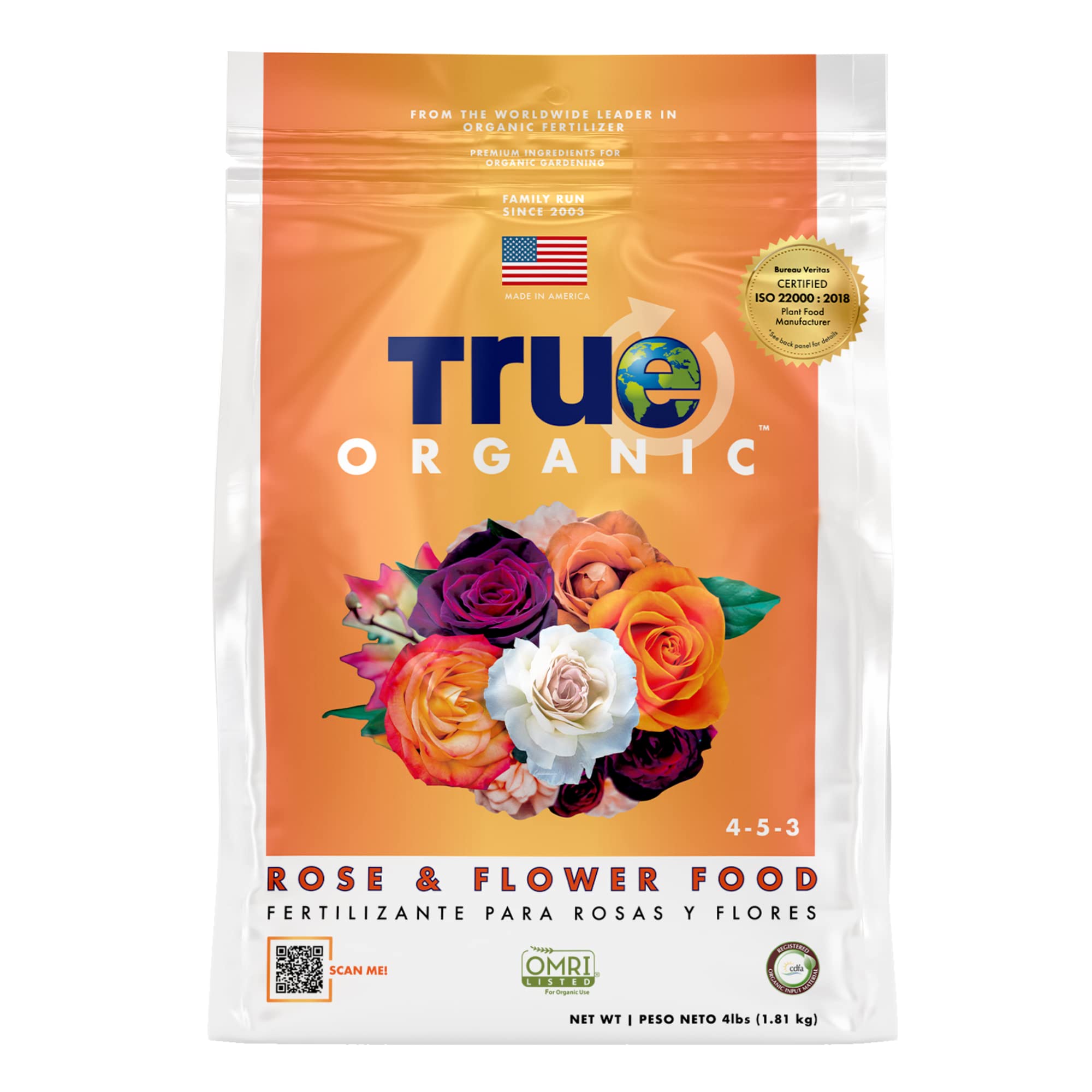
A nutrient-rich blend of seabird guano and crustacean meal that turns tired roses into stunners.
True Organic uses an ingredient list that reads like a superfood smoothie for the soil: seabird guano, shrimp and crab shell meal, fish bone meal, and soybean meal. Those crustacean shells provide chitin (a natural substance that helps plants resist fungal pests), while the seabird guano delivers fast-acting phosphorus. The N-P-K ratio is listed as 4:5:3, which gives you a solid middle-of-the-road phosphorus boost suitable for both flowers and the surrounding soil biology.
One owner reported: “I used it last year for new plantings and will be buying more for this season,” suggesting the results carried over year to year. The 4-pound bag covers 70 square feet, so it is best for targeted applications around roses, flowering shrubs, and container specimens rather than large beds. If you have a True Organic vs the Espoma Rose-Tone choice, the key difference is the marine-based ingredients here versus Espoma’s Bio-tone formula — True Organic brings trace minerals from the ocean that synthetic blends simply cannot replicate.
What makes it special
- Seabird guano and crustacean meal provide trace minerals and natural pest resistance
- Made in the USA with organic inputs
- Versatile for both in-ground beds and container gardens
Limitations
- Coverage of 70 sq. ft. is smaller than Miracle-Gro’s 165 sq. ft.
- Has a noticeable “earthy, ripe smell” per buyer reviews
Ocean-to-soil nutrition: Choose this if you grow roses or flowering shrubs in defined beds and want a marine-based organic fertilizer that adds trace minerals and natural pest-deterring chitin to the soil.
5. Espoma Organic Plant-Tone 5-3-3 Natural & Organic All Purpose Plant Food – 2 Pack

The all-purpose workhorse that feeds everything from roses to redwoods with a single sprinkle.
Espoma has been making organic fertilizers since 1929, and the Plant-Tone formula is their most versatile product. At 5-3-3, it is lower in phosphorus than the bloom-specific options above, but it is designed for a much wider range of uses: annuals, perennials, roses, vegetables, trees, and shrubs. The 2-pack gives you a total of 128 ounces (8 lbs), which is the largest total volume in the list, beating even the Sustane’s 80 ounces by a 60% margin. That makes this the smart buy if you are feeding a large landscape with many different plant types.
The Bio-tone formula (Espoma’s proprietary microbial blend) helps break down the organic nutrients in the soil, making them available to plants faster than standard organic granules. Buyers frequently mention fast spring growth after application. One reviewer wrote: “I use this twice a year and it works like a champ. What a difference this makes with my landscaping and foliage.” The catch is that it is not a dedicated bloom booster — if your main goal is maximum flower production, you want the Espoma Rose-Tone below, which has a 4-3-2 ratio better tuned for flowering plants.
Advantages
- Largest total volume in the list with the 2-pack (128 ounces)
- Bio-tone formula accelerates nutrient breakdown for faster results
- Approved for organic gardening since 1929
Considerations
- 5-3-3 ratio is lower in phosphorus than dedicated bloom boosters
- Has a strong “foul smelling” odor like chicken manure per buyer reviews
Landscape-scale feeding: Grab this if you need one organic fertilizer for your whole yard — flowers, shrubs, trees, vegetables — and you want the biggest volume with a century of proven organic formulation.
6. Espoma Organic Rose-Tone 4-3-2 Organic Fertilizer for All Types of Roses – 2 Pack

The dedicated rose formula with extra calcium (Ca) that turns leggy bushes into bloom factories.
While the Plant-Tone is a general-purpose option, the Rose-Tone is Espoma’s specialized formula for roses and other heavy-feeding flowering plants like bougainvillea, clematis, and viburnum. The N-P-K ratio (4-3-2) has a lower phosphorus number than the Dr. Earth or Miracle-Gro bloom boosters, but it includes 5% calcium — a nutrient that helps prevent blossom-end rot and strengthens cell walls in flower petals. The 2-pack gives you 128 ounces total, the same generous volume as the Plant-Tone 2-pack.
One buyer explained the real-world difference: “When they were once spindly, they are now bursting with color.” That is exactly what the formula is designed to do — shift from leaf growth to flower production over the growing season. You apply it monthly from May through September, sprinkling around the drip line and watering in. The Bio-tone microbial enhancer is included here too, helping the organic matter break down more quickly in the rhizosphere (the root zone). If you are comparing this to the Sustane, note that Sustane is a broader soil-builder, while Rose-Tone is targeted specifically at flower stalks and bud set.
Key strengths
- 5% calcium content supports strong flower petal structure and prevents rot
- Bio-tone formula speeds organic breakdown for quicker availability
- 128 ounces in 2-pack = great value for rose enthusiasts
Knowing its limits
- 4-3-2 ratio is less phosphorus-dense than a dedicated bloom booster like Dr. Earth (4-10-7)
- Not ideal for vegetables or lawns — it is flower-specific
Tailored for rose lovers: This is your choice if you have multiple rose bushes or flowering climbers and want a monthly organic feed with extra calcium for stronger stems and bigger blooms.
7. BuildASoil Fertilizer for Vegetable Garden and Organic Plant Food – 3 LB Craft Blend
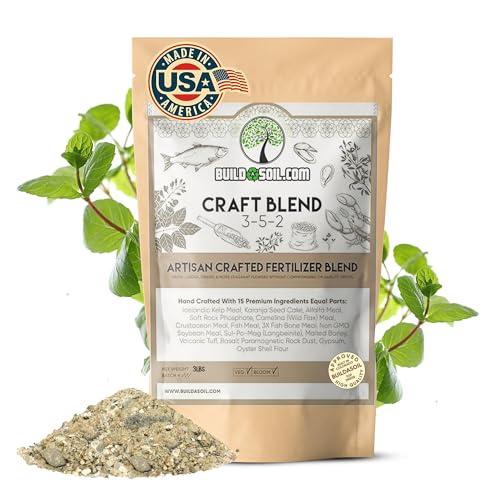
A handcrafted 15-ingredient blend for living soil gardens that rewards you with explosive growth.
BuildASoil’s Craft Blend is the most ingredient-rich fertilizer in the list, with 15 premium inputs including rock dust for trace minerals, calcium, and a 3-5-2 N-P-K ratio that leans slightly toward phosphorus (P) for flower support. This is “living soil” fertilizer — it is designed not just to feed the plant directly, but to feed the billions of microbes in a healthy soil ecosystem. The mixing ratio is 1/4 to 1 cup per 5 gallons of water, applied as a top dressing or brewed into a compost tea (a liquid made by steeping compost in water).
One reviewer wrote about using it in a vegetable garden: “I literally dont know what to do with the explosive growth.” The company also claims “rapid visible impact” in 24 hours, which is fast for a dry organic granule (most take weeks). At 48 ounces (3 lbs), this is the smallest bag in the list, but the concentration is high — you use much less per feeding than the other products here.
If you have a standard flower bed, the Sustane or Dr. Earth will be more straightforward. But for dedicated organic gardeners who maintain a living soil with worms, mulch, and compost teas, the Craft Blend provides a complete spectrum of nutrients that simpler blends miss. The 3-5-2 ratio means it is suitable for flowers, vegetables, and fruiting plants similarly — not as bloom-dedicated as the 4-10-7 Dr. Earth, but far richer in micronutrients.
Why it wins for serious growers
- 15 premium ingredients including rock dust for trace mineral completeness
- “Rapid visible impact” claimed by the maker within 24 hours
- Ideal for living soil, no-till, and organic no-feed methods
Before you buy
- 3 lb bag is the smallest in the list — less value per pound for large gardens
- More expensive per pound than mainstream organic brands
For the soil-obsessed gardener: Choose this if you practice living soil or no-till gardening and want the most complete, mineral-rich organic fertilizer available — and you are willing to pay a premium for those 15 ingredients.
Understanding the Specs
N-P-K Ratio – The Three Numbers on the Bag
The three numbers you see on every fertilizer label stand for nitrogen (N), phosphorus (P), and potassium (K). Think of nitrogen as the leaf-maker — it pushes green growth and is great in spring but bad for flowers if overdone. Phosphorus is your flower fuel; it drives bud formation, root growth, and fruit set. Potassium is the plant’s immune system — it helps resist disease, drought, and cold. A bloom-specific fertilizer for flowers should have a higher middle number, like 4-10-7 or 5-7-10. A general-purpose feed like 5-3-3 is better for mixed gardens where you have both leaves and flowers to support.
Organic Ingredients – What Is Really Inside
Organic fertilizers get their nutrients from once-living things — bone meal, feather meal, blood meal, alfalfa meal, seabird guano, and crustacean shells. These ingredients break down slowly as soil microbes digest them, which means the nutrients stay in the ground longer and the soil itself becomes healthier over time. Look for an OMRI (Organic Materials Review Institute) seal to confirm the product meets certified organic standards. Avoid products that list “bio-solids” or sewage sludge — these are technically organic but often contain heavy metals that accumulate in your garden soil.
FAQ
What is the best N-P-K ratio for flowering plants?
How often should I apply organic flower fertilizer?
Can I use vegetable fertilizer on flowers?
Is organic flower fertilizer safe for pets?
What does OMRI listed mean on fertilizer?
Can I over-fertilize flowers with organic fertilizer?
Should I use liquid or granular organic fertilizer for flowers?
What is the difference between 4-10-7 and 5-3-3 fertilizer?
Can I mix fertilizer into the soil before planting flowers?
Why does organic fertilizer smell bad?
Final Thoughts: The Verdict
If you want one dependable pick, the best organic fertilizer for flowers is the Sustane All Natural Flower and Vegetable Plant Food because it delivers the largest bag, the strongest research backing, and a slow-release chicken manure formula that builds soil biology while producing more blooms. If you want the highest phosphorus content for a targeted bloom boost, grab the Dr. Earth Flower Girl Bud & Bloom Booster. And for living soil enthusiasts who want 15 premium ingredients with rock dust and trace minerals, the standout is the BuildASoil Craft Blend.
How We Picked
We do not accept paid placement. Every pick is matched to a real buyer and a real use-case; we do not hands-on test units.
Sources & Methodology
Specifications: manufacturer listings and product documentation. Review insights: verified customer reviews, as of July 2026. Pricing: not shown on this page (it changes often); check the current price via the retailer link.
As an Amazon Associate, Lawn Gear Lab earns from qualifying purchases. This does not affect which products we feature.