
Specs are compiled from manufacturer listings and verified buyer reviews and can change over time — please confirm the key details on the product page before buying.
You want big, juicy tomatoes, but the wrong plant food can give you giant leaves and almost no fruit. The secret is the N-P-K ratio (Nitrogen, Phosphorus, Potassium) — you need a middle number (phosphorus) that is higher than the first (nitrogen) to push energy into fruit. If your tomato plants look pale or you see black spots on the bottoms, you are probably missing the right food for tomato plants.
I’m Rikta — the founder and writer behind Lawn Gear Lab. This guide is built by comparing the manufacturers’ published specifications and the patterns across verified customer reviews, so you get each pick’s real strengths and trade-offs instead of marketing spin.
You do not need a degree in soil chemistry to get a heavy harvest — what you need is the right ratio of nutrients for your specific growing style. If you are tired of pale plants and tiny fruit, it is time to find the best food for tomato plants that actually delivers.
Our Picks at a Glance


How To Choose The Best Food For Tomato Plants
Tomatoes are heavy feeders, which means they pull a lot of nutrients from the soil over a single season. The wrong fertilizer can give you giant plants with no fruit — or worse, burn the roots. Here is what to look for.
N-P-K Ratio: What Those Numbers Actually Mean
The three numbers on any fertilizer bag stand for Nitrogen (leaf growth), Phosphorus (root and flower development), and Potassium (overall plant health and disease resistance). For tomatoes, you want a formula where the middle number (phosphorus) is higher than the first number (nitrogen). A ratio like 5-10-10 or 4-18-38 pushes energy toward fruit instead of leaves.
Organic vs. Synthetic vs. Slow-Release
Organic formulas (like Down To Earth or Espoma) feed the soil microbes along with the plant, but they release nutrients slowly as the soil warms up. Synthetic formulas (like MasterBlend) are water-soluble and fast-acting — great for hydroponics or giving a wilted plant a quick boost. Spikes (like Jobe’s) sit in the root zone and release steadily over 8 weeks with zero mixing.
Calcium Content and Blossom End Rot
Blossom end rot — that dark, sunken spot on the bottom of your tomato — is a calcium deficiency. Some fertilizers, like FoxFarm Happy Frog and Espoma Tomato-Tone, include added calcium specifically to prevent it. If your soil tends to be acidic or you grow in containers, a calcium-rich fertilizer is a smart move.
Quick Comparison
| Model | Best For | N-P-K Ratio | Item Weight | Item Form | Amazon |
|---|---|---|---|---|---|
| Down To Earth Organic★ Best Overall | Gentle organic feeding | 4-6-2 | 5 lb | Granules | Amazon |
| FoxFarm Happy FrogTop Performer | Preventing blossom end rot | 5-7-3 | 4 lb | Granules | Amazon |
| MasterBlend 4-18-38 | Hydroponic / water-soluble | 12:6:12 mix ratio | 1 lb | Powder | Amazon |
| Jobe’s Tomato Spikes | Tangle-free feeding | 6-18-6 | 0.55 lb | Sticks | Amazon |
| Lilly Miller Morcrop | Classic granular formula | 5-10-10 | 4 lb | Granules | Amazon |
| Purely Organic 8-8-8 | Balanced all-purpose | 8-8-8 | 2.3 lb | Granules | Amazon |
| Espoma Tomato-Tone | Organic large-scale garden | 3-4-6 | 18.1 lb | Granules | Amazon |
In‑Depth Reviews
1. Down To Earth Organic All Purpose Tomato & Vegetable Mix (4-6-2)
Our pick — over 4.5★ from 900+ verified ratings; the strongest balance of quality and price.
A gentle, natural 5-pound blend that rebuilds soil while feeding plants without burning roots.
If you prefer an organic approach, this Down To Earth mix uses ingredients like fish bone meal, blood meal, kelp meal, and greensand. At 4-6-2, the phosphorus is slightly higher than the nitrogen — a good starting point for transplants and early-season feeding. The mix is OMRI-listed (Organic Materials Review Institute — a certification for organic production), so it meets organic certification requirements.
Customers note that it “transformed pale, flimsy tomato plants into healthy ones within two weeks after application.” The granules are gentle enough that you do not have to worry about burning young roots, unlike some synthetic options that require precise measuring.
The catch is the smell — reviewers mention a fishy odor that can linger for a few days after application, and it may attract raccoons if not worked into the soil or watered in right away.
Why Choose It
- OMRI-listed for certified organic gardens
- 5 lb box gives a good amount for the planted area
- Non-burning formula safe for transplants
- High 4.7 rating from 949 customers
Why Not
- Has a strong fishy odor for a few days
- May attract wildlife if not watered in
The smart organic bet: For gardeners who want a certified natural product and are okay with a little odor for great results.
One real limitation: The 4-6-2 ratio is more for general feeding; for heavy fruiting you may need a higher phosphorus bloom booster later.
2. FoxFarm Happy Frog Tomato & Vegetable Fertilizer (5-7-3)
A calcium-rich granular blend that targets blossom end rot while feeding heavy-producing plants.
This 4-pound bag of granules from FoxFarm is built for vigorous feeders — tomatoes, peppers, and berries that pull a lot from the soil. The 5-7-3 ratio keeps the phosphorus high enough to push blooms and fruit, and the added calcium directly targets blossom end rot (that sunken black spot on the bottom of your fruit). It also includes mycorrhizal fungi (soil organisms that help roots take in water and nutrients), which help the roots take up water and nutrients more efficiently.
Unlike the purely organic Down To Earth mix, which has a lower 4-6-2 ratio, this FoxFarm formula steps up the phosphorus to 7 and backs it with calcium. Buyers report that one tiny cherry tomato sprig turned into a “tomato-producing tree.” Owners mention a bumper crop every season, and the granules do not have the strong fishy odor that some organic options carry.
The trade-off is that this is a premium-priced 4 lb bag — you will want to use it for your most productive plants and supplement your rows with a more economical bulk fertilizer.
What Stands Out
- Calcium content helps prevent blossom end rot
- 5-7-3 ratio favors fruit over leaves
- Mycorrhizal fungi boost root function
- Earned a 4.8 rating from 625 reviewers
Keep in Mind
- 4 lb bag is small for large gardens
- Premium tier pricing per pound
Reach for this if: You grow tomatoes in containers or raised beds and frequently deal with blossom end rot.
Look elsewhere if: You are feeding a big in-ground row and need a more economical bulk option.
3. MasterBlend 4-18-38 Tomato & Vegetable Fertilizer (1 lb Bulk)
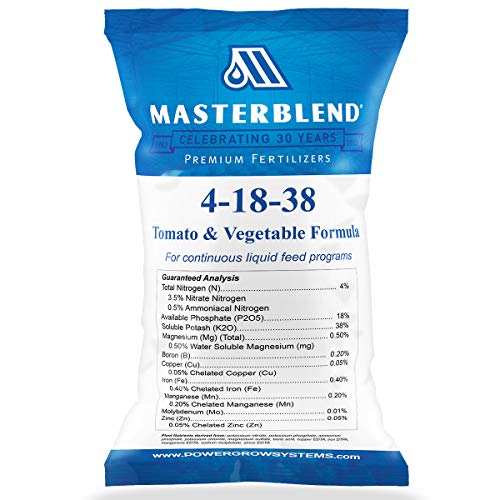
A highly concentrated powder that dissolves completely in water and delivers a heavy phosphorus punch.
MasterBlend is different from every other product on this list — it is a dry powder that you mix with water yourself, and it is designed primarily for hydroponic growing. The 4-18-38 analysis (which mixes to a 12:6:12 ratio) is extremely high in phosphorus, which drives root development and fruit set. A single 1 pound bag is super concentrated — one reviewer noted “it lasted me over a year and its super effective for lush and hefty vegetables.”
Unlike the Down To Earth granules (which carry a 4-6-2 ratio and are 3x lower in the phosphorus component of the mix), MasterBlend is for gardeners who want precise control over what their plants get. It dissolves fully in water with no residue, so it works in drip systems, Kratky jars, and soil drenches. Reviewers point out that the light green powder is easy to measure in teaspoons or grams.
The downside is that you have to mix it yourself every time — there is no scoop-and-go convenience here. And the mixing ratio (12:6:12) requires magnesium sulfate (Epsom salts) and calcium nitrate, which are sold separately.
What Makes It Special
- Extremely high phosphorus (4-18-38) for big fruit sets
- 100% water-soluble — zero residue in lines
- Bulk 1 lb bag lasts over a year for many gardeners
- Includes all trace minerals in the formula
What You Need to Know
- Requires mixing and additional calcium/magnesium sources
- Not a standalone product — you need the full recipe
For the control-seeker: Ideal if you are already comfortable with mixing nutrients for hydroponics or want maximum phosphorus without filler ingredients.
skip it if: You want a grab-and-pour granular fertilizer for traditional soil gardening.
4. Jobe’s Tomato Fertilizer Spikes (6-18-6, 18 Spikes, 2-Pack)

Push-and-forget spikes that feed from below the surface for a full 8-week season.
Jobe’s spikes are the easiest option on this list — you literally push them into the soil around your tomato plants and walk away. Each spike has a 6-18-6 analysis, so the phosphorus is triple the nitrogen, targeting roots and fruit directly. The time-release technology feeds for 8 weeks, meaning one application at planting and another mid-season is usually all you need.
Shoppers say that “every year I have bumper crops of tomatoes to the point where I don’t know what to do with them all.” Unlike the Down To Earth granules (5 lb) or the MasterBlend powder (1 lb), Jobe’s 18-spike 2-pack weighs just 0.55 lb — it is much lighter because the spikes are mostly the active fertilizer with no filler. There is no mixing, no measuring, no smelly liquid, and no runoff mess.
The catch is you cannot adjust the dose per plant — each spike delivers a fixed amount, so very large plants may need more than what a single spike provides. And if you already have nutrient-rich soil, the extra phosphorus might be overkill.
Best Part
- Zero mixing or measuring — just push in the spike
- Continuous feeding for 8 weeks per application
- No runoff, no odor, no messy liquid
- 18 spikes per pack (2-pack total)
Trade-Off
- Cannot customize dosage per plant
- 0.55 lb total is very light — small coverage area per pack
Your best bet if: You want the easiest feeding method with no measuring, mixing, or cleanup.
pass on it if: You have many plants in a big garden — spikes are more expensive per plant than bulk granular options.
5. Lilly Miller Morcrop Tomato & Vegetable Food (5-10-10)

A phosphorus-heavy granular formula that puts double the power behind roots and fruit.
Lilly Miller Morcrop uses a 5-10-10 ratio — meaning the phosphorus and potassium are each double the nitrogen. This directs the plant’s energy away from leaf growth and toward strong root systems and heavy fruit production. The 4 lb bag of granules is fortified with essential plant minerals, and it is made in the United States.
Buyers report it “really made a difference with my tomato plants and sweet potato plants this year.” One reviewer who uses it in a greenhouse calls it a “trusted product” that delivers a good crop every year. The 5-10-10 ratio sits between the gentle 4-6-2 of Down To Earth and the aggressive 4-18-38 of MasterBlend — it is a middle-ground option for gardeners who want strong fruit support without going hydroponic.
The downside is the smell — granules have a strong odor during application, which dissipates after watering in. And some users note you cannot find this specific formula at local big box stores, so online ordering is your only route.
Strong Points
- 5-10-10 ratio heavily favors fruit and root development
- Fortified with micronutrients for plant health
- 4 lb bag provides a solid amount for several plants
- Trusted by greenhouse growers year after year
Weak Points
- Strong odor during application
- Not widely available in local stores
A top pick if: You want a balanced but phosphorus-driven granular feed that is easy to use and proven over many seasons.
Not for you if: You are sensitive to strong smells during garden work.
6. Purely Organic Products LLC 8-8-8 Triple Play Tomato & Vegetable Plant Food

A perfectly balanced 8-8-8 formula that feeds for 6-8 weeks and covers up to 250 square feet.
This Purely Organic product takes a different approach — instead of pushing phosphorus higher, it keeps all three numbers equal at 8-8-8. The balanced nitrogen supports leaf growth while the phosphorus and potassium support fruit and roots equally. It comes in a 36-ounce resealable pouch that covers up to 250 square feet, and the protein-and-plant-based formula provides fast-acting results for 6-8 weeks before needing another application.
One buyer mentioned “my tomato plants alone were five times bigger than my friends tomatoes” after using this compared to a different brand. That is a strong claim from a real customer. The 8-8-8 ratio works well for tomatoes, vegetables, fruits, berries, and herbs — so it is a versatile choice if you have mixed beds.
The catch is that 8-8-8 provides higher nitrogen than the fruit-focused formulas like 5-10-10 or 6-18-6. If your soil is already rich in nitrogen, this could give you more leaves than fruit. It is best for soils that need overall improvement rather than a targeted fruit push.
Why It Works
- Balanced 8-8-8 formula supports whole plant growth
- Covers 250 sq. ft. per pouch — good for medium gardens
- Fast-acting results that keep feeding for 6-8 weeks
- Resealable pouch keeps granules dry during storage
The Limitation
- Higher nitrogen may push leaves over fruit in rich soil
- 2.3 lb bag is smaller than many granular options
Best for: Gardeners with mixed vegetable beds who want a single, balanced fertilizer that covers everything.
One thing to watch: If your tomatoes already have lush leaves but few flowers, consider a lower-nitrogen booster instead.
7. Espoma Organic Tomato-Tone (3-4-6, 18 lb Bag)

An 18-pound organic bag with 8% calcium — built for large, serious tomato patches.
Espoma is a name that has been in the organic gardening game since 1929. Tomato-Tone has a 3-4-6 analysis with 8% calcium to prevent blossom end rot, and it contains the proprietary Bio-tone formula of beneficial microbes. The low nitrogen (3) combined with higher potassium (6) encourages the plant to put energy into fruit quality and disease resistance rather than just growing tall.
Owners mention that it is “the go-to, must have fertilizer for growing tomato plants” because the nitrogen is not too high — it prevents the common problem of getting giant leafy plants with tiny tomatoes. The 18 lb bag is the heaviest on this list by a wide margin, making it the smart choice for gardeners with many plants or rows. One reviewer has been using it for years and calls it “one of the best organic options available.”
The trade-off is the size — 18.1 lbs is a lot of fertilizer to store and move around. It is also priced higher than the smaller bags, though the per-pound cost is actually quite competitive for organic fertilizer.
What You Get
- 18.1 lb bag covers a large garden for the whole season
- 8% calcium content helps prevent blossom end rot
- Low nitrogen (3-4-6) focuses energy on fruit, not leaves
- Approved for organic gardening
What to Consider
- Heavy bag — 18 lbs is not a quick grab
- Requires application every two weeks through the growing season
The big-scale organic pick: If you have a large garden and want a single bag that lasts from planting through harvest, this is your match.
Not for small gardens: The 18-lb quantity is more than a container or raised-bed grower needs in one season.
Understanding the Specs
N-P-K Ratio
The three hyphenated numbers on any fertilizer bag stand for Nitrogen (N), Phosphorus (P), and Potassium (K). Nitrogen drives green leaf growth, phosphorus supports root development and flower/fruit production, and potassium strengthens the plant’s overall health and disease resistance. For tomatoes, look for a middle number (phosphorus) that is equal to or higher than the first number (nitrogen) — you want fruit, not a leafy monster.
Calcium Content
Blossom end rot — the dark, leathery patch on the bottom of the fruit — is caused by a calcium deficiency in the developing fruit. Some fertilizers, like FoxFarm Happy Frog and Espoma Tomato-Tone, include added calcium specifically to prevent this. If you grow in containers or have acidic soil, calcium is a smart addition to your feeding plan.
Item Form (Granules vs. Powder vs. Spikes)
Granules are the most common form — you spread them on the soil and water them in. They release slowly as the soil microbes break them down. Powders like MasterBlend must be dissolved in water first and are best for hydroponic systems or soil drenches. Spikes are solid sticks you push into the ground — they release nutrients directly at the root zone over several weeks with no measuring or mixing.
Mixing Ratio vs. N-P-K
Some fertilizers list both an N-P-K analysis and a separate mixing ratio. The N-P-K (like 4-18-38) is the actual nutrient percentage in the dry product. The mixing ratio (like 12:6:12) is the ratio of nutrients in the final water solution once you mix it. If you use a water-soluble product, always follow the mixing ratio instructions — using the wrong ratio can burn your plants or give them too little of a key nutrient.
FAQ
Should I use a high-nitrogen or high-phosphorus fertilizer for tomatoes?
What causes blossom end rot and how do I prevent it?
Can I use tomato fertilizer on other vegetables?
How often should I apply fertilizer to my tomato plants?
Can I over-fertilize my tomato plants?
Are organic or synthetic fertilizers better for tomatoes?
How much fertilizer do I need for a single tomato plant?
Can I use tomato fertilizer in containers and raised beds?
What does the mixing ratio 12:6:12 mean on MasterBlend?
Is it better to use a balanced 8-8-8 or a high-phosphorus 5-10-10 for tomatoes?
Final Thoughts: The Verdict
If you want one dependable pick, the best food for tomato plants winner is the FoxFarm Happy Frog because it combines calcium to prevent blossom end rot, mycorrhizal fungi for root health, and a 5-7-3 ratio that favors fruit production without burning plants. If you want the simplest feeding method with zero mixing, grab the Jobe’s Tomato Spikes. And for large organic gardens where you need a single bag to last the whole season, the standout is the Espoma Tomato-Tone.
How We Picked
We do not accept paid placement. Every pick is matched to a real buyer and a real use-case; we do not hands-on test units.
Sources & Methodology
Specifications: manufacturer listings and product documentation. Review insights: verified customer reviews, as of July 2026. Pricing: not shown on this page (it changes often); check the current price via the retailer link.
As an Amazon Associate, Lawn Gear Lab earns from qualifying purchases. This does not affect which products we feature.