
Specs are compiled from manufacturer listings and verified buyer reviews and can change over time — please confirm the key details on the product page before buying.
You can buy the prettiest rose bush at the nursery, but if the soil around its roots is wrong — too dense, too wet, too nutrient-poor — those blooms will fade fast and the plant might never bounce back. The right mix fixes that from the moment you pour it in. It balances drainage so the roots do not drown, holds just enough moisture so they do not dry out, and brings the organic matter roses crave. This guide covers three planting soil for roses mixes that handle that balance differently — one is a giant bag for a whole bed, another is a small pouch for a single pot, and the third sits right in the middle with a built-in slow-release boost.
I’m Rikta — the founder and writer behind Lawn Gear Lab. This guide is built by comparing the manufacturers’ published specifications and the patterns across verified customer reviews, so you get each pick’s real strengths and trade-offs instead of marketing spin.
Whatever size your garden is — a single pot on the patio or a row of beds in the yard — the best planting soil for roses is the one that matches your space and your plant’s appetite for nutrients. Here are three options that earn their spots with real specs.
Our Picks at a Glance

How To Choose The Best Planting Soil For Roses
Picking a soil for roses depends on three main things: drainage, nutrients, and the size of the job you are tackling. Skip one of them and you will either drown the roots, starve the blooms, or run out of bag halfway through planting. Here is what to keep an eye on.
Drainage and aeration — the single most important thing
Rose roots rot fast if they sit in soggy soil. Good mixes add perlite, sand, or pine bark to create air pockets and let extra water drain through. If the bag feels heavy and dense like the garden clay, water will pool and the plant will struggle.
Nutrient load — a little boost or a full year of food
Some soils come plain (you add your own fertilizer), and others already have a slow-release granular feed mixed in. A blend like the 18-6-8 NPK (nitrogen-phosphorus-potassium) delivers a full year of gradual feeding, which is perfect for new plantings. Just watch it if you already fertilize on your own schedule.
Bag volume — match it to your project
Two quarts is just enough for one small pot or a top-dress on a container rose. Twenty quarts handles a whole flower bed or several large containers. Check the unit count — measured in quarts here — so you do not come up short halfway through a weekend garden project.
Quick Comparison
| Model | Best For | Volume | Unit Count | Fertilizer Included | Amazon |
|---|---|---|---|---|---|
| Coast of Maine Roses & Flowers★ Best Overall | Large beds & multiple containers | 20 Quarts | 740 Ounce | Compost & manure (natural) | Amazon |
| Specialty Rose Mix by Perfect Plants | Mid-sized pots & vigorous starts | 4 Quarts | 128 Ounce | 18-6-8 slow-release (12 months) | Amazon |
| Rose Soil by Omitgoter | Single pots, small fixes, mini roses | 2 Quarts | 64 Ounce | Natural organic (no added chemical) | Amazon |
In‑Depth Reviews
1. Coast of Maine Organic & Natural Planting Soil for Roses & Flowers (20 Qt)
Our pick — over 4.5★ from 250+ verified ratings; the strongest balance of quality and price.
A 20-quart bag of dark, rich organic compost that handles entire flower beds in one trip.
This is the pick if you are planting a row of roses in the ground or filling several large containers at once. At 20 Quarts (which is 740 Ounce), it gives you ten times the volume of the tiny 64-Ounce bag from Omitgoter, so you can cover serious ground without buying three separate bags and wondering if they match. The mix uses composted manure and sphagnum peat moss, which together hold moisture but still let extra water drain out — exactly what rose roots need.
Buyers report it arrives as “dark, rich soil with textural variations” — no mold, no pests, no bad smell — though a few note the fresh compost can have a strong organic odor that attracts dogs and flies for a day or two. The brand has been making soil since 1996 and carries an OMRI listing (a third-party certification for organic use), so you know no synthetic chemical shortcuts were taken.
Unlike the Perfect Plants mix, this one does not come with a pre-loaded slow-release fertilizer — you feed on your own schedule. That is fine if you already have a rose food routine. It also works as a top-dress mulch for existing beds.
What stands out
- Massive 20-quart bag for big projects (10x the volume of the smallest bag reviewed here)
- OMRI-listed organic ingredients — composted manure and peat moss
- Dark, crumbly texture that buyers call good quality
The honest trade-offs
- Fresh compost smell can be strong for a few days
- No slow-release fertilizer mixed in — you add your own
Best for large gardens: This is the one to buy when you are planting or refreshing a full rose bed or several containers at once — the volume alone makes it the practical choice.
skip it if: You only need to repot one small rose and want a pre-fertilized mix, because the Perfect Plants option suits that smaller job better.
2. Specialty Rose Planting Mix by Perfect Plants (4 Qt)
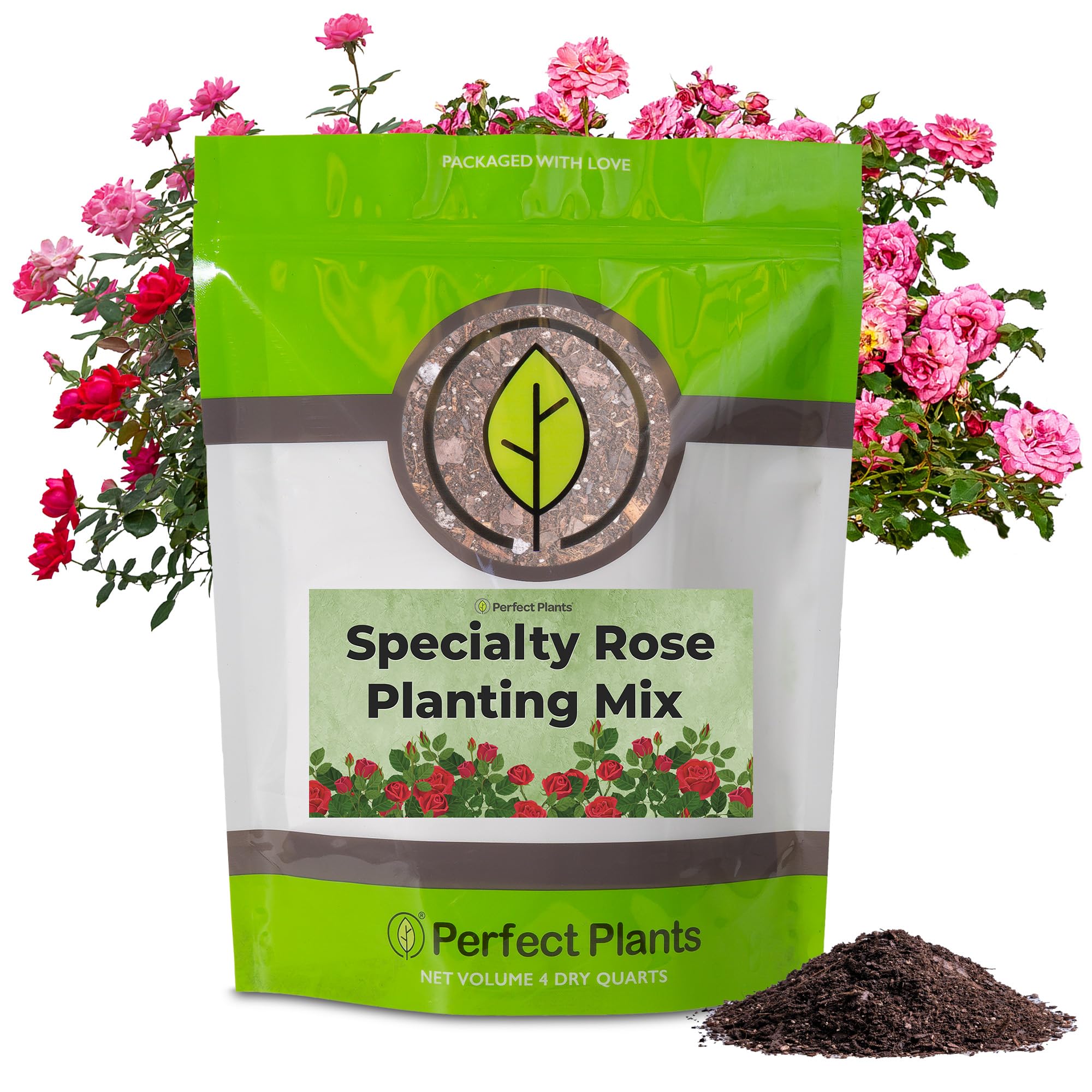
A 4-quart, pre-fertilized blend that feeds your rose for a full year without extra effort.
This mix from Perfect Plants hits the balance between the giant Coast of Maine bag and the tiny Omitgoter pouch. At 4 Quarts (128 Ounce), you have enough for two or three medium pots or a single large patio container — and the heavy-duty resealable bag keeps the leftover fresh for later. What really separates it is the 18-6-8 slow-release granular fertilizer already blended in. Each time you water, those granules dissolve gradually over a full year, so you do not have to remember a feeding schedule for the first twelve months.
Buyers confirm the results. One reviewer noted, “I repotted two store bought mini roses using this soil and it worked beautifully. My pink minis are thriving.” Others note their “rose bushes love this soil” with new buds and flowers appearing soon after transplanting. The texture uses composted pine bark and sand to keep the mix loose and well-drained, which is the same drainage-first approach the Omitgoter soil uses, but the nutrient punch here is much stronger.
The only thing to watch: if you are a heavy fertilizer user on your own schedule, the built-in 18-6-8 release might overlap with your own additions, so you might want to ease back on your usual feed for the first year.
The winning features
- Built-in 18-6-8 slow-release fertilizer that feeds for 12 months
- Sand and pine bark chunks for superior drainage and aeration
- Resealable heavy-duty bag in 4-quart and 8-quart sizes
A small caution
- Not ideal if you already have a separate fertilizer regimen — nutrient overlap is possible
- Size is 4 quarts, so it is not the right volume for a large garden bed
Your best middle-ground pick: This is the go-to for any mid-sized pot or a small cluster of containers where you want low-maintenance feeding for the first year.
Not for large beds: If you are planting a full row of Knockouts in the ground, grab the Coast of Maine bag instead and buy your own rose food separately.
3. Rose Soil Potting Mix by Omitgoter (2 Qt)
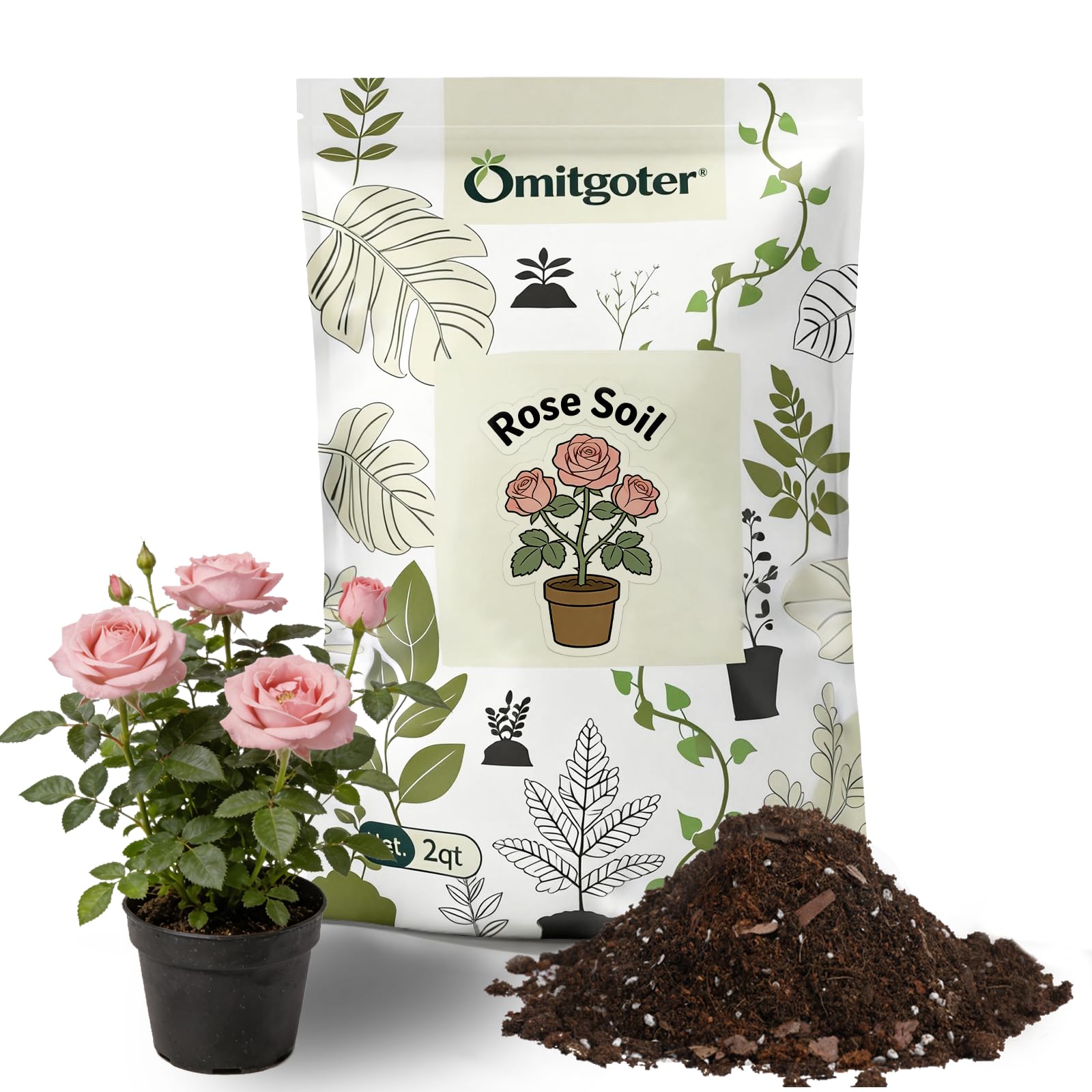
A small, 100-percent-natural bag for repotting a single rose without any chemical additives.
This is the soil you reach for when you have one miniature rose that looks sad in its pot or a stunted plant that needs better drainage fast. The bag holds just 2 Quarts (64 Ounce), which is one-tenth the volume of the Coast of Maine bag — but for a single small pot, that is exactly enough. It uses a 100% natural organic formula of peat, coconut coir, perlite, bark, and humus with no chemical additives at all. The loose structure is built specifically to prevent waterlogging and root rot.
One real-world review proves this works on a small scale. A buyer described a stunted rose that was not thriving: “Small quart bag but sufficient for enriching soil and improving drainage for a stunted rose; plant revived with new leaves and a bud in late June.” Other buyers call it “easy to use” and “not heavy.” It is also ready to go straight from the bag — no mixing required.
The honest downside is that the volume disappears fast if you are doing more than one pot. A reviewer who wished the bag was bigger echoes a common sentiment. And unlike the Perfect Plants mix, this one does not include a slow-release fertilizer, so you will need to supplement nutrients yourself within a couple of months for the best bloom growth.
Why reach for it
- 100% natural ingredients — peat, coir, perlite, bark, humus — with no chemical additives
- Excellent drainage and aeration designed specifically to prevent root rot
- Ready to use right out of the bag; beginner-friendly
Where it falls short
- Only 2 quarts — you will run out fast if you have more than one pot to fill
- No slow-release fertilizer added, so plan to feed your rose separately within a few months
Ideal for single pots and quick fixes: Buy this when you need to repot one store-bought miniature rose or fix drainage for a struggling container plant.
Look elsewhere if: You want a bigger bag or a pre-fed mix — the Perfect Plants 4-quart gives you more value and the built-in nutrients for similar money.
Understanding the Specs
Bag Volume (Quarts)
This is the simplest way to compare soils because it tells you exactly how much space you can fill. Two quarts handles one medium pot. Four quarts covers about two or three pots. Twenty quarts is enough for a whole flower bed or several large containers. Always check the volume before you start digging — running out mid-project means a trip back to the store.
Slow-Release Fertilizer (NPK Numbers)
The three numbers on a fertilizer label stand for nitrogen (N), phosphorus (P), and potassium (K). A mix labeled 18-6-8 contains a high first number for green leaf growth, a middle number for root and bloom support, and a third number for overall plant health. An 18-6-8 slow-release formula feeds the rose gradually over about 12 months — ideal for new plantings. Soils without this listing need you to add your own rose food.
FAQ
Can I use regular potting soil instead of a rose-specific mix?
How much soil do I need for one rose bush?
Should I choose a mix with slow-release fertilizer already added?
What is the difference between organic and non-organic rose soil?
Why does my new rose soil have a strong smell?
Can I use rose planting soil for other flowers or perennials?
How often should I replace the soil in my rose pots?
What does OMRI listed mean on a bag of soil?
Final Thoughts: The Verdict
For the majority of shoppers, the best planting soil for roses winner is the Coast of Maine because its 20-quart organic bag gives you enough soil for a full bed or multiple containers without needing to buy a second bag. If you want a mid-sized pot mix with built-in slow-release feeding for a full year, grab the Specialty Rose Mix by Perfect Plants. And for a single pot fix or a small bag of 100-percent-natural soil, the Rose Soil by Omitgoter is your quick and easy option.
How We Picked
We do not accept paid placement. Every pick is matched to a real buyer and a real use-case; we do not hands-on test units.
Sources & Methodology
Specifications: manufacturer listings and product documentation. Review insights: verified customer reviews, as of July 2026. Pricing: not shown on this page (it changes often); check the current price via the retailer link.
As an Amazon Associate, Lawn Gear Lab earns from qualifying purchases. This does not affect which products we feature.