
Specs are compiled from manufacturer listings and verified buyer reviews and can change over time — please confirm the key details on the product page before buying.
The central problem with a vegetable garden is that the bugs eating your tomatoes and peppers are also the bugs that should not touch anything you plan to harvest tomorrow. You need something that kills the caterpillars, aphids, and mites on contact, yet does not leave a toxic residue on your lettuce or basil. That narrows the field fast — a general-purpose fogger or synthetic powder might nuke everything, including the pollinators your squash plants depend on. The six picks here are all labeled for use on edible vegetables and fruits, and each takes a different approach to the trade-off between stopping an active infestation and keeping your harvest safe to eat.
I’m Rikta — the founder and writer behind Lawn Gear Lab. This guide is built by comparing the manufacturers’ published specifications and the patterns across verified customer reviews, so you get each pick’s real strengths and trade-offs instead of marketing spin.
What follows are six specific products that form the shortlist of bug spray for vegetable garden — each chosen because the raw data confirms it is labeled for edible crops and has enough verified buyer feedback to show you what actually happens in a real garden.
Our Picks at a Glance

How To Choose The Best Bug Spray For Vegetable Garden
Before you grab a bottle off the shelf, pause on the active ingredient. That single compound decides what bugs die, what bugs survive, and how long you have to wait before you can pick a ripe tomato.
Match the active ingredient to the pest
If caterpillars and worms are eating your broccoli leaves, you want Bacillus Thuringiensis (Bt) — a bacterium that targets only leaf-chewing larvae and leaves bees alone. If aphids, spider mites, or whiteflies are the problem, a neem-oil-based spray or a spinosad concentrate works by smothering or poisoning on contact. A single spray labeled “fungicide, insecticide, and miticide” can handle multiple problems at once, but that wide coverage also means you need to read the application timing carefully so you do not hit blooms when bees are active.
Contact kill versus stomach poison
A contact killer (like neem oil or spinosad) must hit the insect directly to work — once the spray dries, it stops being effective against new bugs that crawl onto the leaf later. A stomach poison (like Bt) must be eaten by the caterpillar, which then stops feeding and dies over a day or two. Stomach poisons last longer on the leaf but need the pest to actually bite the plant. Choose contact killers for an active, visible infestation; choose stomach poisons for prevention and for worms that hide inside rolled leaves.
Residue and pre-harvest interval
Every vegetable-label spray has a pre-harvest interval (PHI) — the minimum number of days you must wait between the last spray and picking the crop. OMRI-listed organic sprays often have shorter PHIs, but the raw data for these products does not always list the exact PHI, so check the label on the bottle when it arrives. If you are harvesting leafy greens every few days, a dust or a ready-to-use spray with a very short PHI (often 0-1 day) is safer than a concentrate that takes longer to break down.
Quick Comparison
| Model | Best For | Active Ingredient | Liquid Volume | Form | Amazon |
|---|---|---|---|---|---|
| Garden Safe Fungicide3★ Best Overall | All-in-one fungus + insect control | Neem Oil Extract | 128 fl oz | Ready-to-spray liquid | Amazon |
| Ortho Insect Killer DustBest Value | Long-lasting contact dust | — | 1.75 lb | Dust | Amazon |
| Monterey Spinosad | Organic fast-acting concentrate | Spinosad | 8 fl oz | Concentrate | Amazon |
| Monterey Bt (16 oz) | Targeted caterpillar & worm control | Bacillus Thuringiensis | 16 fl oz | Concentrate | Amazon |
| Organic Insecticide & Fungicide | Concentrate for small gardens | — | 16 fl oz | Concentrate | Amazon |
| Bee Safe 3-in-1 Garden Spray | Bee-safe soft body bug control | Dense oils | 1 count | Ready-to-use spray | Amazon |
In‑Depth Reviews
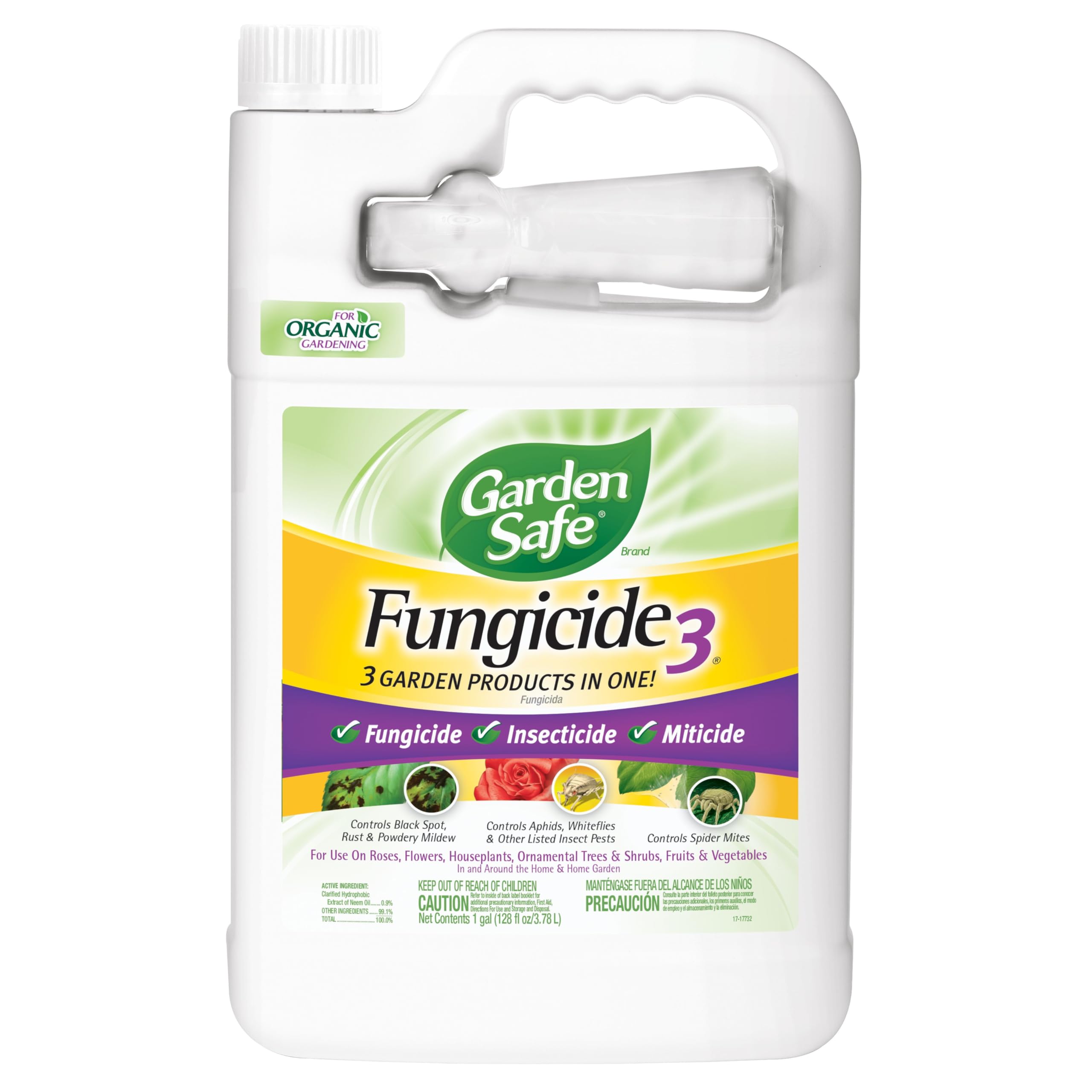
1. Garden Safe Brand Fungicide3, 1 Gallon
Our pick — over 4★ from 800+ verified ratings; the strongest balance of quality and price.
Three garden products in one bottle that handles fungus, aphids, and spider mites.
This gallon jug with an attached sprayer is the easiest all-in-one option for a vegetable garden that has multiple problems at once. It is a fungicide, insecticide, and miticide all in one — the active ingredient is clarified hydrophobic extract of neem oil. Buyers report it “works too well; use less than half recommended dose, avoid daytime use” because the oil can burn leaves if applied in full sun. The liquid volume is 128 fluid ounces, which is a full gallon ready to spray with no mixing — in contrast to the Monterey products that arrive as concentrates you must dilute.
The sprayer attachment drew complaints: one reviewer called it a “dumb design” with only about 4 inches of tube reaching the plant. If you have raised beds or tall tomatoes, you may want to decant the liquid into your own sprayer. For mildew on tomatoes and blueberries, owners mention weekly use eliminates the problem and boosts foliage growth, though it will not heal leaves that already show damage.
Unlike the Ortho dust that lasts up to 8 months on the plant, this spray works on contact and needs reapplying — but it also prevents fungal attack of plant tissues, which the dust cannot do. For a gardener fighting both powdery mildew and aphids on the same plants, this is the one-stop pick.
The defining edge: the only pick here that combines fungicide, insecticide, and miticide in a ready-to-spray gallon — no mixing, no second bottle for mildew.
The honest limit: the short sprayer tube is a real annoyance on taller plants, and the neem oil can burn leaves if you spray in direct sun.
Reach for it if: you have both insect pests and fungal diseases (black spot, rust, powdery mildew) on the same tomatoes, roses, or squash — it covers both in one pass.
Look elsewhere if: you need a product that specifically targets only caterpillars without affecting beneficial insects, or you hate fighting with a poorly designed sprayer wand.
2. Ortho Insect Killer Flower and Vegetable Garden Dust
A dust that kills cucumber beetles on contact and stays active for months.
This 1.75-pound container of dust is the opposite of a liquid spray — you puff a thin film onto the upper and lower leaf surfaces, and it keeps killing insects for up to 8 months. One reviewer noted it “killed cucumber beetles instantly; no beetles seen since” after a single application. The coverage claim is up to 1,300 square feet on vegetable gardens, which covers a large home plot. The dust settles quickly, and the label advises waiting for it to settle before reentering the area.
Unlike the Garden Safe spray that hits fungus and insects together, this dust is strictly an insect killer — it targets aphids, whiteflies, cabbage loopers, and the other listed pests but does nothing for powdery mildew. Buyers notice a “big improvement” on tomato plants, with leaf and fruit nibbling stopping immediately. The dust lasts through rain better than a liquid spray, though a heavy rain will require reapplication. Reviewers recommend applying at night to protect bees, and one noted the bees returned after 2 days.
The dust form makes it tricky to use on a windy day — one reviewer specifically warned to avoid windy application to prevent getting it on yourself. But for a gardener who wants a single treatment that keeps working for months, this is the most low-maintenance option on the list.
Why it stands out
- Kills on contact and lasts up to 8 months — far longer than any liquid spray.
- Covers up to 1,300 sq ft on vegetables and up to 3,500 sq ft on ornamentals.
- Saved one buyer’s entire tomatillo crop from flea beetles within 12 hours.
The catch to know
- Must be applied in calm weather — the dust drifts easily.
- Only kills insects, not fungus; you still need a separate fungicide for mildew.
Best if you want one and done: a single dust application that keeps working for up to 8 months, ideal for gardeners who do not want to mix and spray every week.
skip it if: you garden in a consistently windy area, or you need a product that also controls fungal diseases on your vegetables.
3. Monterey – Spinosad Insecticide – Garden Insect Spray Concentrate
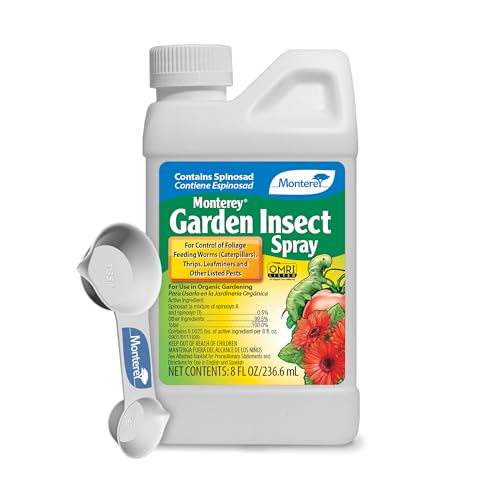
An organic concentrate that kills caterpillars, leafminers, and even fire ants fast.
This 8-ounce bottle of concentrate treats a wide range of insects — caterpillars, leafminers, codling moths, tent caterpillars, gypsy moths, thrips, borers, and fire ants — and it is OMRI Listed for organic gardening. The active ingredient is spinosad, a naturally occurring bacteria that rapidly treats plants and produces no odor. One buyer mentioned it was “effective on harvester ants despite being labeled for fire ants,” showing the spectrum stretches beyond what is on the label. Unlike the Bt products that only work on caterpillars, this one kills a much wider set of pests.
The concentrate format means you mix it with water in a trigger sprayer, hand-held, backpack, or hose-end sprayer. The small 8-fluid-ounce bottle may seem expensive next to the 128-ounce Garden Safe jug, but the concentrate makes many gallons of finished spray — a little goes a long way. Customers note the smell is “bearable” and several call it effective as a preventative spray, not just for active infestations. One buyer who used it on roses plagued with sawfly caterpillars said it “works great.”
The honest trade-off is that spinosad is a broad-spectrum insecticide that can harm beneficial insects if you spray during bloom when bees are foraging. Buyers explicitly warn to follow instructions carefully to avoid harming pollinators.
Signature strength: kills caterpillars, leafminers, thrips, borers, fire ants, and more — the widest pest range of any organic option here.
Watch for: small 8-ounce concentrate bottle; you must mix each batch yourself, and broad-spectrum means you need to time applications away from bee activity.
Choose this for: a vegetable garden hit by multiple insect types — caterpillars, leafminers, and even ants — where you want an organic active ingredient that works fast and smells minimal.
Pass if: you already have a fungus problem on your vegetables (this is insecticide only) or you prefer a ready-to-spray product you can use straight from the bottle.
4. Monterey BT – Bacillus Thuringiensis for Organic Worm and Caterpillar Control

A targeted caterpillar killer that leaves bees, earthworms, and ladybugs alone.
This is the most precisely targeted spray in the lineup: Bacillus Thuringiensis (Bt) is a bacterium that only works against caterpillars and worm-type insects — cabbage looper, bagworm, gypsy moth, fall cankerworm, elm spanworm — and has zero effect on birds, earthworms, honeybees, or ladybugs when used as directed. One buyer confirmed: “After spraying my tomatoes following the directions on the bottle, two days later I found several caterpillars dead.” The 16-fluid-ounce concentrate mixes with water and goes a long way, covering broccoli, celery, cabbage, turnip greens, melons, lettuce, tomatoes, and many ornamentals.
Because Bt is a stomach poison, the caterpillar must eat it to die, so you need to spray the leaves the caterpillars are actively chewing. Reviewers point out that Bt “does not have a long life” and breaks down in sunlight, so they mix only what they can use in one night and apply in the late evening when moths are active. This is the opposite of the Ortho dust that lasts 8 months — you are trading persistence for ultra-specific targeting. One reviewer combined it with net bags to control pickleworm damage on squash.
It is OMRI Listed for organic gardening, and the label explicitly lists the crops it is safe for, which includes the most common home-garden vegetables.
What makes it different
- Zero harm to bees, earthworms, ladybugs, or birds — the safest pick for a pollinator garden.
- Instant mixing with water; the 16-ounce concentrate stretches over many spray sessions.
- Shoppers say seeing dead caterpillars on leaves within two days of spraying.
Its real limitations
- Only kills caterpillars and worms — does nothing for aphids, mites, whiteflies, or fungus.
- Breaks down in sunlight; you must spray in the evening and use the whole mix in one night.
Perfect for: a garden where caterpillars and cabbage loopers are the main pest and you keep honeybees or want zero collateral damage to beneficial insects.
Not for: gardens with aphids, spider mites, whiteflies, or fungal disease — this product cannot touch those pests.
5. Organic Insecticide & Fungicide for Plants — Indoor/Outdoor Protection

A dual-purpose concentrate that knocks out both insects and fungus with one mix.
This 16-ounce concentrate from Evergreen Way Inc is designed as two separate products in one box — an insecticide concentrate and a fungicide concentrate that you mix with water. The manufacturer says to use 2 tablespoons per gallon for the insecticide and 1 tablespoon per gallon for the fungicide, each yielding about 8 gallons of finished spray. One owner reported it “killed insects within seconds!” when they used 10 drops in 32 ounces of water. The formula targets mites, aphids, whiteflies, thrips, and fungus gnats, and suppresses powdery growths on vegetables, herbs, ornamentals, and lawns.
Unlike the single-ingredient Monterey Bt, this is a broad-spectrum insecticide and fungicide in one — but the catch is that it does not kill Japanese beetles, as one customer observed. Another buyer found the insecticide eliminated aphids and caterpillars on raised beds and a vertical planter, and said the fungicide improved leaf lushness without causing leaf burn. The product is odorless, which is a plus for indoor use or if you spray near a patio where you sit.
Reviewers loved it for fungus gnats in houseplants: one user highlighted a single soaking eliminated a severe gnat problem, and weekly soaks kept the plants gnat-free. The concentrate yields multiple refills, making it economical for a small garden that needs both insect and fungal control.
The combo advantage: two concentrates (insecticide and fungicide) in one package, so you mix only what you need for the pest you have — no second bottle to buy.
The honest catch: ineffective against Japanese beetles, and the fungicide has a stronger smell than the insecticide, according to reviewers.
Pick this if: your vegetable garden has both insect pests and mildew or powdery fungus, and you want an odorless, bio-based concentrate that does not burn leaves.
pass on it if: you are fighting Japanese beetles specifically, or you need a product that is safe to use right up to harvest day (the PHI is not listed in the data).
6. Bee Safe 3-in-1 Garden Spray

An OMRI-listed insecticide, fungicide, and miticide that can be sprayed right up to harvest.
This spray is designed around one non-negotiable priority: not harming bees. It is OMRI Listed, acts as an insecticide, fungicide, and miticide all in one, and the label says it can be sprayed at harvest time — a major advantage if you pick tomatoes and peppers daily. The active approach is suffocation: the dense oils kill the eggs, larvae, nymphs, and adults of over 25 small soft-bodied insects and mites, plus fungal diseases like powdery mildew, by contact. One buyer who keeps a honeybee hive in the backyard reported “not a single bee was harmed and this product killed all the unwanted pests eating my tomato leaves.”
Unlike the Garden Safe neem oil spray, which burned plants when used at full strength in daytime, this product is designed to be sprayed either early in the morning or late in the evening, avoiding full sun. Another reviewer said it “works on aphids and some flies along with soft body bugs” after two applications. The single-count bottle is ready to use from the start — no mixing, no measuring. That convenience makes it a strong choice for a small kitchen garden where you want to grab a bottle and walk out to the plants.
The honest limit is that because it kills by suffocation via dense oils, you need thorough coverage on both sides of the leaf, and heavy infestations may need more than one application. But for a gardener who wants absolute bee safety with the flexibility to spray right up to picking, this is the most reassuring option.
Its defining feature: OMRI listed and explicitly bee-safe in practice, verified by a reviewer who sprayed near a honeybee hive without losing a single bee.
The fine print: like all oil-based sprays, it works best when applied in the early morning or evening to avoid leaf burn in direct sun.
Grab this for: a vegetable garden 20 feet from a beehive, or for any gardener who harvests daily and needs a spray that can go right up to picking day.
Pass if: you have a big garden with tough-shelled beetles (this spray targets soft-bodied bugs) or you prefer a concentrate to minimize plastic bottles.
Understanding the Specs
Active Ingredient
This is the single compound that kills the bugs. Neem oil extract smothers insects and prevents fungal attacks. Spinosad is a naturally occurring bacteria that attacks the nervous system of caterpillars, leafminers, thrips, and ants. Bacillus Thuringiensis (Bt) is a bacterium that produces a protein only toxic to leaf-chewing larvae — it is harmless to bees, earthworms, and birds. Each ingredient targets a different set of pests, so match the ingredient to the bug you actually see.
Concentrate vs Ready-to-Spray
A concentrate (like the 8-ounce or 16-ounce bottles) must be mixed with water in a sprayer before use. It stores smaller and makes many gallons of finished spray. Ready-to-spray products (like the Garden Safe gallon jug) come pre-mixed and are convenient but bulkier. The Ortho dust is in a third category — a dry powder applied with a duster — and its advantage is that it lasts up to 8 months on the plant instead of washing off in the next rain.
OMRI Listing
The Organic Materials Review Institute (OMRI) reviews products to confirm they comply with the USDA’s National Organic Program (NOP) standards. An OMRI-listed spray is approved for use in certified organic gardens. The Monterey products (Spinosad, Bt 16 oz, Bt 32 oz) and the Bee Safe 3-in-1 are OMRI Listed. The Garden Safe Fungicide3 contains neem oil extract and is labeled “for organic gardening” but is not OMRI Listed in the data. This matters if you keep an organic-certified kitchen garden.
Pre-Harvest Interval (PHI)
The PHI is the number of days you must wait between the last spray and harvesting the crop. None of the product data here lists an exact PHI number, but the Bee Safe 3-in-1 is the only one whose label explicitly says “can be sprayed at harvest time,” suggesting a 0-day PHI. For the others, check the label on the bottle when it arrives. Leafy greens harvested every few days need a short PHI; fruit like tomatoes and peppers are more forgiving because you can wait a few days after spraying to pick.
FAQ
Can I spray bug spray on my vegetable garden the same day I harvest?
What is the difference between Bacillus Thuringiensis (Bt) and Spinosad?
Will neem oil spray burn my tomato plants?
Does the Ortho dust wash off in rain?
How do I apply a dust product without it drifting onto me?
Can I mix two different bug sprays together?
How long does Bt last on leaves after I spray?
Is organic bug spray safe for my dog or cat?
Will these sprays kill ladybugs or praying mantises?
How often should I spray my vegetable garden with bug spray?
Final Thoughts: The Verdict
For most buyers, the bug spray for vegetable garden winner is the Garden Safe Fungicide3 because it handles insects, mites, and fungus in one ready-to-spray gallon without mixing. If you want a long-lasting dust that you apply once and forget for months, grab the Ortho Insect Killer Dust. And for a garden with honeybees where you need absolute pollinator safety right up to harvest day, the standout is the Bee Safe 3-in-1 Garden Spray.
How We Picked
We do not accept paid placement. Every pick is matched to a real buyer and a real use-case; we do not hands-on test units.
Sources & Methodology
Specifications: manufacturer listings and product documentation. Review insights: verified customer reviews, as of July 2026. Pricing: not shown on this page (it changes often); check the current price via the retailer link.
As an Amazon Associate, Lawn Gear Lab earns from qualifying purchases. This does not affect which products we feature.