
Specs are compiled from manufacturer listings and verified buyer reviews and can change over time — please confirm the key details on the product page before buying.
You want heavy, sweet pods from your pea vines, and you choose a fertilizer so they get the right food. A bag with the wrong N-P-K ratio (the three numbers on the bag that stand for nitrogen, phosphorus, and potassium) leaves you with big leaves and empty pods. This guide helps you find the product that actually fills your bowl.
I’m Rikta — the founder and writer behind Lawn Gear Lab. This guide is built by comparing the manufacturers’ published specifications and the patterns across verified customer reviews, so you get each pick’s real strengths and trade-offs instead of marketing spin.
Every pick here was chosen for its pea-friendly balance and checked against hundreds of gardener experiences. Read on for the fertilizer for peas that actually delivers.
Our Picks at a Glance

How To Choose The Best Fertilizer For Peas
Peas are light feeders compared to tomatoes or corn, but they still need the right balance of nutrients to produce full pods. Here is what to look for.
Read the N-P-K Ratio
The three numbers on a fertilizer label stand for nitrogen (N), phosphorus (P), and potassium (K). Peas need moderate nitrogen — too much makes bushy leaves but few pods. Look for a balanced or slightly lower-first number like 5-5-5 or 8-8-8. A ratio like 2-7-4 is also great because it supplies the phosphorus peas need for flowering and pod set.
Choose the Right Form
Fertilizer comes as spikes, granules, powders, or liquids. Spikes are set-and-forget — you push them into the soil and they release food slowly over weeks. Granules need mixing into the top layer of soil. Powders and liquids mix with water for a quick feed, which is handy if you want to give a mid-season boost.
Check for Organic Certification
If you are growing peas for a chemical-free kitchen, look for an OMRI listed (Organic Materials Review Institute) product. This seal means the fertilizer is approved for organic food production. Many organic options also avoid chicken manure and sewage sludge, keeping your soil clean.
Quick Comparison
| Model | Best For | N-P-K Ratio | Form | Item Weight | Amazon |
|---|---|---|---|---|---|
| Organic Fertilizer Vegetable Spikes★ Best Overall | Best Overall | 2-7-4 | Spikes | 8.82 Ounces | Amazon |
| Dr. Earth 5-5-5 All Purpose Fertilizer | Premium Pick | 5-5-5 | Powder | 1 lb | Amazon |
| Bloom City Tomato & Veggie Plant Food | Best Liquid | 2 oz/gallon | Liquid | 32 Ounces | Amazon |
| Purely Organic Triple Play 8-8-8 | Budget Champion | 8-8-8 | Granules | 2.3 Pounds | Amazon |
In‑Depth Reviews
1. Organic Fertilizer Vegetable Spikes
Our pick — over 4.5★ from 350+ verified ratings; the strongest balance of quality and price.
A pre-measured stake that feeds your peas for the whole season in one step.
These spikes aim to boost flowers and pods, not leaves, done with a 2-7-4 formula. The first number (nitrogen) stays low at 2 to avoid making the plant go leafy instead of productive. The higher phosphorus (7) and potassium (4) support flowering and pod fill, so you get more peas per vine. Each spike is designed to feed for 8 weeks — you push them in at planting and you’re done. Because they are OMRI listed (certified for organic food production), you can use them in a chemical-free kitchen garden.
Compared to the bagged granular picks, the 50-count pack has 50.0 individual feeding points versus a single bag — better for spacing along a long row. Reviewers report the product “resulted in massive pea yield and 100% seed germination, unlike previous attempts.” One gardener in a short Montana season said the spikes boosted vegetable growth, which matters when your growing window is tight.
Why the spikes work
- Pre-measured 2-7-4 ratio is nearly perfect for pea pod set — it feeds flowers, not just leaves
- Omri listed (organic certified) for clean kitchen gardens
- Lasts 8 weeks per spike, which covers the entire pea growth cycle
- Comes in a 50-pack, enough for a whole row or raised bed
Things to watch
- At 8.82 ounces total weight, the bag is small — but each spike is concentrated
- Must be pushed into moist soil to start dissolving; dry soil slows release
Best for: Any gardener who wants a simple, one-time feeding for their peas that keeps working all season.
Consider another if: You prefer to mix your own feed each week or you are growing in containers where a liquid feed is easier to control.
2. Dr. Earth 91164 1 lb. 5-5-5 MINIS Life All Purpose Fertilizer
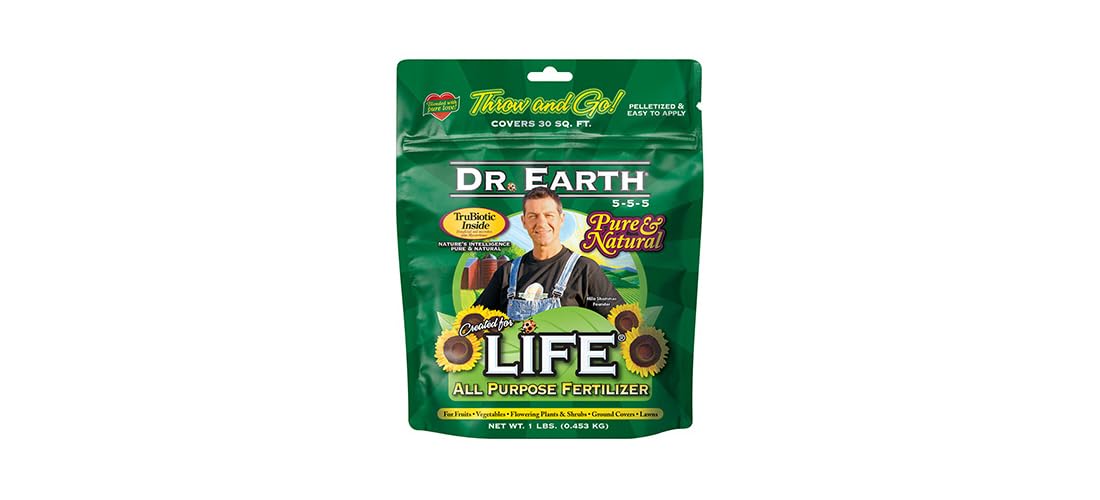
A balanced 5-5-5 powder the manufacturer says is safe for seedlings and carries peas to harvest.
This powder mixes into the top few inches of soil before planting or gets scattered as a side-dress mid-season. The brand guarantees it contains no GMOs, no chicken manure, and no sewage sludge (which they call “bio solids”). That makes it a clean option for an organic garden, though the 1 lb bag means you might need multiple boxes for a large plot — unlike the 2.3 lb Purely Organic granules below. Reviewers praise the time-release effect that helps growth without burning roots, with a few noting it works on all their vegetables.
Strengths of this blend
- 100% organic and natural handcrafted blend with no synthetic additives
- Balanced 5-5-5 ratio is safe for peas at every growth stage
- Can be used on all fruits, vegetables, and flowering plants — one bag for the whole garden
- No GMOs, chicken manure, or sewage sludge keeps the soil clean
Possible drawbacks
- Powder form can be dusty to handle, and a bag hole can cause spillage
- At 1 lb, it is a smaller quantity than a granular bag — you may need multiple bags for a large pea patch
Choose this Dr. Earth powder if you want one bag that works on peas, flowers, shrubs, and lawns — it is more versatile than the spike-only pick. Skip it for a big pea row where you will want the 2.3 lb budget bag instead.
3. Bloom City Tomato & Veggie Plant Food – Liquid Fertilizer for Bigger Harvests, 32 oz

A liquid concentrate that feeds your peas instantly when you water.
You mix 2 oz per gallon of water and pour it straight onto the roots. Because it is water-soluble concentrate, the nutrients reach the plant right away — you do not wait for spikes to dissolve or granules to break down. This makes it a good rescue feed for pale leaves or slow growth, and it works easily in containers where spikes are hard to place. One reviewer noted it “made a huge difference” and another used it with a hose-end sprayer for a large tomato patch — which is how you would handle a big pea row. The trade-off is you must mix and reapply regularly; it is not set-and-forget.
Where it shines
- Liquid form gives immediate nutrient uptake — great for a quick rescue of yellowing pea vines
- Mixes easily in a watering can or hose-end sprayer for large areas
- Made in the USA with a simple application schedule (2 oz per gallon)
Considerations
- Requires mixing and regular application throughout the season — more work than spikes
- One reviewer saw “no noticeable difference” compared to their usual granule food, so results can vary
Reach for this liquid when your peas need a targeted mid-season rescue — not as a long-release option like the spikes. Choose the 2-7-4 spikes instead if you prefer a single, season-long feed.
4. 2.25lb Tomato & Vegetable Plant Food Fertilizer Triple Play 8-8-8 (Covers Up to 250 Square Feet)

A large bag of granules that covers 250 square feet for less than the smaller picks.
This is a 2.3 lb (36.0 oz) granular bag, at 2.3 lb versus the spikes at 8.82 oz for the same price range. The 8-8-8 ratio is higher in nitrogen than ideal for peas — the extra N can push leaf growth over pod production. You can counter this by using it at half the recommended rate, then adding a phosphorus booster if needed. The manufacturer uses a patented protein technology and claims “no chicken manure = no odor,” which is useful near a seating area. One buyer mentioned a “dramatic turnaround for droopy, yellow tomato plants” within weeks. For the budget-conscious, this gives the most coverage per dollar for a large raised bed.
Why it wins on value
- Large 2.3-pound bag covers 250 square feet — ideal for a big pea bed or entire vegetable garden
- Patented protein technology with no odor (no chicken manure)
- Reviews confirm it turns around weak, yellow plants quickly
Keep in mind
- 8-8-8 ratio is higher in nitrogen than ideal; use less on peas or pair with a phosphorus booster
- Granules need to be mixed into the top soil and watered in — more initial work than spikes
Choose this bag for a big pea bed on a budget, but accept the 8-8-8 ratio is not as pea-tuned as the 2-7-4 spikes. For perfect ratio precision, pick the spikes.
Understanding the Specs
N-P-K Ratio (the three numbers)
Every fertilizer label shows three numbers like 5-5-5 or 2-7-4. These stand for nitrogen (N), phosphorus (P), and potassium (K). Nitrogen makes leaves grow — peas need only a little. Phosphorus helps flowers form, which becomes pods. Potassium helps the plant fill those pods. For peas, a lower first number (2 or 5) and a balanced or higher second and third number (like 7-4 or 8-8) is the balance.
Form: Spikes vs. Granules vs. Liquid
Spikes are solid stakes you push into the ground. They dissolve slowly and feed for weeks with one action. Granules are dry pellets you scatter and mix into soil — they also release gradually but need to be watered in. Liquids are concentrates you mix with water and pour on. They feed instantly but require regular reapplication. Your choice depends on how much hands-on time you want.
FAQ
What N-P-K ratio is best for peas?
Can I use tomato fertilizer on my peas?
Should I use spikes, granules, or liquid for peas?
How often should I fertilize peas?
Is organic fertilizer worth it for peas?
Can I use a general all-purpose fertilizer on peas?
Will fertilizer spikes burn my pea roots?
How much fertilizer does a 100-square-foot pea bed need?
Can I make my own fertilizer for peas?
Should I fertilize peas at planting or after they flower?
Final Thoughts: The Verdict
Across the board, the fertilizer for peas winner is the Organic Fertilizer Vegetable Spikes because the 2-7-4 ratio is perfectly tuned for pea pod set, and the 50-pack of OMRI listed spikes makes feeding easy. If you want a versatile premium powder that works on your whole garden, grab the Dr. Earth 5-5-5. And for feeding a large pea bed on a budget, the standout is the Purely Organic Triple Play 8-8-8.
How We Picked
We do not accept paid placement. Every pick is matched to a real buyer and a real use-case; we do not hands-on test units.
Sources & Methodology
Specifications: manufacturer listings and product documentation. Review insights: verified customer reviews, as of July 2026. Pricing: not shown on this page (it changes often); check the current price via the retailer link.
As an Amazon Associate, Lawn Gear Lab earns from qualifying purchases. This does not affect which products we feature.