
Specs are compiled from manufacturer listings and verified buyer reviews and can change over time — please confirm the key details on the product page before buying.
Throwing grass seed onto bare dirt is a gamble. Birds feast on it, wind scatters it, and the next rain washes it into a puddle. The fix is a light blanket of mulch that locks moisture in and keeps the seed exactly where you put it until roots take hold. The right mulch for grass seed is clean, weed-free straw that lets sunlight and water through while shielding the soil from drying out.
I’m Rikta — the founder and writer behind Lawn Gear Lab. This guide is built by comparing the manufacturers’ published specifications and the patterns across verified customer reviews, so you get each pick’s real strengths and trade-offs instead of marketing spin.
Every option below was selected for how well it protects seed, retains moisture, and degrades naturally after the lawn fills in. This guide helps you find the right mulch for grass seed that fits your yard size, slope, and budget.
Our Picks at a Glance

How To Choose The Best Mulch For Grass Seed
Not all straw mulch works the same over a freshly seeded lawn. The key is picking one that holds moisture, resists wind, and decomposes before the new grass needs mowing.
Coverage and thickness
A thin layer — roughly ¼ inch thick for lawn seeding — is enough to shade the soil without blocking the grass shoots. One bale covering 500 sq. ft. at that depth will go much further than the same bale used at 2–3 inches for garden beds. Buy based on the square footage you actually need to cover.
Tackifier: the glue that holds it
A tackifier is a natural bonding agent mixed into the straw that makes the fibers stick together when dampened. This matters most on slopes or in spots hit by heavy rain, because the mat stays put instead of washing into a pile at the bottom of the yard.
Weed seed content
Straw from wheat fields often carries leftover wheat grains that sprout in your lawn. Look for products described as “processed” or “thoroughly cleaned” to reduce unwanted shoots. No product is 100% weed-free, but the best options remove most of the seed heads before bagging.
Quick Comparison
| Model | Best For | Coverage | Weight | Size | Amazon |
|---|---|---|---|---|---|
| HealthiStraw GardenStraw★ Best Overall | Gardens & medium lawns | Up to 600 sq. ft. at ¼” | 20 lbs | 3 cu ft | Amazon |
| EZ-Straw with TackifierAlso Great | Large, flat lawns & slopes | Up to 500 sq. ft. | 21 Pounds | 2.5 CU FT | Amazon |
| Seeding Straw with Tackifier | Protecting seed on hills | Up to 500 sq. ft. | — | 2.5 CU FT | Amazon |
| Blue Mountain Hay Organic Straw | Small beds & potted use | ~100 sq ft at 1 inch | 5 pounds | — | Amazon |
| Pennington Smart Patch | Bare spot repair in shade | 10 LB bag | 10 Pounds | — | Amazon |
| Natural Wheat Straw | Small patches & animal use | 1 LB bag | 1 pounds | — | Amazon |
| Jonathan Green SeedRoll Mat | Slopes & erosion spots | 50 Sq. Ft. | 1 Pounds | — | Amazon |
In‑Depth Reviews
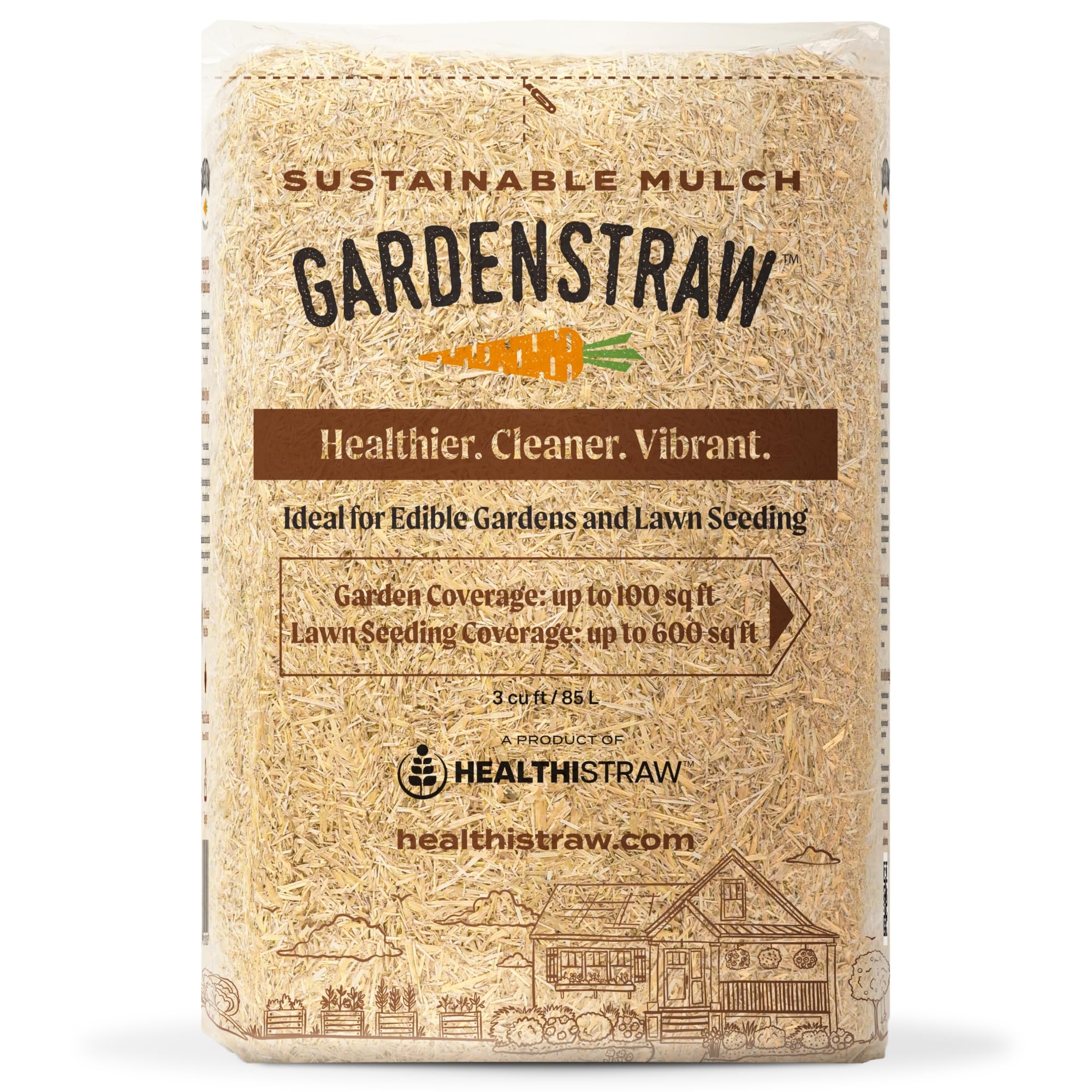
1. HealthiStraw GardenStraw
Our pick — over 4★ from 800+ verified ratings; the strongest balance of quality and price.
The largest bale on the list — 3 cu ft — that stretches further for both garden beds and lawn seeding.
That extra bulk matters if you have a large area to cover. For garden beds at a thicker 2–3 inch layer, it still covers up to 100 sq. ft.
Customers note that it keeps plants and flowers from drying out in heat, no wheat seed germination issues, and it looks better than dry dirt. The straw is sustainably sourced, non-GMO, and naturally filtered to remove dust and as much seed as possible. Without a chemical tackifier, the straw fibers interlock when watered — reviewers point out it stays in place well in normal conditions but may not hold as firmly on steep slopes as the tackifier options.
Clean, weed-free straw
- 3 cu ft bale covers up to 600 sq. ft. — best coverage per bale on this list
- Naturally filtered to remove wheat seeds — very low germination in reviews
- Adds carbon to compost when the straw breaks down
No tackifier added
- No tackifier — on steep slopes it may shift more than the glued options
- Some reviews note grass seeds still present, though far fewer than with hay
Seed beds: Someone covering both garden beds and a lawn seeding area with one single, clean bale of straw.
Steep hills: Your seeding site is on a noticeable incline where washout has been a problem before.
2. EZ-Straw Seeding Mulch with Tackifier
A processed straw bale with a built-in bonding agent that locks seed in place on slopes.
The standout feature here is the tackifier — a natural bonding agent mixed right into the straw that makes the fibers cling together once you dampen them. That mat action stops the mulch from sliding down a hill or piling up in a corner after a downpour. The bale covers up to 500 sq. ft. at a seeding thickness, and the straw is processed twice to remove most weed seeds. Buyers report that grass grew after 5 days, with full coverage in 10 days, which is noticeably faster than the loose-bale approach.
At 21 Pounds and 2.5 CU FT, this is a mid-weight option — heavier than a simple straw bag but still easy to carry. The straw is 99% weed free according to the maker, and the bag itself is UV-protected so you can store it outside between applications. Unlike loose straw that needs a separate tackifier spray, this one brings everything in one package.
Tackifier locks straw
- Built-in tackifier keeps straw matted on slopes and in wind
- Covers up to 500 sq. ft. from one 2.5 CU FT bale
- Processed straw is 99% weed free and biodegradable
Clumpy on slopes
- Reviews note it is messy to apply — expect loose fibers flying around
- Light raking or stepping is needed to bed it into the soil
Erosion control: Anyone reseeding a medium to large lawn, especially on a gentle slope where washout is a real risk.
Loose straw: You only need to patch a tiny 5×5 bare spot — a smaller bag would waste less material.
3. Seeding Straw with Tackifier

A tackifier-loaded straw bale that delivers the same coverage as the top pick with a higher rating.
Covers up to 500 sq. ft. from a 2.5 CU FT bale — identical volume to the EZ-Straw option above. The tackifier bonding agent works the same way: you water it in lightly and the fibers stick together, forming a protective blanket that shields seed from birds and heavy rain. Owners mention it keeps seed in place so it can grow easier, and one user specifically noted no seeds sprouting from the straw itself.
This product is 100% biodegradable, so after the grass fills in you just mow right over it — no cleanup needed. The maker states it is safe for pets and children, and the bale arrives compressed inside a box. Several reviewers were surprised by how much straw expands once opened, noting it was more than enough for their yard.
Lightweight straw blanket
- Strong 4.5 rating from 517 reviews — one of the best-rated on this list
- Tackifier holds the mat together during rain and wind
- Biodegradable — no removal needed after grass germinates
Needs extra water
- Box arrives tightly compressed — you need to fluff it by hand to spread evenly
- Higher price point than standard loose straw for the same volume
Dry climates: You want the highest-rated tackifier straw on the market and don’t mind paying a small premium for that confidence.
Wet areas: Budget is your main constraint — there are cheaper options that still deliver good results on flat ground.
4. Blue Mountain Hay Organic Garden Straw
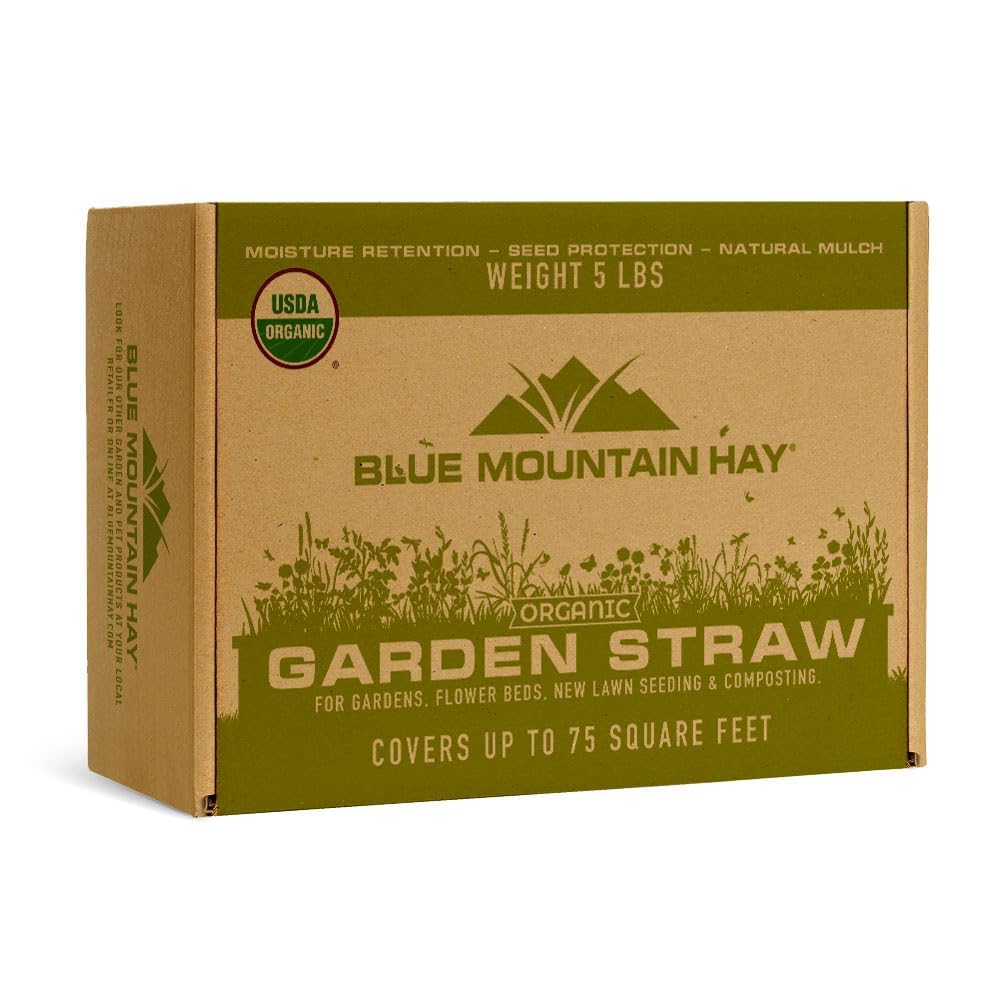
An organic, low-dust garden straw that is clean enough for raised beds and potted plants.
If you are seeding a small patch or covering vegetable beds alongside your lawn, this 5-pound box keeps things simple. The straw is naturally dried and minimally processed, so it arrives clean, soft, and free of dirt and bugs according to reviewers. Multiple owners praised it for being easy to spread by hand around individual plants and for keeping the soil moist without introducing weeds.
Compared to the larger bales above, the trade-off is coverage. Shoppers say the box equals roughly 1/3 of a full bale and covers around 100 sq ft at a 1-inch depth — not the 300 sq ft some expected. For a small lawn seeding patch or a set of raised garden beds, that is plenty. For a half-acre reseeding project, you would need multiple boxes, and the per-square-foot cost climbs fast.
Organic hay mulch
- Organic, pesticide-free, and very clean — minimal dust and no bugs reported
- Comes in a compact box for easy storage and handling
- Works well for cat grass, flower beds, and light lawn seed covering
May contain weed seeds
- One reviewer found grass seeds introduced into raised beds — not 100% weed-free
- Expensive per square foot compared to bulk bales for large lawns
Vegetable gardens: You are seeding a small area or need a clean organic straw for raised beds where chemical-free matters.
Lawn patches: Large lawn projects where a 20+ lb bale gives you much better value per square foot.
5. Pennington Smart Patch Dense Shade Grass Seed

A seed-mulch-fertilizer combo designed for dense shade spots that get almost no sun.
This is a different class of product — the mulch, seed, and starter fertilizer are blended together in a 10 LB bag so you just sprinkle it onto bare soil. The mulch contains a tackifier that acts like a blanket, protecting the seed from washing away on slopes. A smart touch: the mulch turns a lighter color when dry, telling you exactly when to water again.
The seed mix is Pennington’s Dense Shade formula, which is built for yards with virtually no sun. One buyer with a back yard that gets almost no direct light reported the seed germinated quickly and established a mowable lawn in a few weeks. However, the product does not work for everyone — some reviewers saw zero grass growth while the fertilizer patches stained the yard. The effectiveness seems highly dependent on soil preparation and consistent watering.
Dense shade seed
- All-in-one — no need to buy seed, mulch, and fertilizer separately
- Color-changing mulch tells you when to water
- Dense Shade formula works where other seeds struggle
Slow germination
- Mixed reviews — some buyers saw zero germination
- You cannot control the mulch thickness separately from the seed
Shady lawns: Anyone with a small, deeply shaded bare spot who wants a single-bag solution with no mixing needed.
Full sun: Gardeners who prefer to control seed type and mulch separately for better results.
6. Natural Wheat Straw

A 1-pound bag of clean sun-dried straw for tiny patches and animal bedding that doubles as seed cover.
At just 1 pounds, this bag is tiny — think about the size of a 17-inch laptop, as one reviewer described it. That makes it ideal for a single bare spot, a small herb garden, or covering a flower bed after seeding. The straw is vacuum-packed, so it stays clean and odor-free until you open it. Buyers report it is excellent for covering seeded land, protects from birds, and retains moisture effectively.
The big caveat is value. At this size, the per-pound cost is much higher than a bulk bale. Several reviewers mention it is overpriced for the volume and will blow away in strong wind if not bedded in. It also weighs 1 pound versus the 21 pounds of the EZ-Straw bale — so for any project larger than a few square feet you will need multiple bags, and the cost adds up fast. Use this for precision patching, not whole-lawn work.
Pure wheat straw
- Very clean, dry straw with no chemicals — safe for pets and animals
- Vacuum packaging keeps it fresh and dust-free
- Easy to store in a closet or garage shelf
Blows away easily
- Extremely small — 1 pound covers a very limited area
- Per-pound cost is high compared to bulk bales
- May blow away in wind without a tackifier or heavier cover
Mulching beds: A single small patch, a container garden, or as backup animal bedding that also works as seed cover.
Windy sites: You are covering more than a few square feet of lawn — buy a larger bale instead and save money.
7. Jonathan Green Black Beauty SeedRoll

A biodegradable grass-seed mat that unrolls like carpet for instant erosion control on slopes.
Instead of loose straw, this is a pre-made mat containing Black Beauty Ultra grass seed, starter fertilizer, and mulch all bonded together. You unroll it over prepared soil, cut it with scissors to fit, water frequently, and the mat holds everything in place. The grass types are tall fescue, perennial rye, and Kentucky bluegrass — a cool-season blend that germinates in 10–20 days. The best time to apply is mid-August to mid-October or mid-March through mid-May.
The mat hides seed from birds and warms the soil underneath while letting light and water through. However, the 3.2 rating from 183 reviews tells a mixed story. Some owners mention it worked well on hillsides, but many report the mat did not decompose as expected and nothing grew underneath it. One reviewer described it as “an icky mess” that ripped into pieces across the yard. Success depends heavily on keeping the mat consistently moist — if it dries out even once, the seed beneath may fail.
Seed roll convenience
- Perfect for steep slopes where loose straw slides off
- Includes seed, fertilizer, and mulch — unroll and water
- Biodegradable — no cleanup required if it breaks down properly
Expensive per roll
- Low rating — many customers note the mat fails to decompose or germinate
- Only 50 sq. ft. of coverage — expensive per square foot
- Requires very consistent watering twice a day to succeed
Small patches: A tricky hillside patch where loose mulch will not stay and you are willing to water religiously.
Large areas: Large flat areas — loose straw or a tackifier bale covers more ground for less money with higher reliability.
Understanding the Specs
Tackifier
A tackifier is a natural bonding agent added to straw that makes the fibers stick together when you water them. Think of it as a light glue that turns loose straw into a protective mat. This is essential on slopes and in windy areas because the mat stays put instead of washing into a pile or blowing into the neighbor’s yard.
Coverage at seeding depth
For grass seed, you want a thin ¼-inch layer of mulch — just enough to shade the soil and retain moisture without blocking the grass shoots. A 2.5 CU FT bale at this depth covers about 500 sq. ft., while a 3 cu ft bale stretches to about 600 sq. ft. Always calculate your yard’s square footage before buying to avoid running short or overpaying for excess.
Weed-free vs. seed-free
Wheat straw comes from the stalks left after harvesting wheat grain. The grain heads often contain leftover wheat seeds that can sprout in your lawn. “Weed-free” usually means the straw has no invasive weed seeds, but wheat seeds may still be present. “Processed” or “thoroughly cleaned” straw has gone through extra steps to shake out most of those grain seeds, giving you a cleaner blanket for your grass seed.
Biodegradable mulch
All wheat straw mulch is biodegradable — it breaks down naturally into the soil over weeks to months. For lawn seeding, that means you do not need to remove it after the grass grows. Just mow over it. The straw adds organic matter back to the soil as it decomposes, improving soil structure over time. Avoid treated or dyed straw for lawn seed, as chemicals can slow germination.
FAQ
Can I use any straw mulch for grass seed?
How thick should I spread mulch over grass seed?
Does straw mulch prevent birds from eating grass seed?
Will straw with a tackifier wash away in heavy rain?
How long does it take for straw mulch to biodegrade?
Can I mow over straw after the grass grows?
What is the difference between straw and hay for lawn seeding?
How much straw do I need for a 1,000 sq. ft. lawn?
Does straw mulch attract pests or mold?
Can I use straw from a farm bale instead of a bagged product?
Final Thoughts: The Verdict
Across the board, the mulch for grass seed winner is the EZ-Straw Seeding Mulch with Tackifier because it combines a 21-pound bale, a built-in bonding agent (a tackifier that glues straw to soil), and 500 sq. ft. of coverage into one reliable package that keeps seed in place on flat ground and slopes alike. If you want maximum coverage from a single bale, grab the HealthiStraw GardenStraw — its 3 cu ft size covers up to 600 sq. ft. for lawn seeding. And for tricky hillside patches, the Seeding Straw with Tackifier holds the highest rating on this list at 4.5 out of 5 stars, making it the top choice for slopes where the EZ-Straw might slip.
How We Picked
We do not accept paid placement. Every pick is matched to a real buyer and a real use-case; we do not hands-on test units.
Sources & Methodology
Specifications: manufacturer listings and product documentation. Review insights: verified customer reviews, as of July 2026. Pricing: not shown on this page (it changes often); check the current price via the retailer link.
As an Amazon Associate, Lawn Gear Lab earns from qualifying purchases. This does not affect which products we feature.