
Specs are compiled from manufacturer listings and verified buyer reviews and can change over time — please confirm the key details on the product page before buying.
Planting carrots by hand means hours hunched over the soil, fumbling tiny seeds, and hoping you didn’t drop them in a clump. A good seed planter turns that back-breaking chore into a walk in the park, dropping each seed at the right depth and spacing so you get straight rows and fewer thin spots to replant later.
This guide is built by comparing the manufacturers’ published specifications and the patterns across verified customer reviews, so you get each pick’s real strengths and trade-offs instead of marketing spin.
Here is what matters most for a carrot seed planter: the seed plate system must handle tiny carrot seeds reliably, or you will waste hours resetting and resowing by hand — and the frame needs to be tough enough to push through prepared soil without flexing apart.
Our Picks at a Glance

How To Choose The Best Carrot Seed Planter
Carrot seeds are among the smallest and lightest in the vegetable garden, so a general purpose seeder often fails them. You need a machine designed to pick up a single tiny seed at a time and drop it at a consistent depth.
Seed Plate Versatility vs. Precision
Most planters come with interchangeable seed plates (discs with different hole sizes). A plate that works for corn or beans is usually too big for carrots — the seeds either slip through in clumps or don’t get picked up at all. The best carrot seed planter offers a plate specifically calibrated for tiny seeds, and ideally lets you test the drop on a table before heading to the garden.
Frame Durability and Weight
A lightweight aluminum frame is easier to push and carries just fine over soft, well-tilled soil. Heavier steel frames (often powder-coated) are more durable season after season but require more muscle to push and create deeper furrows that may not suit shallow carrot beds. The choice depends on your soil type and how much strength you want to use.
Ease of Seed Change and Cleaning
Carrot planters that require tools (wrenches, sockets, screwdrivers) to swap seed plates or clear a jam quickly become frustrating mid-row. Look for a design where you can pop the plate out and rinse the hopper without disassembling half the machine — especially if you switch between different seed types in the same session.
Quick Comparison
| Model | Best For | Weight | Seed Plates | Frame Material | Amazon |
|---|---|---|---|---|---|
| EarthWay 10001★ Best Overall | Large-scale bulk seed planting | 2.49 lbs | 6 plates (38 seed types) | Aluminum / Poly Hopper | Amazon |
| Chapin 8701G | Multi-crop versatility on a steel frame | 18.76 lbs | 6 plates (20 seed types) | Powder-Coated Steel | Amazon |
| Chapin 8701B | Proven reliability and broad seed range | 14.4 lbs | 6 plates (20+ seed types) | Powder-Coated Steel | Amazon |
| Varomorus Precision Seeder | Budget-friendly metal build | 2.49 lbs | Rotating drum / nozzles | Stamped Steel | Amazon |
In‑Depth Reviews
1. EarthWay Products 10001 Precision Garden Seeder
Our pick — over 4★ from 2,000+ verified ratings; the strongest balance of quality and price.
The lightweight champ that plants 500 feet of seeds in under 10 minutes.
Thanks to its exceptionally light aluminum frame (just 2.49 pounds), the EarthWay 10001 lets you zip through a large garden fast — owners mention planting 500 feet of beets in less than 10 minutes. It comes with six interchangeable seed plates (discs with different hole sizes) that cover 38 crop types, from sweet corn to peas to beets. The poly hopper (the container holding the seeds) resists rust without adding weight, so you spend more time planting and less time resting your arms.
However, carrot growers should take note: this seeder is not perfectly reliable for very small seeds. Several customers note that carrot and cabbage seeds may not come up because the plates don’t grab them cleanly. You may need to go over rows multiple times to ensure coverage. The seeder also works best with bulk seed — small packets won’t fill the hopper properly.
At 2.49 pounds it is a fraction of the weight of the Chapin 8701G (18.76 pounds), which makes all the difference when you are covering long rows on soft soil. The trade-off is that the EarthWay feels less durable under heavy use; the aluminum construction is practical but not as rugged as a steel frame.
What speeds up your planting
- Lightest model on this list at 2.49 lbs, so easy to push for hours
- 6 seed plates cover 38 seed types — very versatile for a mixed garden
- Reviewers point out excellent speed: 500 ft of beets in less than 10 minutes
- Lifetime technical support included
Where it trips up
- Small seeds like carrots and cabbage may fail to plant reliably
- Does not work well with single seed packets — needs bulk seed
- Seeds can bind under the plate; some buyers use wax spray to fix it
The speed-buy verdict: Grab this if you have a big garden, plant in bulk, and can test plates on a table before hitting the soil.
The main catch: Carrot growers may need to double-pass rows and accept some thin spots — this machine is better for larger seeds.
2. Chapin 8701B Garden Push Seeder Planter

The proven workhorse that cuts hours of hand-planting into minutes.
The Chapin 8701B is the best-selling seeder on this list with over 1,700 ratings and a solid 4.1-star average — for good reason. It includes six seed plates that cover more than 20 seed varieties, including carrots, and the 1.5-liter poly hopper is rust-resistant. The powder-coated steel frame is sturdy (14.4 pounds) and the cushioned handle grips make long planting sessions more comfortable. Buyers rave that it turned their old “hours on hands and knees” method into a one-hour job for 1,000 feet of pea rows.
That said, the seed plate designations are a bit off — one reviewer noted the carrot plate might need to be swapped for a beet plate for better performance. Soil preparation is critical: the soil must be loose, tilled, and free of debris, or the furrow opener will jam and the seeds won’t drop properly. The handle angle can also push the machine down into soft soil instead of forward, making it harder to push than you might expect.
When compared side by side with the EarthWay 10001 (2.49 pounds), the Chapin 8701B is 14.4 pounds versus the EarthWay’s 2.49 pounds, which gives it more stability on uneven ground but makes it a workout on long rows. Unlike the Varomorus Precision Seeder (which has no depth gauge), this Chapin model includes a row marker and adjustable seed depth, so you get straight, consistent rows.
What makes it a top performer
- High buyer satisfaction with 4.1 stars from 1,702 ratings
- Does four jobs in one pass: marks, plows, drops seeds, and covers the row
- Adjustable row marker ensures straight rows every time
- Backed by Chapin’s 1-year limited warranty and US-based technical support
Where to be careful
- Seed plate labels may not match the actual best plate for each seed type
- Handle angle can push the planter down into soft soil, not forward
- Needs very well-prepared soil — debris or clumps will cause jams
Who it really fits: The experienced gardener who wants a reliable machine for a wide range of seeds and is willing to fine-tune plate selection.
One honest limitation: Carrot seeds may need a different plate than labeled, so expect some trial and error before the machine runs smoothly.
3. Chapin 8701G Garden Push Seeder Planter
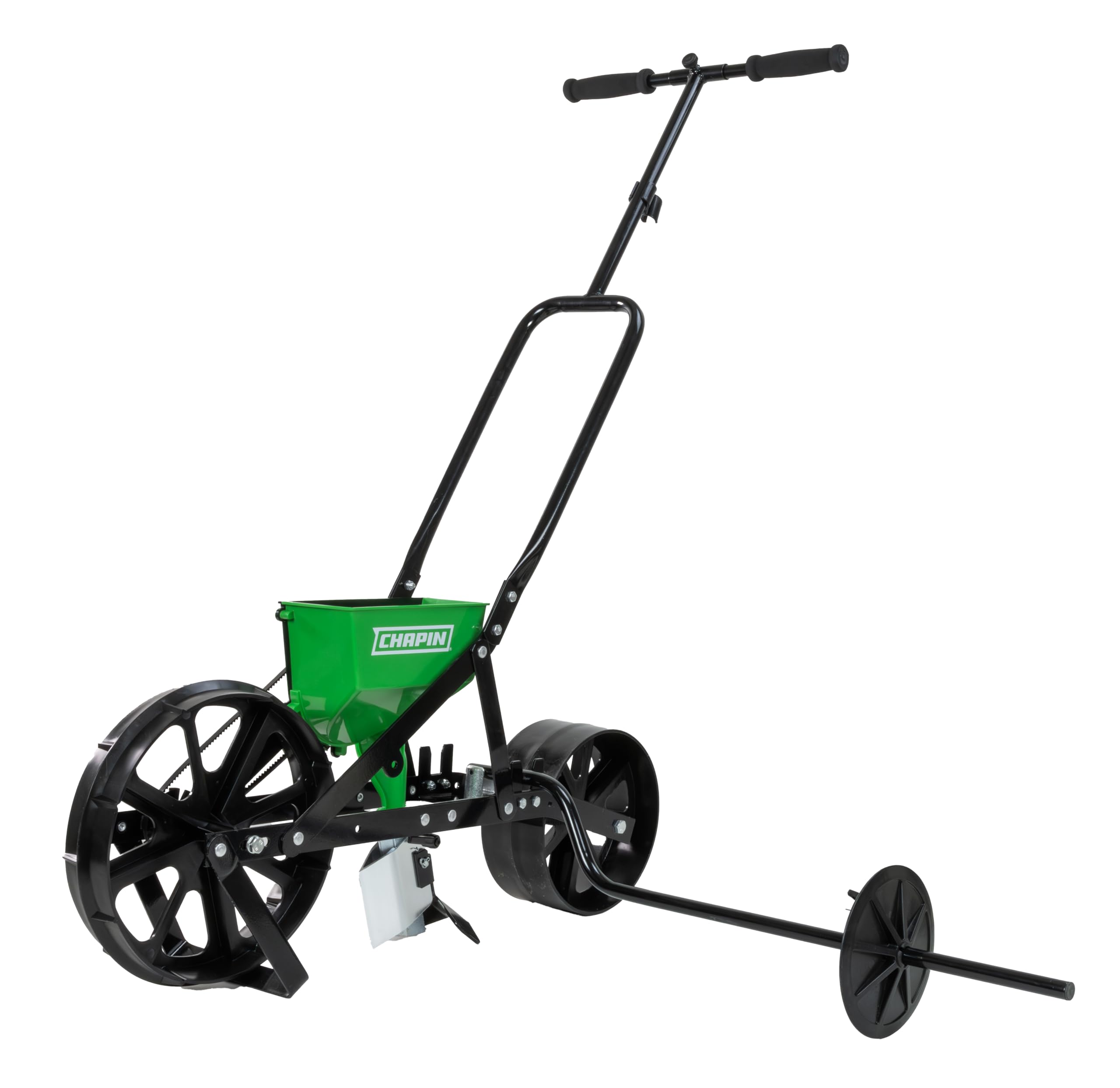
Built like a tank, but the seed plates need a second look.
The Chapin 8701G shares the same basic design as its 8701B sibling but comes in a slightly heavier build at 18.76 pounds (the heaviest seeder here) with a zinc plow blade and a powder-coated steel frame. It includes six seed plates that work with up to 20 vegetable varieties, and the 1.5-liter poly hopper resists rust. The cushioned handle grips and adjustable rotating wheel row marker are nice touches that reduce fatigue during long planting sessions.
However, the planting accuracy is a real letdown. One verified buyer wrote: “While planting cucumbers the seed plate would grab 2-3 seeds and somehow become lodged and just fall behind the plate and not actually go down the tube to plant.” The same reviewer noted that larger seeds work fairly well, but about every other seed drops in pairs. For carrot seeds — already tiny and hard to handle — this kind of inconsistency means you will likely end up with patchy rows and lots of hand-reseeding.
Compared to the 8701B (14.4 pounds), the 8701G is heavier by 4.36 pounds, which makes it even more of a workout to push through soft soil. And unlike the EarthWay 10001 (2.49 pounds), you are not getting any speed advantage — the 8701G weighs 18.76 pounds versus the EarthWay’s 2.49 pounds without delivering better planting accuracy for small seeds.
Where it earns its keep: The build quality is genuinely sturdy, and the zinc plow blade cuts clean furrows. For large-seed crops like corn and beans, this machine is fine.
The honest trade-off: The 18.76-pound weight makes it a chore to push, and the seed plate issues make it unreliable for carrots and other small seeds — you may end up replanting by hand.
Reach for this if: You plant mostly large seeds (corn, beans, peas) on a large plot and want a solid steel frame that will last for years.
Look elsewhere if: Carrots, lettuce, or other tiny seeds are your main crop — the 8701B or EarthWay will serve you better.
4. Varomorus Precision Seeder
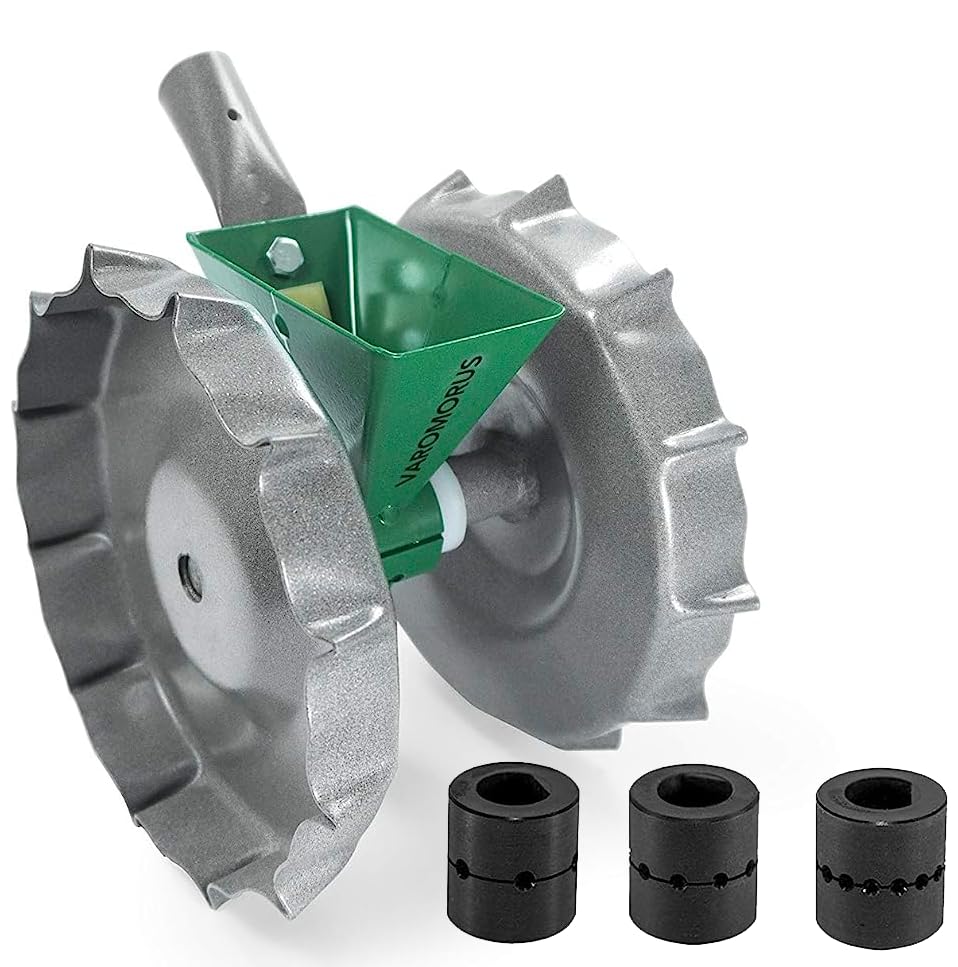
A metal budget seeder that works great — unless you plant carrots.
The Varomorus Precision Seeder is the most affordable option here, built from stamped steel with a rotating sowing drum instead of interchangeable plates. It comes with a nozzle set designed for smaller crops like radishes, onions, beets, and carrots, and arrives fully assembled — you just need to attach your own broomstick handle. At 2.49 pounds, it matches the EarthWay 10001 for lightness, making it easy to maneuver on raised beds and small plots.
Here is the problem: carrot seeds are notoriously tricky for this seeder. One buyer’s blunt review says it all: “Carrot seeds failed: piles or none, seeds slipped through cracks, multiple seeds per hole.” The rotating drum design does not consistently pick up the tiny, irregular shapes of carrot seeds. Changing the seed wheel is also a pain — you need a 1/4-inch ratchet, a 10mm socket, and a long extension, and several buyers broke screws during the process.
When placed next to the Chapin 8701B (14.4 pounds and 4.1 stars), the Varomorus feels like a gamble. It is much lighter and cheaper, but at 3.1 stars from only 41 ratings, buyer confidence is low. The EarthWay 10001 (also 2.49 pounds) handles small seeds better thanks to its six interchangeable plates, while the Varomorus relies on a drum design that leaves carrots in piles or empty spots.
What works well here
- Lightest possible build at 2.49 lbs — easy to one-hand on raised beds
- Durable stamped steel construction that reviewers call “built like a tank”
- Arrives fully assembled, no complicated setup
What is a struggle
- Carrot seeds fail: they slip through cracks or drop in clumps
- No handle included — you must supply your own broomstick
- Seed wheel change requires tools (ratchet, socket, extension) and patience
A strong choice for: Round seeds like okra and radishes on a small garden, and for buyers who already own a 1/4″ ratchet set.
A weak choice for: Carrot growers who need consistent single-seed drops — the drum design simply cannot handle tiny irregular seeds.
Understanding the Specs
Seed Plates vs. Rotating Drum
Seed plates are interchangeable discs with holes of different sizes — you swap them depending on the seed type. A rotating drum uses a single cylinder with calibrated indentations. Plates offer more variety (you can buy extra plates for different crops), while drums are simpler but often fail tiny irregular seeds like carrots. If you plant many different crops, get a seeder with at least six plates.
Weight and Frame Material
Aluminum frames (like the EarthWay 10001) are lightweight (around 2.5 pounds) and easy to push but feel less durable over rocky soil. Powder-coated steel frames (like the Chapin 8701B) are heavier (14 pounds and up) and last longer but require more effort to push through soft soil. Your choice depends on soil type, garden size, and how much weight you are comfortable handling.
Hopper Capacity
The hopper holds the seeds before they drop into the furrow. A 1.5-liter hopper (standard on the Chapin models) is fine for large gardens but still requires refilling for very long rows. Bulk seed works best — small packets from the store may not fill the hopper enough for the mechanism to work consistently. If you use small packets, look for a seeder with a smaller, more manageable hopper.
Row Marker and Depth Adjustment
A row marker is an arm that drags a line in the soil next to the planted row, showing you where the next row will go. This keeps your rows straight and evenly spaced without measuring. Depth adjustment lets you set how deep the furrow opener buries the seeds — shallow for carrots (around 1/4 inch), deeper for corn or beans (1-2 inches). Without these features, you are guessing at spacing and depth.
FAQ
Will any carrot seed planter handle tiny carrot seeds reliably?
Can I use a carrot seed planter for other vegetables like lettuce or radishes?
How deep should I set the furrow for carrot seeds?
Is a heavier seeder better for carrot planting?
Do I need to prepare my soil before using a carrot seed planter?
How do I clean a carrot seed planter between seed types?
Can I plant carrots in raised beds with a push seeder?
How many rows can I plant with a single hopper fill?
What if the carrot planter jams or skips seeds mid-row?
Is a 3-in-1 seeder (mark, plow, plant, cover) better than a basic model?
Final Thoughts: The Verdict
For most people, the carrot seed planter winner is the EarthWay 10001 Precision Garden Seeder because its exceptionally lightweight frame (2.49 pounds) and seven seed plates offer the best balance of speed and versatility for a mixed garden — but you should test the carrot plate on a table first. If you want a more durable steel frame and are willing to fine-tune the seed plate for carrots, grab the Chapin 8701B. And for budget-conscious gardeners who mostly plant round seeds like radishes and okra, the Varomorus Precision Seeder gets the job done with its metal build and simple rotating drum design.
How We Picked
We do not accept paid placement. Every pick is matched to a real buyer and a real use-case; we do not hands-on test units.
Sources & Methodology
Specifications: manufacturer listings and product documentation. Review insights: verified customer reviews, as of July 2026. Pricing: not shown on this page (it changes often); check the current price via the retailer link.
As an Amazon Associate, Lawn Gear Lab earns from qualifying purchases. This does not affect which products we feature.