
Specs are compiled from manufacturer listings and verified buyer reviews and can change over time — please confirm the key details on the product page before buying.
Getting African violets to bloom indoors can feel tricky, but the missing piece is almost always the right light. A standard window often provides too little or too much direct sun, leaving you with lush leaves and no flowers. A dedicated grow light changes that — it gives your plants the specific spectrum and intensity they need to thrive on your schedule.
I’m Rikta — the founder and writer behind Lawn Gear Lab. This guide is built by comparing the manufacturers’ published specifications and the patterns across verified customer reviews, so you get each pick’s real strengths and trade-offs instead of marketing spin.
We break down six very different options — from clip-on lamps to bar strips — to help you find the perfect light for african violets that fits your setup and skill level.
Our Picks at a Glance


How To Choose The Best Light For African Violets
African violets are picky about light. Too little and they stop blooming; too much intense light can scorch their fuzzy leaves. You need a grow light that delivers the right spectrum, intensity, and duration — without complicated setup. Here are the three most important factors to get right.
Spectrum: Why Full Spectrum Matters
Look for a “full spectrum” light that includes both cool white and warm red wavelengths. Violets use red light (around 660nm) to trigger flower buds, while blue and white light keeps the leaves compact and prevents leggy growth (stretching toward a weak light source). A light labeled full spectrum usually covers the 380-800nm range, which mimics natural sunlight and supports both leaf growth and flowering.
Timers and Dimming for Consistency
African violets need about 12 to 16 hours of light each day for reliable blooming. A built-in timer that cycles on and off automatically is far more dependable than remembering to switch it yourself. Dimming levels let you adjust intensity — lower for young plants or propagation (starting new plants from leaf cuttings), higher for mature violets ready to flower.
Mounting and Placement Options
Violets grow low and wide, so the light needs to be close — usually 6 to 12 inches above the leaves. Clip-on lamps with a flexible gooseneck work well for a single pot on a desk or shelf. Strip lights or bar lights are better for wire shelving or multi-plant setups where you need even coverage across several pots.
Quick Comparison
| Model | Best For | Wattage | Timer Options | Dimming Levels | Amazon |
|---|---|---|---|---|---|
| SANSI Clip-on 10W★ Best Overall | Single plant with precise control | 10W | 3/6/12 Hrs | 4 levels (25%-100%) | Amazon |
| SANSI 4-Gooseneck Clip (600W equiv)Also Great | Multi-plant setups needing high output | 40W total (4 x 10W) | 4/8/12 Hrs | — | Amazon |
| SDOVUERC 16” 6 Bars | Wide shelf coverage | — | 6/12/18 Hrs | 5 levels | Amazon |
| Xuligron Halo Clip 3-Pack | Multiple single pots | — | 6/12/16 Hrs | 5 levels | Amazon |
| Wiaxulay 192 LED 4-Head | Small-space under-cabinet use | — | 6/12/16 Hrs | 5 levels | Amazon |
| bseah Pedestal | Desktop plants needing height adjust | — | 3/9/12 Hrs | 10 levels | Amazon |
In‑Depth Reviews
1. SANSI Grow Light for Indoor Plants, Clip-on LED Full Spectrum 10W
Our pick — over 4.5★ from 850+ verified ratings; the strongest balance of quality and price.
A single-pot specialist with precise dimming and proven results.
For a single prized African violet you want to keep blooming on your desk, this SANSI clip-on is the most refined option. Its 10W ceramic LED pushes 169.7 μmol/s/m² at 6 inches (a measurement of photosynthetic photon flux density — how much usable light reaches the leaf surface for photosynthesis). That is a serious amount for one plant, and the 4-level dimmer lets you dial down to 25% for young plants or propagation (starting new plants from leaf cuttings) and crank to 100% when buds are forming. That dimmer range is wider than the Wiaxulay’s five fixed brightness levels, giving you finer control for a single violet.
The timer runs 3/6/12 hour cycles and repeats daily without fuss. Buyers confirm it promotes new leaf growth in about a month on houseplants like monstera, so violets respond similarly. The flexible gooseneck holds its angle well, and the clip fits both pot rims and thin shelving.
Standout features
- 169.7 μmol/s/m² at 6 inches — verified PPFD for violet-healthy intensity.
- 4-level dimmer (25%-100%) — rare fine-tuning for different growth stages.
- 2-year protection plan included.
Limitations
- Light coverage area is small — only good for one or two violets.
- Gooseneck may be too short for tall planters — best on low, wide pots.
Best for: a single prized African violet on your desk where you want precise intensity control and verified light output.
Not enough for: a multi-plant shelf or a collection needing wide-area coverage.
2. SANSI LED Grow Lights for Indoor Plants, 600W Full Spectrum 4-Gooseneck Clip
Four independent heads in one unit for serious violet collections.
If you have several African violets spread across a desk or plant stand, this SANSI model saves you from buying multiple single lamps. It packs four separate gooseneck arms, each with its own 10W ceramic bulb that produces a strong 4000 lumens (lumens measure total visible light output) — enough to cover a wide area so leaves grow dense and blooms keep coming. The full spectrum range spans 380nm to 800nm, so your violets get both the blue light for compact leaves and the red light that signals it is time to flower.
The auto on/off timer runs in three cycles — 4hrs, 8hrs, or 12hrs — letting you dial in the 12 to 16 hours violets prefer for repeat blooms. Buyers report the clips are strong and the goosenecks hold their angle well, though one reviewer noted the bulbs get hot enough to burn leaves if placed too close. The biggest trade-off is the timer resets if you unplug the unit, and you cannot control each head individually without turning all four on at once. Still, for a single purchase that lights multiple plants, this is the most capable option here.
Four-head powerhouse: Covers a full shelf or desk — no daisy-chaining separate lamps. The 40W total draw replaces a 600W traditional bulb, saving energy while delivering serious PAR output.
One real trade-off: The timer resets if power is interrupted, and the bulbs run hot — keep the light at least 8-10 inches above leaf tops to avoid scorch.
Reach for this if: you have three or more violet pots in one spot and want a single, clutter-free fixture with commercial-like light output.
Look elsewhere if: you need individual head control or a timer that remembers settings after a power blip.
3. SDOVUERC 16” 6 Bars Grow Light Strips
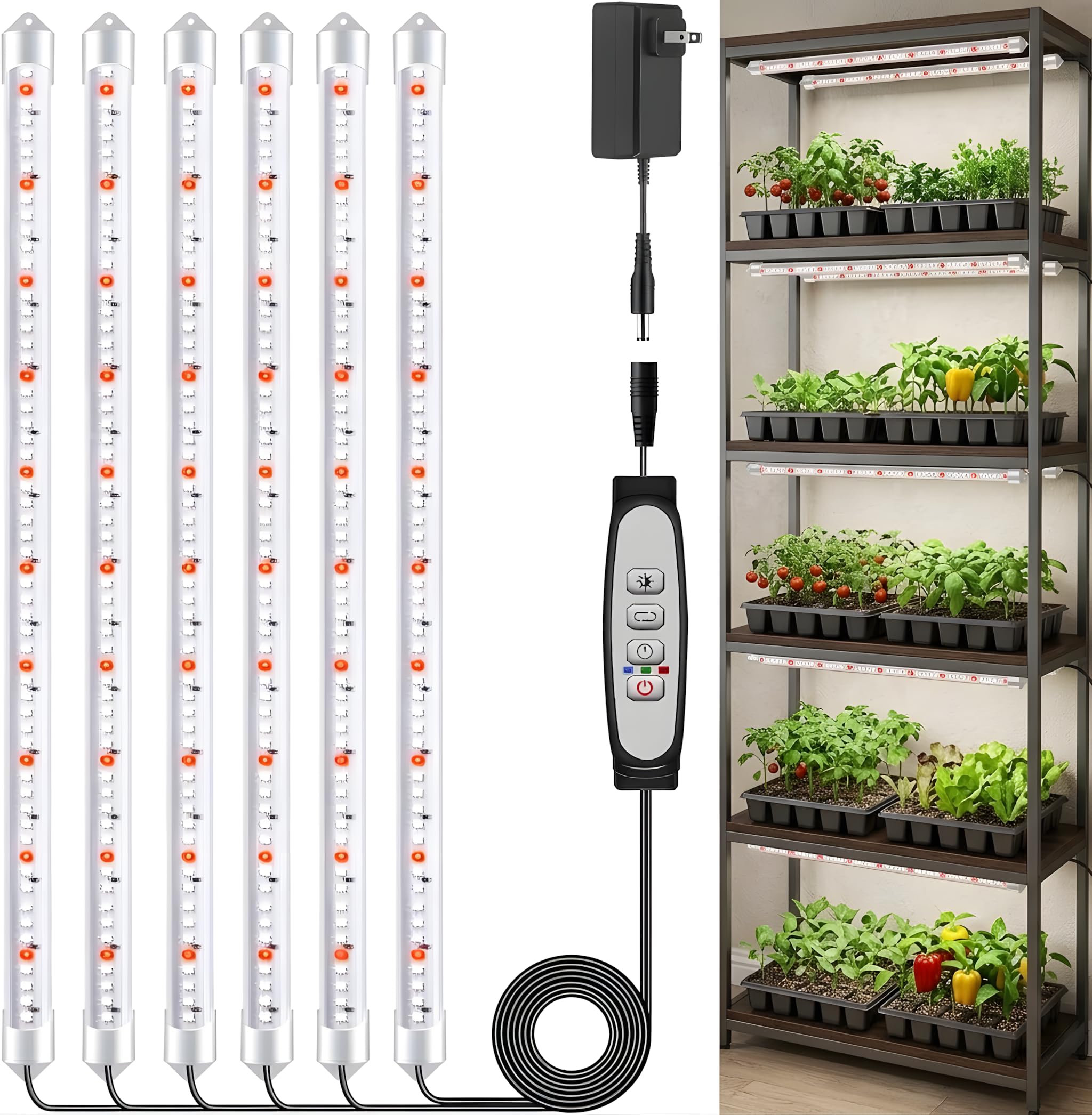
Six bars of even light for a whole shelf of violets.
You get six 16-inch bars, each packing 360 high-efficiency LEDs (light-emitting diodes) that together emit 3600 lumens — that is bright enough for violets on every tier of a multi-shelf rack to grow compact and flower. The full spectrum covers 380 to 800nm, including specific 660nm red LEDs for triggering blooms, so your plants get the red wavelength the SANSI 4-Gooseneck also provides, but spread across a wider area.
The timer offers three cycles: 6hrs, 12hrs, or 18hrs — giving you a 2.0x longer maximum than the bseah pedestal’s 12hr cap. That extra range is useful if you want to run 16 hours of light without waking up to turn it off. Buyers mention the zip-tie setup is fast on wire shelves and that the bars stay cool even after hours of use. One caveat: owners mention the light looks very blue even on the “red” setting — fine for plant growth, but not a warm glow for a living room.
What stands out
- 3600 lumens across six bars — even coverage for a full shelf.
- 18-hour maximum timer cycle — ideal for long-day flowering schedules.
- Installation via zip ties, screws, or double-sided tape.
What to note
- Light tint is very blue even on the “red” mode — not a room-ambient light.
- No dimming below the 5 set levels — brightness is fixed per level.
Best for: growers with a multi-shelf wire rack who want uniform light bar coverage across every tier.
Skip if: you prefer warm-toned light or only need one or two spot-lit pots.
4. Xuligron Grow Lights for Indoor Plants, Full Spectrum Clip on Halo Grow Lamp 3 Pack
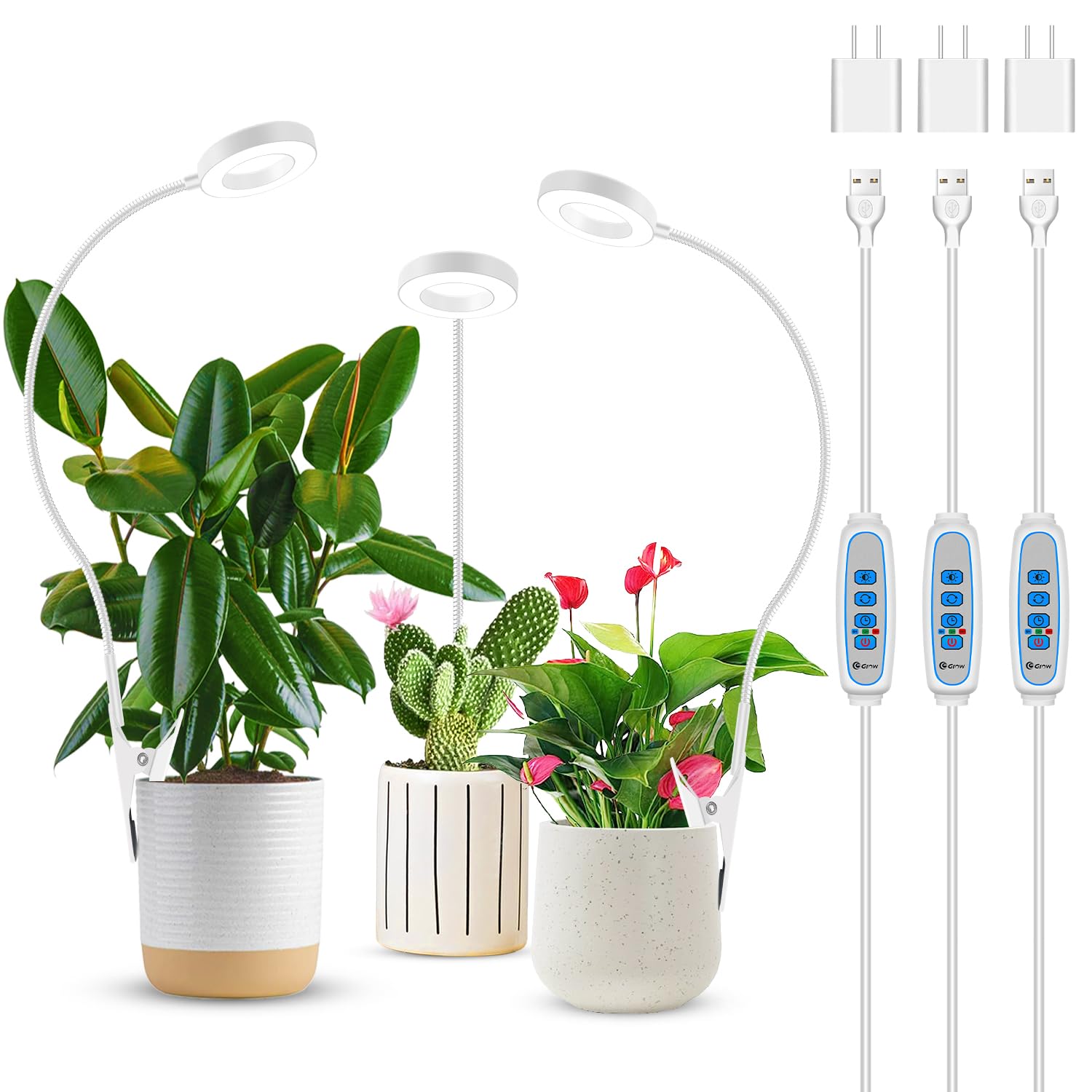
Three halo lamps with a timer that beats the SANSI clip-on’s maximum.
If you need to light multiple violets in different rooms or positions and do not want to manage three separate brands, this 3-pack from Xuligron delivers a clear advantage: the timer goes up to 16 hours, which is 4 hours longer than the single SANSI clip-on’s 12hr cap. That extra time matters if you want to run a full 16-hour day cycle for maximum flower bud production. Each halo-style head uses 660nm red light, warm 3500K, and white 6000K LEDs to cover the full spectrum violets need.
The goosenecks are flexible and hold their position well, and you get both a clamp for the pot edge and a stake to push into the soil. Customers note the lights are sturdy and that plants perk up noticeably within weeks. The three lighting modes and five dimming levels let you start seedlings at a lower setting and turn up intensity as plants mature. One buyer mentioned the clip can be fussy to reposition on thicker surfaces, but most find the soil stake more reliable for growing violets.
Why it works for violets
- 16-hour timer cycle — best max duration among clip-on picks here.
- Three lights per pack — cover three separate pots or areas.
- Two mounting options: clip or soil stake.
Potential drawbacks
- Clip feels less sturdy on thick shelving — stake is the more stable choice.
- Each light uses a separate USB adapter — three outlets needed.
Ideal for: someone starting a small violet collection who wants one purchase to cover three separate pots with individual control.
Not for: those wanting a single elegant fixture — this is three separate lamps with dangling USB cords.
5. Wiaxulay Grow Lights for Indoor Plants, 192 LED Full Spectrum 4-Head
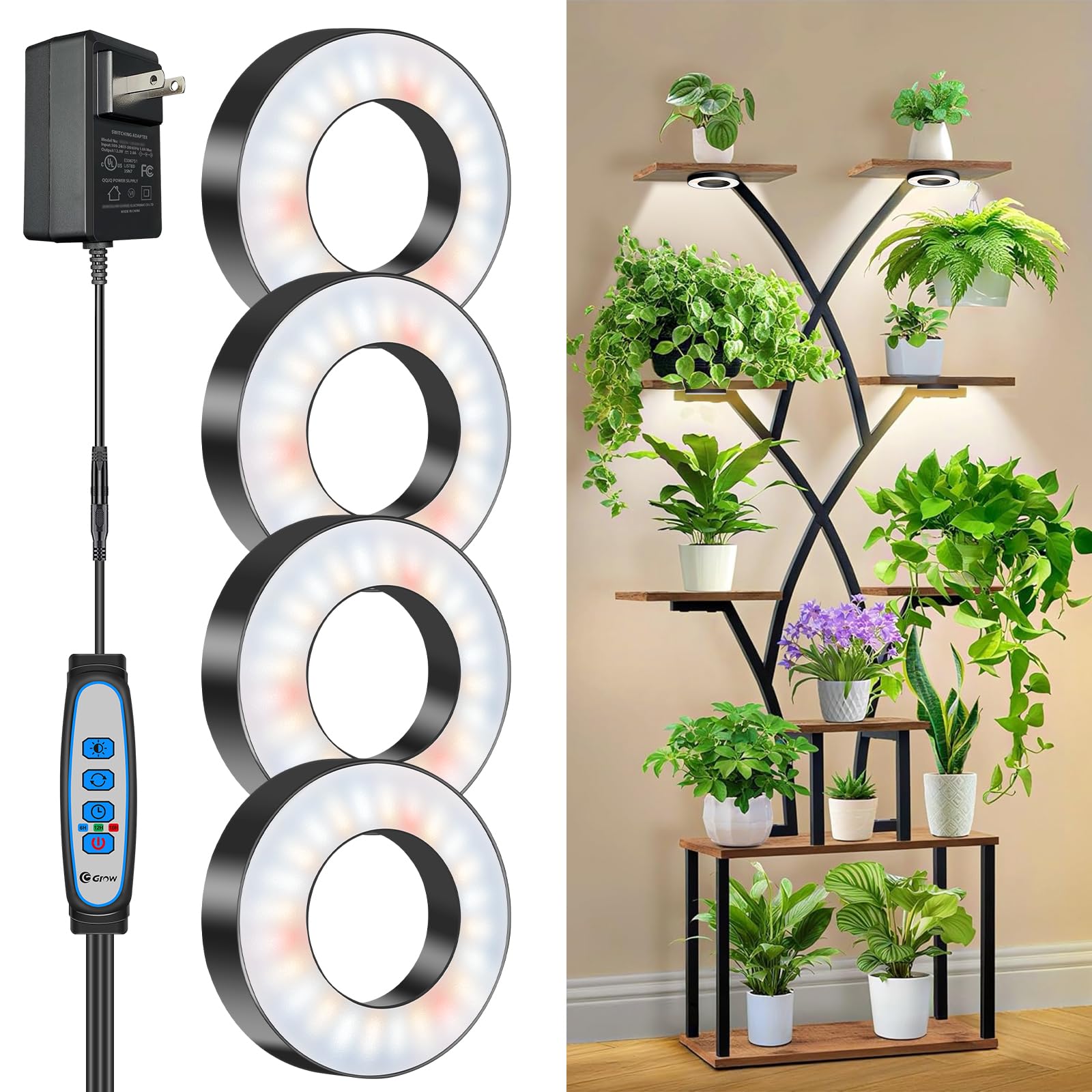
A tiny under-cabinet light that slips into the tightest shelf gaps.
At only 3.5 inches in diameter per head, this Wiaxulay lamp is designed for narrow shelves, small cabinets, or the top tier of a plant stand where you barely have vertical room. The four heads each contain 48 LEDs (33 white, 12 warm white, 3 red) emitting a full 380-800nm spectrum, so violets still get the red wavelength for flowering despite the small package. The 118-inch power cord means you can plug it into a distant outlet without extension drama.
The controller gives you three spectrum modes — White, Warm White and Red, and Mixed Light — plus five brightness levels from 20% to 100%. The timer runs 6/12/16H, matching the Xuligron’s 16-hour top end. A single head is fairly weak on its own at distance, but with all four aimed at a tight cluster of violets it delivers enough punch. Brightness on the white setting is harsh on the eyes, so position it where you aren’t looking directly at the LEDs for long periods.
Shelf-space saver: Fits under a 4-inch shelf gap — the smallest profile here. Comes with zip ties, double-sided tape, and buckles for almost any flat surface.
Lower overall output: Each head is modest; better for a small cluster of violets than a wide spread. The white LED mode is uncomfortably bright for a living area.
Pick this for: tight spaces like a cabinet or a narrow shelf tier where a full-size bar light won’t fit.
skip it if: you need to light a large, open table of plants at a distance — the small heads lose intensity fast.
6. bseah Grow Light, LED Plant Light with Pedestal, 10 Dimmable Levels

A freestanding lamp that grows taller as your violet collection does.
If you prefer a traditional desktop lamp over clipping lights onto pots, the bseah pedestal is the most flexible standalone option. The telescopic rod adjusts from 15 to 26 inches, so you can raise it as your violets grow or move it to a different spot without measuring clearance. The 10 dimming levels are the widest brightness range of any pick here — double the SANSI clip-on’s 4 levels — letting you dial in intensity perfectly for a single violet or a pair on your desk.
The timer cycles are 3hrs, 9hrs, and 12hrs — shorter than the 16-18hr caps on the Xuligron or SDOVUERC, which means you cannot run a full 16-hour violet day automatically. The metal base is stable but reviewers point out the lamp is tippy on narrow surfaces; one recommended sticking the base into a heavy pot instead. For entry-level growers who want one simple light for one or two violets and appreciate a classic lamp silhouette, this is the budget-friendly path.
Why it stands out
- Height adjustable from 15 to 26 inches — fits violets on low desks or taller stands.
- 10 dimming levels — the widest brightness range of any pick here.
- Freestanding design — no clip marring your furniture.
Honest limits
- Timer maxes at 12 hours — cannot reach a 16-hour violet cycle automatically.
- Narrow metal base can tip on a small surface; a heavy pot provides stability.
This fits: a beginner who wants a straightforward desktop lamp with adjustable height and excellent brightness control.
Not the best: if you need a long timer cycle or you are lighting more than two violets — the coverage area is tight.
Understanding the Specs
PPFD (Photosynthetic Photon Flux Density)
This measures how much usable light from the grow lamp actually reaches the leaf surface — it is the number that tells you if your violet is getting enough energy to produce flowers. A higher PPFD (measured in μmol/s/m²) means more photons per second hitting the leaves. African violets do well in the range of 100-200 μmol/s/m² at the leaf top. The SANSI clip-on, for example, delivers 169.7 μmol/s/m² at 6 inches, putting it right in the balance for triggering blooms.
Timer Cycles and Photoperiod
African violets are “photoperiodic” — they need a consistent number of light hours each day to switch from leaf growth to flowering. Most require 12 to 16 hours of light followed by 8 to 12 hours of complete darkness. A timer that repeats the same cycle daily takes the guesswork out. The options here range from 3/6/12 hours up to 6/12/18 hours, so choose one that can reach your target photoperiod without manual intervention.
Full Spectrum vs. Red/Blue Only
Full spectrum lights mimic the sun by emitting wavelengths across the whole 380-800nm range. For African violets, this means the plant gets both blue light (for compact, dense leaf growth) and red light around 660nm (which triggers the flower bud formation). A “blurple” light that only emits red and blue may work, but full spectrum looks more natural to your eyes and supports healthier overall plant structure.
Dimming Levels and Growth Stages
Not all growth stages need the same light intensity. A young violet propagation (a new plant started from a leaf cutting) or a plant recovering from stress benefits from lower light (around 50% output) to prevent leaf burn. Mature violets ready to flower can handle full intensity at 100%. Lamps with 4, 5, or even 10 dimming levels give you the control to adjust the light as your plant’s needs change over the season.
FAQ
How close should I place a grow light to African violets?
Can I leave a grow light on 24 hours for African violets?
What color temperature is best for African violet grow lights?
How many watts do I need for one African violet?
Will a standard LED desk lamp work for African violets?
Can I use a clip-on light for African violets on a wire shelf?
What is the difference between 3/9/12H and 6/12/18H timers?
Do grow lights raise the temperature around African violets?
Final Thoughts: The Verdict
For most people, the light for african violets winner is the SANSI 4-Gooseneck Clip because it covers multiple violets with one premium fixture, offers a lifetime bulb replacement, and delivers high PPFD in a full spectrum. If you need a wide bar light for a multi-shelf rack, the SDOVUERC 6-bar strip provides uniform coverage with a generous 18-hour timer. And for a budget-friendly 3-pack that lights three separate pots, the Xuligron halo lamps give you flexibility and a longer 16-hour cycle than most single-clip options.
How We Picked
We do not accept paid placement. Every pick is matched to a real buyer and a real use-case; we do not hands-on test units.
Sources & Methodology
Specifications: manufacturer listings and product documentation. Review insights: verified customer reviews, as of July 2026. Pricing: not shown on this page (it changes often); check the current price via the retailer link.
As an Amazon Associate, Lawn Gear Lab earns from qualifying purchases. This does not affect which products we feature.