
Specs are compiled from manufacturer listings and verified buyer reviews and can change over time — please confirm the key details on the product page before buying.
Aphids multiply fast. One day you have a few green specks on a stem, and a week later they are clustering every new leaf, draining the life out of your plants. Spray-on killers often miss the ones tucked inside curled leaves or hiding under the canopy. A systemic insecticide changes the strategy entirely — you apply it to the soil or the plant base, the roots pull it up into the plant’s sap, and any aphid that bites dies. No spraying, no guessing whether you hit every bug.
I’m Rikta — the founder and writer behind Lawn Gear Lab. This guide is built by comparing the manufacturers’ published specifications and the patterns across verified customer reviews, so you get each pick’s real strengths and trade-offs instead of marketing spin.
Whether you are protecting rose bushes, houseplants, or a vegetable patch, picking the right systemic insecticide for aphids means understanding how each formula works and which plants it is safe for — the details below will help you make that call without trial and error.
Our Picks at a Glance

How To Choose The Best Systemic Insecticide For Aphids
A systemic insecticide works differently from a contact spray — it has to be absorbed by the plant first, then distributed through the sap. That means how you apply it, what ingredient it uses, and which plants you use it on all matter. Here are the three factors to weigh before buying.
Concentrate vs. Granules vs. Ready-to-Use
Concentrated liquid you mix with water gives you control over dosing and works well as a soil drench — you pour the mixed solution around the base of the plant. Granules are simpler: you sprinkle them on the soil and water them in. Granules release the chemical slowly, which means fewer applications per season. Ready-to-use spray bottles are for smaller jobs but cost more per treatment.
What plants are you treating?
Not every systemic is safe for every plant. Some are labeled strictly for ornamentals like roses, shrubs, and flowers — you cannot use them on vegetables or fruit trees. Others are specifically formulated for edible crops. Always check the product label for the list of approved plants. A product that works great on a rose bush could ruin a tomato crop if it is not labeled for edibles.
Active ingredient and longevity
Imidacloprid is the most common active ingredient in systemic insecticides for aphids. It is reliable and can protect the plant for weeks or even a full year depending on the concentration and application method. Alternative ingredients like rosemary-based rosemeric acid work differently — they act as a deterrent rather than a fast kill. If you need immediate control on a heavy infestation, an imidacloprid-based product is usually the stronger choice.
Quick Comparison
| Model | Best For | Liquid Volume | Form | Lasts | Amazon |
|---|---|---|---|---|---|
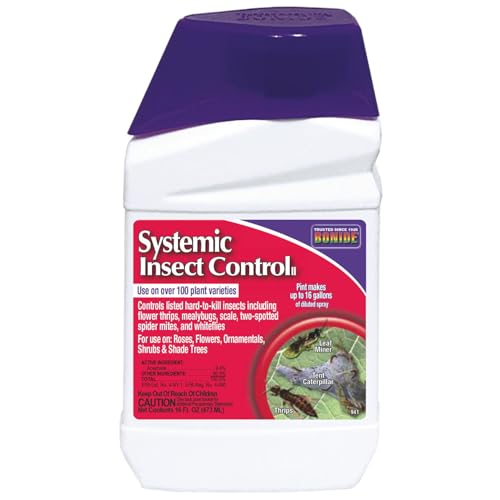
| Bonide Systemic Insect Control★ Best Overall | Ornamentals | 16 oz | Liquid concentrate | — | Amazon |
| Bonide Systemic GranulesAlso Great | Houseplants & roses | 1 lb | Granules | 8 months | Amazon |
| Fertilome 2-N-1 Systemic | Flowers & shrubs | 32 oz | Liquid concentrate | 6 weeks | Amazon |
| SNS-209 Systemic Concentrate | Indoor plants | 16 oz | Liquid concentrate | — | Amazon |
| Monterey Once A Year II | Trees & shrubs | 32 oz | Liquid concentrate | 1 year | Amazon |
| Monterey Fruit Tree & Vegetable | Edible crops | 1 gallon | Liquid concentrate | 1 season | Amazon |
In‑Depth Reviews
1. Bonide Systemic Insect Control, 16 oz Concentrate
Our pick — over 4★ from 800+ verified ratings; the strongest balance of quality and price.
A fast-acting liquid that hits scales, aphids, and whiteflies with noticeable speed.
This 16-ounce concentrate makes up to 16 gallons of spray solution, and it is labeled for use on over 100 plant varieties including flower beds, roses, and shrubs. The formula is designed to treat infestations immediately — it is not a slow-build deterrent. One buyer who struggled with scale on an indoor Majestic Palm said surface treatments never worked, but after bringing the plant outside and treating it with Bonide once, the scale disappeared completely. Another reviewer described the smell as “actual poop,” which is something to keep in mind if you are sensitive to odors, though the strong odor also signals it is working.
Unlike the Fertilome 2-in-1 above, this product is purely an insecticide with no fungicide mixed in. You can combine it with certain fungicides or fertilizers for a combined spray if you wish. The 16-ounce bottle and the Fertilome 32-ounce jug are different volumes, but the concentrate goes a long way when diluted. One major limitation: it is not intended for vegetable or fruit plants — ornamental use only. Reviewers also warn that the smell lingers, so using it outdoors rather than in a closed greenhouse is strongly recommended.
Strengths
- Fast-acting on scales, aphids, mealybugs, whiteflies
- Makes 16 gallons from one bottle
- Mixable with fungicides or fertilizers
Weaknesses
- Strong odor buyers describe as unpleasant
- Not labeled for edible plants
Grab this for ornamentals: If your roses or shrubs have an active scale or aphid outbreak, this concentrate hits hard and fast.
Skip if you mind the smell: The odor is genuine — use it outdoors and keep it away from enclosed spaces.
2. Bonide Systemic Granules Insect Killer 1 lb.
The low-maintenance granules that keep aphids away for months on end.
This is the simplest path to systemic protection. You sprinkle the ready-to-use granules onto the soil around the base of your plant, water them in, and the roots start absorbing the insecticide. The effect lasts a full 8 months according to the label directions, so one treatment in spring often covers you through the entire growing season. Buyers report it works great on rose bushes — one reviewer noted it killed cutworms, black flies, and June bugs that were devouring their roses.
Unlike the liquid concentrates below, these granules require no mixing, no measuring, and no sprayer. That makes them ideal for houseplants, hanging baskets, and container plants where you want a clean, quick application. The granules are also well-suited for orchids — one orchid owner called it the only product that properly dealt with scale on their plants. There is one catch: the active ingredient does not kill spider mites, so if two-spotted mites are also a problem on your plants, you will need a separate treatment for those.
No-mess protection: One sprinkle and water — granules cover you for 8 months, perfect for anyone who wants to treat and forget.
One blind spot: Spider mites survive this product, so check whether that pest is on your plant before relying solely on it.
Reach for this if: you have roses, houseplants, or containers and want the easiest application with the longest coverage.
Look elsewhere if: spider mites are part of your pest problem, or you need something labeled for edible vegetables.
3. Fertilome (10478) 2-N-1 Systemic (32 oz)

A two-in-one drench that tackles both aphids and fungal diseases in one pour.
This liquid concentrate does double duty — it contains both a systemic insecticide and a systemic fungicide. That means you are protecting against aphids, thrips, and borers while also fighting black spot and rust, all from the same root drench. The protection lasts up to 6 weeks per application, which is shorter than the 8 months from the Bonide granules above, but the 2-in-1 coverage is unique here. The bottle holds 32 fluid ounces, and one buyer mentioned each jug covers 16 rose bushes.
The real-world advantage showed up in reviews from Florida gardeners, who called it the single best treatment for the mix of bugs and blights common in humid climates. It is labeled for use on shrubs, roses, and flowers — not for vegetable gardens. You simply mix it with water at the rate on the label and pour it at the base of the plant. One owner reported the plants showed more vigorous growth and bloom after treatment, though they noted that annual compost helps offset the chemical harshness over time.
What stands out
- Insecticide and fungicide in one mix
- 32 oz jug covers 16 rose bushes per buyer reports
- Controls aphids, thrips, black spot, and rust
What to note
- Only lasts up to 6 weeks, not a full season
- Not labeled for edible crops
Best for flower beds: If aphids and fungus issues hit your roses and shrubs together, this one product solves both.
Not for edibles: Stick to ornamentals — this is not the right choice for a vegetable patch or fruit trees.
4. Sierra Natural Science SNS-209 Systemic Concentrate

A rosemary-derived systemic that deters pests without harsh synthetic chemicals.
This is the only product on this list that relies on a naturally occurring substance — rosemeric acid from the rosemary plant — rather than a synthetic compound like imidacloprid. You mix the 16-ounce concentrate with water and apply it as a soil drench. The plant absorbs the rosemeric acid, and when an aphid or thrips bites into the plant, it encounters the substance and stops feeding. One customer observed they were able to get rid of thrips and now use the solution at every watering as a preventative.
The SNS-209 is notably safer around pets. One user highlighted the smell is pleasant and the product is safe for dogs, which is a sharp contrast to the strong odor reported with the Bonide liquid above. Multiple buyers use it consistently with every watering for their large plant collections and have not seen pests return. The trade-off, as one reviewer pointed out, is that this product works more as a systemic deterrent than a rapid poison — it takes a couple of weeks to build up in the plant tissue. If you have a heavy, active aphid infestation, you may see better immediate results from the imidacloprid-based picks.
Gentle but effective: Ideal for indoor plant collections where you want pest prevention without harsh chemicals or strong smells.
Patience required: It takes about two weeks to reach full effectiveness, so it is better as a preventative than a rescue treatment for an active outbreak.
Choose this for indoor use: If you want a mild-smelling, pet-safe option that keeps aphids and thrips at bay long-term, this is your pick.
Not for emergencies: A severe infestation already damaging your plants will need a faster-acting synthetic systemic.
5. Monterey Once A Year Insect Control II (32 oz)
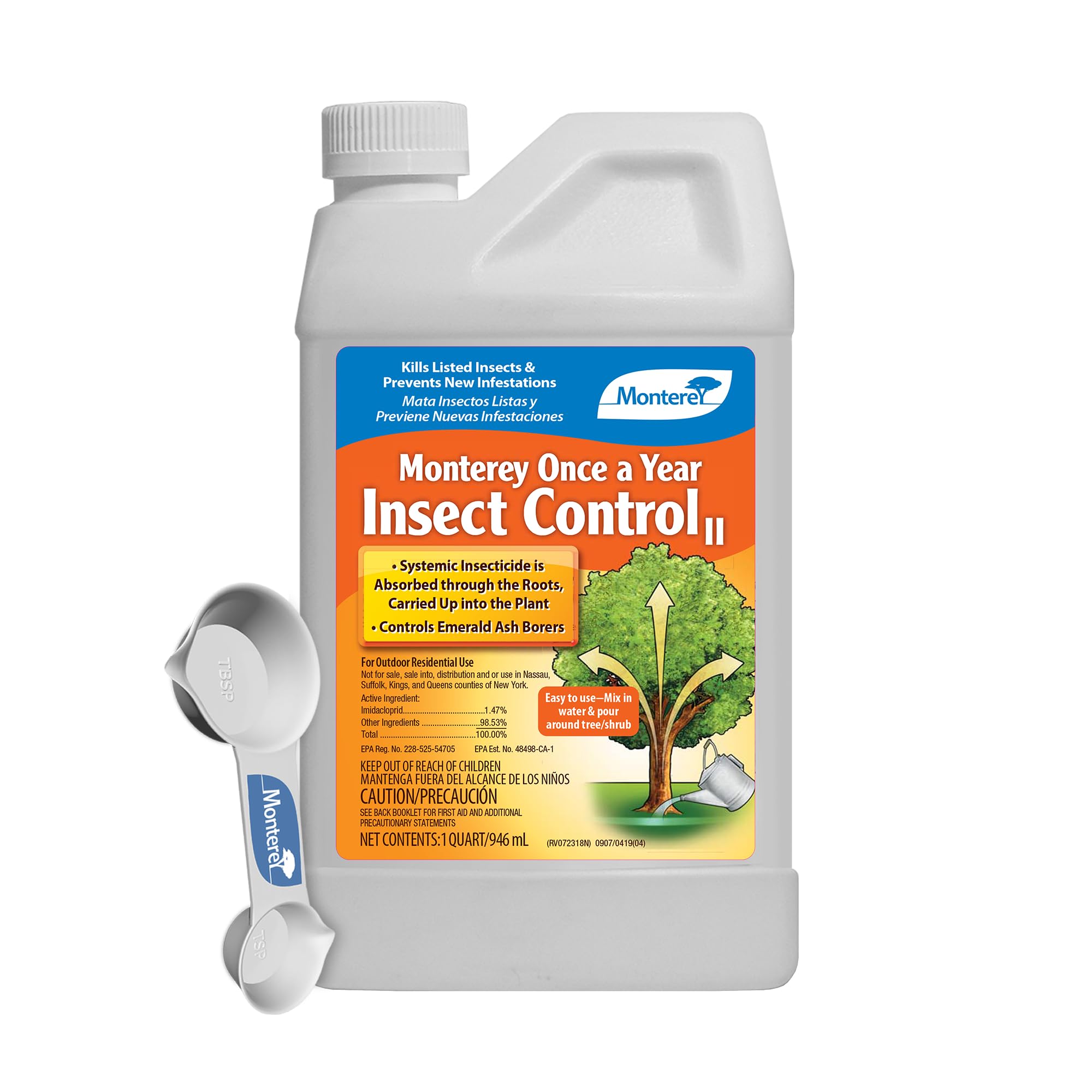
The one-and-done drench that protects trees and shrubs for a full 12 months.
If you have large trees or established shrubs, this Monterey product is built for exactly that. The 32-ounce concentrate is designed to be mixed in a bucket of water and poured around the root zone as a soil drench. Once absorbed, the insecticide moves through the tree’s vascular system and provides year-long protection against aphids, Japanese beetles, leaf beetles, mealybugs, scale, and whiteflies — even protecting new growth as it appears. You apply it once per year and the work is done.
One key difference from the other liquid concentrates here is that this product is specifically labeled for use on certain fruit and nut trees including apple, loquat, oriental pear, pecan, crabapple, mayhaw, pear, and quince. That makes it useful beyond pure ornamentals, though the list is not as broad as the Monterey Fruit Tree & Vegetable option below. The systemic nature means the product will not wash away with rain, which is a big advantage over contact sprays if you live in a wet climate. The bottle comes bundled with a measuring spoon for accurate dosing.
Why it stands out
- One application covers a full year of protection
- Rain won’t wash it off — it is absorbed inside the plant
- Labeled for certain fruit and nut trees
Limitations
- Designed for trees and shrubs, not small potted plants
- Fruit tree list is narrower than the vegetable-specific Monterey option
Ideal for large landscapes: If you have a mature tree or hedgerow and want to forget about aphids for the year, this is the efficient solution.
Not for small containers: The dosing is calibrated for established trees — for potted roses or houseplants, the Bonide granules or Fertilome liquid are better fits.
6. Monterey Fruit Tree & Vegetable Systemic Soil Drench (1 gal)
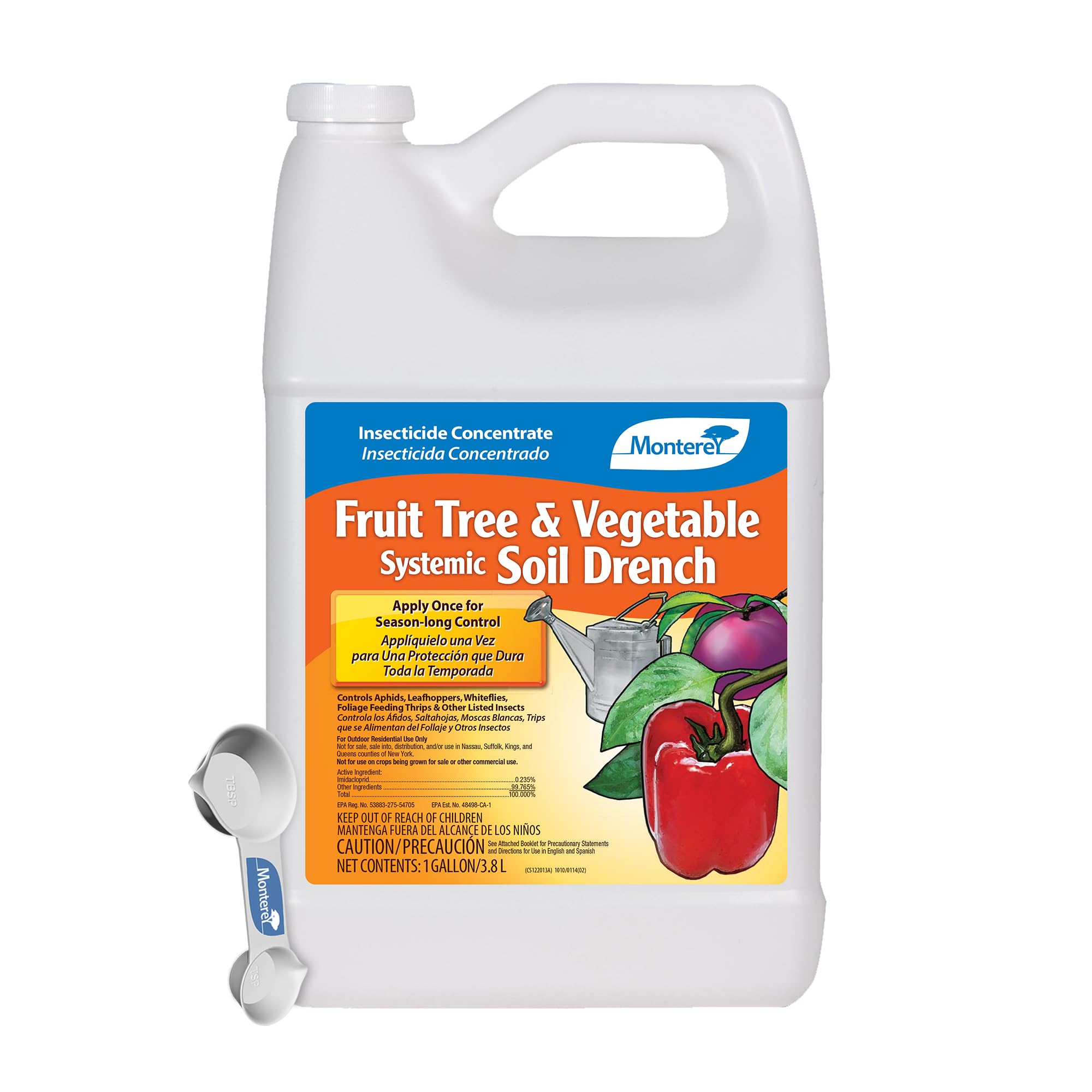
The gallon-size drench you can use on vegetables, herbs, and fruit trees with confidence.
This is the largest jug on the list at a full gallon, and it is the one you want if you are growing food. The product is labeled for use on a wide range of edible crops including bananas, citrus, grapes, berries, avocados, mangos, and a long list of vegetables and herbs such as basil, cilantro, kale, parsley, celery, lettuce, cauliflower, and Brussels sprouts. You mix it with water, pour it over the soil around the base of the plant, and the roots carry the imidacloprid upward for season-long control.
The sheer volume of the one-gallon container makes this the best value if you have a large garden or multiple fruit trees to treat. This 1 gallon (128 oz) concentrate is a larger volume compared to the 32 oz of the Monterey Once A Year and covers a broader range of edible plants. It comes with a measuring spoon included. Because it is a soil drench rather than a spray, there is no drift onto nearby plants or flowers, and no need to time applications around pollinators once the drench has soaked in. One downside: a gallon is a lot of product for a small backyard vegetable patch, so you will want to calculate your garden size before buying.
Edible-safe and generous: Covers vegetables, herbs, and fruit trees with one soil drench per season — the most versatile option for food gardens.
Big bottle commitment: The gallon size makes sense for large gardens but may be excessive for a single raised bed; store it properly for next season.
Your pick for edible gardens: If you grow vegetables, herbs, or fruit trees and want a systemic you know is labeled for food crops, this is the right buy.
Too much for small pots: A small collection of houseplants or a few flower pots do not need a full gallon — the Bonide granules or smaller bottle options will suit you better.
Understanding the Specs
Liquid Volume vs. Coverage Area
A 16-ounce concentrate and a 32-ounce concentrate will make very different amounts of finished spray when diluted. The Bonide 16-ounce bottle makes up to 16 gallons of spray, while the Fertilome 32-ounce jug covers roughly 16 rose bushes per customer reports. Always check the label for mixing ratios — a larger bottle does not always mean more treatments if the concentrate is more dilute.
Protection Duration: 6 Weeks vs. 8 Months vs. Year-Long
The length of protection varies dramatically between products. Fertilome’s liquid lasts up to 6 weeks per application, whereas Bonide’s granules provide 8 months of control. Monterey’s Once A Year line aims for a full 12 months from a single soil drench. Shorter-duration products give you more flexibility to switch treatments, while long-duration products are ideal for low-maintenance approaches.
FAQ
What does systemic insecticide mean for aphids?
Can I use a systemic insecticide on vegetables I plan to eat?
How long after applying should I wait before harvesting edible plants?
Will rain wash away a systemic insecticide?
How do I apply granules vs. a liquid concentrate?
Is SNS-209 safe for pets and beneficial insects?
What is the difference between imidacloprid and rosemeric acid systemics?
Can I use a systemic on my indoor houseplants?
How often should I reapply a systemic insecticide?
Does a systemic insecticide kill aphids on contact?
Final Thoughts: The Verdict
For most buyers, the systemic insecticide for aphids winner is the Bonide Systemic Granules because it combines the easiest application with 8 months of protection and works beautifully on roses, houseplants, and containers. If you want a fungicide-and-insecticide combo for flower beds, grab the Fertilome 2-N-1 Systemic. And for edible crops where you need a systemic labeled for vegetables and fruit trees, the Monterey Fruit Tree & Vegetable Soil Drench is the gallon-size workhorse that gets the job done.
How We Picked
We do not accept paid placement. Every pick is matched to a real buyer and a real use-case; we do not hands-on test units.
Sources & Methodology
Specifications: manufacturer listings and product documentation. Review insights: verified customer reviews, as of July 2026. Pricing: not shown on this page (it changes often); check the current price via the retailer link.
As an Amazon Associate, Lawn Gear Lab earns from qualifying purchases. This does not affect which products we feature.