
Specs are compiled from manufacturer listings and verified buyer reviews and can change over time — please confirm the key details on the product page before buying.
Most carnivorous plants are naturally found in bogs and swamps, which means their roots demand constant moisture but absolutely cannot sit in waterlogged, stagnant soil—it is a delicate balance that a regular flower pot often gets wrong. The right container makes the difference between a thriving Venus flytrap and a plant that slowly rots from the bottom up.
I’m Rikta — the founder and writer behind Lawn Gear Lab. This guide is built by comparing the manufacturers’ published specifications and the patterns across verified customer reviews, so you get each pick’s real strengths and trade-offs instead of marketing spin.
Whether you are growing pitcher plants, sundews, or flytraps, the key is a pot that offers deep root space, excellent drainage, and a material that won’t leach minerals. Below, you will find the top contenders for the pots for carnivorous plants based on real specs and what actual buyers discovered after months of use.
Our Picks at a Glance

How To Choose The Best Pots For Carnivorous Plants
Carnivorous plants have very specific needs that a standard geranium pot does not satisfy. The biggest mistake beginners make is picking a container that is too wide and too shallow, or one made from material that releases minerals into the acidic, nutrient-free soil these plants require.
Depth Over Diameter
Most carnivorous plants (especially flytraps and pitcher plants) send a long taproot straight down. A pot that is taller than it is wide gives that root room to stretch without coiling. Look for pots with a height at least equal to or greater than the top diameter—a 4.40-inch pot with a 5.15-inch height, for example, is a far better shape than a squat bowl.
Drainage That Actually Works
These plants like wet feet but not flooded ankles. The pot needs multiple drainage holes—not just one central hole—so excess water can escape quickly and air can flow up through the soil from below. Buyers often report root rot as the top cause of death, and a pot with poor drainage is the main culprit.
Material Matters: Plastic Is King Here
Unglazed terracotta and clay absorb water and slowly release minerals that can poison the nutrient-poor soil carnivorous plants depend on. Plastic is the standard choice: it is inert, holds moisture without leaching anything into the soil, and is easy to clean between repotting cycles. Clear plastic has the bonus of letting you check root health without disturbing the plant.
Quick Comparison
| Model | Best For | Pot Height | Number of Pieces | Drainage | Amazon |
|---|---|---|---|---|---|
| homenote 30 Pack Clear★ Best Overall | Root monitoring & variety | 3 / 4 / 5 inches | 30 | Multi-hole + raised base | Amazon |
| BangQiao 14 Pack Deep PotsAlso Great | Deep taproots & seedlings | 5.15 inches | 14 | Swirl drain | Amazon |
| SwinDuck 20 Pack with Saucers | Indoor setups & clean look | 5 inches | 20 | Multi-hole + saucer | Amazon |
| JERIA 30 Pack Clear | Budget-friendly starter set | 4 / 5 / 6 inches | 30 | Small drain holes | Amazon |
| DUNPUTE 45 Pack Clear | Large collections & variety | 3 / 4 / 5 / 6 / 7 inches | 45 | Strategically placed holes | Amazon |
In‑Depth Reviews
1. homenote Nursery Pots 30 Pack, 3/4/5 Inch Clear Pots
Our pick — over 4.5★ from 850+ verified ratings; the strongest balance of quality and price.
Clear enough to watch roots grow through the wall, plus a raised center base that stops the bottom from sitting in water.
This 30-pack gives you ten pots in each of three sizes (3, 4, and 5 inches), plus 20 plant labels to keep your collection organized. That variety is useful if you are starting seedlings and also potting up more mature plants at the same time—the 5-inch size works for a single adult Venus flytrap, while the 3-inch size is perfect for cuttings or small sundews.
The stand-out feature here is the transparent plastic: it is like a classroom window into your soil. You can see whether the growing medium is still moist several inches down, and you can spot root development without pulling the plant. The drainage system uses multiple holes plus a raised middle base that lifts the pot slightly off the surface, creating an air gap underneath so water does not get trapped. The plastic is polished and smooth, with buyers reporting it is sturdy enough to hold 3-foot moss poles without warping—”the 7″ are what we are using for our 3 ft moss pots and they work perfectly,” one owner noted.
At 13.19 x 5.12 x 5.28 inches, the overall package is large, but the individual pots nest neatly inside each other for storage. The biggest missing piece is saucers: nothing is included to catch drips, so you will need to buy your own trays if you want to bottom-water.
Why it earns its spot: The raised base is a smart passive-drainage feature—it keeps the drain holes off the table so water flows freely even on a flat surface.
The catch: Three inches tall is the tallest size (5 inches), which still falls short of the BangQiao’s 5.15 inches for deep-rooted species.
Best suited for: Beginner growers who want to see moisture levels at a glance without guessing, and anyone propagating multiple plants in different stages.
Not ideal if: You need deep pots for mature pitcher plants—the 5-inch max height limits root depth compared to the taller options.
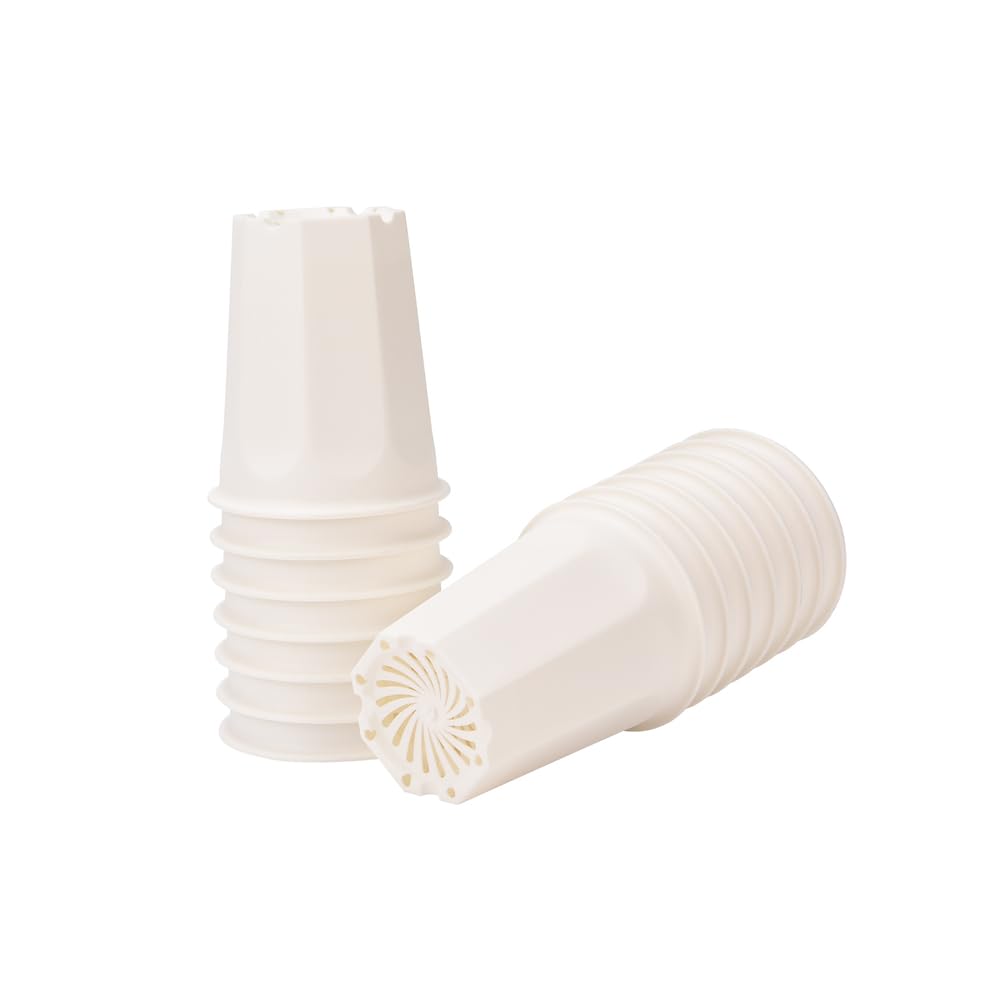
2. BangQiao 14 Pack 4.40 Inch White Plastic Deep Nursery Pots
Designed specifically for plants with a long taproot, making it the natural choice for Venus flytraps and pitcher plants.
You would be hard-pressed to find a better shape ratio for carnivorous plants anywhere near this price. It measures 4.40 inches across at the top but reaches 5.15 inches in height, so the pot is taller than it is wide—exactly what a mature sundew or a young Nepenthes wants its roots to do. BangQiao uses a thicker, more rigid plastic than a standard nursery pot, which buyers report feels solid in the hand and survives multiple seasons without cracking.
The swirl pattern on the bottom is not just for looks: it provides drainage from several angles at once, helping prevent water from pooling in any one spot. Reviewers specifically mention using these for carnivorous plants and tropical pitcher plants, noting that the depth is a welcome alternative to hanging pots or improvised drinking cups. One buyer commented that the “survival rate of young trees has increased 3 fold since I started using these pots,” which speaks to how well the design handles long root systems generally.
At just 14 pots per pack, you get fewer units than some multi-size sets, but each pot is built to be reused year after year. They are stackable for storage between growing seasons, and the vertical flat sides give you a stable grip even when the plastic is wet from bottom-watering.
What makes it the pick: The 5.15-inch depth in a compact 4.40-inch diameter is the ideal cavity for carnivorous roots that grow straight down rather than out sideways. No other pot in this list matches that proportion.
One trade-off to know: The white color hides root development from view—you have to pull the plant out to check on soil moisture and root health, unlike with clear options.
Reach for it if: You are growing pitcher plants, flytraps, or seedlings with taproots that need deep, narrow vertical space.
Look elsewhere if: You want to visually monitor root growth without disturbing the plant—a clear plastic pot would suit you better.
3. SwinDuck 20 Pack 6 Inch Plant Pots with Drainage and Saucers
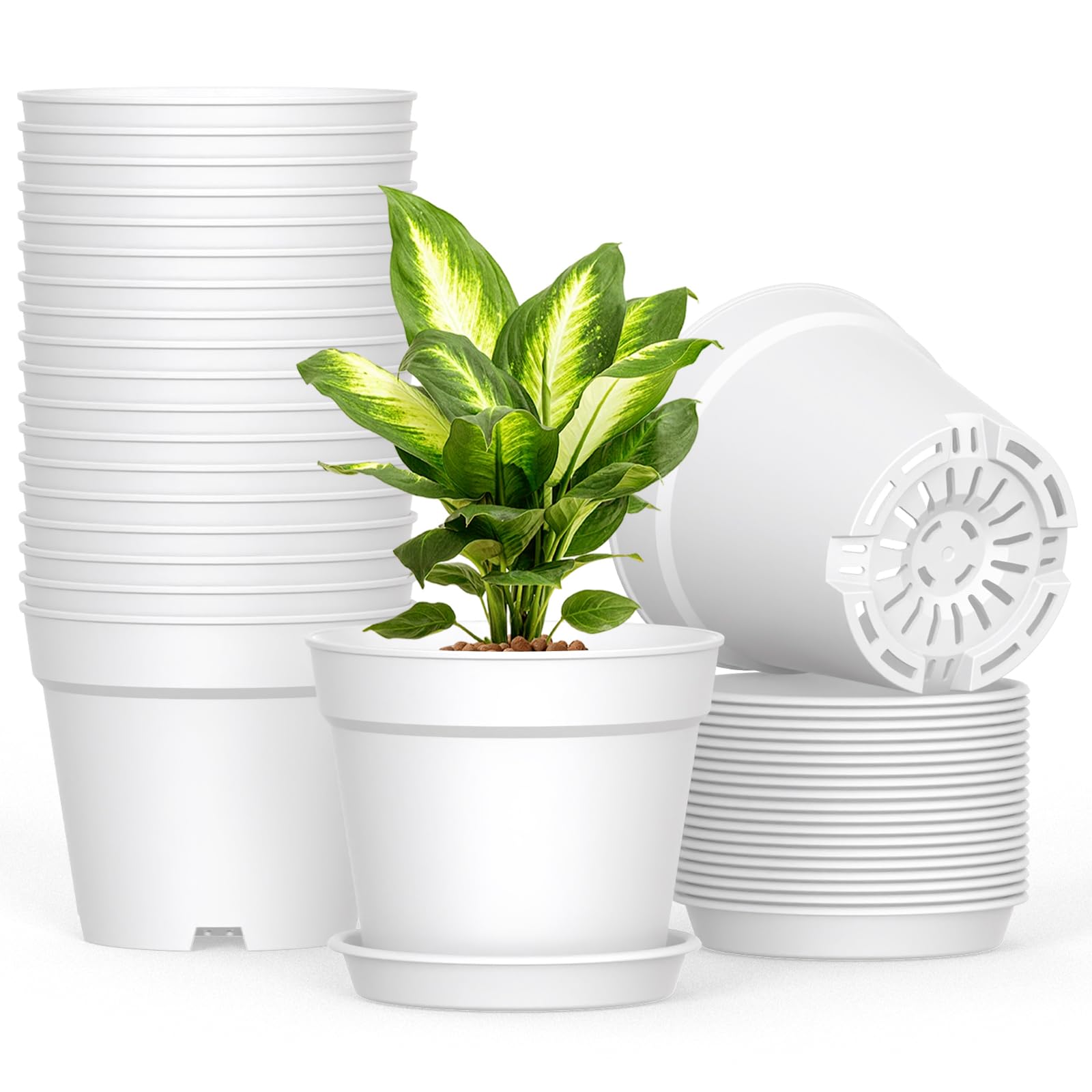
A complete indoor kit with saucers that catch runoff, so you can bottom-water without making a mess on your shelves.
Most nursery pots leave you hunting for a separate saucer that fits. SwinDuck solves that by including matching white saucers with every pot, each designed to catch the excess water that drains out—a practical advantage when you are tray-watering your carnivorous plants from below, which many growers prefer. The pot itself is 6 inches across by 5 inches tall, offering a solid middle ground between shallow seed-starting cups and oversized containers.
Unlike the clear pots further down this list, these are a clean matte white with a smooth, non-glossy surface. They are made from UV-resistant plastic, so if you move your bog garden outdoors for the summer, the pots will not become brittle or fade in direct sunlight. Buyers consistently note that the plastic is thicker than expected and “not flimsy,” and the saucers lock snugly under the pot without wobbling.
The biggest difference from the BangQiao pots above is the shape: at 6x6x5 inches, this pot is as wide as it is tall, which means less vertical root space for the same footprint. That makes it a better fit for plants like butterworts or smaller drosera that spread horizontally rather than plunging deep. At 1.82 kilograms total for the 20-pack, it is the heaviest set here, but the weight comes from the included saucers and thicker walls.
Why it works for carnivorous plants
- Matching saucers let you bottom-water without standing water on your furniture.
- UV-resistant plastic means it holds up on a sunny windowsill or greenhouse.
- Matte finish hides mineral deposits better than clear or glossy pots.
Where it falls short of the top pick
- 5-inch height is notably shorter than the BangQiao’s 5.15 inches, despite the larger diameter.
- White color blocks root visibility—you cannot check soil moisture at a glance.
Your move if: You want a tidy, all-in-one indoor setup with saucers included and UV protection for a sunny window.
Pass if: You are growing deep-rooted pitcher plants or flytraps—the 5-inch height runs shallow.
4. JERIA 30 Pack 6/5/4 Inch Clear Pots

An entry-level price for 30 clear pots that includes the largest single size in this comparison—6-inch plant pots for mature specimens.
If you need big pots without spending premium money, this is the pack to look at. JERIA gives you ten of each size: 4-inch, 5-inch, and 6-inch. That 6-inch pot is the tallest container in the entire roundup by top diameter, offering enough room for a full-grown Sarracenia or a cluster of Venus flytraps. The clear PP plastic is the same type used by the homenote set, so you get the same root-visibility benefit, but the JERIA pots weigh just 0.35 kilograms total—2.4x lighter than the homenote set according to the specs—because the plastic walls are thinner.
That thinness is the trade-off. While owners mention the cups feel sturdy for general use, one reviewer noted “I ended up breaking one so far” while trying to separate pots that were packed tightly together. For carnivorous plants, the 6-inch height is still shallower than the BangQiao’s depth by about an inch, so this is better for spreading-type plants than deep-taproot types. The transparency works well for moisture monitoring, and the multiple drainage holes do a solid job of keeping the growing medium from getting stagnant.
Considering the price per pot, this is the most affordable way to get a 6-inch clear nursery pot if you are willing to handle the plastic gently and do not need the thickest walls available.
The value angle
- Includes 6-inch pots—the largest top diameter in the comparison—for mature carnivorous plants.
- Very lightweight at 0.35 kg total for the whole 30-pack.
- Clear plastic lets you see root growth and moisture without lifting the plant.
The cost-cutting trade-off
- Thinner walls than the other clear options; one buyer mentioned breaking a pot separating the stack.
- Despite the 6-inch diameter, the actual height is less than the BangQiao’s deep shape, so taproots have less room.
Buy these if: You are on a budget, need 6-inch pots, and want to keep an eye on root development through clear walls.
Skip them for: Heavy-handed repotting or if you want maximum durability—the thinner plastic needs careful handling.
5. DUNPUTE 45 Pack Clear Pots (3 to 7 Inch)
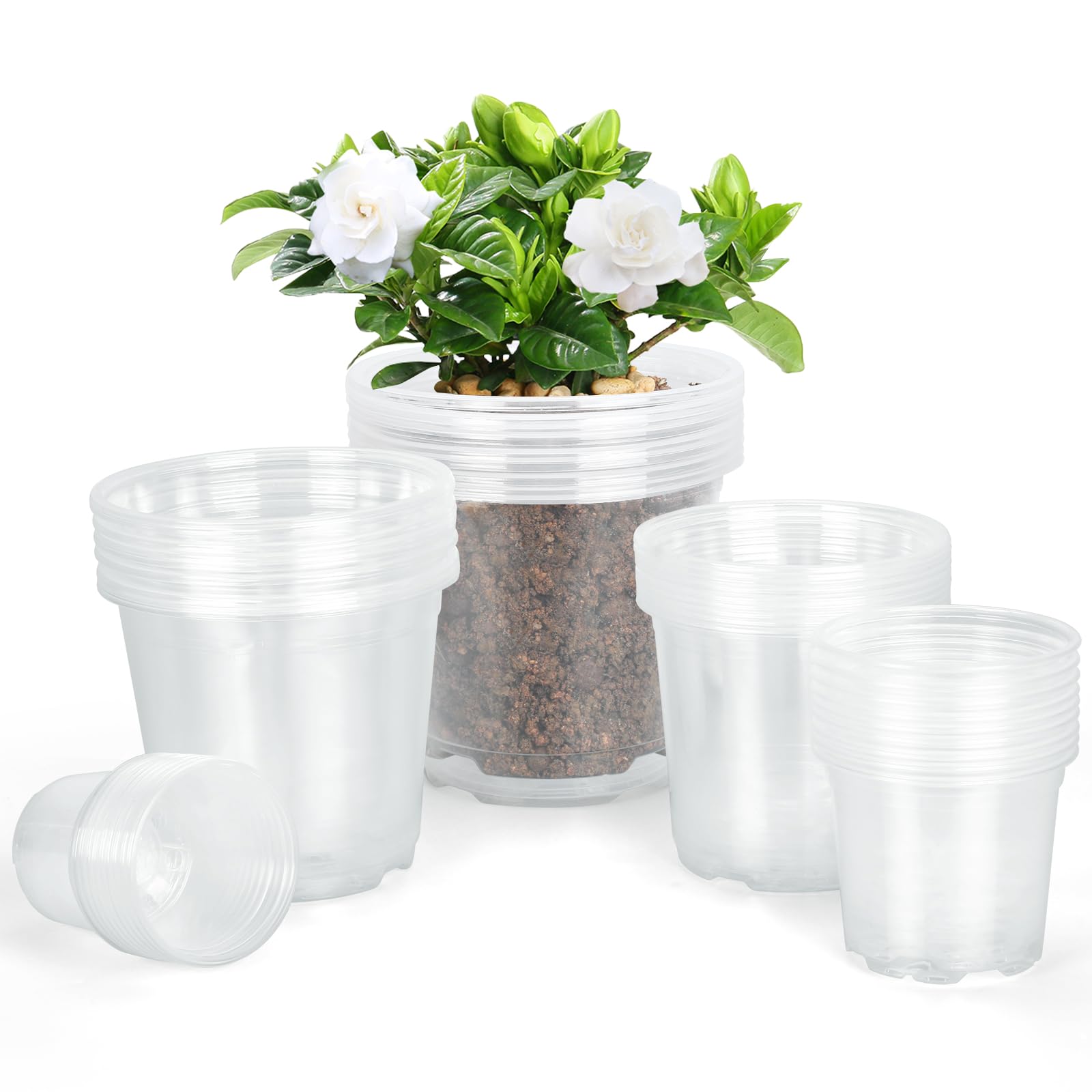
A massive 45-piece variety pack spanning five sizes from 3 to 7 inches, giving you a pot for every stage of growth.
If you maintain a large carnivorous plant collection or run a propagation station, this is the single most comprehensive set in the list. DUNPUTE packs nine pots of each size—3, 4, 5, 6, and 7 inches—totaling 45 clear plastic pots. That 7-inch size is unique here; none of the other packs include anything that large, which means you can move a mature Nepenthes into its permanent home using the same type of pot you used for the seedling.
The clear material is the same PP (polypropylene) plastic used by homenote and JERIA, making it easy to check on root health and soil moisture without disturbing the plant. Buyers describe the pots as durable and good-quality for the price, with one reviewer rooting fig cuttings in them and reporting that the clear wall helps track root growth and avoid overwatering. The “strategically placed drainage holes” are spread across the bottom, not just clustered in the center, so water finds multiple escape routes.
That said, with 45 pots, you are committing to a lot of plastic. The more sizes you have, the more you need to store when they are not in use. And compared to the BangQiao deep pots, even the 7-inch DUNPUTE pot is wider than it is tall—so while it offers plenty of volume, it does not give taproots the same vertical stretch as the BangQiao’s 5.15-inch height does in a narrower diameter. The total package measures 7 x 7 x 6 inches, which is bigger than the homenote pack by 2.6x on one dimension alone.
The strength of this set: class-leading size range. You get 7-inch pots for large plants and 3-inch pots for seedlings, all in one order.
The honest limitation: This is variety over specialization—none of the pots are extra deep, so deep-rooted species still prefer the BangQiao shape.
Ideal for: Enthusiasts with mixed collections spanning seedlings to mature plants, across multiple species.
Not the best if: You are focused solely on deep taproots—the pots are wider than they are tall, which is less ideal for pitcher plants and flytraps.
Understanding the Specs
Pot Depth vs. Diameter
This is the single most important number for carnivorous plants. A pot listed as “6 inches wide” might only be 4 inches tall, which forces the taproot to coil at the bottom. Look for a height measurement that is at least as large as the top diameter—for example, a 4.40-inch pot with a 5.15-inch height is ideal because it channels root growth straight down into the cooler, moister soil at the bottom of the pot.
Drainage Hole Layout
One small hole in the center is not enough. Carnivorous plant soil is typically a mix of peat moss and perlite that holds a lot of water, and stagnant water will quickly rot the roots. The best pots use multiple small holes spread across the base, or a swirl pattern that allows water to exit from several points. Some pots also include a raised center on the inside that lifts the soil slightly off the bottom, which creates an air gap that keeps the lowest layer of soil from getting waterlogged.
Plastic Material and Transparency
Plastic is the default material for carnivorous plant pots because it does not leach minerals or salts into the acidic, nutrient-free soil these plants need. Clear plastic adds a practical benefit: you can see the moisture level through the wall and spot root development without pulling the plant out. White plastic blocks light from hitting the roots (which some growers prefer), but it hides the soil condition. In either case, make sure the plastic is labeled PP (polypropylene) for durability and resistance to UV damage if the pot will sit in a sunny window.
FAQ
Can I use terracotta or clay pots for carnivorous plants?
How tall should a pot be for a Venus flytrap?
Do clear pots harm roots by letting light through?
How many drainage holes are enough?
Can I reuse these pots from one season to the next?
Do I need saucers to grow carnivorous plants indoors?
What size pot should I use for a pitcher plant (Nepenthes)?
Is the “raised base” feature important for drainage?
Can I use these pots outdoors in full sun?
Final Thoughts: The Verdict
Across the board, the pots for carnivorous plants winner is the BangQiao 14 Pack Deep Pots because the 5.15-inch height in a narrow 4.40-inch diameter directly matches the taproot shape that flytraps, pitcher plants, and sundews need to thrive. If you want a tidy indoor setup with saucers included and UV resistance for a sunny window, grab the SwinDuck 20 Pack with Saucers. And if you are building a large collection and need a wide variety of sizes from 3 to 7 inches, the standout is the DUNPUTE 45 Pack Clear Pots for sheer versatility.
How We Picked
We do not accept paid placement. Every pick is matched to a real buyer and a real use-case; we do not hands-on test units.
Sources & Methodology
Specifications: manufacturer listings and product documentation. Review insights: verified customer reviews, as of July 2026. Pricing: not shown on this page (it changes often); check the current price via the retailer link.
As an Amazon Associate, Lawn Gear Lab earns from qualifying purchases. This does not affect which products we feature.