
Specs are compiled from manufacturer listings and verified buyer reviews and can change over time — please confirm the key details on the product page before buying.
Your Green Giant Arborvitae cost real time and money to plant. Give them the wrong food and they yellow, stall, or worse—burn. The right fertilizer for green giant arborvitae pushes dense, fast growth and keeps that deep green color all season. This guide compares six top picks—spikes, granules, and liquids—so you match one to your soil, schedule, and budget.
I’m Rikta — the founder and writer behind Lawn Gear Lab. This guide is built by comparing the manufacturers’ published specifications and the patterns across verified customer reviews, so you get each pick’s real strengths and trade-offs instead of marketing spin.
You want a simple spike to hammer in and forget, or a granular feed for a full row of trees. This roundup covers the best fertilizer for green giant arborvitae to keep your evergreens thriving all season.
Our Picks at a Glance

How To Choose The Best Fertilizer For Green Giant Arborvitae
Green Giant Arborvitae need steady nitrogen to push out dense branches. The wrong fertilizer can starve them or dump too much nitrogen at once and burn the roots. Here is what to look at before you buy.
NPK Ratio: What Your Tree Actually Needs
The three numbers on a bag (N-P-K, or nitrogen-phosphorus-potassium) tell you what your tree gets. For Green Giants, you want a higher first number (nitrogen). Nitrogen fuels the lush, green foliage you want for a privacy screen. A ratio like 12-3-3 or 11-3-4 is ideal for steady growth. Avoid high-phosphorus blends (a high middle number) unless a soil test shows a deficiency—it is rarely needed for established trees.
Spikes vs. Granules vs. Liquid
Your choice depends on convenience versus control. Spikes are the simplest option—you hammer them into the soil and they feed for months. Granules require you to measure and spread them around the drip line (the outer edge of the branches), but you have more control over the amount. Liquids act fastest, which is great for reviving a stressed tree, but they need to be reapplied more often.
Quick Comparison
| Model | Best For | NPK Ratio | Item Weight | Unit Count | Amazon |
|---|---|---|---|---|---|
| Jobe’s Evergreen Spikes★ Best Overall | Value & Simplicity | 11-3-4 | 0.23 Pounds | 9 Spikes | Amazon |
| SimplyGro Fertilizer SpikesAlso Great | Set & Forget Feeding | 12:3:3 | 3 Pounds | 12 Spikes | Amazon |
| Espoma Evergreen-Tone | Organic Gardening | 4:3:4 | 18 lb. Bag | 1 Bag | Amazon |
| Nelson NutriStar | Quick Recovery | 21-6-8 | 4 Pounds | 64 Ounce | Amazon |
| GARDENWISE Evergreen Fertilizer | Long-Term Granular | 8:4:8 | 10 Pounds | 5 quarts | Amazon |
| TPS Nutrients Arborvitae Food | Liquid Rescue | Mixing ratio 2 tbsp/gal | 32 Ounces | 32.0 Ounce | Amazon |
In‑Depth Reviews
1. Jobe’s Slow Release Evergreen Fertilizer Spikes, 9 Count
Our pick — over 4.5★ from 6,500+ verified ratings; the strongest balance of quality and price.
At 0.23 lbs, these are the lightest spikes but the most tried-and-true option.
Jobe’s has been around for a reason. The 11-3-4 NPK ratio is very close to the higher-nitrogen ideal that arborvitae need for dense green growth. These spikes avoid the runoff, mess, and smell that can come with bagged granular fertilizers.
One reviewer noted they have “used it on my trees for two years and they are very happy.” Another buyer warned it burned leaves on certain shrubs, so for arborvitae specifically, it is safe if you follow the label and don’t cluster spikes too close to the trunk. A neighbor’s landscape architect recommended these, providing professional backing.
Smart pick for
- Lowest upfront cost for a simple spike fertilizer.
- Formulated specifically for acid-loving evergreens like arborvitae.
- No mixing, no measuring, no mess.
Watch out for
- Only 9 spikes per box and a much lighter weight of 0.23 lbs vs the 3.0 lbs of the SimplyGro pick.
- Some buyers report burning on non-target plants, so precise placement matters.
A solid start: Perfect if you need a small, cheap pack to test on a couple of trees first.
Not ideal for: A large privacy hedge of 10+ trees—you will run out of spikes fast.
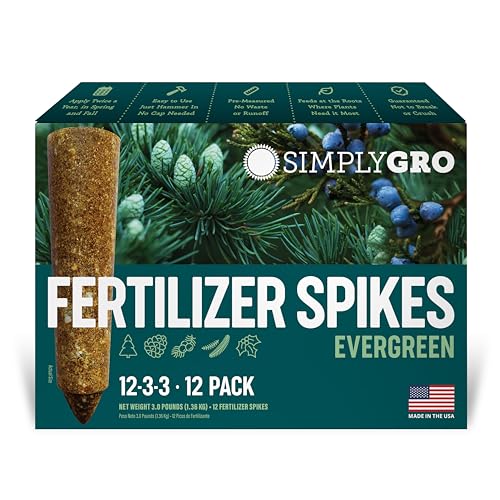
2. SimplyGro Fertilizer Spikes for Evergreen Trees & Shrubs (12 Spikes – 3.0 Lbs)
The spike that feeds for a full season while you do absolutely nothing.
This is the pick if you want to feed your Green Giants without measuring, mixing, or remembering a schedule. Each 5-inch TruSpike packs a 12:3:3 ratio (nitrogen-phosphorus-potassium), heavy on nitrogen, which is exactly what arborvitae crave for dense, green foliage. The 12 spikes weigh 3.0 lbs total, compared to Jobe’s spikes at 0.23 lbs per pack of 9, and the box contains 12 spikes versus Jobe’s 9.
The “low-maintenance” aspect is real. Reviewers report the spikes brought dying trees “back to life in a matter of 2 weeks,” even on sandy soil that tends to drain nitrogen away. The manufacturer guarantees these won’t break, crush, or smash when you hammer them in, a notable upgrade from older spike designs that crumbled.
Why it wins
- 12:3:3 nitrogen-rich ratio matches arborvitae needs perfectly.
- Pre-measured spikes remove any guessing about how much to apply.
- Works up to 3 months per spike, so twice a year is all you need.
One consideration
- Can be harder to drive into compacted clay soil without pre-drilling a hole.
The key choice: This is for the person who wants the strongest, simplest nutrition for a row of trees with zero effort.
Look elsewhere if: You prefer an organic-certified product; this is a synthetic formula.
3. Espoma Organic Evergreen-Tone 4-3-4 Natural & Organic Fertilizer, 18 lb. Bag

A 4:3:4 organic blend with Bio-tone that feeds the soil as much as the tree.
If you want to avoid synthetic chemicals and feed the biology in your soil, Espoma is the go-to. The 4:3:4 ratio is lower in nitrogen than the spikes above (4 vs 12), but because it is an organic granular (derived from natural materials), it feeds slowly as soil microbes break it down. This makes it nearly impossible to burn your trees. The 18 lb. bag covers many more applications than the small boxes of spikes.
One long-time buyer reports “consistent results for years” and refuses to use anything else. It includes 5% sulfur, which helps acidify the soil (a bonus for arborvitae that prefer a slightly acidic pH of around 6.0–7.0). Expect a barnyard smell during and after application; as one buyer put it, “chicken/fowl poop is a main ingredient,” but the evergreens love it.
Why go organic
- Approved for organic gardening with a registered Organic Input Material label.
- Bio-tone formula enhances soil health for long-term root development.
- 18 lb. bag covers a lot of ground—best for a full hedge or multiple trees.
Trade-offs
- Lower NPK ratio (4:3:4) means growth is slower than high-nitrogen synthetic spikes.
- Granules require measuring and spreading; more effort than hammering in a spike.
For the organic gardener: This is the most reliable organic choice for a big, established privacy screen.
Who might skip it: If you want fast, explosive growth and do not mind synthetic fertilizers, a high-N spike will produce faster results.
4. Nelson Plant Food NutriStar 21-6-8 (4 lb.)
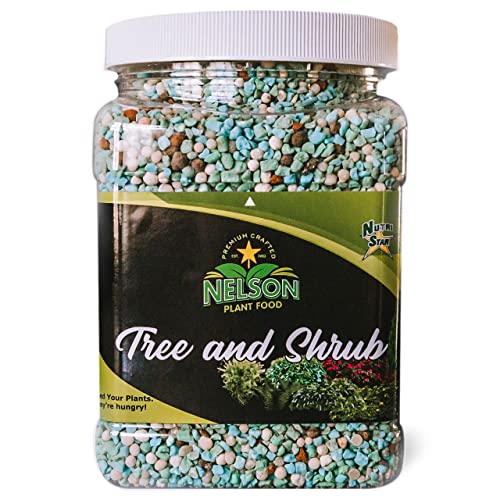
The highest nitrogen content here, designed to green up anemic trees within days.
When your Green Giants look yellow or stunted and you need a fast turnaround, reach for this granular. At 21-6-8, it has the highest nitrogen percentage of any product in this roundup—21% nitrogen compared to the SimplyGro’s 12% nitrogen. It uses five different nitrogen sources, each with a different time-release characteristic (so some feed immediately while others release over time), giving you an instant green-up effect plus a slow feed over 30 days.
Owners mention dramatic results on shrubs that “took an awful hit over winter.” One buyer mentioned their boxwoods “started turning more green” almost immediately after watering in the granules. The manufacturer claims it feeds for 30 days, meaning you’ll apply it monthly during the growing season instead of twice a year like the spikes. That monthly schedule makes it more work than the SimplyGro, but the speed is class-leading here.
When to choose this
- 21-6-8 ratio is the most potent nitrogen source for deep greening.
- Multiple time-release sources give a rapid initial boost plus lasting feed.
- Works on a wide range of trees and shrubs beyond just evergreens.
Caveats
- Risk of root burn if over-applied; must be measured carefully.
- Monthly application schedule is more work than a twice-yearly spike.
Your best bet if: You need to fix a nitrogen deficiency fast and see visible greening within two weeks.
Skip it for: Low-maintenance gardeners who want a single “apply-and-forget” solution.
5. GARDENWISE Evergreen Fertilizer (8-4-8), 5 Quarts
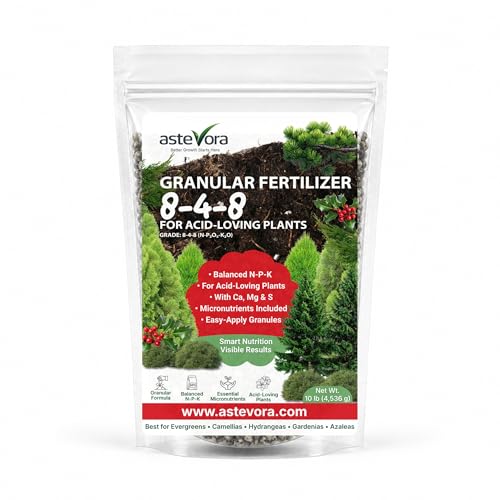
A balanced 8-4-8 slow-release granule that builds roots and resilience.
GARDENWISE takes a different approach by balancing nitrogen with a higher potassium level (8:4:8). Potassium strengthens roots and helps the tree handle winter stress—a key advantage for Green Giants in cold climates. The 10 lb. bag offers a good middle ground between the small spike boxes and the massive Espoma bag, making it a solid choice for a medium-sized hedge of about 4 to 6 trees.
Reviewers have used it to revive struggling evergreens, with one reporting it helped their arborvitae “make it through a very hard winter.” The granular format is easy to spread around the drip line of each tree. One buyer did find the bag contained “larger and unusable pieces of branches” that needed to be sifted out, a quality-control hiccup worth knowing before you spread it.
Why pick this
- Balanced NPK with extra potassium for winter hardiness.
- 10 lb. bag is a good volume for a medium-sized hedge.
- Slow-release formula reduces the risk of root burn.
Things to note
- Some batches contained debris that needed to be sifted out.
- Lower nitrogen than the Nelson or SimplyGro—growth may be slower.
A good bet for: Gardeners in colder climates who want to strengthen their trees before winter dormancy.
Not the best if: You need a pure nitrogen boost for fast vertical growth in spring.
6. TPS Nutrients Arborvitae Tree Fertilizer – Liquid Plant Food, 32 oz
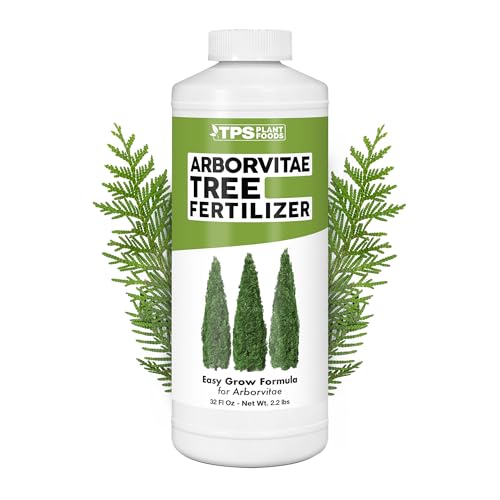
A liquid formula that gets nutrients into the root zone immediately.
While spikes and granules work over weeks, a liquid fertilizer like this one is absorbed within days. It is formulated specifically for arborvitae and supports dense foliage and strong root systems. The mixing ratio is 2 tablespoons per gallon of water, easy to apply with a watering can or hose-end sprayer.
This is the product buyers recommend for trees that have been neglected. One owner reported their trees “survived Chicago winter; neighbor’s unfertilized trees died.” Another user with sandy soil said it “outperformed fertilizer spikes” at reviving dying branches. It does require more frequent reapplication than spikes or granules—think every 2 to 4 weeks during the growing season—making it best for targeted rescue, not a full-hedge maintenance plan.
When liquid wins
- Fastest absorption—ideal for reviving stressed or yellowing trees.
- Specifically formulated for arborvitae, not a general-purpose blend.
- Easy to mix and apply with water.
Limitations
- Needs to be reapplied more often than spikes or slow-release granules.
- 32 oz bottle does not cover as many trees as a large bag of granular.
Reach for this if: You have a few struggling Arborvitae that need an immediate intervention.
Look elsewhere for: Maintaining a large, healthy hedge—the effort of mixing and applying liquid regularly adds up.
Understanding the Specs
NPK Ratio
This is the three-number code on every fertilizer bag (like 12-3-3). The first number is nitrogen, which drives leaf and stem growth—the most important number for Green Giant Arborvitae because dense foliage is your goal. The second is phosphorus, which supports roots and blooms (low priority for established trees). The third is potassium, which helps with overall health and winter hardiness. A higher first number (10–12) is generally better for arborvitae.
Slow-Release vs. Quick-Release
Slow-release fertilizers (most spikes and some granules) meter out nutrients over weeks or months, so one application lasts a long time and the risk of burning roots is low. Quick-release fertilizers (many liquids and some synthetic granules) deliver nutrients immediately, which is great for fixing a problem fast but requires careful measuring and more frequent application. For a low-maintenance hedge, slow-release is usually the smarter choice.
FAQ
When is the best time to fertilize Green Giant Arborvitae?
Can I use a general-purpose lawn fertilizer on my Arborvitae?
How many fertilizer spikes do I need per tree?
Will fertilizer burn my Arborvitae roots?
Is organic or synthetic fertilizer better for Arborvitae?
Why are my Arborvitae turning yellow even after fertilizing?
Can I use liquid fertilizer on newly planted Green Giants?
How deep should I drive fertilizer spikes into the ground?
How often should I water after applying granular fertilizer?
Can I use fertilizer spikes in clay soil?
Final Thoughts: The Verdict
For most people, the fertilizer for green giant arborvitae winner is the SimplyGro Fertilizer Spikes because its high-nitrogen 12:3:3 ratio, long 3-month feeding window, and simple to use spike format cover all the bases for a low-maintenance, healthy hedge. If you want an organic granular option that feeds the soil and is nearly impossible to overdo, Espoma Evergreen-Tone is the top choice. And for a liquid solution to quickly revive stressed trees, the TPS Nutrients Arborvitae Food provides the fastest results.
How We Picked
We do not accept paid placement. Every pick is matched to a real buyer and a real use-case; we do not hands-on test units.
Sources & Methodology
Specifications: manufacturer listings and product documentation. Review insights: verified customer reviews, as of July 2026. Pricing: not shown on this page (it changes often); check the current price via the retailer link.
As an Amazon Associate, Lawn Gear Lab earns from qualifying purchases. This does not affect which products we feature.