
Specs are compiled from manufacturer listings and verified buyer reviews and can change over time — please confirm the key details on the product page before buying.
If your wrists ache after pruning or you dread the stack of branches waiting in the yard, a battery-powered pruner transforms that chore into a trigger-pull. These tools put a sharp, motor-driven blade in your hand so you cut through thick limbs in one second instead of wrestling with manual shears for minutes.
I’m Rikta — the founder and writer behind Lawn Gear Lab. This guide is built by comparing the manufacturers’ published specifications and the patterns across verified customer reviews, so you get each pick’s real strengths and trade-offs instead of marketing spin.
Whether you have arthritis, a large orchard, or just want to finish Saturday chores faster, you need to know which model actually delivers on cut capacity, battery life, and ease of use before you spend a dollar. That is exactly what this guide to the best battery powered pruners does for you.
Our Picks at a Glance

How To Choose The Best Battery Powered Pruners
Before you click “buy”, a few specs decide whether a pruner will feel like a power tool or a toy. Here is a plain‑English look at the features that actually matter for your yard.
Cut Capacity — The Branch Size It Can Handle
This is the single most important number. A pruner with a 1‑inch cut capacity is great for roses and thin saplings, but it stops cold on a 1.5‑inch oak branch. If you regularly trim limbs thicker than your thumb, look for a model advertising a 1.5‑inch or larger maximum cut diameter. Buyers report that the rated spec is often conservative — a pruner rated for 1.5 inches often handles thicker green wood, but dead wood is tougher and may require the full rated capacity or less.
Battery System — Bare Tool vs. Kit
Some pruners come with a battery and charger (a “kit”), while others are “tool‑only” and use batteries from a platform you already own, like DeWalt 20V Max or Milwaukee M12. If you already have a collection of power tools from one brand, a tool‑only pruner saves money and means you share spares. If you are starting fresh, a kit with two batteries is a major advantage — you keep one charging while you keep cutting.
Blade Type — Bypass vs. Anvil
A bypass blade (two curved blades that slide past each other like scissors) makes a clean, precise cut that heals faster on live plants. An anvil blade (one blade cuts down onto a flat surface) can crush softer green stems but handles dead, tough wood well. For general gardening, a bypass blade is almost always the better choice.
Motor — Brushed vs. Brushless
A brushless motor is more efficient, runs cooler, and delivers more torque per watt than a traditional brushed motor. You get more cuts per battery charge and longer motor life. Every premium pick here uses a brushless motor, and several mid‑range models do too.
Quick Comparison
| Model | Best For | Cut Capacity | Weight | Battery Type | Amazon |
|---|---|---|---|---|---|
| DEWALT DCPR320D1★ Best Overall | All‑day heavy pruning | 1.5 Inches | 5.33 lb | 20V Max Kit | Amazon |
| PAOWAFOL B0G344LLN5Best Value | Best value with extra batteries | 2.05 Inches | 1.6 lb | 21V 2‑Battery Kit | Amazon |
| BLACK+DECKER BCPR320C1 | High cut count per charge | 1 Inch | 4.6 lb | 20V Max Kit | Amazon |
| Milwaukee M12 2534-20 | Premium brand integration | 1.25 Inches | 3.28 lb | M12 Tool‑Only | Amazon |
| Gisam PS001 | Large opening for thick wood | 1.6 Inches | — | 21V 2‑Battery Kit | Amazon |
| Scotts PR17215S | Lightweight occasional trimming | 0.5 Inches | 1.8 lb | 7.2V Built‑in | Amazon |
| Okeelney (for DeWalt) | Budget alternative using DeWalt batteries | 1.4 Inches | — | Tool‑Only (DeWalt 20V) | Amazon |
In‑Depth Reviews
1. DEWALT 20V MAX Cordless Pruner (DCPR320D1)
Our pick — over 4.5★ from 650+ verified ratings; the strongest balance of quality and price.
The heavy lifter that keeps cutting from sunrise to sunset.
If your weekend involves clearing overgrown property or lopping branches thicker than your thumb, the DEWALT DCPR320D1 is the tool you reach for. Its 1.5‑inch cut capacity chews through limbs that would stop most cordless pruners dead, and the on‑board LED work light means you see exactly where the blade lands even in dim spots under a tree canopy. The anvil blade design (one blade cuts down onto a flat surface) handles dead, tough wood without jamming, and the non‑stick coating keeps sap from gumming up the cut.
At 5.33 pounds, this is the heaviest pruner in the group — at 5.33 pounds versus the 1.6-pound PAOWAFOL — so you feel the heft during extended overhead work. But the trade‑off is battery stamina that genuinely lasts. Owners mention that “the batteries last all day or at least 90% of the day, with a lot of use,” which matches the 20V Max platform’s reputation. The included charger and battery kit means you have everything from the start.
Reviewers also note it is a game‑changer for arthritic hands — the trigger does all the squeezing so you get clean cuts without joint pain. Just keep your fingers clear; as one owner put it, “this machine will take one off.”
Best for serious cutting sessions
- Powerful 1.5‑inch cut capacity for thick limbs
- All‑day battery stamina reported by owners
- On‑board LED for low‑light work
- Non‑stick coated anvil blade resists sap
The weight trade‑off
- Heaviest pick at 5.33 lb, tiring for overhead use
- Anvil blade crushes green stems — not ideal for delicate live pruning
Reach for this if: you tackle heavy brush, thick branches, and full‑day clearing where battery life and raw cutting force matter more than weight.
Look elsewhere if: you only prune roses or thin saplings — the weight and anvil blade are overkill, and a lighter bypass pruner will serve you better.
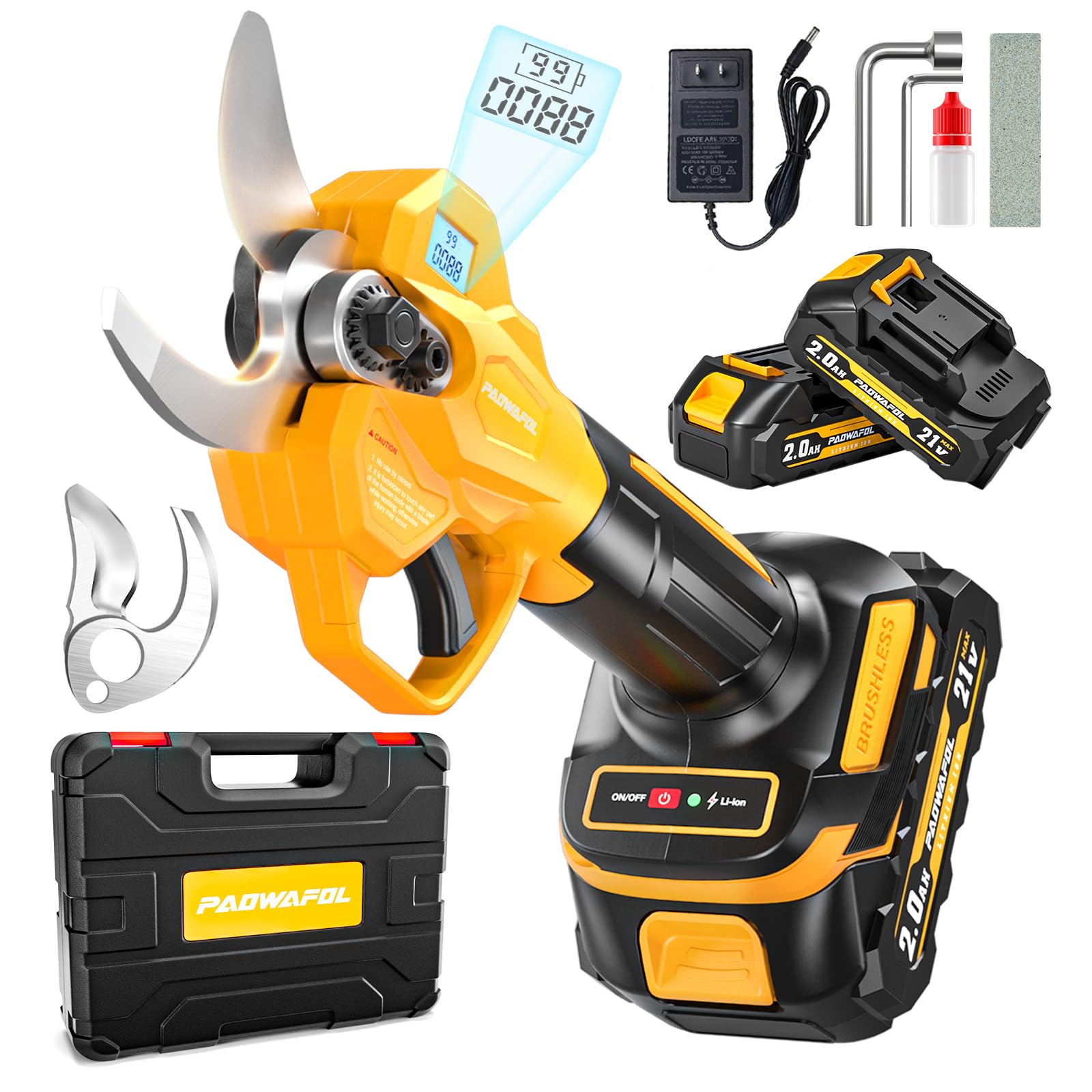
2. PAOWAFOL 2.05″/52mm Electric Pruning Shears
A featherlight branch cutter that punches way above its weight class.
At just 1.6 pounds, the PAOWAFOL is a full 3.3x lighter than the DEWALT above, yet it boasts the highest cut capacity in this entire roundup — 2.05 inches. The imported SK5 high‑carbon steel bypass blades stay sharp through heavy use, and you get two blades in the box so a spare is ready when you need it. Two 2000mAh batteries and a charger are included, meaning the cordless runtime can go as long as you do — swap the depleted pack for the fresh one and keep trimming.
Customers note it “easily cuts through a 2 inch branch,” which backs up the manufacturer’s claim. The brushless motor (a more efficient type of motor that delivers more torque while using less battery) makes that power possible without the weight of a traditional motor. The built‑in safety switch requires you to pull the trigger twice quickly before the blade moves — a feature that prevents accidental starts if you bump the tool while carrying it.
One knock is the included instructions, which some reviewers found lacking. But the tool itself gets consistent praise from owners with arthritis who say it saves their hands, plus the price point is well below premium competitors while matching or beating their specs.
Why it wins on specs
- Industry‑leading 2.05‑inch cut capacity at a budget‑friendly price
- Only 1.6 lb — easy on wrists and shoulders for hours
- Two 2000mAh batteries for non‑stop work
- Bypass blade makes clean cuts on live plants
The honest downsides
- Instructions are sparse — you may need to figure out assembly details on your own
- Not a household brand, so long‑term part availability is uncertain
Snag it for: anyone who wants maximum cut capacity and minimum weight without emptying their wallet — it even beats premium picks on the numbers.
Pass if: you prefer the after‑sales support of a major brand like DeWalt or Milwaukee for warranty and blade replacements.
3. Milwaukee M12 BRUSHLESS Pruning Shears (2534-20)
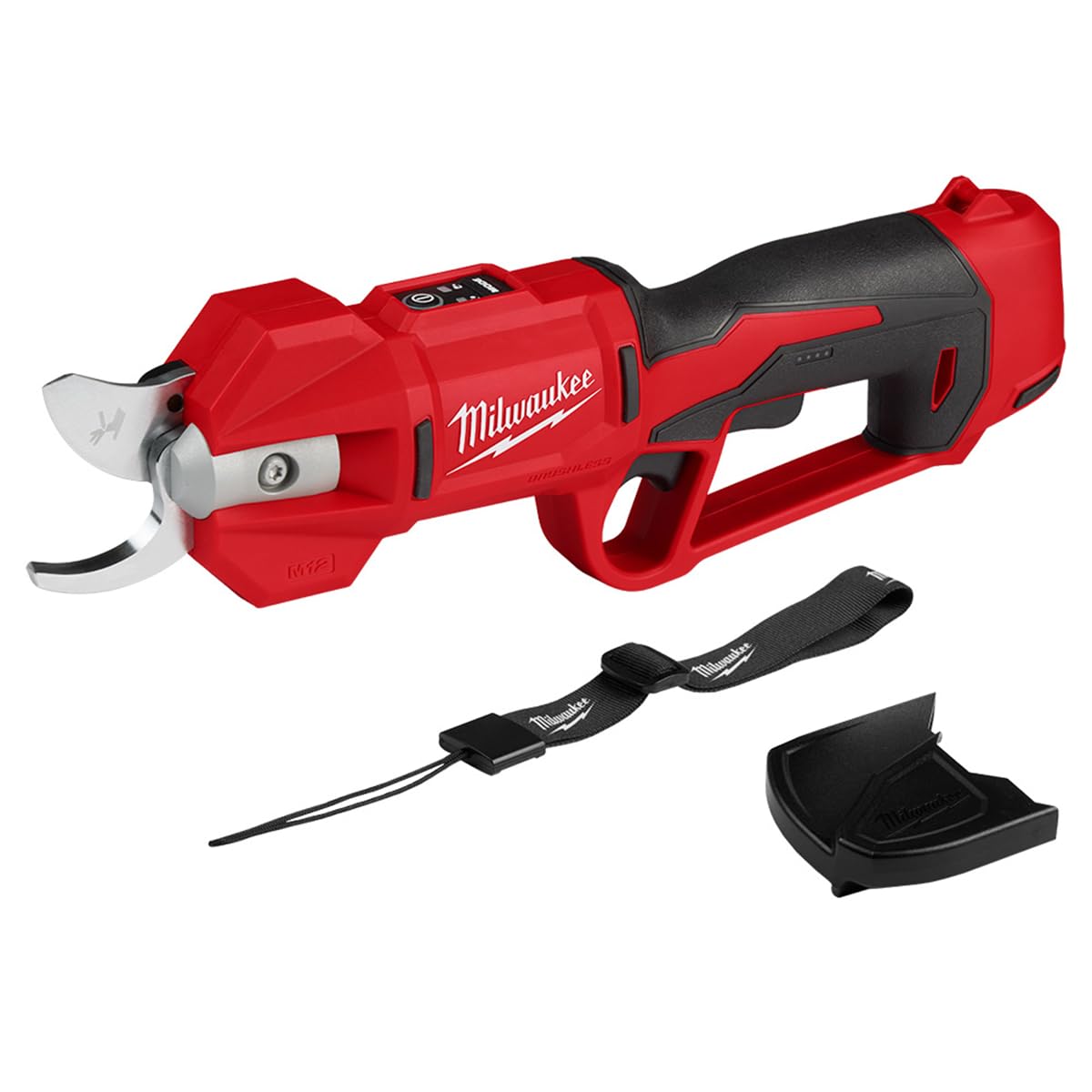
Red‑tier engineering that balances power, weight, and maneuverability.
If you already own Milwaukee M12 tools, this tool‑only pruner slides into your existing battery lineup without adding another charger to the garage wall. The 1.25‑inch cut capacity handles most yard branches, and the brushless motor (a motor without brushes that runs more efficiently and lasts longer) delivers the torque Milwaukee fans expect. At 3.28 pounds, it sits in the middle of the pack — lighter than the 5.33‑lb DEWALT but heavier than the 1.6‑lb PAOWAFOL — and owners say it has good balance and is easy to maneuver even for an 80‑year‑old user.
The dual‑power setting is a practical touch: you can set the blade to open fully or half‑way so the cutting cycle is faster on smaller twigs. One reviewer noted cutting “hundreds of 4‑12″ pieces with a 6Ah battery lasting 45+ min on full charge.” That is serious runtime for a sustained pruning session. A bypass blade design gives you clean cuts that are healthy for live plants like roses and hydrangeas.
A minor quibble: the upward‑facing LED is bright enough to be blinding if you look directly at it, according to owners. This is not a delicate tool for precision tip‑pruning — it lacks the “feel” of manual shears — but for bulk branch reduction it is fast and efficient.
Where it shines
- Integrates into the M12 battery ecosystem — no new charger needed
- Dual opening setting speeds up work on small branches
- Excellent battery life with M12 high‑capacity packs
- Bypass blade for clean, plant‑friendly cuts
What holds it back
- Tool‑only — no battery or charger, which adds cost if you are new to M12
- LED glare can be bothersome if you work at eye level
Best for: Milwaukee tool owners who want a single‑brand solution and need a capable, balanced pruner for medium‑duty yard work.
Skip if: you are starting from scratch — the PAOWAFOL or DEWALT kits include batteries and cut thicker branches for less money.
4. Gisam Electric Pruning Shears (PS001)
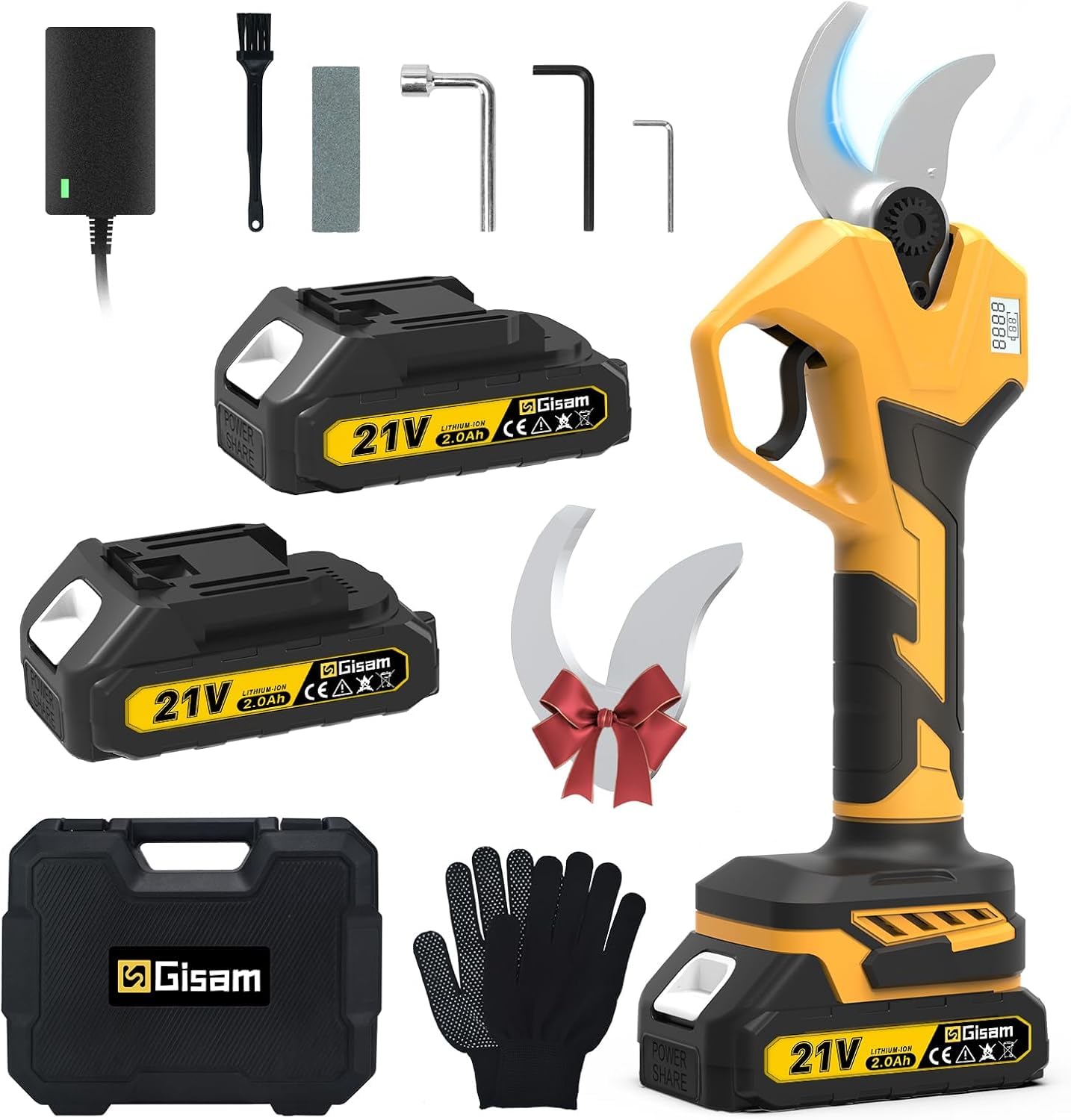
A powerful 1.6‑inch cutter with an LCD readout and dual batteries.
The Gisam PS001 differentiates itself with an LCD display that shows battery status and mode, plus an adjustable blade opening that you can set from 1.77 inches to 2.36 inches depending on branch size. The maximum shear diameter is 1.6 inches (40mm), which puts it ahead of the Milwaukee (1.25 inches) and the BLACK+DECKER (1 inch) on raw cutting power. Like the PAOWAFOL, it uses SK5 blades — a high‑carbon steel known for holding a sharp edge — and a brushless motor for energy efficiency.
Two 2000mAh batteries (milliamp-hours, a measure of energy storage) come in the kit, giving you a hot‑swap option in the field — swap the dead one for the charged one without stopping work. The safety mechanism requires a double‑trigger pull to start, and the tool enters sleep mode after one minute of inactivity to preserve charge. Buyers consistently call it “a beast” and note it “cuts above its weight class,” though one owner mentioned it is “a little bit heavy” compared to ultralight rivals. The brand offers a one‑year after‑sales service with 12‑hour response, which adds confidence for a lesser‑known name.
A practical tip from the maker: dried branches have tougher bark, so if you hit resistance, sharpen the blades or step down to a thinner branch.
Standout features
- Large 1.6‑inch cut capacity for serious wood
- LCD display shows battery level clearly
- Adjustable blade opening (1.77″ to 2.36″)
- Two 2000mAh batteries included
Points to consider
- Weight not listed, but owners note it is not ultralight
- Brand is less established than DeWalt or Milwaukee
Choose this if: you want a high cut capacity with the convenience of an LCD battery gauge and adjustable blade opening — great for orchard work and mixed branch sizes.
Skip if: minimum weight is your priority; the PAOWAFOL is significantly lighter at a similar price and cut capacity.
5. BLACK+DECKER 20V MAX Cordless Pruner (BCPR320C1)
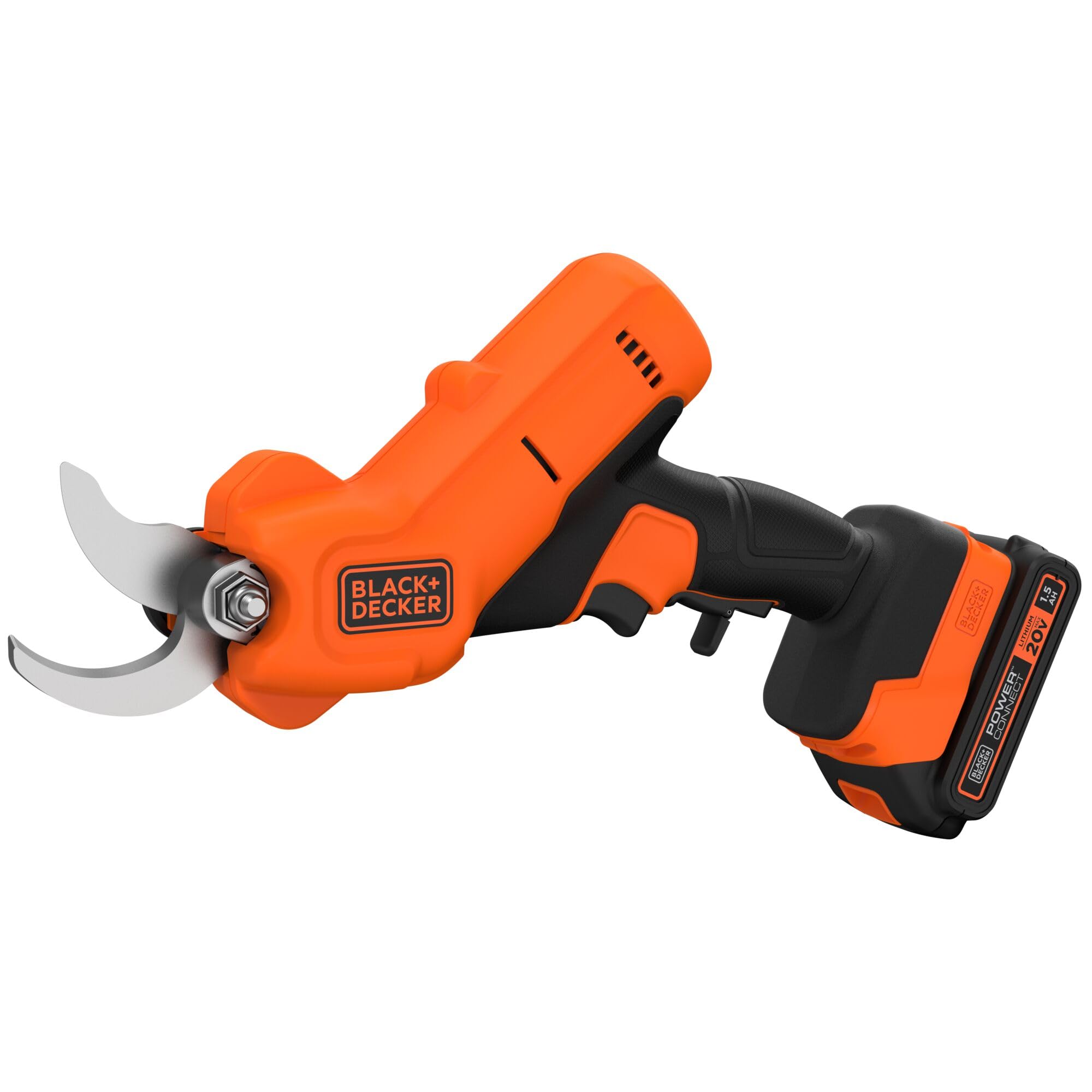
Up to 900 cuts per charge — the endurance champion of the list.
BLACK+DECKER claims this pruner delivers up to 900 cuts per charge on its 20V Max battery, which is a huge number for any cordless garden tool. It cuts at a rate of about one cut per second, so you work through a pile of branches fast. The 1‑inch cut capacity is on the smaller side compared to the 2.05‑inch PAOWAFOL or the 1.5‑inch DEWALT, but it handles the vast majority of routine yard pruning — rose canes, lilac suckers, thin volunteer trees — without struggling. The bypass blade design (two curved blades that slide past each other like scissors) gives a clean scissor‑like cut that is healthy for live plants.
The tool‑free blade change means you swap a dull blade in seconds without hunting for a hex key. A battery and charger are included, so you are ready to go from the start. Reviewers love the battery life — one said “battery life is stellar” — and note it saves hands from blisters that manual pruners cause. The included charger is also compatible with older BLACK+DECKER 20V tools, which is a nice bonus if you already own them.
The honest catch: some users say the tool feels “a little scary” because it is powerful enough that you must keep your holding hand well away from the cutting head. Take it slow as you learn the trigger feel.
What makes it great
- Up to 900 cuts per charge — best in class for stamina
- Tool‑free blade swaps for quick maintenance
- Bypass blade for clean, live‑plant cuts
- Battery and charger included
What limits it
- 1‑inch cut capacity is below the top contenders
- At 4.6 lb, it is heavy for prolonged overhead trimming
Get this for: long days of trimming hundreds of small branches where battery endurance matters more than maximum branch thickness.
Look elsewhere if: you regularly cut branches over 1 inch thick — the PAOWAFOL or DEWALT will handle those without stopping.
6. Okeelney Electric Pruning Shears (for DeWalt 20V Max)
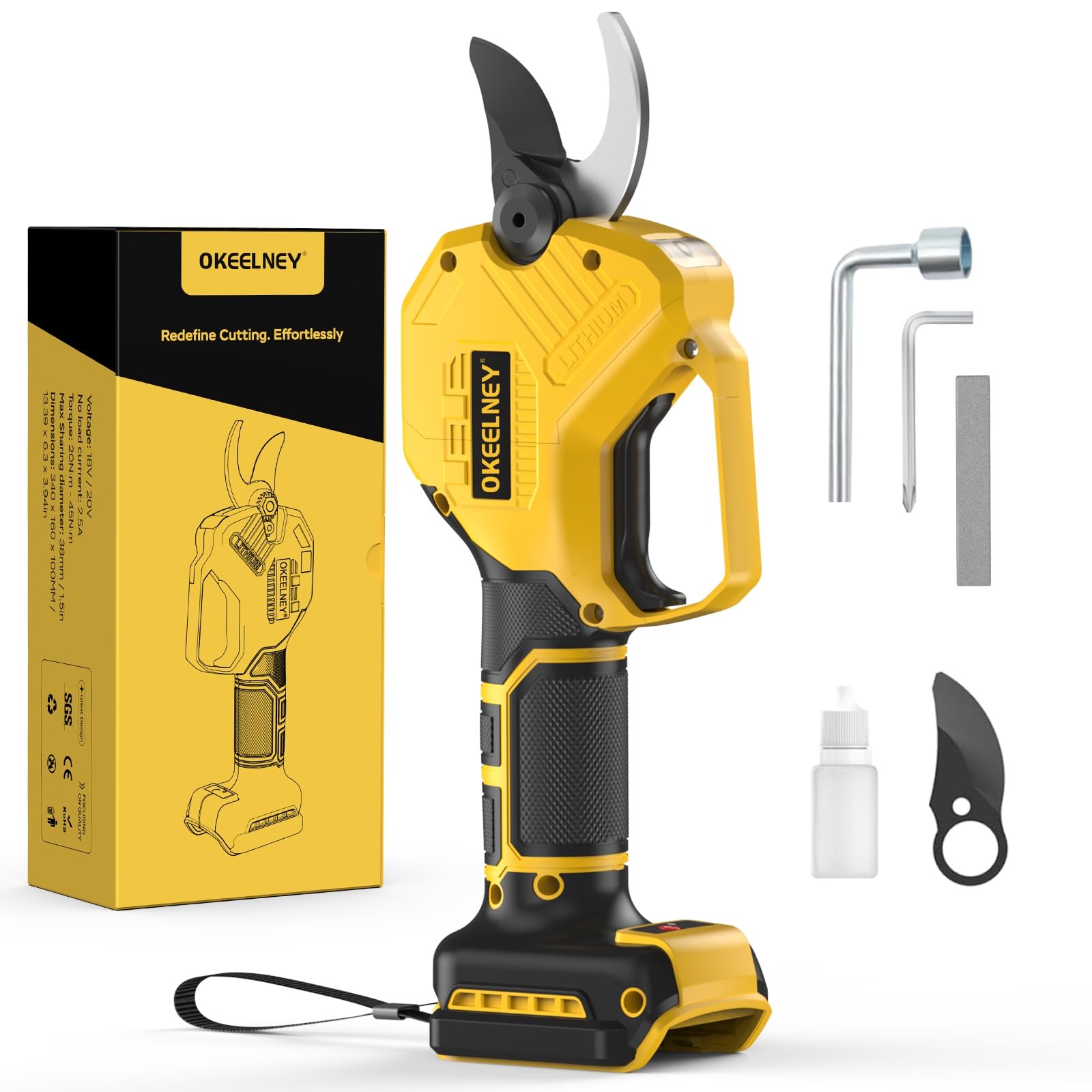
A DeWalt‑battery‑compatible pruner that costs a fraction of the real thing.
If you already have a stack of DeWalt 20V Max batteries from drills, saws, and blowers, the Okeelney is a tool‑only hack that saves serious money. It claims a 1.4‑inch cut capacity — close behind the DEWALT’s 1.5 inches — and uses a brushless motor with Swiss‑grade SK5 high‑carbon steel blades. The dual‑mode cutting adjustment lets you set it to 25mm for smaller twigs or 35mm for bigger branches, so the cutting cycle stays fast on light work instead of opening fully each time. An integrated LED helps you see the blade in dark spots.
Reviewers are surprisingly enthusiastic. One owner said “cut 1 inch limbs with ease probably could go even bigger” and another claimed it “cuts better than Dewalts” while noting the price is much better. The auto‑power‑off kicks in after 2 minutes of inactivity to save battery, and the safety trigger requires a 3‑second press to turn on, which prevents accidental starts in your tool bag.
The biggest downside: no battery or charger in the box, so this only makes sense if you already own DeWalt 20V gear. Also, the brand is newer, so long‑term warranty support may not match a big‑name tool company. Okeelney offers a 1‑year unlimited replacement guarantee and 2‑year limited warranty, which is better than nothing.
Why it is a smart buy
- Fully compatible with DeWalt 20V Max batteries you already own
- 1.4‑inch cut capacity rivals premium pruners
- Dual‑mode opening for faster cycles on small branches
- SK5 steel blade with non‑stick coating
The catch
- Tool‑only — no battery, so only works for existing DeWalt owners
- Brand is not a household name for warranty and parts
Buy this if: you are already in the DeWalt ecosystem and want a battery‑powered pruner without spending on a whole new kit.
Pass if: you have no DeWalt batteries — the PAOWAFOL or Gisam include everything you need for a similar price.
7. Scotts Outdoor Power Tools PR17215S 7.2V Cordless Power Pruner

A lightweight, no‑fuss pruner for quick trimming around the flower bed.
The Scotts PR17215S is the entry‑level option that prioritizes simplicity over raw power. Its built‑in 7.2‑volt lithium‑ion battery (2Ah capacity) is not removable, so you plug the whole tool into the included charger when it runs low. At 1.8 pounds it is very light — barely heavier than the featherweight PAOWAFOL — which makes it easy to carry around the yard for quick touch‑ups. The cushioned grip and compact size mean it fits well in smaller hands, and the dual‑pull safety trigger prevents accidental starts.
The cut capacity is modest — it handles branches up to about half an inch — so it is best for roses, small shrubs, and deadheading flowers (removing spent blooms to encourage new growth). One owner who has used the same unit for five years calls it “one of the best garden tools that I have” and says “it cuts thru any vegetation that will fit in the tool.” Another buyer with carpal tunnel and neuropathy reports it made trimming rose beds “nearly impossible” become easy.
Watch the battery: it is built in, so when it eventually wears out you cannot swap in a fresh pack. The manufacturer includes a 2‑year warranty, and replacement blades are available, though some reviewers point out difficulty finding them after several years of use.
Why it earns a spot
- Very lightweight at 1.8 lb — easy on the wrists
- Simple operation with no separate battery to manage
- Proven reliability — some shoppers say 5+ years of service
- Budget‑friendly entry into cordless pruning
Limitations to know
- Built‑in battery cannot be swapped — tool is down when charging
- Half‑inch cut capacity limits it to lighter trimming only
- Replacement blades can be hard to source
Ideal for: a senior gardener, someone with mild arthritis, or a household that mostly prunes flowers and thin shrubs and wants a simple grab‑and‑go tool.
Not for: anyone who needs to cut branches thicker than a pencil, or anyone who wants multiple hours of continuous runtime without waiting for a charge.
Understanding the Specs
Cut Capacity
This is the thickest branch the pruner can cut in a single pass, measured in inches. A 1‑inch cap handles most roses and thin saplings; a 1.5‑inch or 2‑inch cap tackles real tree limbs. Note that green (living) wood is easier to cut than dry, dead wood — if you mostly prune dead branches, stay at or below the rated capacity.
Bypass vs. Anvil Blade
A bypass blade has two curved blades that slide past each other like scissors, making a clean slice that heals well on live plants. An anvil blade has one blade that cuts down onto a flat metal surface; it crushes green stems a bit but handles dead, tough wood without getting stuck. For general gardening, prefer bypass.
FAQ
How thick of a branch can battery powered pruners cut?
Can I use a DeWalt battery in a pruner that is not made by DeWalt?
How long does a battery charge last in a cordless pruner?
Are battery powered pruners safe for people with arthritis?
What is the difference between a brushed and brushless motor in a pruner?
Can battery pruners cut dead wood or only green branches?
How do I change the blade on a cordless pruner?
What does a safety trigger do on these pruners?
Can I use a battery pruner for delicate pruning like fruit trees?
What should I do if my pruner stops cutting through branches?
Final Thoughts: The Verdict
If you want one dependable pick, the battery powered pruners winner is the DEWALT DCPR320D1 because it combines a powerful 1.5‑inch cut capacity with all‑day battery stamina that real owners confirm. If you want maximum cut capacity and lighter weight at a lower price, grab the PAOWAFOL. And for quick flower‑bed trimming with minimal fuss, the lightweight Scotts PR17215S is the one to pick.
How We Picked
We do not accept paid placement. Every pick is matched to a real buyer and a real use-case; we do not hands-on test units.
Sources & Methodology
Specifications: manufacturer listings and product documentation. Review insights: verified customer reviews, as of July 2026. Pricing: not shown on this page (it changes often); check the current price via the retailer link.
As an Amazon Associate, Lawn Gear Lab earns from qualifying purchases. This does not affect which products we feature.