
Specs are compiled from manufacturer listings and verified buyer reviews and can change over time — please confirm the key details on the product page before buying.
For years, the promise of a robot mower meant burying a boundary wire around your entire yard—a tedious weekend project that got cut in half by the first shovel strike. Today’s best wireless robot mowers ditch the wire entirely, using GPS, LiDAR, or camera vision to map your lawn and mow it in neat rows without you lifting a finger. The hard part now is figuring out which navigation system actually works in your yard, under your trees, and on your slopes.
I’m Rikta — the founder and writer behind Lawn Gear Lab. This guide is built by comparing the manufacturers’ published specifications and the patterns across verified customer reviews, so you get each pick’s real strengths and trade-offs instead of marketing spin.
The wrong choice leaves you with a mower that spins in circles under a tree or drives itself into the road. That is why this roundup of the best wireless robot mower options focuses on three things: real-world obstacle avoidance, slope handling, and the quality of the app-based mapping that replaces the old buried wire.
Our Picks at a Glance
How To Choose The Best Wireless Robot Mower
The switch from a wired to a wireless robot mower is a big leap in convenience, but the technology that replaces the buried wire varies wildly. Before you buy, focus on three areas that make or break the experience.
Navigation: LiDAR, RTK, or Camera Vision
This is the single biggest difference between models. LiDAR (Light Detection and Ranging—basically spinning lasers) builds a 3D map of your yard and works well under trees and near fences where GPS can be spotty. RTK (Real-Time Kinematic—a super-accurate GPS correction system) delivers centimeter-level positioning but needs a clear view of the sky. Camera vision systems use AI to recognize your lawn boundaries, but they can struggle in low light or with overhanging branches. If you have dense tree cover, a LiDAR mower like the ECOVACS models is your safest bet.
Slope Rating and Traction
A mower’s slope rating tells you the steepest incline it can handle, measured in percent (45% means a rise of 45 feet over 100 feet of run—roughly a 24-degree angle). Flat yards are fine for any model, but if your lawn has a visible hill, you want a mower with a rating of at least 45% and preferably four-wheel drive. The Segway Navimow X-series handles an extreme 84% slope, while budget-friendly options top out around 20 degrees.
Cutting Width and Multi-Zone Mapping
A wider cutting deck (measured in inches) means fewer trips across the lawn, which translates to faster total mowing time. Cutting width ranges from about 7 inches on compact models to 17 inches on the heavy hitters. Multi-zone mapping is just as important—it lets you set separate mowing areas for front and back yards, with defined no-go zones around gardens or pools, all managed from a single app.
Quick Comparison
| Model | Best For | Navigation Type | Max Cutting Height | Cutting Width | Amazon |
|---|---|---|---|---|---|
| ECOVACS Goat O1000 LiDAR PRO★ Best Overall | Complex layouts under dense trees | 360° Dual-LiDAR + AI Vision | 3.6 in | 8.66 in | Amazon |
| MOVA LiDAX Ultra 2000Premium Power | Zero-RTK setup with 3D LiDAR | 360° 3D LiDAR + AI Vision | 3.9 in | 8 in | Amazon |
| Segway Navimow X430Slope Master | Steep slopes and tough terrain | Tri-frequency RTK + 360° Vision | 4 in | 17 in | Amazon |
| Segway Navimow X450 | Larger acreage, 1.5 acres | Tri-frequency RTK + 360° Vision | 4 in | 17 in | Amazon |
| ECOVACS Goat A3000 LiDAR PRO | Thick grass, larger lawns | 360° Dual-LiDAR | 3.6 in | 12.99 in | Amazon |
| Worx Landroid Vision Cloud 4WD | PTK cloud nav, extreme slopes | RTK Cloud + AI Vision | 3.54 in | 8.7 in | Amazon |
| Husqvarna Automower 410iQ | Brand reliability, EPOS nav | EPOS RTK + Radar | 4 in | 9.4 in | Amazon |
| ANTHBOT Genie 3000 | Weak-signal areas, 4-eye vision | Full Band RTK + 4-Eye Vision | 2.76 in | 7.9 in | Amazon |
| ANTHBOT M9 | Entry-level, beginner-friendly setup | Dual Vision + Full-Band RTK | 2.7 in | 7.9 in | Amazon |
| YARDCARE N1600 PRO | Budget pick, RTK + Vision | RTK + AI Vision | 2.4 in | 7.09 in | Amazon |
In‑Depth Reviews
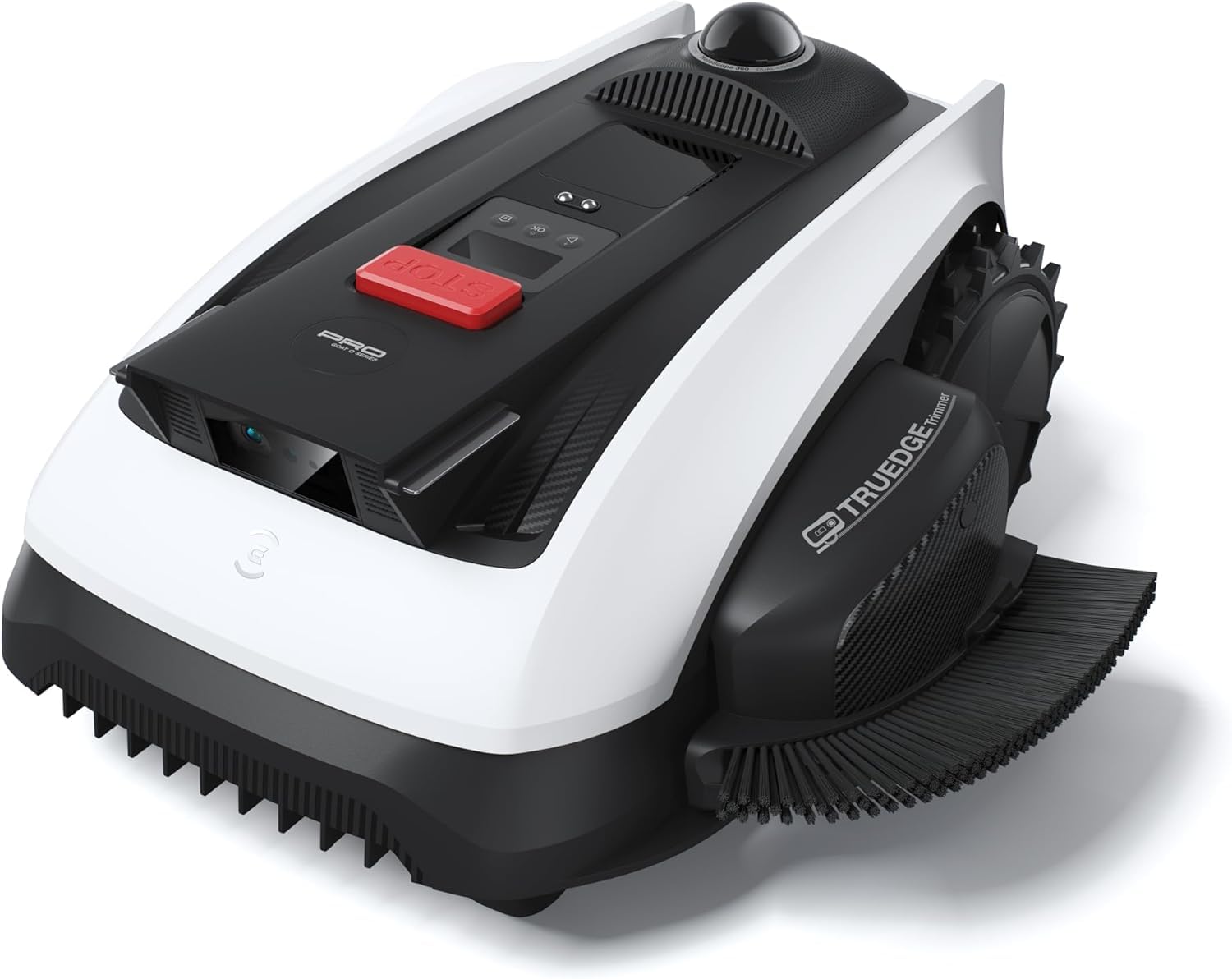
1. ECOVACS Goat O1000 LiDAR PRO Robot Lawn Mower
Our pick — over 4★ from 100+ verified ratings; the strongest balance of quality and price.
The wire-free mower that sees around every corner, even under a shady oak.
The defining move here is the HoloScope 360° Dual-LiDAR system, which builds a precise 2 cm map of your yard without needing a single perimeter wire or an RTK antenna (a pole that needs a clear view of the sky for GPS correction). That matters because it keeps mowing accurately under trees, along fences, and in shaded spots where RTK-based mowers typically lose their signal and start guessing.
Buyers also get a built-in TruEdge trimmer that cuts right along driveways and flower beds, reducing the string-trimming follow-up. The AI Vision and 3D ToF LiDAR (Time-of-Flight—a sensor that measures distance by bouncing light) can identify over 200 types of obstacles, from a forgotten sprinkler to a lounging dog, with detection precision down to 5 cm. The adjustable cutting height maxes out at 3.6 inches, versus the YARDCARE’s 2.4 inches, which gives you more flexibility for longer grass or warm-season lawns.
One thing to note: the 1/4-acre coverage rating means it fits small-to-medium yards best, and the plastic build keeps it lighter than steel-framed competitors. The super-narrow body (passes through spaces as slim as 0.8 m) is a real advantage if you have side gates or tight pathways that bulkier mowers can’t squeeze through. Reviewers praise the precise mapping, though a few mention the initial app setup takes a few tries to get no-go zones perfect.
LiDAR-first confidence: If your yard has tree cover or tricky corners that confuse GPS mowers, this is the most reliable wire-free option for the size. The Dual-LiDAR keeps cutting where others stop spinning.
precise navigation: Homeowners with a 1/4-acre or smaller lawn that has trees, fences, or shaded strips where GPS mowers falter.
needs clear paths: The 1/4-acre max coverage means larger properties will need a different pick, and occasional manual trimming may still be needed on very complex raised edges.
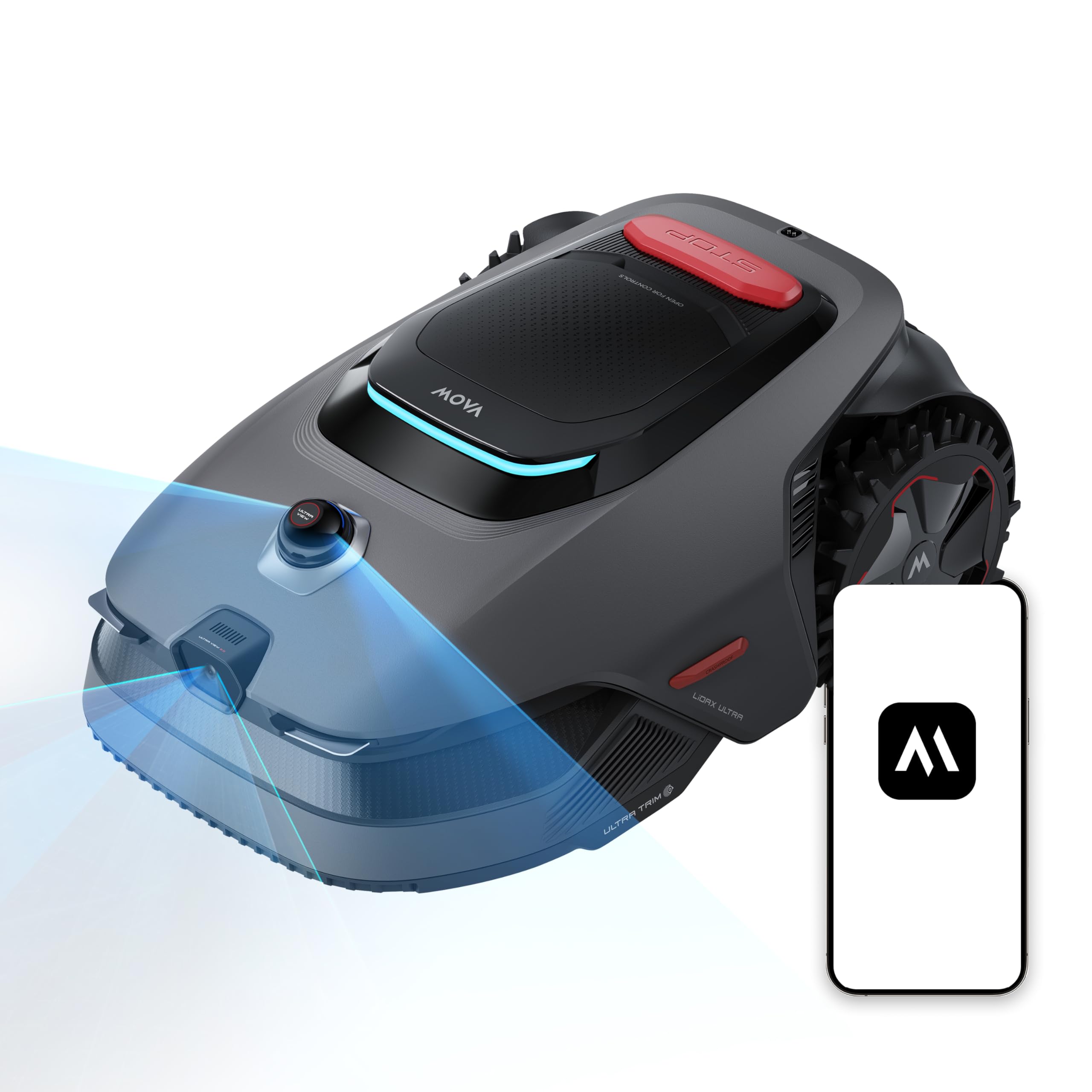
2. MOVA LiDAX Ultra 2000 Robot Lawn Mower
A 3D LiDAR brain that maps your lawn without a single RTK antenna or wire.
This is one of the few premium mowers that completely skips the RTK station (the extra pole and receiver many systems need). Instead, it relies on 360° 3D LiDAR and AI vision to auto-map your yard in 3D with centimeter accuracy, even in dim or harsh light. The cutting height adjusts from a short 1.2 inches up to 3.9 inches — a wider range than the ECOVACS Goat O1000’s 3.6-inch max, which is handy if you like to vary your grass length by season.
The UltraTrim 1.0 movable disc cuts within 2 inches of walls, hedges, and raised edges, and the rear-wheel drive with off-road tires handles slopes up to 45% and obstacles up to 1.6 inches high. The 60-minute battery average life, combined with auto-return-and-resume, actually covers 0.5 acre if the lawn isn’t insanely complex. A 3-year manufacturer warranty comes standard, which is longer than most competitors’ coverage. One reviewer noted the setup takes about an hour and that it can get stuck in loose mulch or dirt—so set no-go zones for those spots.
Dual-map support means you can store separate maps for a front and back yard on a single mower, which removes the need to remap if you move the unit between properties. The 150 managed zones are overkill for most buyers, but the flexibility is there if you have a highly landscaped lot with many defined sections.
LiDAR without extra gear: The cleanest wire-free setup on the list — no RTK antenna, no perimeter wire, just power on and map. Built for buyers who want minimal hardware clutter in their yard.
sensor simplicity: Owners of 0.5-acre lots who want the simplest possible wireless installation and a 3-year warranty for confidence.
lacks redundancy: A few reviewers report false obstacle detection (dandelions, invisible pets) causing stops, and the 8-inch cutting width means it takes longer to cover the lawn than 17-inch models.
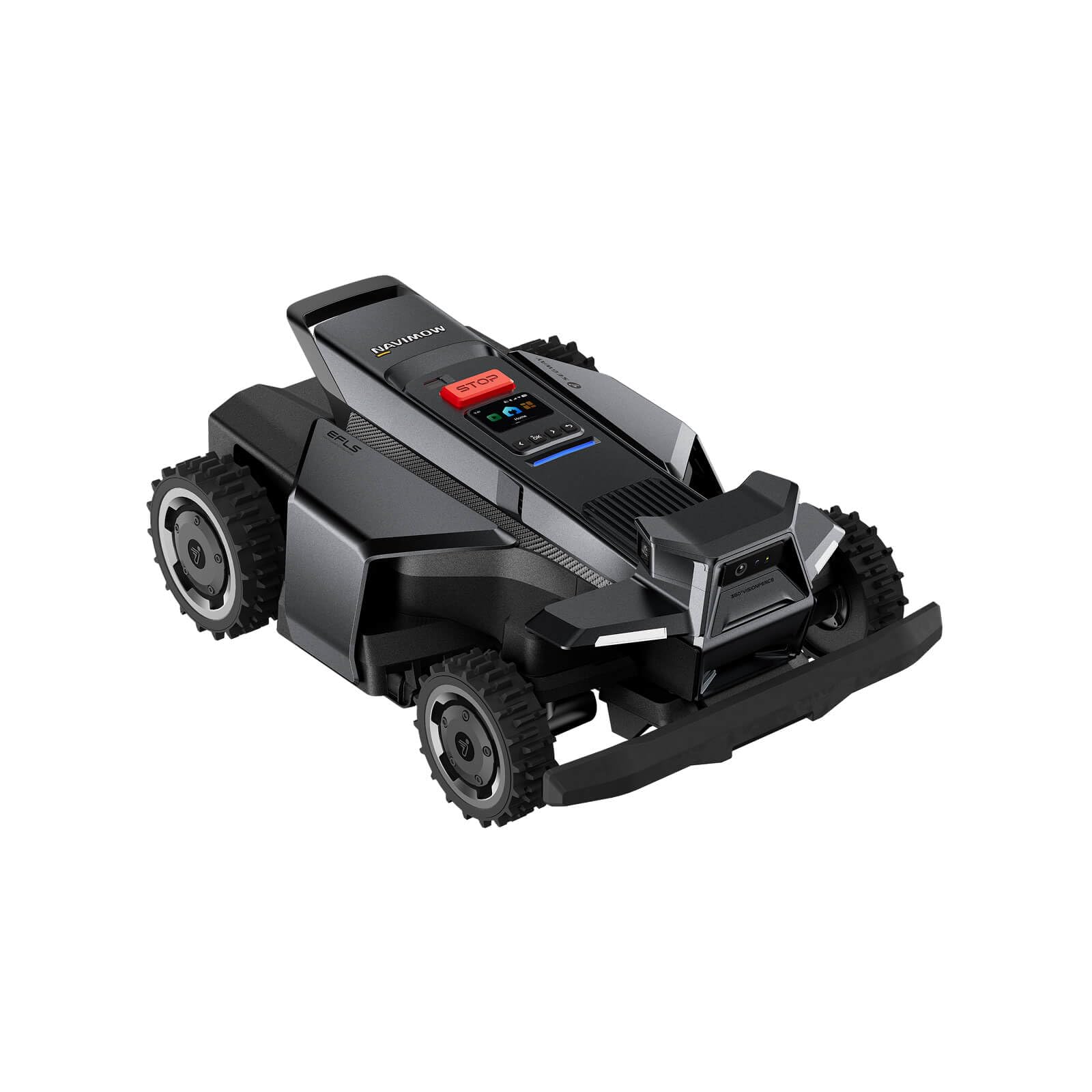
3. Segway Navimow X430 Robot Lawn Mower
The 4WD mower that treats your 40-degree hill like flat ground.
The stand-out spec here is the 84% slope rating (a 40-degree angle) — that is nearly twice as steep as what the 45%-rated mowers can handle. The ORV-tuned dual suspension system (Off-Road Vehicle—the same kind of shock absorption found on ATVs) helps all four wheels stay planted on uneven terrain, and the Xero-Turn AWD steering prevents turf scuffing during tight turns. Dual 180W motors spin a 17-inch cutting width with 12 blades, which is roughly double the cutting width of many competitors, so the X430 covers more ground faster.
The EFLS tri-frequency Network RTK (Enhanced Fusion Location System—uses three GPS signal bands for better accuracy) combined with a 360° Vision camera ensures centimeter-level positioning even under trees or along fences, where single-frequency RTK often drops out. The AI-powered VisionFence system recognizes over 200 obstacle types — from kid toys to pets — and adapts its path. The 63.71-pound weight gives it serious traction on slopes, but one buyer mentioned the mower is so heavy you cannot easily carry it to the charger if the battery dies during mapping.
Buyers report the X430 delivers a clean, patterned cut (parallel, checkerboard, or diamond) and the EdgeSense feature reduces trimming margins to under 2 inches. The main trade-off: the large 17-inch cutting width and 17-inch cutting height range from 0.75 to 4 inches means it handles lawns from short bermudagrass to tall fescue. One owner reported getting a defective charging dock from the start, though replacement parts fixed the issue.
extreme-terrain specialist: If your yard has a hill that makes you nervous on a riding mower, this is the wireless mower that handles it without tearing the turf.
steep slopes: Homeowners with steep, uneven lawns up to 1 acre who want the fastest total mow time thanks to the wide 17-inch cutting deck.
narrow pass: The hefty 63.71-pound weight makes it cumbersome to move manually, and a few buyers have reported early firmware navigation bugs that required support intervention.
4. Segway Navimow X450 Robot Lawn Mower
The acreage buster that cuts a 17-inch swath through tall grass.
This is the bigger sibling of the X430, rated for up to 1.5 acres versus the X430’s 1 acre, while keeping the same 17-inch cutting width and dual 180W motors. The Xero-Turn AWD (All-Wheel Drive with a zero-turn radius—so it spins in place without ripping the grass) and ORV-tuned suspension let it handle the same 84% slopes. The 2.6 ft/s mowing speed, combined with the 12-blade dual cutting discs, means it chews through denser St. Augustine or tall fescue without bogging down. One reviewer who upgraded from a Mammotion Luba 2 said the X450’s protected blade system (the blades sit sandwiched between mowing discs) prevents grass clippings from jamming the blades—a common headache on other models.
The EFLS tri-frequency Network RTK + 360° Vision setup maintains that centimeter-level accuracy across the full 1.5 acres, and the EdgeSense system keeps trimming margins under 2 inches. The X450 also supports GeoSketch (drawing mowing zones on a map in the app), GeoFence alerts, and voice control via Alexa or Google Home. At 63.7 pounds, it is heavy but the 4WD traction means it rarely gets stuck. One customer observed a learning curve for the initial mapping drive, but once the boundary is set, it stays exactly the same every mow.
The adjustable cutting height covers 0.75 to 4 inches across 11 positions, so you can fine-tune the grass length more precisely than the 5-position mowers. The mower sends lift alerts if someone tries to pick it up, and the GPS tracking adds anti-theft confidence.
large-lot workhorse: The widest cutting path and highest acreage rating among these picks means fewer recharge cycles and a faster finished lawn for bigger properties.
big lawns: Anyone with a 1 to 1.5-acre sloped lawn who wants the fastest mow time and doesn’t mind the weight for the stability it provides.
hard to move: The price sits at the premium end of the market, and the 63.7-pound weight makes it a two-person job to reposition manually.
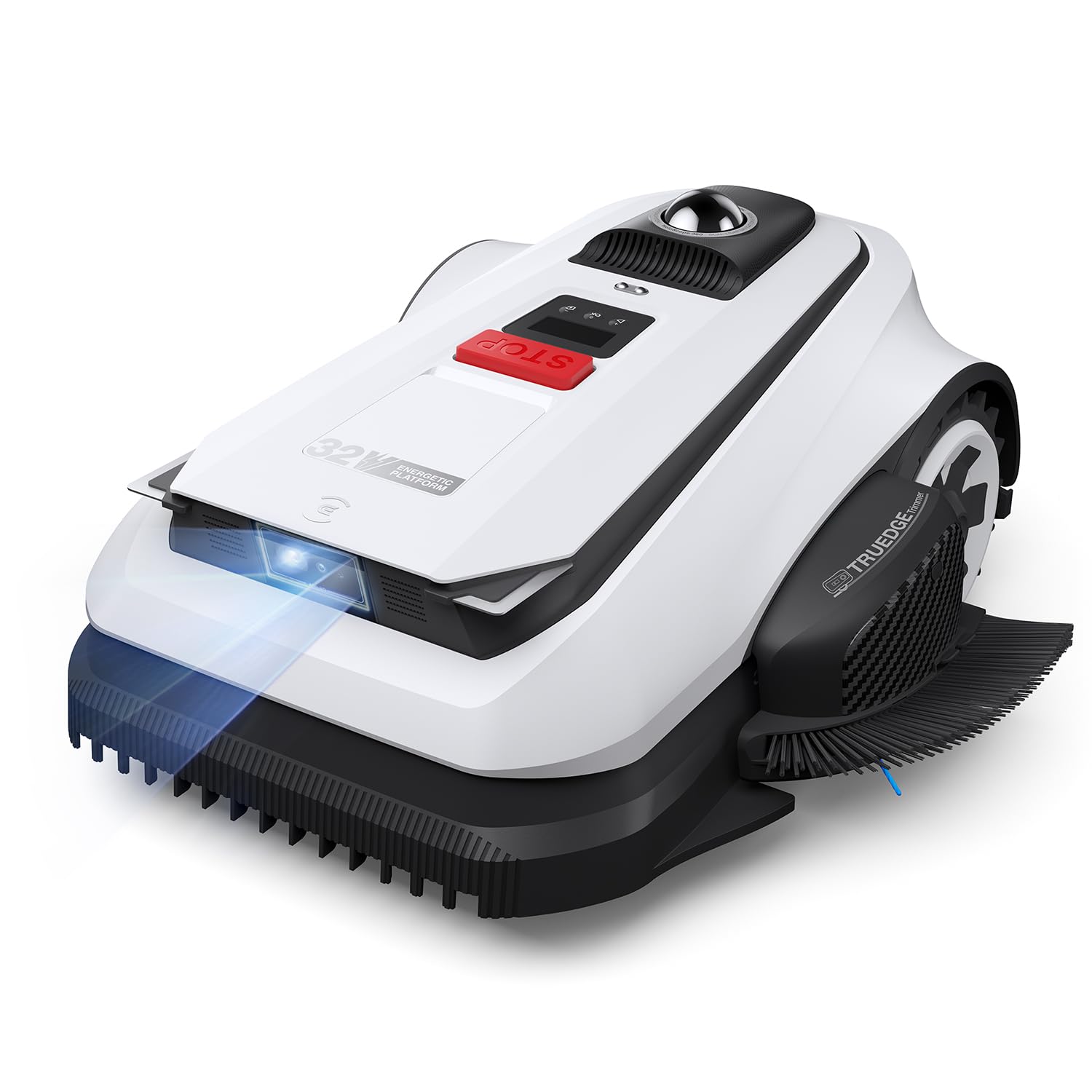
5. ECOVACS Goat A3000 LiDAR PRO Robotic Lawn Mower
A 32V power system built to chew through Bermuda and St. Augustine without stalling.
The headline feature is the 32V high-power platform combined with a 7500 mAh battery that recharges in about 70 minutes thanks to the 189W fast charging system. That means less downtime between mowing sessions, which matters if you have thick warm-season grass like Bermuda or Zoysia that needs frequent cutting. The 12.99-inch cutting width is a middle ground between the 8.66-inch O1000 and the 17-inch Segway—wide enough to make progress fast but narrow enough to navigate through gates and tight corners.
Built for up to 3/4 acre, the A3000 uses the same HoloScope 360° Dual-LiDAR navigation as the O1000, so it maps without wires or an RTK antenna and keeps 2 cm precision under trees. The integrated TruEdge trimmer handles borders along driveways and flower beds. The cutting height spans 1.2 to 3.6 inches, good for 3/4-acre lot owners who want a manicured finish without manual trimming. One reviewer called it “among the most impressive smart yard tools I’ve owned” and noted the edge trimming worked better than expected.
The app control lets you set multiple mowing zones, no-go areas, and travel paths between separated lawn sections — useful for yards with a fence dividing front and back. However, one user highlighted a bug where the app forced two separate mapped areas to merge as one, despite a fence between them, which suggests the app’s zone management still has edge cases ECOVACS needs to fix.
thick-grass specialist: The 32V system and fast charging give it a clear edge over lower-voltage mowers when your lawn is dense, fast-growing, and needs frequent passes.
dense turf: Owners of 1/2 to 3/4 acre lawns with thick, warm-season grass like St. Augustine or Bermuda who want the fastest recharge time between mows.
budget strain: A few buyers have reported the app’s zone-merging logic can be buggy if your lawn has a fence with a narrow passage between two sections.
6. Worx Landroid Vision Cloud 4WD Robot Lawn Mower
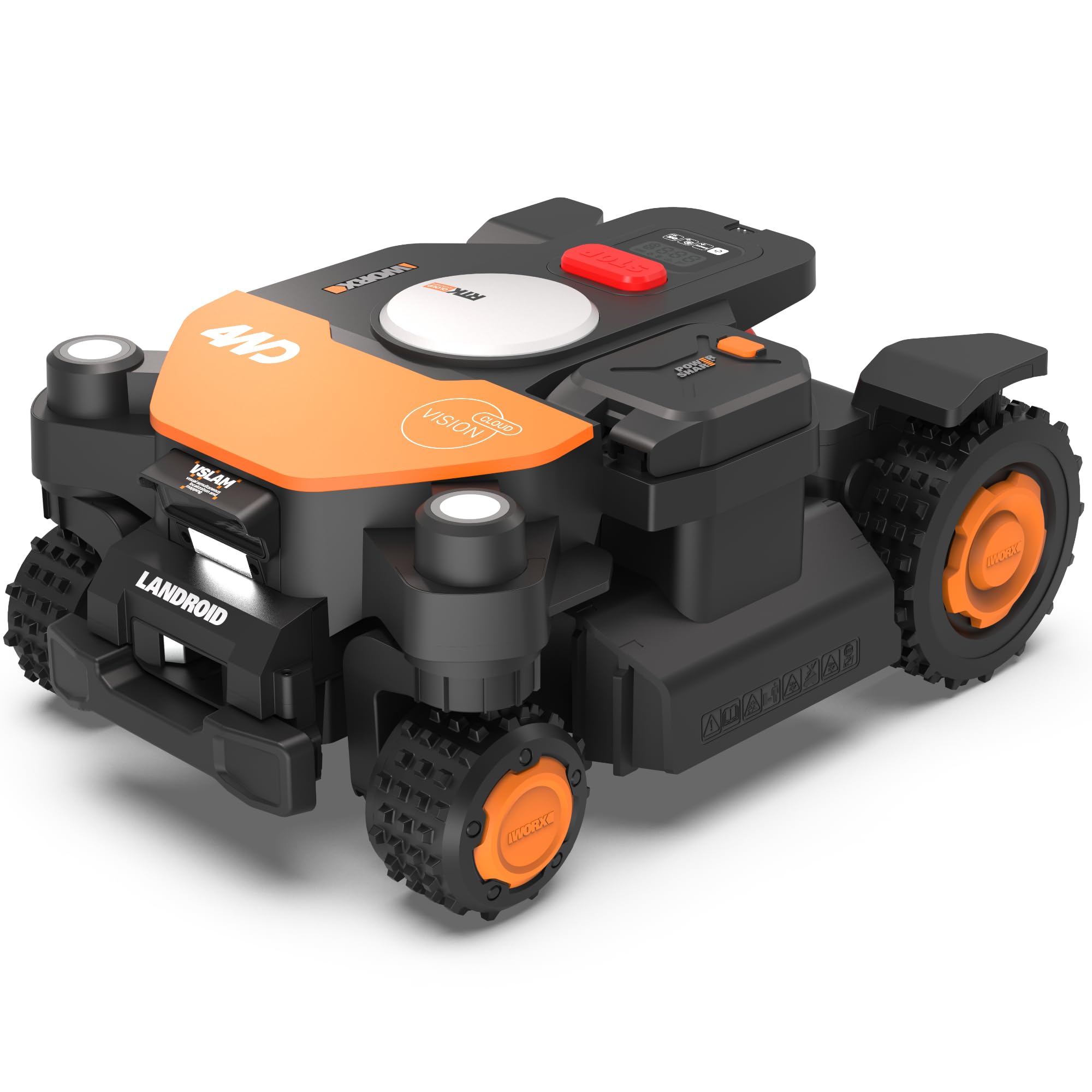
RTK accuracy beamed from the cloud—no antenna pole cluttering your yard.
The Worx Vision Cloud takes a clever approach: the RTK correction data comes straight from the cloud via a 4G cellular connection, so you never install a local reference station. That removes one of the biggest setup headaches of RTK mowers. The AI Vision system, powered by a neural network capable of 10 trillion operations per second, identifies obstacles and understands boundary types, letting it decide which edges it can ride over for closer cutting. The Cut-to-Zero offset blade trims right along fixed borders, reducing the need for a string trimmer.
The 4WD chassis handles slopes up to 84% (the same extreme rating as the Segway Navimow), and the adaptive suspension keeps all four wheels planted on uneven transitions like raised borders or curbs. The cutting width sits at 8.7 inches with a height range of 1.57 to 3.54 inches across 7 positions. The mower supports unlimited zones, which is unique among these picks, and you can switch between Parallel, Checkerboard, or Diamond mowing patterns from the app. The FiatLux LED light system lets you mow after dark safely.
Buyers with 0.7-acre rolling yards report the auto mapping works well after a manual boundary tweak. The “Find My Landroid” feature includes GPS tracking and cellular connectivity to locate the mower even when powered off. That said, one buyer experienced persistent firmware update errors and an auto-mapping failure, calling it a “lawn ornament” after setup attempts failed. A strong 2.4 GHz Wi-Fi signal is essential for setup, and a few reviewers needed a Wi-Fi extender.
no-pole RTK: This is the cleanest RTK installation available—cloud-processed correction means one less piece of hardware to mount and power in your yard.
wire-free setup: Tech-savvy owners with a strong home Wi-Fi network and a yard up to 1 acre who want cloud-based RTK without any antenna hardware.
needs good light: Setup firmware issues and Wi-Fi dependency can make initial configuration frustrating; auto-mapping may fail on yards with weak signal, requiring a manual boundary walk.
7. Husqvarna Automower 410iQ Robotic Mower
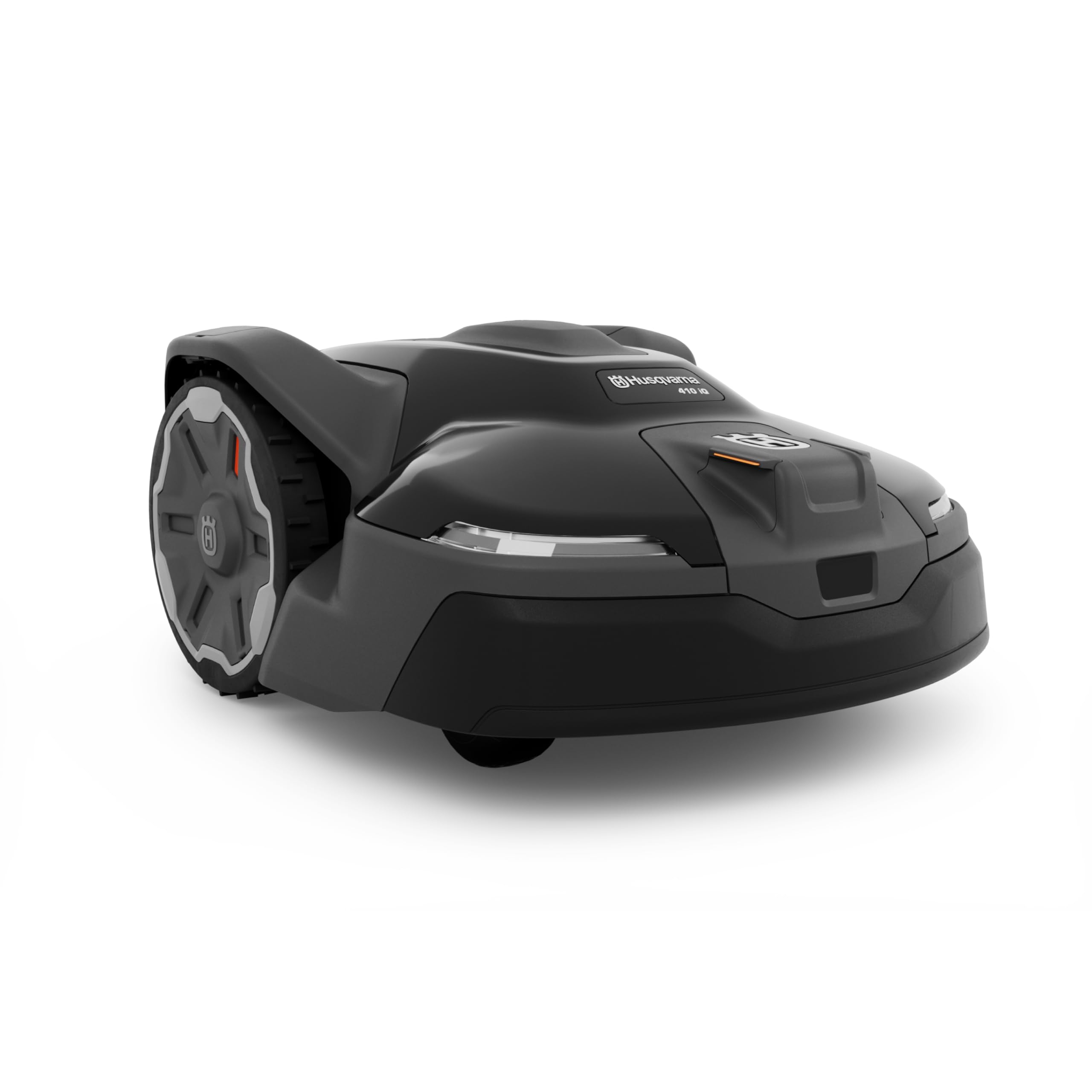
The world’s #1-selling robotic mower, now wire-free with centimeter-perfect EPOS navigation.
Husqvarna is the biggest name in robot mowing, and the 410iQ brings their Exact Positioning Operating System (EPOS) to a wire-free design. The system uses an RTK-based reference station and onboard radar for obstacle avoidance, plus the widest adjustable cut height range on this list: 1 to 4 inches, which lets you handle anything from a golf-green short cut to a shaggy tall fescue lawn. The 9.4-inch cutting width is solid for a 1/2-acre capacity, and the mower handles slopes up to 45% with larger wheels designed to cross driveways and paths.
The app lets you drive the mower around the yard to create a virtual map during setup, then define mowing areas and stay-out zones. One reviewer praised the irregular mowing pattern that creates a carpet-like lawn finish—different from the strict parallel rows of most competitors. The 59-pound weight is heavy but provides stability on slopes. The 4-year warranty is the longest of any mower here, backed by Husqvarna’s US-based customer support hotline.
The 410iQ also includes an anti-theft alarm with GPS tracking and a year’s worth of free replacement cutting blades. However, one shopper added that the EPOS system loses GPS signal on the sides of houses in suburban lots, leaving the mower unable to navigate from front to back yard. Dense tree coverage (10-15%) can occasionally cause signal drops, though dragging the mower to an open area usually resolves it.
brand confidence: The 4-year warranty and Husqvarna’s long history in mowers make this the lowest-risk purchase for buyers who want proven support, not just a promising spec sheet.
reliable support: Homeowners with open, suburban yards up to 1/2 acre who prioritize warranty coverage and brand reputation above raw cutting width or extreme slope ratings.
costly ownership: The EPOS system struggles with GPS signal on the sides of houses in dense suburban developments, which can prevent it from traveling between front and back yards.
8. ANTHBOT Genie 3000 Robot Lawn Mower
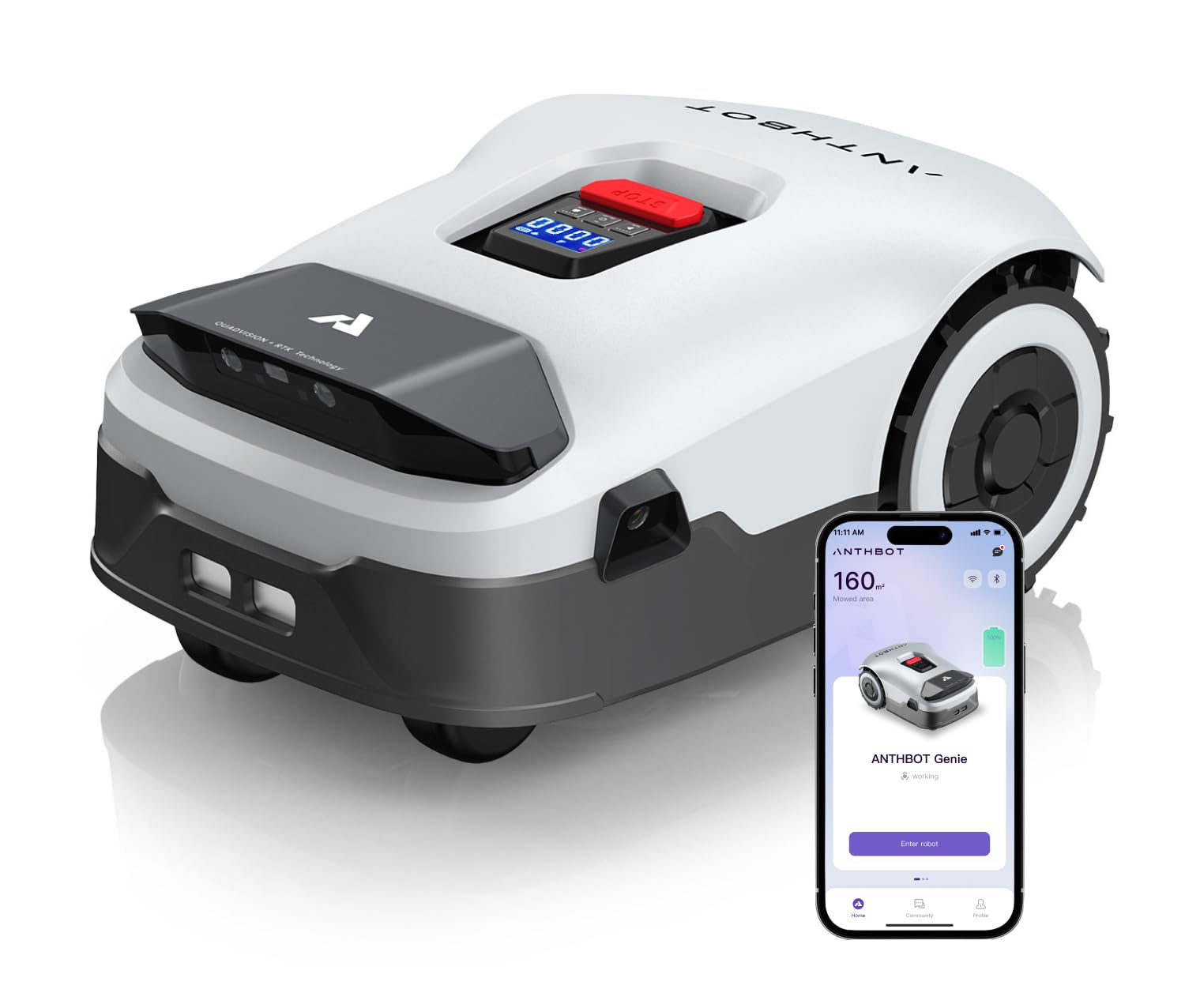
Four cameras and Full Band RTK for yards where GPS usually gives up.
The Genie 3000’s defining trick is the Full Band RTK paired with a 4-Eye Vision system (four cameras giving a 300° field of view). That setup is designed for homes with weak or no GPS signal under dense trees, eaves, or near buildings where single-band RTK fails. The dual-positioning system switches between RTK and 3D vision smoothly, so the mower doesn’t stop and spin when it loses a satellite lock. It handles up to 0.9 acres with a 7.9-inch cutting width and adjustable height from 1.18 to 2.76 inches.
The app supports 30+ mowing zones and no-go zones, so you can section off gardens, pools, or play areas. One reviewer who had the mower for about five weeks said it “keeps the lawn looking perfect” and that friends commented it looked like a golf course. The Genie 3000’s 46-pound weight is heavy but provides solid traction on uneven ground. The ACC (Adaptive Cruise Control) technology helps the 4-camera system identify boundaries and create optimal cutting routes.
That said, one year-long owner reported the mower doesn’t learn from repeated stuck points and can get frustrating over time. The initial setup is noted as pretty straightforward by most, with the first mapping run taking the longest. The lack of learning from previous stuck spots is a genuine annoyance that firmware updates may or may not fix.
signal-proof design: The 4-camera plus Full Band RTK combo makes this the best choice for yards with large trees, deep eaves, or buildings that create GPS dead zones.
offline operation: Homeowners with up to 0.9 acres of partially shaded or building-surrounded lawn where standard RTK mowers lose signal and need frequent rescues.
basic controls: The mower does not learn from repeated stuck spots, so if it gets caught in the same divot or branch every cycle, you have to set a no-go zone manually.
9. ANTHBOT M9 Robot Lawn Mower
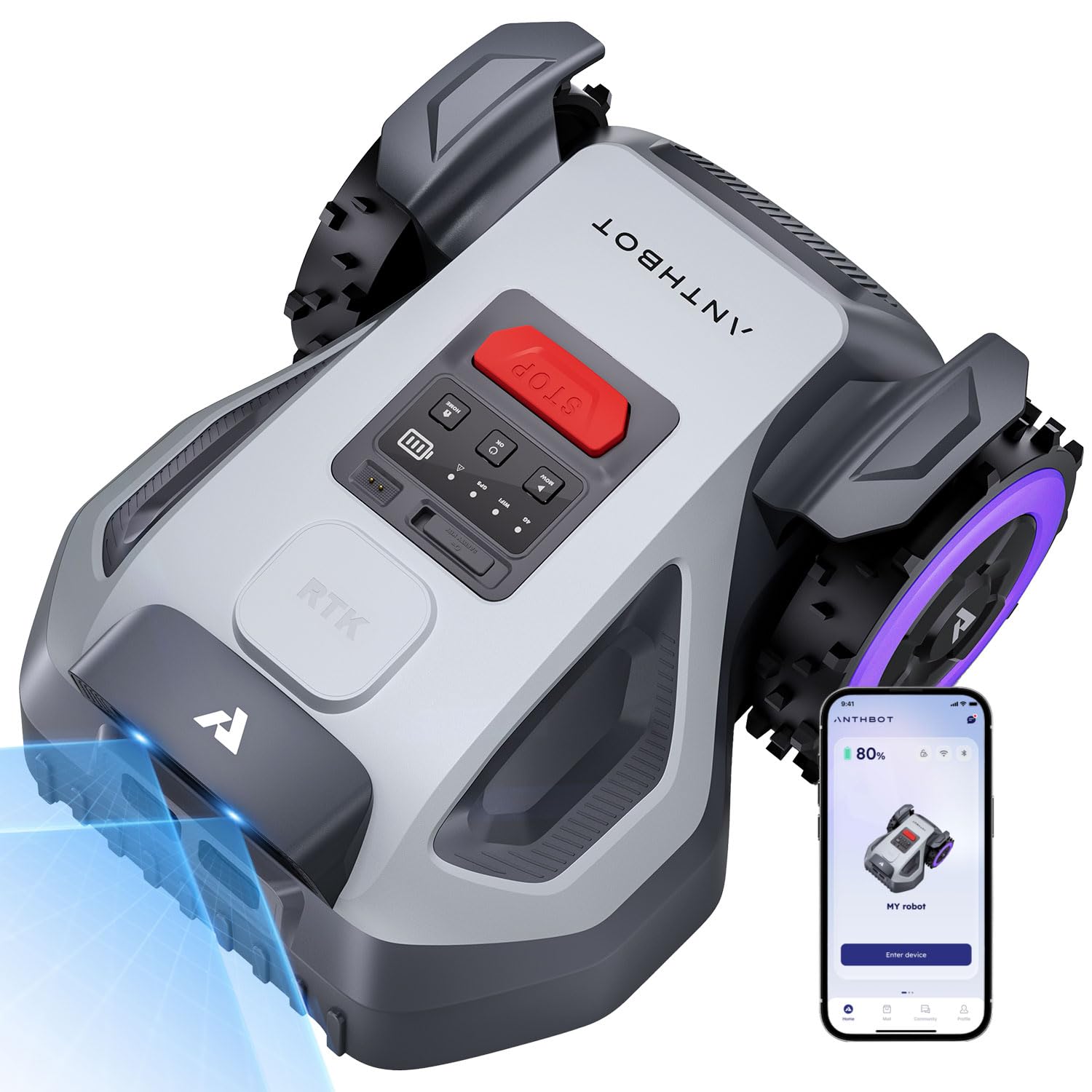
The entry-level wire-free mower that maps your yard in 10 minutes.
The M9 is the most affordable mower here that still delivers full wire-free operation via Dual Vision and Full-Band RTK. It is designed for small to medium lawns up to 0.3 acre, making it a low-risk entry point for anyone curious about robot mowing but not ready to spend +. The dual 150° HDR cameras (High Dynamic Range—better image quality in mixed lighting) paired with AI can recognize over 1,000 types of garden objects, and the mower handles slopes up to 45%. The cutting height adjusts from 1.2 to 2.7 inches with five free-rotating blades that create a carpet-like finish.
Owners mention the setup is genuinely beginner-friendly — one reviewer noted “it took about 20 minutes from opening the box to get it on the charger.” The app lets you manage up to 30 work zones and set no-go areas. The 21.6-pound weight is notably lighter than the YARDCARE N1600 PRO’s 39.5 pounds, making it much easier to carry through the house or reposition in the yard. The operating noise runs at ≤58 dB, which is quiet enough to run during a backyard gathering without being disruptive.
However, some users report the claimed 10-minute auto-mapping is optimistic and that a realistic setup takes closer to an hour, especially when finding the ideal dock and RTK location. The Genie3000 sibling has 4-eye vision for signal-deprived areas, though the M9’s dual-camera system works well for the typical open-pattern suburban lot.
lowest barrier to entry: For under, you get genuine RTK wire-free navigation and AI obstacle detection — the same core tech as models costing twice as much, just in a smaller package for smaller lawns.
budget choice: First-time robot mower buyers with small, open yards (under 1/3 acre) who want a fully wireless experience without the premium price tag.
needs frequent charge: The 0.3-acre max coverage is the smallest of any pick here, and some users report network/communication errors that require patience to resolve.
10. YARDCARE N1600 PRO Wireless Robotic Lawn Mower
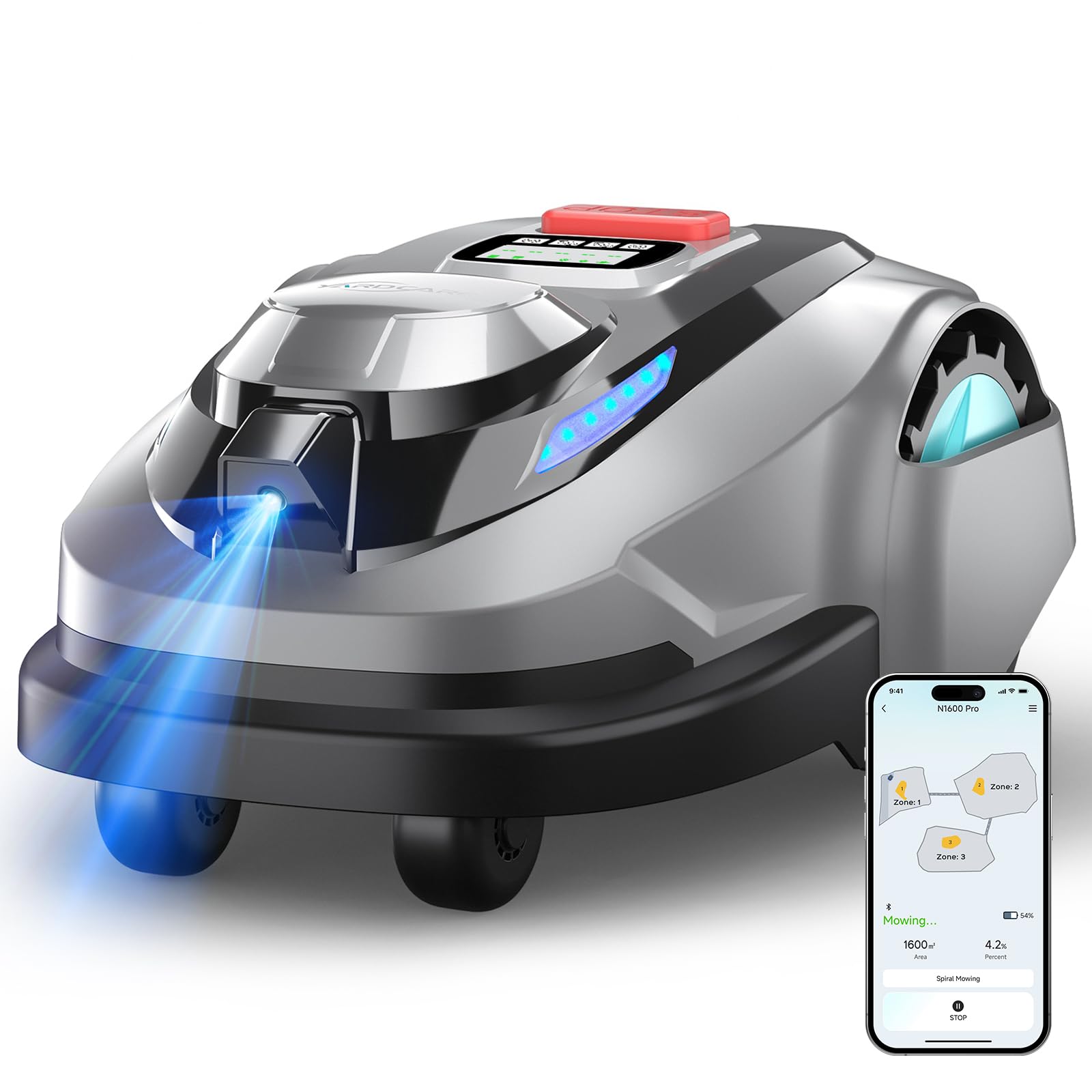
A budget-friendly gateway into RTK-vision mowing with a strong 45-minute battery.
The N1600 PRO pairs RTK positioning with AI visual navigation for centimeter-level accuracy in systematic mowing, covering up to 0.4 acre. It is among the most affordable wireless options available that uses real RTK (not just a camera-based perimeter). The brushless motor and strong traction handle slopes up to 20°, and the adjustable cutting height ranges from 0.8 to 2.4 inches — the lowest minimum height of all picks, which is great if you like a very close cut on Bermuda or Zoysia. The 17 cutting height positions give you the most fine-tuning options in this list.
The cutting width is 7.09 inches — narrower than the already-compact ANTHBOT M9’s 7.9 inches. That means more passes to cover the same area, but the 45-minute battery average life allows for sustained runtime before auto-returning to charge and resuming. The mower’s 39.5-pound weight is heavier than the M9’s 21.6 pounds by a factor of 1.8 — customers note the extra heft makes it feel substantial but harder to carry to a far corner of the yard.
However, the review data reveals some serious reliability concerns. Multiple verified buyers reported the mower arriving with non-fitting RTK poles, loose screws, slow customer support, and one reviewer’s replacement being “lost in transit” with no tracking. Another buyer said the app failed to map the yard despite correct setup, with no troubleshooting guidance in the manual and a support call marred by background noise and a thick accent. The positive reviews note the app is intuitive and the mowing is quiet and thorough — but the quality control and support issues are hard to ignore.
value with a caveat: The RTK+Vision tech at this price point is compelling, but the build-quality and support reports make it a riskier buy than slightly more expensive alternatives.
affordable option: Budget-focused buyers willing to gamble on a startup brand’s QC for the lowest possible price of entry into wireless RTK mowing.
less durable: Multiple verified one-star reviews report non-functional RTK poles, defective units, and slow support — the risk of receiving a defective unit is higher than with established brands.
Understanding the Specs
Navigation System: LiDAR vs RTK vs Camera Vision
LiDAR uses spinning laser beams to build a 3D map of your yard, so it works under trees and in shade where GPS mowers fail. RTK uses a correction signal (either from a local antenna or from the cloud) to achieve centimeter-level GPS accuracy, but needs a clear view of the sky. Camera vision systems use AI to recognize lawn boundaries from images, but can struggle in low light or with overhanging branches. Know your yard’s tree cover before choosing.
Slope Percentage
The slope rating tells you the steepest incline the mower can climb, measured in percent — 45% means a rise of 45 feet over 100 feet, roughly a 24-degree angle. A standard gently sloped lawn is 15-20%. A visibly steep hill is 30-40%. The top-tier mowers handle 84% (40 degrees), which covers virtually any residential slope. If your yard is flat, you don’t need a high slope rating, but if you have a challenging grade, this spec will save you from a stuck mower.
Cutting Width and Cutting Height
Cutting width (measured in inches) determines how much grass the mower covers per pass — wider means fewer trips and faster total mow time. Heights range from under an inch (for a very short golf-green cut on Bermuda) up to 4 inches (for tall fescue or cool-season grass). The number of height positions (5, 11, 17) tells you how precisely you can dial in the grass length. A wider range and more positions give you more control over the final look of your lawn.
Battery Life and Acreage Ratings
Battery life is measured in minutes of runtime before the mower returns to charge. The acreage rating (like 1/4 acre or 1.5 acres) is an estimate based on the battery, cutting width, and mowing speed. A mower with a smaller battery but a faster recharge (like the ECOVACS A3000 with 189W fast charging) may finish a lawn faster than one with a longer single run but a slower recharge. Look at the runtime-plus-recharge cycle, not just the acreage number, for a realistic picture.
FAQ
Do wireless robot mowers really need no perimeter wire at all?
Will a wireless robot mower work under large trees or in shaded yards?
How long does the initial setup and mapping take?
Can a wireless robot mower handle hills?
What happens when the battery runs low?
Can I set no-go zones to keep the mower out of flower beds or pools?
How often do I need to replace the blades on a robot mower?
Is a wireless robot mower worth it for a small lawn under 0.25 acre?
What does the slope percentage actually mean in degrees?
Final Thoughts: The Verdict
For most homeowners, the wireless robot mower winner is the ECOVACS Goat O1000 LiDAR PRO because its Dual-LiDAR navigation works perfectly in the shaded, tree-filled yards where RTK mowers struggle, without you burying a single wire. If you need to cover steeper, larger terrain with the fastest possible mow time, grab the Segway Navimow X430. And for a straightforward, no-extra-hardware setup on a 0.5-acre lot, the MOVA LiDAX Ultra 2000 gives you 3D LiDAR precision with an excellent 3-year warranty — no RTK antenna needed at all.
How We Picked
We do not accept paid placement. Every pick is matched to a real buyer and a real use-case; we do not hands-on test units.
Sources & Methodology
Specifications: manufacturer listings and product documentation. Review insights: verified customer reviews, as of July 2026. Pricing: not shown on this page (it changes often); check the current price via the retailer link.
As an Amazon Associate, Lawn Gear Lab earns from qualifying purchases. This does not affect which products we feature.