
Specs are compiled from manufacturer listings and verified buyer reviews and can change over time — please confirm the key details on the product page before buying.
If deer treat your garden like their personal salad bar, you already know the frustration of trying every spray, noise maker, and physical barrier that just does not hold. An electric fence for deer is the one solution that actually draws a line they learn to respect — a moveable, effective wall that keeps your landscaping intact and your patience in one piece. The key is picking the right height, post quality, and portability for your specific setup, and that is exactly what this guide sorts through.
I’m Rikta — the founder and writer behind Lawn Gear Lab. This guide is built by comparing the manufacturers’ published specifications and the patterns across verified customer reviews, so you get each pick’s real strengths and trade-offs instead of marketing spin.
Protecting a vegetable plot, a flower bed, or a whole property boundary means matching netting height, post durability, and ease of relocation to your land’s specific demands — and this breakdown covers the top options side by side.
Our Picks at a Glance

How To Choose The Best Electric Fence For Deer
Deer are jumpers — they can clear a standard garden fence without breaking stride. An electric fence works by giving them a memorable, harmless shock that rewires their thinking. To make the right choice, focus on these three aspects.
Netting height is your first decision
A deer’s natural response to a barrier is to jump it. Fences under 40 inches are often cleared by a determined deer, while netting at or above 47 inches creates enough mental hesitation to make them look for an easier meal instead. Taller netting also works for larger livestock if your needs change.
Post and stake durability for long-term use
The fiberglass posts (the vertical supports) and the metal stakes that hold them into the ground take the most abuse — from rocky soil, weather, and repeated moving. Thicker posts with double-spiked stakes resist breaking when you pull them out and push them back in week after week. A flimsy base is the most common source of a sagging fence that deer can push under.
Portability versus permanent installation
If you plan to move the fence every few weeks for rotational grazing (shifting livestock to fresh pasture) or seasonal garden protection, you want a lightweight roll that one person can lift and re-set. Heavier netting with more posts is more stable for a fixed boundary but a chore to relocate. Match the total weight and the number of included posts to how often you intend to shift it.
Quick Comparison
| Model | Best For | Height | Weight | Conductive Strands | Amazon |
|---|---|---|---|---|---|
| VEVOR Electric Fence Netting★ Best Overall | Budget-friendly entry point | 42 in | 13.23 lbs | — | Amazon |
| PPOLB Electric Fence Netting | Premium balance of height & portability | 47.2 in | 16.17 lbs | 9 | Amazon |
| TMEE Electric Fence Netting | Long-term durability | 49.6 in | 17.11 lbs | 7 | Amazon |
| LMRSTOO Electric Poultry Netting | Dense mesh for small-to-medium animals | 49.6 in | 22 lbs | — | Amazon |
In‑Depth Reviews
1. VEVOR Electric Fence Netting, 42″H x 164’L, PE Net Fencing with Posts
The lightest roll at 13.23 pounds, but you trade height and post quality.
The VEVOR is the cheapest option here and also the lightest at 13.23 pounds — nearly 4 pounds less than the PPOLB, which makes it the easiest to carry and move on your own. But at 42 inches, this fence is 7.6 inches shorter than the TMEE, a height difference that can mean a deer treats it as a suggestion rather than a barrier. One buyer with experience setting up name-brand versions said the VEVOR fence had a tight string in the center that made tensioning difficult. Another reviewer reported that after about three months of weekly moving, several of the plastic stake feet bent, and one foot came off entirely when pulling it out. The fence supports multiple power supply options including solar. This is a viable option for a flat, soft-soil garden used for a single season without frequent moves.
Where it wins
- 13.23 pounds is the lightest — easiest single-person move
- Lowest upfront cost to get started with electric netting
Where it falls short
- 42 inch height is marginal for deer — many will jump it
- Posts lack long-term durability in rocky or frequently-moved setups
Reach for this if: Your budget is tight, the fence stays in one spot on soft ground, and you are willing to keep the grass short to prevent shorts.
Look elsewhere if: You need a fence that survives weekly moves or stands up to rocky soil — the stakes simply do not hold up in the long run.
2. PPOLB Electric Fence Netting – 47.2″ H x 164′ L
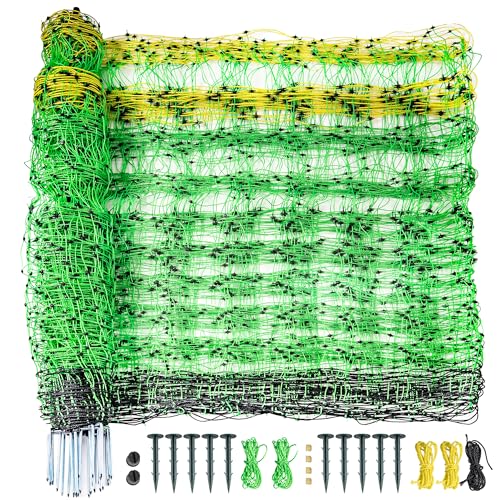
The 47-inch all-rounder that stops deer without weighing you down.
The PPOLB hits the balance for deer control because its 47.2 inch height is tall enough to discourage most deer from jumping, yet the whole roll weighs only 16.17 pounds, making solo relocation realistic. The fence uses 11 horizontal strands total, with 9 of them conductive (the strands that carry the electric shock) — a denser setup than the 7 conductive strands on the TMEE fence below. Each post is reinforced with built-in fiberglass rods and placed every 12.5 to 13.1 feet, so the line stays taut rather than sagging between supports. Buyers report that a friend gave one of these fences with damage from a horse running through it, and they still found it fixable enough to buy a taller section to expand their dog’s yard. The bottom strands are not electrified — a deliberate design that prevents grass from shorting out the circuit (causing a loss of power through contact with wet vegetation), which keeps the shock consistent in weedy areas.
Why it earns the top spot
- 47.2 inch height creates a mental barrier for deer
- 9 conductive strands deliver a more consistent shock zone than the TMEE’s 7
- Fiberglass post rods resist snapping during moves
The honest trade-offs
- Posts can bow in the middle — consider adding a few extra supports for tension
- Base spikes could be deeper for gripping rocky or loose soil
The smart buy: This suits anyone who wants a portable deer fence that one person can manage, with the height to actually work and enough conductive strands to deliver a reliable jolt.
Not for you if: You need a fence that stays perfectly drum-tight without buying a few extra posts — the spacing can leave some sag in the middle.
3. TMEE Electric Fence Netting Livestock Fencing with 14 Posts – 49.6″ H x 164′ L

Nearly 50 inches of fence that one buyer kept running for three full years.
If maximum height is your priority, the TMEE is the tallest netting here at 49.6 inches — that is 2.4 inches more than the PPOLB, which can be the difference between a deer testing it or walking away. The design uses 9 horizontal strands with 7 of them conductive, and the lowest 2 strands are insulated (they do not carry electricity) to stop the fence from grounding out on wet grass or soil. One reviewer specifically reports that the first unit lasted three years. The 14 fiberglass posts use double-spiked carbon structural steel stakes that grip hilly or uneven terrain better than the VEVOR’s single-spike design. At this height, deer rarely test the boundary, but the mesh is too wide for poultry or small animals. Reviewers also note that unrolling requires patience to avoid tangles.
Why it stands out
- 49.6 inch height is the tallest option here
- Double-spiked stakes handle uneven terrain well
- Reported 3-year lifespan from a real owner
The honest trade-offs
- Unrolling can be frustrating if you do not follow the packing pattern
- Only 7 conductive strands, fewer than the PPOLB’s 9
Grab this if: Maximum height is your priority and you want a fence that real buyers have kept running for years on a rotational grazing setup.
Look elsewhere if: You need the most conductive strands per dollar — the PPOLB gives you 9 vs 7 at a similar price point.
4. LMRSTOO Electric Poultry Netting Fence – 49.6″ x 164′
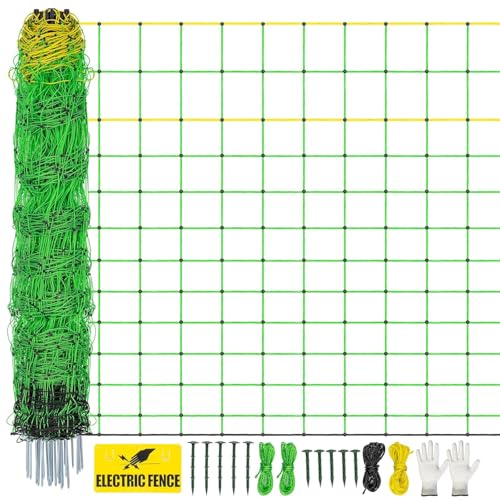
The heaviest build here, with a finer mesh for small critters and deer alike.
The LMRSTOO stands apart because its grid is noticeably tighter than the PPOLB or TMEE — each opening measures 3.5 inches by 6.2 inches (height by width), which means it works for poultry and small livestock in addition to deer. The fence uses stainless steel conductors woven with nylon wires, designed to flex into corners without breaking the circuit. One reviewer notes the posts are very sharp and easy to push into the ground, making it great for rotational goat pastures when paired with a solar energizer (a device that powers the fence from sunlight). Another buyer says the netting feels slightly flimsy and recommends caution with larger animals. At 22 pounds, this is the heaviest roll in the lineup — plan for a two-person setup if you rotate grazing areas weekly.
Density advantage: The 3.5 x 6.2 inch mesh is the tightest here, which is a genuine differentiator if your property has mixed-size animals.
The weight penalty: At 22 pounds you feel every move — plan for a two-person setup if you rotate grazing areas weekly.
Best for the mixed-use property: Grab this when deer are your main problem but you also keep chickens or ducks that need a smaller mesh to stay contained.
skip it if: You move your fence every few days — the extra weight turns a quick job into a chore.
Understanding the Specs
Netting Height And Why It Matters For Deer
A deer will jump any barrier it thinks it can clear. Fences at 42 inches or shorter give a deer too much confidence — many will hop right over, especially if they are hungry or habituated to gardens. Netting at 47 inches or taller creates a visual and physical barrier that most deer will not test, because the risk of getting shocked at that height outweighs the reward of reaching your plants. Always measure your tallest deer sighting: if bucks are a regular presence, lean toward the 49.6 inch options.
Conductive Strands And Shock Delivery
An electric fence works because the animal completes a circuit (an electrical path) when it touches a live, or electrified, strand and the ground at the same time. The more horizontal strands that are conductive — meaning they carry the electric pulse — the more likely a deer gets a memorable shock regardless of where it touches the fence. A netting with 9 conductive strands covers a taller zone than one with 7 strands, which matters for deer because they are tall and tend to lean into the fence rather than bump it with their nose.
FAQ
Will a 42-inch electric fence stop deer?
Do I need a special energizer for an electric deer fence?
Can I move an electric fence netting every week without breaking it?
How do I prevent grass from shorting out my electric fence?
What is the difference between a 7-strand and a 9-strand conductive fence?
Can I use an electric deer fence for goats or sheep too?
How long does an electric fence netting typically last outdoors?
Do I need a grounding rod for an electric deer fence?
Can I connect two rolls of netting together for a larger enclosure?
Is an electric fence safe for deer?
Final Thoughts: The Verdict
If you want one dependable pick, the best electric fence for deer winner is the PPOLB Electric Fence Netting because it delivers the best balance of height (47.2 inches), weight (16.17 pounds for easy moves), and conductive strand density (9 strands) at a premium-tier price that still makes sense. If you want maximum height for the same 164-foot run, grab the TMEE Electric Fence Netting at 49.6 inches. And for a mixed-animal property where you need a tighter mesh to also contain chickens or small livestock, the LMRSTOO Electric Poultry Netting Fence is the only one with a grid small enough for the job.
How We Picked
We do not accept paid placement. Every pick is matched to a real buyer and a real use-case; we do not hands-on test units.
Sources & Methodology
Specifications: manufacturer listings and product documentation. Review insights: verified customer reviews, as of July 2026. Pricing: not shown on this page (it changes often); check the current price via the retailer link.
As an Amazon Associate, Lawn Gear Lab earns from qualifying purchases. This does not affect which products we feature.