
Specs are compiled from manufacturer listings and verified buyer reviews and can change over time — please confirm the key details on the product page before buying.
Getting your azaleas and rhododendrons to explode with color starts with the right food. These acid-loving plants turn a sickly yellow if the soil pH or nutrient mix is off, leaving you guessing whether the issue is watering, sunlight, or the fertilizer itself. The picks in this guide focus on the specific NPK ratios (the three numbers for nitrogen, phosphorus, and potassium) and acidifying ingredients that actually solve that problem.
I’m Rikta — the founder and writer behind Lawn Gear Lab. This guide is built by comparing the manufacturers’ published specifications and the patterns across verified customer reviews, so you get each pick’s real strengths and trade-offs instead of marketing spin.
Whether you are reviving a struggling bush or feeding a mature hedge, these seven reviewed options focus on finding a quality fertilizer for azaleas and rhododendrons.
Our Picks at a Glance


How To Choose The Best Fertilizer For Azaleas And Rhododendrons
Not all plant foods are created equal for acid-loving shrubs. Azaleas and rhododendrons require a specific set of nutrients and a soil pH on the lower side, usually between 4.5 and 6.0. Picking a fertilizer that matches their needs means looking at the numbers on the bag and the form of the product.
The NPK Ratio and Acidifying Power
The three numbers on the label (Nitrogen, Phosphorus, Potassium) tell you what the plant gets for leaves, roots, and blooms. For these shrubs, a higher middle number (phosphorus) supports flower production, while the right balance keeps foliage healthy and deep green. Many effective options also contain sulfur or other acidifiers to naturally lower the soil pH around the roots.
Slow-Release vs. Water-Soluble
Granular slow-release formulas feed the plant over weeks or months, requiring fewer applications and reducing the risk of burning the roots. Water-soluble powders, on the other hand, give an immediate nutrient boost that is absorbed quickly, which is ideal for visibly struggling plants or for those who prefer a regular feeding schedule every 7 to 14 days.
Organic vs. Synthetic Ingredients
Organic fertilizers, like those made from seabird guano, shrimp and crab shell meal, or composted materials, improve the soil structure and microbial life over time. Synthetic fertilizers offer precise nutrient ratios and faster results. Your choice depends on whether you prioritize long-term soil health or immediate, measurable growth.
Quick Comparison
| Model | Best For | NPK Ratio | Item Form | Unit Count | Amazon |
|---|---|---|---|---|---|
| Miracle-Gro Water Soluble★ Best Overall | Immediate feeding | — | Powder | 80.0 oz | Amazon |
| Schultz ACR 14-7-7Top Value | Slow release ease | 14-7-7 | Granules | — | Amazon |
| Dr. Earth Acid Lovers | Organic purity | — | Granules | — | Amazon |
| GARDENWISE 8-4-8 | Economical slow feed | 8-4-8 | Granules | 32.0 oz | Amazon |
| Espoma Organic Holly-Tone | Trusted organic brand | 4-3-4 | Granules | 128.0 oz | Amazon |
| True Organic ACR Food | Large area coverage | 5-4-3 | Granules | — | Amazon |
| Fertilome (13695) 9-15-13 | High phosphorus blooms | 9-15-13 | Granules | 160.0 oz | Amazon |
In‑Depth Reviews
1. Miracle-Gro Water Soluble Azalea, Camellia, Rhododendron Plant Food, 5 lb
Our pick — over 4.5★ from 600+ verified ratings; the strongest balance of quality and price.
You get fast results by mixing this powder with water and feeding every 7 to 14 days.
The Miracle-Gro Water Soluble plant food is the most flexible pick here because it works with 7 types of plants, including azaleas, camellias, rhododendrons, and even orchids. You mix it at different ratios depending on where the plant grows: 1 part powder to 144 parts water for indoor plants, or 1 part to 18 parts water for outdoor ones. This lets you control the strength precisely for each plant.
Buyers report that the “acidic water soluble fertilizer dissolves completely and easily,” and they note that their azaleas, rhododendrons, and blueberries love it. The bag holds 80 ounces of powder, which is more than double the 32-ounce GARDENWISE bag, so it goes further if you have many plants to feed.
Reasons to buy
- Dissolves completely, making it easy to apply with a watering can.
- Suitable for a wide range of acid-loving plants, not just azaleas and rhododendrons.
- High 4.8 rating across 643 reviews speaks to consistent results.
A note of caution
- The resealable closure on the bag is reportedly weak, requiring clips to keep it airtight.
- Requires mixing and frequent application every 7–14 days.
Smart pick if: you want fast, measurable results and are already comfortable mixing your own liquid feed.
Look elsewhere if: you prefer a “low-maintenance” granular that requires fewer applications — like the GARDENWISE 8-4-8 that needs just three feeds per year.
2. Schultz Azalea, Cameillia, Rhododendron, ACR 14-7-7 Slow Release Plant Food
This granular feed greens up leaves within a week with no mixing required.
The Schultz 14-7-7 formula has the highest nitrogen content of any pick here, so it pushes out lush foliage quickly. You spread the granules dry around the base of the plant, and rain or watering activates the release. It comes in a 1-pound bag, which is much smaller than the 5-pound Miracle-Gro bag — a 5.0x gap in weight — so it works best for a small number of shrubs.
Buyers confirm that this product “spreads easily and starts showing noticeable results in about a week,” with one dedicated user noting they apply it every year to their camellia bushes and that the plants “bloom luscious and are so healthy.” It is a straightforward entry-level granular that gives visible greening faster than the 8-4-8 GARDENWISE, though that larger bag covers more ground for the money.
Straightforward feed: Apply granules, water them in, and watch the foliage green up. It isn’t the highest-capacity option, but the results per pound are reliable.
This is a good fit if you have a small collection of acid-loving shrubs and want an easy, effective granular. skip it if you need to cover large garden beds — you will need multiple bags for extensive coverage.
3. Dr. Earth Acid Lovers Azalea, Camellia, Rhododendron & Maple Fertilizer 4 lb

You get a people- and pet-safe organic feed that builds soil health over time.
Dr. Earth is the only Non-GMO Project Verified fertilizer in the U.S.A., and it is certified organic by OMRI (Organic Materials Review Institute), OIM, and CCOF (California Certified Organic Farmers). It uses humic acids (natural molecules that help roots absorb nutrients) and beneficial microbes instead of synthetic chemicals. You simply toss the granules around the drip line of the plant and water.
One buyer shared that it “revived sad camellias” with a simple application of just tossing and watering — no digging or making tea required. That same reviewer noted the plant “greened up quickly with new leaves.” Compared to the Espoma Holly-Tone, which has a published 4-3-4 ratio, Dr. Earth does not publish the exact NPK for this specific formula, so it is harder to track nutrient levels.
Pros at a glance
- Certified organic by OMRI, OIM, CCOF, and Non-GMO Project.
- Contains humic acids and beneficial microbes for soil structure.
Consider this first
- The exact NPK ratio is not published for this specific formula, making nutrient tracking harder.
The organic gardener who values ingredient transparency and soil health over raw N-P-K numbers will favor this pick. pass on it if you need a guaranteed high-phosphorus boost for immediate flowering in container plants — the Fertilome 9-15-13 is better for that.
4. GARDENWISE 8-4-8 Acidic Fertilizer for Azaleas, Camellias, Hydrangeas, Blueberries & More (1 Quart)
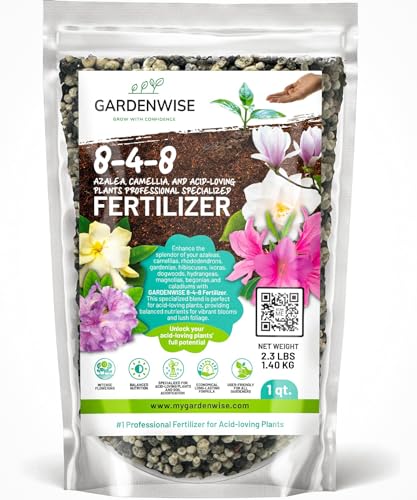
You feed your shrubs just three times per year with this slow-release granular.
The GARDENWISE 8-4-8 formula acidifies the soil while delivering magnesium, iron, and manganese to prevent chlorosis (the yellowing of leaves caused by nutrient deficiency). It uses live bacterial microbes from a bio-solid process that help build the soil food web. The bag holds 32 ounces of granules, compared to the 80-ounce Miracle-Gro bag, but the less frequent application schedule means you use less product over a season.
One reviewer noted that their “newly planted rhododendron has doubled in size,” and another said their rhododendron “came back to life” with greener leaves and abundant blooms. This is a solid pick for infrequent feeding of a moderate-sized bed of azaleas, hydrangeas, and blueberries. Consider another if you prefer a water-soluble feed for controlled dosing in individual pots.
What stands out
- Only needs three feedings per year; less hands-on time.
- Contains iron-rich micronutrients that fight yellow leaves.
What to know
- Only suitable for acid-loving plants — a misapplication could harm non-acid species.
- Bag is 32 oz versus the 80 oz of the Miracle-Gro, so consider your garden size.
Grab this for: infrequent feeding of a moderate-sized bed of azaleas, hydrangeas, and blueberries.
Consider another if: you prefer a water-soluble feed for controlled dosing in individual pots.
5. Espoma Organic Holly-Tone 4-3-4 Evergreen & Azalea Plant Food; 4 lb. Bag (Pack of 2)
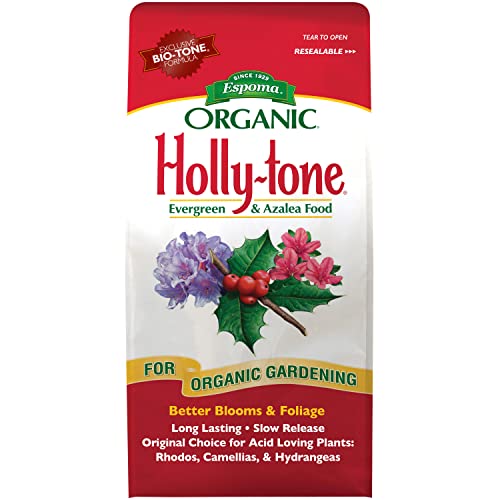
A trusted organic formula from 1929 that uses 5% sulfur to keep soil acidic.
Espoma’s Holly-Tone comes in a pack of two 4-pound bags, giving you 8 pounds total for a medium-sized garden. The 4-3-4 analysis includes 5% sulfur to maintain acidic soil conditions, and the Bio-tone formula (a proprietary blend of beneficial microbes) enhances microbial activity around the roots. It is approved for organic gardening as a registered Organic Input Material, and it is made in the USA.
Owners mention this product is “recommended by my tree expert” and that it “gives trees and shrubs the food they need for year round good health.” Some users did note a strong smell for a few days after application, which dissipates after watering. Compared to the True Organic 5-4-3 pick, this formula requires no mixing and is applied in both spring and fall for best results.
Heritage and reliability: You get a rich blend of organic ingredients backed by decades of use in American gardens. It is a safe, proven choice for any acid-loving shrub.
Choose this if you want a classic, well-documented organic fertilizer that is easy to find and use. Pass on it if you cannot tolerate any odor near your living spaces, as the granules smell noticeable before watering.
6. True Organic Azalea, Camellia & Rhododendron Food – Organic Fertilizer for Low-pH Plants – 12lb Bag
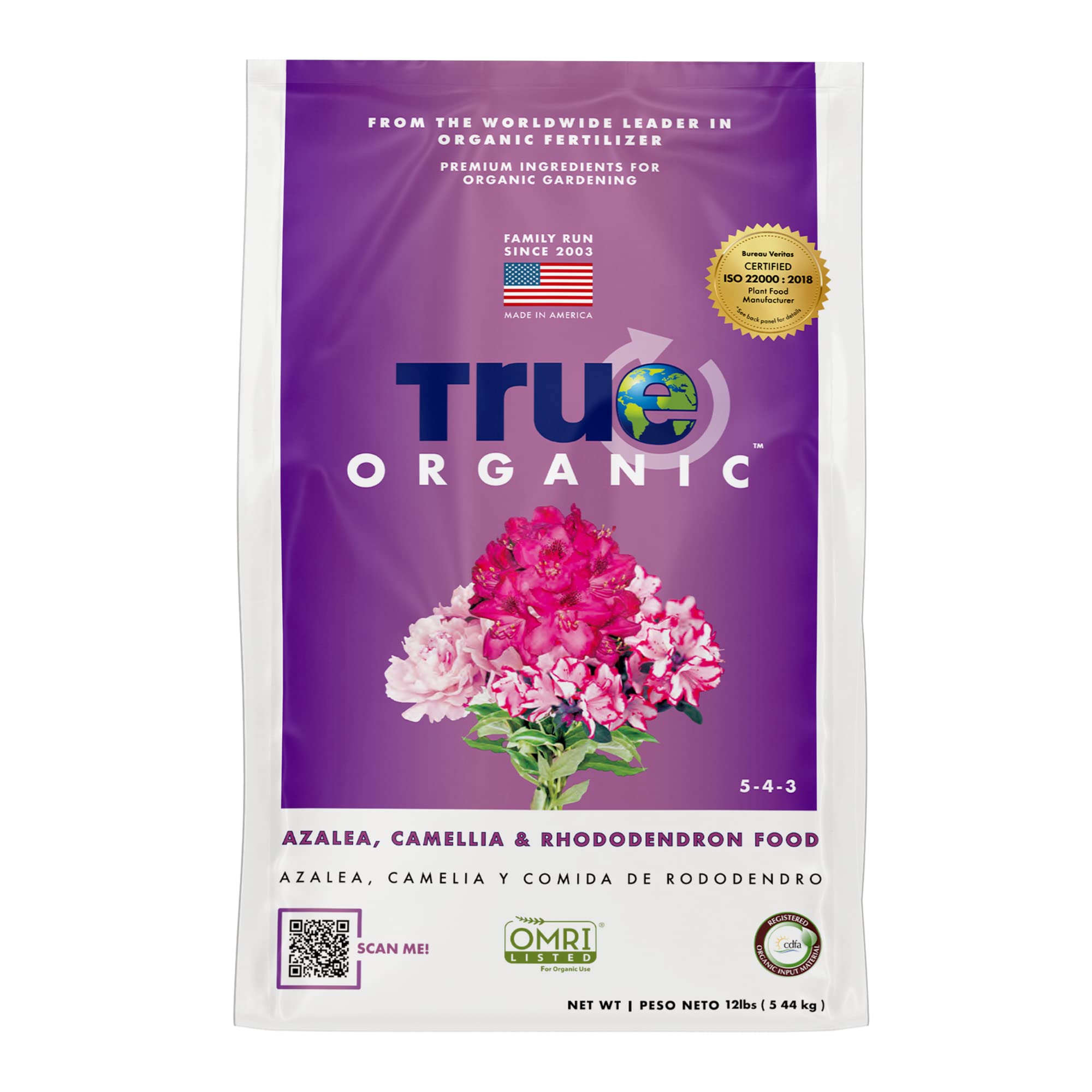
This 12-pound bag covers up to 261 square feet in one application for big gardens.
True Organic is the largest bag on the list at 12 pounds, more than tripling the 4-pound Espoma bag. The 5-4-3 formula includes 5% soil sulfur, which actively works to lower the soil pH for acid-loving plants. It uses seabird guano and shrimp and crab shell meal for slow-release nourishment throughout the growing season. The manufacturer recommends a twice-yearly application schedule (spring and fall) for shrubs and trees.
The 12lb bag covers up to 261 sq. ft., making it an excellent match for extensive rhododendron hedges or multiple azalea beds. Reviews highlight that this product “promotes lush blooms” and works well for a variety of low-pH plants. The main trade-off is the heavy bag — carrying 12 pounds across a large yard can be cumbersome.
Why it works for big spaces
- Large 12lb bag reduces the need for repeat purchases mid-season.
- Contains natural sulfur for effective soil pH management.
Keep in mind
- Heavy bag at 12 pounds may be cumbersome if you are carrying it across a large yard.
- Some reviewers mention the earthy smell persists for a short time after application.
This is best for large-scale organic gardening where you need coverage for hundreds of square feet of acid-loving shrubs. It is not for small container gardens or indoor use — the bag is simply too much product.
7. Fertilome (13695) Azalea, Camellia, Rhododendron Food 9-15-13 (10 lbs.)
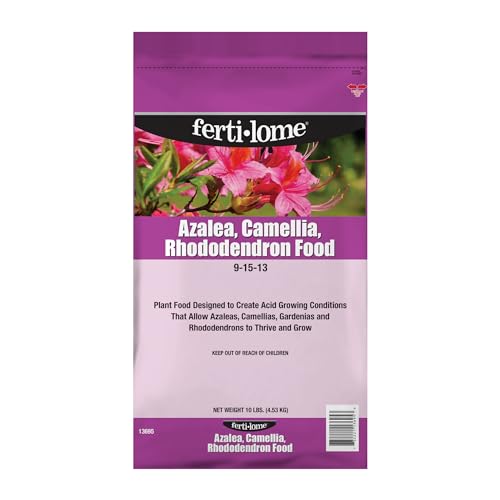
The 9-15-13 formula’s high phosphorus (15%) targets maximum bloom production.
Fertilome has the highest phosphorus content of any pick here, which is the nutrient that fuels flower and root development. The formula creates an acid growing condition for azaleas, camellias, and gardenias. You feed existing plants in early spring, again after blooming, and then again in the fall — a simple three-step annual schedule. The dosage is straightforward: 1/4 to 1/2 cup for plants 1 to 5 ft tall, and 3/4 to 1 1/4 cups for plants 6 to 12 ft tall.
One buyer shared that their rhododendrons had not bloomed in three years until they used this product. Another noted that their “azaleas were looking draped” but after using this, the plants “look excellent.” At 10 pounds, this bag is big enough for multiple large shrubs without being overly heavy. The 160-ounce unit count doubles the 80-ounce Miracle-Gro bag in pure quantity.
What works well
- High phosphorus content (15%) strongly supports bloom development.
- Large 10 lb bag provides excellent value for multiple feedings per season.
Points to consider
- High nitrogen (9%) can encourage foliage at the expense of blooms if over-applied.
- Not an organic formula, so not suitable for certified organic gardeners.
Choose this for reviving mature, stressed shrubs, especially those that have stopped blooming. If you insist on organic gardening certification, the Dr. Earth Acid Lovers is a better fit for you.
Understanding the Specs
The NPK Ratio
The three numbers on a fertilizer label stand for Nitrogen (N) for leaf growth, Phosphorus (P) for root and flower development, and Potassium (K) for overall plant health and disease resistance. A ratio like 14-7-7 is higher in nitrogen, ideal for green foliage, while a 9-15-13 targets blooms with its phosphorus lead. For azaleas and rhododendrons, look for a formula where the middle number is equal to or slightly higher than the first.
Slow-Release vs. Water-Soluble
Slow-release granules, like the Schultz 14-7-7 or the Espoma Holly-Tone, break down over weeks thanks to moisture and soil microbes. They are convenient because you apply them once and let nature do the rest. Water-soluble powders, like the Miracle-Gro option, dissolve instantly in water and feed the plant within hours. The trade-off is that you must reapply every 7 to 14 days to maintain the effect.
Soil Acidifiers
Many fertilizers for these shrubs include sulfur or other acidifying agents. This is important because azaleas and rhododendrons can only properly absorb iron and manganese when the soil pH is between 4.5 and 6.0. If the soil is too alkaline, the leaves turn yellow (chlorosis). The Espoma Holly-Tone and the True Organic products both contain 5% sulfur to safely lower the pH over time.
Organic vs. Synthetic
Organic fertilizers, such as the Dr. Earth Acid Lovers or the True Organic option, feed the soil biology first, releasing nutrients slowly as the microbes break down the material. They contain ingredients like seabird guano, bone meal, and plant meals. Synthetic formulas, like the Fertilome 9-15-13, deliver nutrients in a form the plant can absorb immediately, which can produce faster visible results but does little to improve long-term soil structure.
FAQ
What is the best NPK ratio for azaleas and rhododendrons?
Can I use a general all-purpose fertilizer on azaleas?
When is the best time to fertilize rhododendrons?
How often should I water after applying granular fertilizer?
Why are my azalea leaves turning yellow after fertilizing?
Can I over-fertilize my rhododendrons?
Is organic or synthetic fertilizer better for azaleas?
How much fertilizer does a mature rhododendron need?
Can I use azalea fertilizer on my blueberries?
Will fertilizer make my hydrangeas turn blue?
Final Thoughts: The Verdict
Across the board, the best fertilizer for azaleas and rhododendrons overall is the Miracle-Gro Water Soluble Azalea, Camellia, Rhododendron Plant Food because of its proven versatility, high user rating, and the instant feeding control it offers. If you want a true organic option that builds soil health over time, grab the Dr. Earth Acid Lovers. And for the best value on a large-scale slow-release feed, the GARDENWISE 8-4-8 requires only three applications per year while delivering impressive results for many acid-loving plants.
How We Picked
We do not accept paid placement. Every pick is matched to a real buyer and a real use-case; we do not hands-on test units.
Sources & Methodology
Specifications: manufacturer listings and product documentation. Review insights: verified customer reviews, as of July 2026. Pricing: not shown on this page (it changes often); check the current price via the retailer link.
As an Amazon Associate, Lawn Gear Lab earns from qualifying purchases. This does not affect which products we feature.