
Specs are compiled from manufacturer listings and verified buyer reviews and can change over time — please confirm the key details on the product page before buying.
You want a lawn that is thick, deep green, and the envy of your block — but the fertilizer aisle is a fog of numbers and brand claims. The single most important number to understand is the first one in the N-P-K ratio (the three-number code on the bag, where N stands for nitrogen, P for phosphorus, and K for potassium) — that first number is the nitrogen percentage, and it is what drives leaf growth and color. The trick is matching the right nitrogen type and concentration to your grass, your soil, and your schedule, without wasting money on the wrong bag.
I’m Rikta — the founder and writer behind Lawn Gear Lab. This guide is built by comparing the manufacturers’ published specifications and the patterns across verified customer reviews, so you get each pick’s real strengths and trade-offs instead of marketing spin.
The six picks below cover every realistic scenario for a homeowner — from a fast-rescue liquid for a yellow lawn to a slow-release organic option for a vegetable garden — all delivering the best nitrogen punch in their category. No matter which you choose, you will have the right fertilizer with nitrogen to get the results you are after.
Our Picks at a Glance
How To Choose The Best Fertilizer With Nitrogen
The best place to start is with the N-P-K ratio on the bag. The first number is the nitrogen percentage — a high first number (like 46-0-0) means a very concentrated nitrogen source, while a balanced number (like 16-0-8) means other nutrients are included, too. You also need to decide between fast-acting and slow-release forms.
Quick-Release vs Slow-Release Nitrogen
Quick-release nitrogen gives you a rapid green-up — you see the difference in days — but it can burn the grass if you over-apply. Slow-release nitrogen (often labeled as coated or controlled-release) feeds the lawn steadily over weeks, reducing the risk of burn and requiring fewer applications. Many premium blends combine both types so you get an immediate color pop plus weeks of steady feeding.
The Role of Additional Nutrients
A pure nitrogen source like urea (46-0-0) is the cheapest way to add nitrogen, but it does not contain phosphorus (for root development), potassium (for root strength and stress tolerance), or micronutrients (tiny amounts of elements like iron and zinc that help grass resist disease). A blend like 16-0-8 adds potassium for root strength and stress tolerance, plus iron for that deep blue-green color. If your soil already has enough phosphorus, a phosphorus-free blend avoids throwing your soil chemistry out of balance.
Granular vs Liquid vs Organic
Granular fertilizers spread with a broadcast or drop spreader (a wheeled device that scatters pellets) and are the most common for lawn care. Liquid fertilizers mix with water and spray on — they work faster but require more frequent applications (every few weeks during the growing season). Organic options, such as feather meal (12-0-0), are derived from natural sources and release nitrogen more slowly as soil microbes (tiny organisms in the soil) break them down, making them gentle and sustainable but sometimes slower to show results.
Quick Comparison
| Model | Best For | N-P-K Ratio | Nitrogen Type | Size | Amazon |
|---|---|---|---|---|---|
| Andersons PGF 16-0-8★ Best Overall | High-phosphorus soil and serious lawn care | 16-0-8 | Dual quick- and slow-release | 18 lb | Amazon |
| Yard Mastery Flagship 24-0-6Also Great | All-around lawn rescue and green-up | 24-0-6 | Slow-release + quick-release | 18 lb | Amazon |
| Petramax Liquid 28-0-0 | Fast liquid green-up for nitrogen-deficient lawns | 28-0-0 | 70% quick / 30% slow-release | 128 fl oz | Amazon |
| Duda Energy Prilled Urea 46-0-0 | High-concentration nitrogen for crops and tie-dye | 46-0-0 | Quick-release (prilled) | 10 lb | Amazon |
| Down To Earth Feather Meal 12-0-0 | Organic slow-release for gardens and deer deterrence | 12-0-0 | Slow-release (organic) | 20 lb | Amazon |
| Dirty Gardener Urea 46-0-0 | Budget pure-nitrogen top-up | 46-0-0 | Quick-release (prilled) | 5 lb | Amazon |
In‑Depth Reviews
1. The Andersons Professional PGF 16-0-8 Fertilizer with Humic DG (18lb)
Our pick — over 4.5★ from 900+ verified ratings; the strongest balance of quality and price.
The phosphorus-free specialist for lawns that already have too much P — and it feeds for up to 8 weeks.
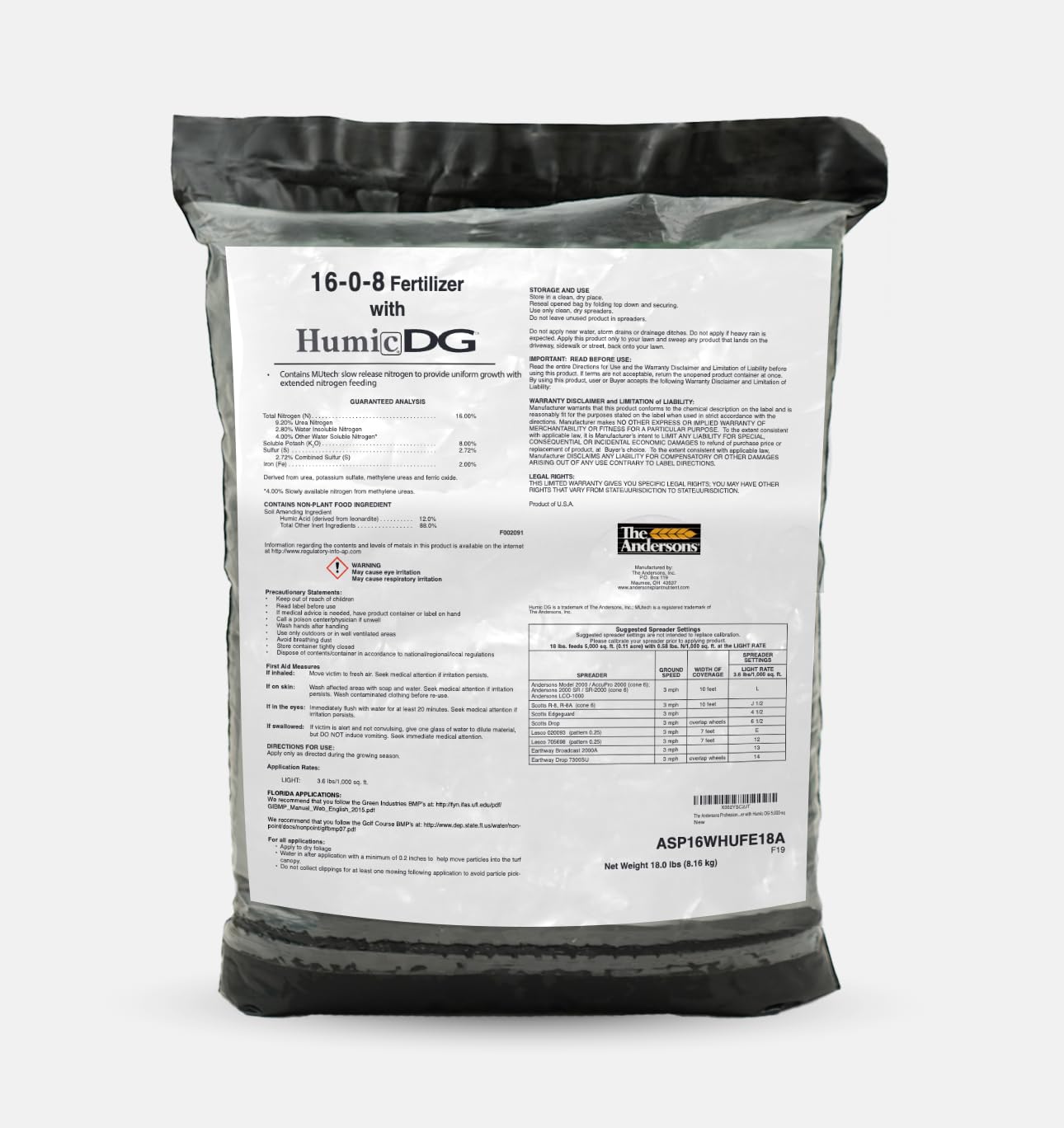
If a soil test shows your phosphorus levels (the second number in the N-P-K ratio) are already high, this 16-0-8 blend is the right choice — it delivers 16% nitrogen and 8% potassium without adding more phosphorus. The granules are super-fine, providing twice the number of particles per square foot for even distribution compared to standard granular products. It includes Humic DG (a form of humic acid designed to improve nutrient uptake from the soil), plus iron and micronutrients for total nutrition. The dual quick- and slow-release nitrogen gives you an immediate green-up and extended feeding for up to 8 weeks. Reviewers point out the Andersons line is “a higher grade of fertilizer” — that smaller particle size lets you spread it evenly, avoiding the patchy burn that can happen with cheaper granulars. One buyer says it “dramatically improved lawn quality (greener, healthier).” This product is phosphorus-free, so it is a smart choice if you have tested your soil, unlike the 24-0-6 Flagship which does not mention phosphorus level concerns.
It is not for sale in California or Oregon, so check local restrictions. Also, the 16-0-8 blend has less nitrogen than the 24-0-6 Flagship, so you will see slightly less dramatic green-up speed — though the steady feeding over 8 weeks is a strong trade-off for a more consistent lawn.
What stands out
- Phosphorus-free — ideal for high-P soil
- Super-fine particles for even spreading
- Feeds for up to 8 weeks with quick + slow release
A fair limitation
- Not available in CA or OR
- Pricier than basic urea options
Your best bet if: your soil test shows high phosphorus and you want a premium granular that feeds steadily for two months.
skip it if: you are in CA or OR, or you just want a cheap nitrogen-only top-up.
2. Yard Mastery Flagship 24-0-6 Granular Lawn Fertilizer
The do-it-all granular that buyers report revived a dead lawn within a week.
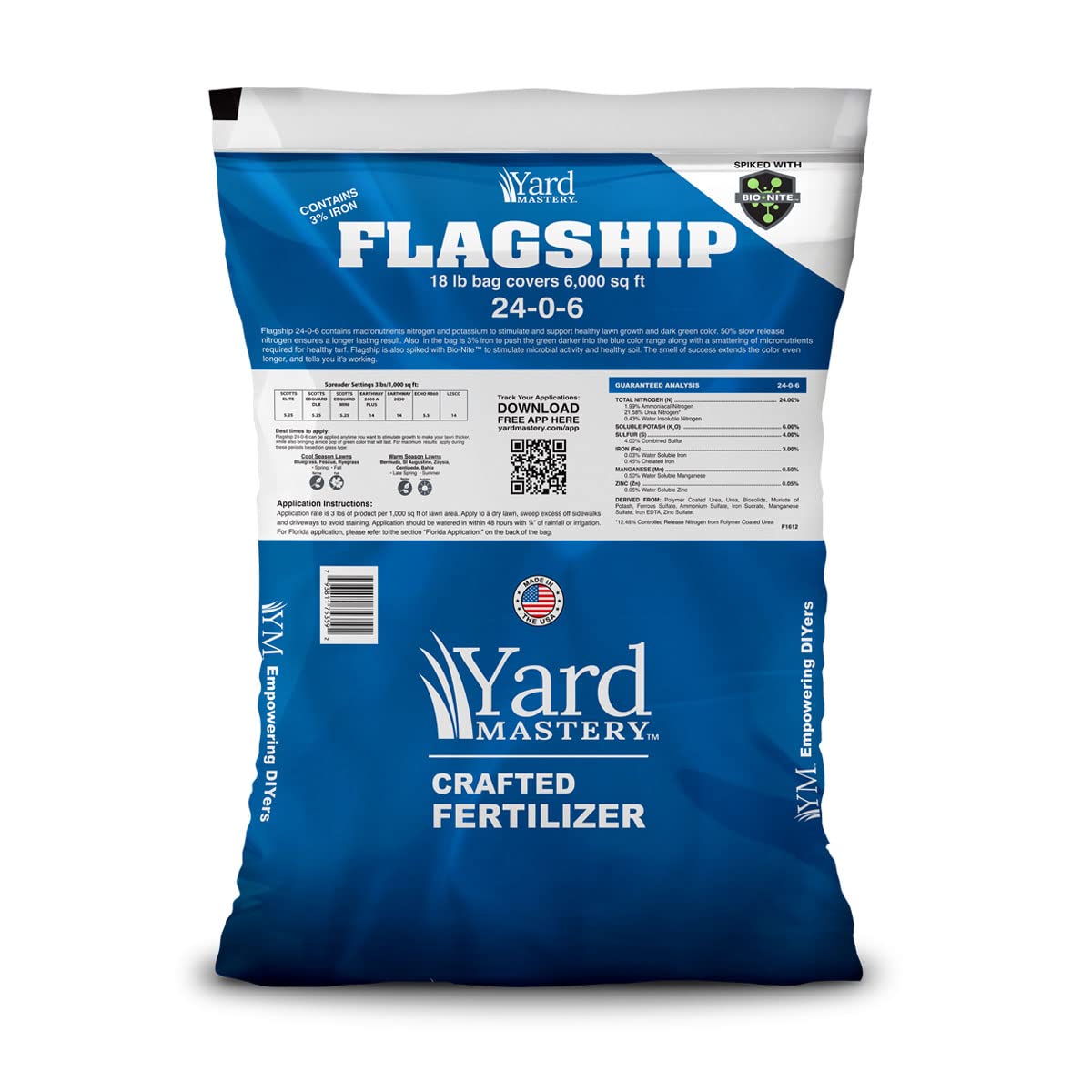
This Yard Mastery Flagship uses a 24-0-6 N-P-K ratio, and that 24% nitrogen is split between slow-release forms (which feed gradually for weeks) and quick-release (for an immediate green burst) — so your grass gets color in days while staying fed for longer between applications. It also includes 3% iron, which owners mention gives a deep blue-green color, along with a full set of micronutrients (boron, copper, manganese, molybdenum, and zinc — tiny amounts of elements that help grass resist stress). A single 18 lb bag covers 6,000 square feet, which is more generous than the prilled urea options that need careful mixing to avoid burning. Customers note it “revived dead, patchy brown lawn to full deep green within a week,” calling it the “best fertilizer I have ever experienced.” Some also mention it outperformed 10 other methods they tried, including plugs, seed, and watering. Unlike the prilled urea products in this list, the 24-0-6 blend includes 6% potassium for root health, so you are feeding the whole plant, not just the leaves.
One honest caveat from the reviews: you will be cutting grass more often — one reviewer noted you should “prepare to cut grass twice a week” because this stuff really stimulates growth. That is a sign it is working, but if you prefer a slower pace, you might want a less aggressive blend.
Why it wins
- 24% nitrogen with slow-release technology means fewer applications
- 3% iron delivers dramatic color change within days
- Full micronutrient package supports overall lawn health
One real trade-off
- Stimulates fast growth — expect to mow more frequently
Reach for it if: you want the easiest path to a deep-green, thick lawn and are okay with extra mowing.
Think twice if: you need a pure nitrogen source with zero extras — this bag also has potassium and micronutrients built in.
3. Petramax Liquid Nitrogen Fertilizer 28-0-0 – 1 Gallon

A liquid nitrogen booster that turns a yellow lawn green in days — shoppers say they are “skeptic turned believer.”
If your grass is nitrogen-deficient (looking pale or yellow) and needs a fast rescue, this 28-0-0 liquid formula delivers — it combines 70% quick-release nitrogen for an immediate green burst and 30% slow-release nitrogen to keep working between applications. You mix 5 oz per gallon of water for maintenance or 10 oz per gallon to correct a deficiency. One gallon treats up to 25,600 sq ft for maintenance, so a little goes a long way. It works with all grass types, warm or cool season. Buyers report “this stuff works great and my lawn has never been so green,” and one reviewer called themselves a “skeptic turned believer” after seeing results. This is a liquid, so you will need to spray it — many use a battery-powered sprayer (the Petramax brand makes one) for even coverage. Unlike the granular options like The Andersons, liquids require more frequent applications but deliver faster visible results.
One thing to note: because it is liquid, it has no built-in potassium or micronutrients (other blends like the 16-0-8 and 24-0-6 do). For a complete feeding program, you might want to alternate with a balanced fertilizer later in the season.
Why pick this
- Ultra-high 28% nitrogen for rapid color change
- Split release — quick green plus slow feed
- Large coverage: up to 25,600 sq ft per gallon
Keep in mind
- Requires a sprayer for application
- No potassium or micronutrients included
Grab this for: a fast-acting liquid rescue when your lawn looks pale and you want noticeable results within days.
Look elsewhere if: you prefer a simple granular spread-and-forget approach, or you need a complete NPK blend with potassium.
4. Duda Energy Prilled Urea 46-0-0 – 10 lb (2 x 5 lb Bags)

The purest nitrogen source for crops and DIY applications — 46% nitrogen with 98.5% purity.
This is prilled urea (small, round pellets of pure urea) with a guaranteed 46% minimum nitrogen content and 98.5% purity — about as concentrated as dry nitrogen gets. It comes in two 5 lb bags for easy handling and is commercial-grade, meaning it is meant for agricultural crops and large-scale use. You can broadcast it before rain and let the water carry it in, or dissolve it in a spray tank for liquid application. It is also a favorite among tie-dye makers for making chem water. One buyer sums it up: “The Urea helps that plants grow bigger and stronger.” Another gardener notes it is “easy to apply in the granular form, just broadcast before a rain and let the rain do the work.” Compared to the 16-0-8 Andersons or the 24-0-6 Flagship, this is a pure nitrogen source with no potassium, phosphorus, or micronutrients — so you must be careful not to over-apply, as pure urea can dehydrate soil if you do not have enough water.
Because it is 46% nitrogen, a little goes a very long way. If you are used to standard lawn fertilizer blends, you will want to dial your spreader to a very low setting — buyers on the sister product (Dirty Gardener Urea) recommend the lowest spreader setting for weekly application.
What makes it special
- 46% nitrogen — the highest concentration in this list
- 98.5% pure commercial-grade prills
- Versatile for broadcast, spray, or garden sprinkle
Use with care
- No other nutrients — pure nitrogen only
- Can dehydrate soil if water is inadequate
- Easy to over-apply and cause burn
Ideal for: experienced gardeners who want the cheapest, most concentrated nitrogen source and understand precise application.
Not for: casual homeowners who want a complete lawn feed with iron and potassium — stick with the 24-0-6 Flagship or 16-0-8 Andersons.
5. Down To Earth All Natural Fertilizers Organic Feather Meal 12-0-0, 20 lb
An organic nitrogen source that also keeps deer away — and it works, owners mention, despite the “haunted fart” smell.
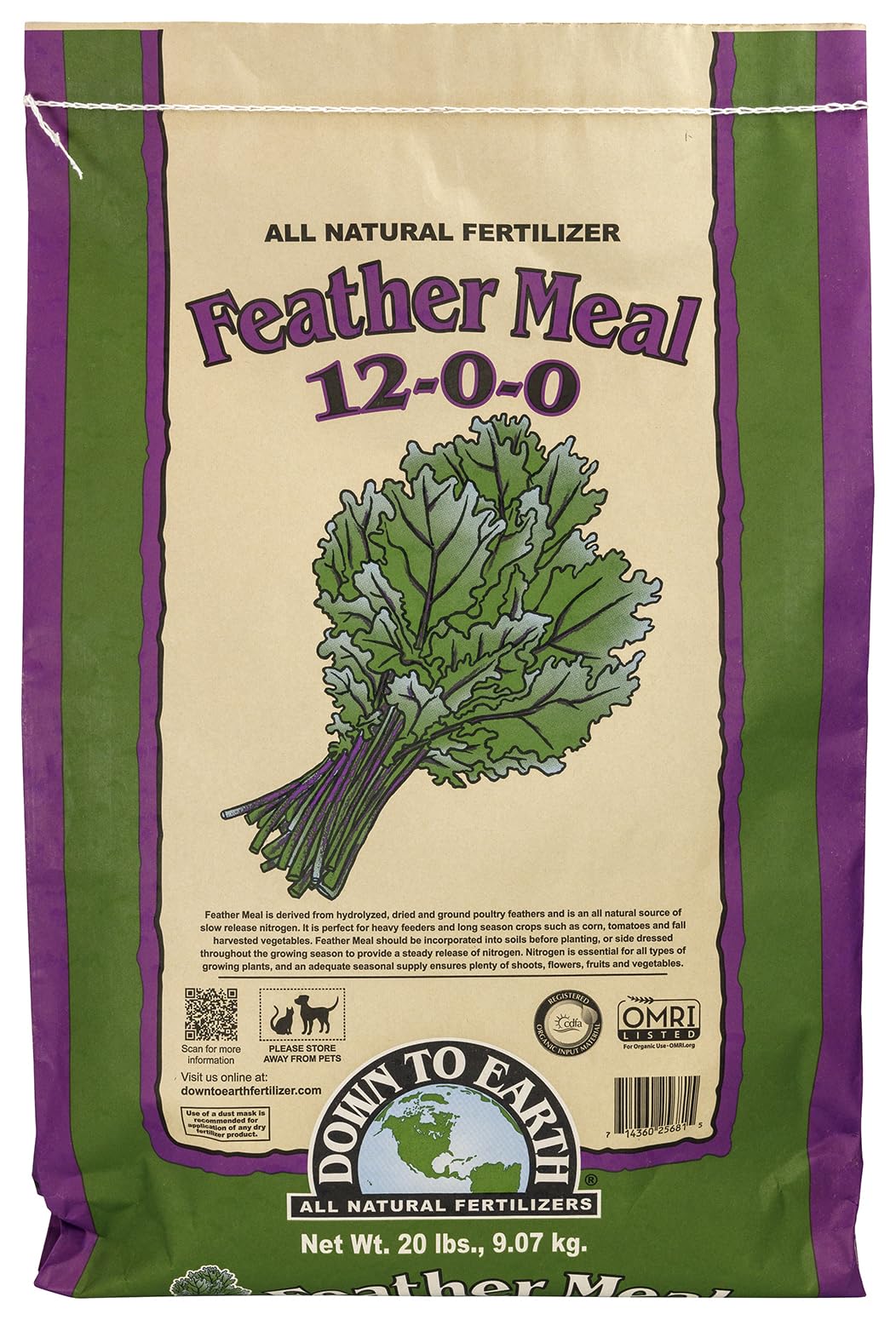
This 12-0-0 feather meal is made from ground and hydrolyzed poultry feathers, listed by the Organic Materials Review Institute (OMRI — an organization that certifies products for organic production). It is a slow-release nitrogen fertilizer perfect for heavy feeders like corn, tomatoes, and long-season crops. You incorporate it into the soil before planting or side-dress it (sprinkle it alongside growing plants) throughout the growing season. The 20 lb bag is a good value compared to smaller boxes of the same product. Buyers are clear: it works — “plants thrive (lush, green, blooming).” But they are equally clear about the smell. One review calls it a “haunted fart, demon’s armpit.” That foul odor is the natural decomposition of feathers, and it is strong. The upside: that smell also keeps deer away — one gardener reports hostas, tulips, and lilies were protected for weeks in a deer-heavy area, an effect you will not get from any synthetic granular. This is a very different tool than the Petramax liquid or the 46-0-0 urea — it feeds slowly and smells, but it is truly organic.
The trade-off is that 12% nitrogen is much lower than synthetic options, so you need more product per application, and the release is entirely dependent on soil temperature and microbial activity. If you want a fast green-up, look at the liquid 28-0-0 instead.
The organic edge
- OMRI-listed for certified organic gardens
- Slow-release — gentle, no risk of burn
- Surprise benefit: the strong odor naturally deters deer
Be honest about
- Extremely foul smell that lingers after application
- Only 12% nitrogen — weaker than synthetics
- Slower results — needs soil microbes to break it down
Choose this when: you grow an organic vegetable garden or want a natural slow-release feed that keeps deer at bay.
Avoid if: you are sensitive to strong odors or need a quick green-up for a tired lawn.
6. The Dirty Gardener Nitrogen Fertilizer Urea 46-0-0, 5 Pounds

The pure nitrogen shot that costs less than a pizza — 46% nitrogen in a small 5 lb bag for a quick test run.
At 46% nitrogen, this is the most concentrated nitrogen source in this list — a pure prilled urea with no fillers. The 5 lb bag is entry-level small, so it is perfect for testing or for a small lawn or garden patch. The dry granular form spreads well with most fertilizer spreaders, and buyers confirm it “worked well in my broadcast spreader” and does not clump. One user reports applying “it weekly in the spring and fall on the lowest spreader setting” with results that gave them “an amazingly green thick lawn.” Compared to the Duda Energy 10 lb prilled urea, this is the same 46% concentration but in a smaller, cheaper bag. Both are pure urea with no other nutrients. The caution is the same: because it is so concentrated, uneven application can cause patchy growth and dead spots. You really need a spreader and to follow the instructions precisely — one reviewer says to “use with care” because it can burn turf if not distributed evenly. It is a budget-friendly option, but it demands more attention than a balanced granular blend like the 16-0-8 Andersons.
One more thing: some have noted it uses a non-Prime shipping method (UPS Ground), which is actually a bonus for delivery in some areas, but plan accordingly for shipping time.
Low-cost, high-impact
- 46-0-0 — maximum nitrogen content for the price
- Small 5 lb bag for trial or small-area use
- Works well in broadcast spreaders
Watch out for
- Requires precise, even spreading to avoid burn
- No potassium, phosphorus, or micronutrients
- Non-Prime shipping (UPS Ground) — may take longer
Best for: budget-conscious gardeners who want the cheapest pure nitrogen per pound and are comfortable with precise spreader calibration.
Pass on it if: you want a complete lawn food with iron and slow-release technology — go with the 24-0-6 Flagship or 16-0-8 Andersons instead.
Understanding the Specs
N-P-K Ratio (The Three Numbers)
The three numbers on a fertilizer bag stand for Nitrogen (N), Phosphorus (P), and Potassium (K) — in that order. The first number is the percentage of nitrogen by weight. A ratio like 46-0-0 means it is 46% nitrogen with no phosphorus or potassium. A blend like 24-0-6 includes 24% nitrogen plus 6% potassium for root and stress support. For green leaf growth, the first number is the one you care about most.
Slow-Release vs Quick-Release Nitrogen
Quick-release nitrogen dissolves in water and enters the soil immediately — your grass greens up in days, but the effect fades fast and there is a higher risk of burn if you over-apply. Slow-release nitrogen is coated or formulated to break down gradually over weeks, feeding steadily and reducing burn risk. Many premium products combine both types: you get an immediate color pop plus weeks of steady feeding between applications.
Prilled vs Granular Form
Prilled means the fertilizer is formed into small, round pellets (like tiny beads) that are uniform in size — this makes them easier to spread evenly with a broadcast spreader (a wheeled device that scatters pellets over the lawn). Standard granular fertilizers often have a mix of particle sizes. Prilled urea is a common form for pure nitrogen fertilizers because the uniform size allows for consistent distribution, which is critical since a urea overdose in one spot will burn that patch.
Iron and Micronutrients
Iron is included in many lawn fertilizers (like the 24-0-6 Flagship at 3% iron) because it deepens the green color of grass without stimulating massive leaf growth. Micronutrients — such as boron, copper, manganese, and zinc (tiny amounts of elements that help grass resist disease and stress) — help the grass resist environmental stress and disease. If you are using a pure nitrogen source like urea, your grass gets the nitrogen it needs but misses these extras, which may matter for long-term lawn health.
FAQ
What does the first number in N-P-K mean for my lawn?
How often should I apply a nitrogen fertilizer to my lawn?
Can I use a nitrogen-only fertilizer on my vegetable garden?
What is the difference between prilled urea and standard granular fertilizer?
Will nitrogen fertilizer burn my lawn if I apply too much?
Can I use nitrogen fertilizer in the summer heat?
Why does the organic feather meal smell so bad?
Can I use liquid nitrogen fertilizer with a standard sprayer?
How do I know if my soil needs nitrogen or a different nutrient?
What is the difference between 46-0-0 urea and 24-0-6 lawn fertilizer?
Final Thoughts: The Verdict
For most buyers, the fertilizer with nitrogen winner is the Yard Mastery Flagship 24-0-6 because it combines 24% slow-release nitrogen with 3% iron and full micronutrients — one bag covers 6,000 sq ft and delivers dramatic green-up within days, as multiple verified reviews confirm. If you want a phosphorus-free blend for high-testing soil, grab the Andersons PGF 16-0-8 with its super-fine particles and 8-week feeding window. And for a fast liquid rescue on a nitrogen-deficient lawn, the standout is the Petramax Liquid 28-0-0 — one gallon treats up to 25,600 sq ft and customers note the greenest grass in the neighborhood.
How We Picked
We do not accept paid placement. Every pick is matched to a real buyer and a real use-case; we do not hands-on test units.
Sources & Methodology
Specifications: manufacturer listings and product documentation. Review insights: verified customer reviews, as of July 2026. Pricing: not shown on this page (it changes often); check the current price via the retailer link.
As an Amazon Associate, Lawn Gear Lab earns from qualifying purchases. This does not affect which products we feature.