
Specs are compiled from manufacturer listings and verified buyer reviews and can change over time — please confirm the key details on the product page before buying.
Spring overseeding is a race against the calendar — you want the new grass to germinate fast and knit into the existing lawn before summer heat arrives. The difference between thin, patchy grass and a thick green carpet often depends on one decision: which starter fertilizer you put down on the same day as the seed.
I’m Rikta — the founder and writer behind Lawn Gear Lab. This guide is built by comparing the manufacturers’ published specifications and the patterns across verified customer reviews, so you get each pick’s real strengths and trade-offs instead of marketing spin.
You need a fertilizer that delivers a phosphorus boost for root development and a nitrogen blend that feeds without burning tender seedlings. This guide breaks down the top five starters, from budget-friendly bags to premium formulas, so you can choose the right fertilizer for overseeding in spring for your lawn’s specific needs.
Our Picks at a Glance

How To Choose The Best Fertilizer For Overseeding In Spring
Spring overseeding is different from fall seeding — the soil is warming up, but it’s also competing with awakening weed seeds and sometimes cool, wet weather. Your starter fertilizer needs to do three things all at once: push roots deep, green up the new blades without burning them, and hold those nutrients in the root zone long enough to matter.
Focus on the Middle Number (Phosphorus)
The three numbers on the bag tell the whole story. The middle number — phosphorus — is the most important for overseeding because that is what drives root formation in new seedlings. Look for a ratio where the middle number is the highest or close to the highest, like 12-18-8 or 15-20-10. That phosphorus signal tells the new grass to send roots down deep before the top growth takes off.
Check the Nitrogen Type
Nitrogen (the first number) gives you the green-up you want to see, but too much fast-release nitrogen on a newly seeded lawn can scorch the tender sprouts. The best spring starters use a blend of quick-release for an initial green kick and slow-release (sometimes labeled “XCU” or “polymer-coated”) that continues feeding without burning. The Andersons 20-27-5 and Lawn Synergy 15-20-10 both use this dual-release approach.
Match the Bag to Your Lawn’s Size
A 5,000 sq. ft. bag is the most common size, but if you have a bigger lawn, you might end up buying two or three bags and paying a premium per square foot. The Jonathan Green Veri-Green 45-pound bag covers 15,000 sq. ft., which gives you a much better coverage-per-dollar ratio if your lawn is on the larger side.
Quick Comparison
| Model | Best For | Coverage | NPK Ratio | Weight | Amazon |
|---|---|---|---|---|---|
| Pennington UltraGreen Starter★ Best Overall | Fast green & 3-month feeding | 5,000 sq ft | 30-0-4 | 14 lb | Amazon |
| The Andersons Premium New Lawn StarterAlso Great | Balanced nutrients & iron color | 5,000 sq ft | 20:27:5 | 18 lb | Amazon |
| Jonathan Green Green-Up (5M) | Phosphorus-rich root building | 5,000 sq ft | 12-18-8 | 15.2 lb | Amazon |
| Lawn Synergy 15-20-10 Starter | Professional-grade precision blend | Up to 4,500 sq.ft. | 15:20:10 | 18 lb | Amazon |
| Jonathan Green Veri-Green (15M) | Large-lawn coverage & value | 15,000 sq ft | 12-18-8 | 45 lb | Amazon |
In‑Depth Reviews
1. Pennington UltraGreen Starter Lawn Fertilizer, 14 LBS
Our pick — over 4★ from 950+ verified ratings; the strongest balance of quality and price.
This starter swaps phosphorus for extended feeding — the 30-0-4 NPK (nitrogen-phosphorus-potassium) ratio means zero phosphorus but high nitrogen that feeds for up to 3 months from one spring application.
Instead of a phosphorus-heavy root-booster, Pennington uses a 30-0-4 ratio with zero phosphorus but a high nitrogen count that feeds for up to 3 months. The “extended feeding” technology means you put it down once in spring and the grass gets a steady nitrogen supply through the early summer, reducing the need for a second round. The trade-off is that without phosphorus, this is less of a dedicated root-builder and more of a general turf feeder that coincides with overseeding. Customers note “fast results: patchy lawn became lush and healthy,” especially on Kentucky Blue Grass after dethatching and reseeding. The NPK 30-0-4 with 5% iron is a sharp contrast to the high-phosphorus starters (like the Jonathan Green 12-18-8 or The Andersons 20:27:5), so it is better suited for overseeding into an already established lawn that just needs thickening up rather than a bare-soil new seeding.
Why choose this option
- Extended feeding for up to 3 months — fewer applications needed
- High nitrogen (30%) delivers quick, visible greening
- 5% iron adds deep color without extra steps
Where it falls short
- Zero phosphorus (0%) means less targeted root development for brand-new seed or bare soil
Best for: a spring overseed into an existing lawn that is thin but established — the extended nitrogen feed will thicken it up and keep it green all season.
Not ideal when: you are seeding into bare dirt or starting a new lawn from scratch; the Jonathan Green or Andersons high-phosphorus starters will give you stronger initial root growth.
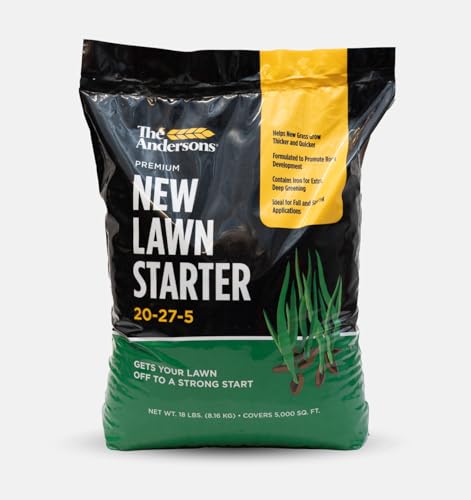
2. The Andersons Premium New Lawn Starter 20-27-5 Fertilizer
This bag gives your new grass the highest phosphorus concentration of anything here (27%) for root growth, plus dual-release nitrogen to avoid burning tender shoots and 1% iron for fast greening.
The 20:27:5 NPK (nitrogen-phosphorus-potassium) ratio puts phosphorus front and center — at 27%, it is a higher concentration than most competitors. The first number, 20% nitrogen, is split between quick-release for an early green-up and slow-release that keeps feeding without burning those tender seedlings. The 1% iron means you get that deep green color you want to see within the first week after germination, not a month later. Buyers report they “were able to get grass in just over a week,” which matches the bag’s dual-release design. One reviewer noted it significantly outperformed using Milorganite alone.
What makes it the top pick
- Highest phosphorus in this group (27%) for aggressive root push
- Dual-release nitrogen prevents burning on new seed
- 1% iron gives visible greening within days
The real drawback
- Only available in an 18 lb bag; wish there was a larger size for bigger lawns
The one to grab: Anyone doing a spring overseed who wants fast root establishment and noticeable green color without worrying about burn — this is the most complete formula here.
Look elsewhere if: you have a lawn over 10,000 sq. ft. and want to buy a single bag; the 5,000 sq. ft. coverage means buying two bags.
3. Jonathan Green (11541) Green-Up Lawn Food for Seeding & Sodding – 12-18-8
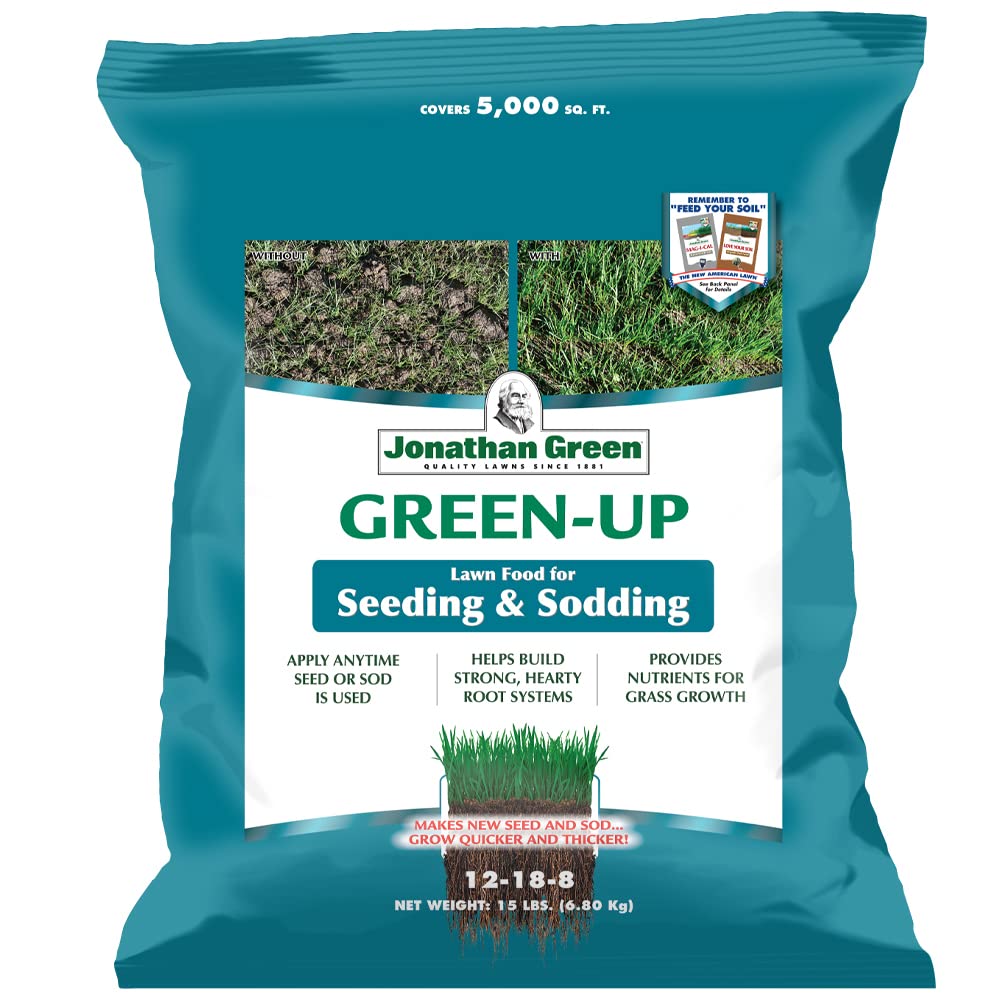
This is the classic phosphorus-driven starter, with 18% phosphorus that gives new seedlings a strong rooting signal, plus humates — organic compounds that help cool spring soil hold nutrients.
The 12-18-8 NPK (nitrogen-phosphorus-potassium) ratio puts 18% phosphorus to work from day one. It also includes humates, which are organic compounds that improve the soil’s ability to hold and exchange nutrients — helpful if your spring soil is still cool and sluggish. The bag covers 5,000 sq. ft. and feeds for up to 2 months, so one application can carry the new grass through the critical establishment window. Owners mention they “saw grass growing within a week and movable in 4,” even in full shade in Minnesota. One customer who switched from Scott’s said the results were “far superior” just seven days after application.
Standout strengths
- High phosphorus (18%) targets root development specifically
- Humates improve nutrient availability in cool spring soil
- Contains iron for deep greening alongside root growth
The trade-off
- At 15.2 lb, the bag is notably lighter than the 45 lb Veri-Green sibling for the same coverage
Reach for this when: you are overseeding in spring and want the highest phosphorus-per-pound in this price range to push roots deep before summer heat.
skip it if: you want extended feeding beyond 2 months without another application; the Pennington UltraGreen feeds for 3 months.
4. Lawn Synergy Starter Fertilizer 15-20-10 (18 lbs.)
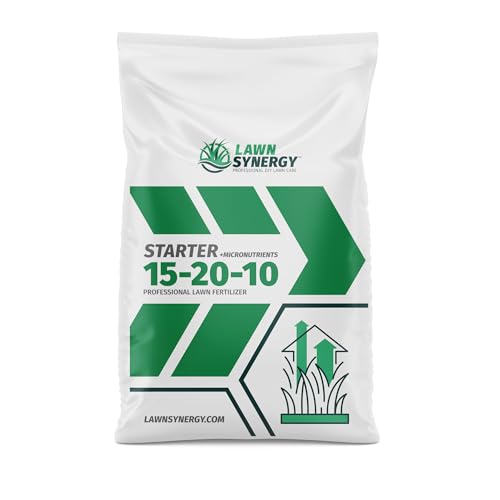
This is the only bag in the group that uses XCU nitrogen — a polymer-coated slow-release form that meters out nitrogen over time, giving a steady feed without the spike-and-crash pattern.
The 15:20:10 NPK (nitrogen-phosphorus-potassium) ratio is phosphorus-heavy at 20%, making it a dedicated root-builder for overseeding. The addition of ammonium sulfate and essential micronutrients gives you early color on top of deep roots. Reviewers point out the product works fast — “grass is coming in good” with visible results quickly. One buyer mentioned the granules handled easily in their spreader and they would use it again. The per-square-foot cost is higher than the Jonathan Green Veri-Green (which covers 15,000 sq. ft. at a larger size), so you pay a premium for precision ingredients.
Why it stands out
- XCU slow-release nitrogen prevents burning on delicate new seedlings
- High phosphorus (20%) targets root development for overseeding
- Professional-grade with less filler than mass-market brands
The honest catch
- At and 4,500 sq. ft. coverage, the per-square-foot cost is higher than the Jonathan Green Veri-Green (15,000 sq. ft. at )
Pick this if: you want professional-grade ingredients — XCU nitrogen plus micronutrients — and are willing to pay a premium for precision feeding on a moderate-sized lawn.
Skip it for: a large lawn; the 4,500 sq. ft. coverage means you are buying multiple bags at a higher per-square-foot cost.
5. Jonathan Green (16008) Veri-Green Starter Fertilizer for Seeding & Sodding – 12-18-8 (15,000 Sq. Ft.)
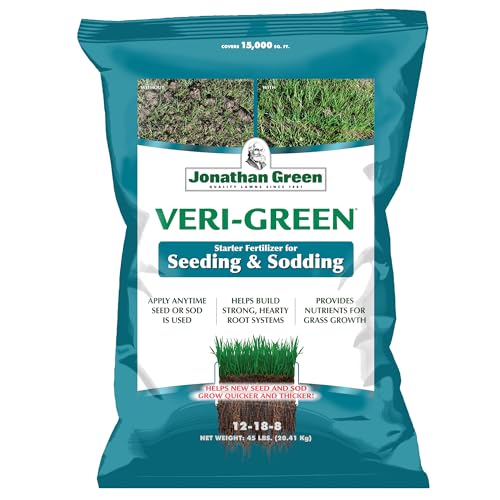
This is the same proven 12-18-8 phosphorus-rich ratio and humate blend as the smaller Green-Up bag, but in a 45 lb bag that covers 15,000 sq. ft. instead of 5,000 sq. ft.
The 12-18-8 NPK (nitrogen-phosphorus-potassium) ratio is identical to product #2, including the humates that improve nutrient exchange. At 45 lb covering 15,000 sq. ft., it gives you coverage of 15,000 sq. ft. versus the 5,000 sq. ft. of the 15.2 lb Green-Up bag. That coverage gap means you are getting a much better value per square foot if you have a lawn of any real size. The formula feeds for up to 2 months. Shoppers say dramatic results: “after just one month, my yard looks 10x better.” Another noted the new grass was green, they had mowed it four times, and there were “no burning or brown spots.” The big bag is heavy (45 lb) and harder to haul and pour for smaller spreaders.
The big advantage
- 45 lb bag covers 15,000 sq. ft. — versus the 5,000 sq. ft. coverage of the 15.2 lb bag of the same formula
- Proven 12-18-8 phosphorus-rich ratio with humates
- Feeds for up to 2 months with no burning reported by users
What to consider
- Large bag is heavy (45 lb) and harder to haul and pour for smaller spreaders
The best match for: anyone with a lawn over 10,000 sq. ft. who wants the same high-phosphorus, humate-enriched starter as the smaller bag but at a dramatically better value per square foot.
Not right for: small yards under 3,000 sq. ft. — the 45 lb bag is overkill and physically unwieldy for a single spreading.
Understanding the Specs
NPK Ratio: The Three Numbers that Matter
The three numbers on a fertilizer bag — for example, 12-18-8 — stand for the percentage of nitrogen (N), phosphorus (P), and potassium (K) in the bag. For overseeding in spring, the middle number (phosphorus) is the most important because it drives root growth in new grass seedlings. A higher middle number, like 18% or 20%, tells the new grass to push roots deep before the top growth takes off. A bag with zero phosphorus (like 30-0-4) is better for thickening up an existing lawn than for encouraging new seed to root.
Slow-Release vs. Quick-Release Nitrogen
Nitrogen gives grass that green color, but too much fast-release nitrogen on a newly seeded lawn can burn the tender roots and leave you with yellow patches. Slow-release nitrogen — sometimes labeled as “XCU,” “polymer-coated,” or “sulfur-coated” — meters out the nitrogen over several weeks or months, feeding the grass steadily without the harsh spike. The Andersons 20-27-5 and Lawn Synergy 15-20-10 both use dual-release blends that combine a quick green-up with extended feeding.
FAQ
What is the best NPK ratio for overseeding in spring?
Can I use a regular lawn fertilizer instead of a starter for spring overseeding?
Should I apply starter fertilizer on the same day as the seed?
How long does starter fertilizer feed the lawn?
Will starter fertilizer burn my existing grass?
What is the difference between the Jonathan Green Green-Up and the Veri-Green?
Can I use The Andersons 20-27-5 on a Bermuda grass lawn?
How do I apply starter fertilizer evenly without burning stripes?
Do I need to water in starter fertilizer after application?
Final Thoughts: The Verdict
For the majority of shoppers, the fertilizer for overseeding in spring winner is the The Andersons Premium New Lawn Starter 20-27-5 because it combines the highest phosphorus concentration for root growth with dual-release nitrogen and added iron for fast greening — all in a balanced, burn-safe formula. If you want a high-phosphorus root builder with humates for cool spring soil, grab the Jonathan Green Green-Up 12-18-8. And for large lawns that need value, the Jonathan Green Veri-Green 45 lb bag covers 15,000 sq. ft. with the same proven formula at a dramatically better price per square foot.
How We Picked
We do not accept paid placement. Every pick is matched to a real buyer and a real use-case; we do not hands-on test units.
Sources & Methodology
Specifications: manufacturer listings and product documentation. Review insights: verified customer reviews, as of July 2026. Pricing: not shown on this page (it changes often); check the current price via the retailer link.
As an Amazon Associate, Lawn Gear Lab earns from qualifying purchases. This does not affect which products we feature.