
Specs are compiled from manufacturer listings and verified buyer reviews and can change over time — please confirm the key details on the product page before buying.
If your burning bushes look more like sad sticks than the fiery red showstoppers you planted, the problem is almost certainly soil chemistry. These acid-loving shrubs need a specific pH range and nutrient balance to produce those deep scarlet leaves — get it wrong and they stay stubbornly green or worse, start dropping leaves. The right fertilizer feeds the plant and the soil’s microbial life.
I’m Rikta — the founder and writer behind Lawn Gear Lab. This guide is built by comparing the manufacturers’ published specifications and the patterns across verified customer reviews, so you get each pick’s real strengths and trade-offs instead of marketing spin.
You want a fertilizer that gives your burning bush the right nutrients without guesswork. For a new planting, a water-soluble (dissolves in water) quick boost works fast. For established shrubs, a slow-release organic option feeds gradually. This guide compares the top choices so you pick the best fertilizer for burning bushes for your situation.
Our Picks at a Glance


How To Choose The Best Fertilizer For Burning Bushes
Burning bushes (Euonymus alatus) are tough plants, but they are picky about their food. A generic all-purpose fertilizer can lock out the iron and sulfur they need to keep leaves vibrant. Focus on these three factors to avoid wasting money and effort.
Acidifying Formula
You need a fertilizer specifically labeled for acid-loving plants. Look for ingredients like sulfur or ammonium nitrogen, which naturally lower the soil pH around the root zone. A neutral or alkaline fertilizer will starve the shrub of nutrients, turning leaves yellow.
Release Type: Water-Soluble vs. Slow-Release
Water-soluble powders (like Miracle-Gro or Jack’s Classic) give you instant control — you see results within days but need to reapply every 7 to 14 days. Slow-release granules (like FoxFarm Happy Frog or Espoma Holly-Tone) break down over weeks or months, feeding steadily with fewer applications. If you are forgetful or plant in spring only, go slow-release.
Micronutrient Content
Beyond the main N-P-K numbers (nitrogen, phosphorus, potassium), watch for iron and sulfur on the label. Iron prevents yellowing (chlorosis) in high-pH soil. Sulfur helps acidify the soil over time. Products like Jack’s Classic Acid Special include both, which is why serious gardeners gravitate toward them.
Quick Comparison
| Model | Best For | Form | Item Weight | Unit Count | Amazon |
|---|---|---|---|---|---|
| Miracle-Gro Azalea & Camellia★ Best Overall | Quick weekly feeding | Powder | 5 Pounds | 80.0 Ounce | Amazon |
| FoxFarm Happy FrogAlso Great | Slow, gentle feeding | Powder | 4 Pounds | — | Amazon |
| Jack’s Classic Acid Special | Precise pH & iron control | Powder | 1 Pounds | 24.0 Ounce | Amazon |
| Espoma Organic Holly-Tone | Organic, no-mix feeding | Granules | 4 Pounds | 128.0 Ounce | Amazon |
| ENVY Acid-Loving Special | All-in-one with measuring scoop | Powder | — | 24.0 Ounce | Amazon |
| Bloom City Acid-Loving | Liquid option for potted plants | Liquid | 32 Ounces | 32.0 Fluid Ounces | Amazon |
| Dr. Earth Acid Lovers | Organic, budget-friendly toss | Granules | 1 Pounds | — | Amazon |
In‑Depth Reviews
1. Miracle-Gro Water Soluble Azalea, Camellia, Rhododendron Plant Food (5 lb)
Our pick — over 4.5★ from 600+ verified ratings; the strongest balance of quality and price.
The 5-pound bag with 80.0 ounces of powder that dissolves completely, feeding weekly for a fast green-up.
At 5 pounds, this is the heaviest bag in the lineup and gives you 80.0 ounces of product — at 80.0 ounces versus the ENVY’s 24.0 ounces. That alone makes it the best value if you have a large yard or multiple acid-loving shrubs to feed. The powder dissolves completely and easily, according to buyers, and one reviewer who has used Miracle-Gro for 30+ years says it outperformed a pricier, highly publicized alternative.
You apply every 7 to 14 days using a watering can or a Miracle-Gro Garden Feeder. The mixing ratio is 1:144 for indoor plants and 1:18 for outdoor ones, so you get a lot of liquid fertilizer from one bag. The catch is the resealable bag closure — several owners mention the Velcro-style seal fails quickly, letting moisture in. One buyer mentioned they had to use clothespins to keep it shut. If you live in a humid area, transfer the powder to an airtight container after opening. Unlike the FoxFarm slow-release above, this gives you instant results, but you have to stay on a weekly schedule.
The formula is designed not to burn foliage when used as directed, so it is safe around tender new leaves. For a quick, budget-friendly solution that covers a lot of ground, this is the volume winner.
Massive coverage: At 80.0 ounces, you feed more plants per dollar than any other pick.
The bag flaw: The resealable closure fails; plan to store in a separate container.
Who it fits: Gardeners with large beds of acid-loving shrubs who want a proven, fast-acting formula.
The dealbreaker: If you want a single annual application or an organic certification, look at Espoma Holly-Tone instead.
2. FoxFarm Happy Frog Acid Loving Plants Fertilizer (4 lb)
The slow-feeding powder that saved frost-damaged Katsura bushes and brought them back to life.
This is the pick for anyone who wants to feed once and trust the soil to do the rest. Happy Frog is a 4-pound powder designed specifically for low pH-loving plants like azaleas, rhododendrons, and blueberries — exactly the same soil conditions burning bushes crave. It contains mycorrhizal fungi and beneficial soil microbes that enhance nutrient uptake and water absorption, so the fertilizer keeps working between rains.
Buyers report that their Katsura bushes got frosted after unseasonable warm weather then turned to very cold again in the spring; they trimmed dead branches, applied this fertilizer, and the bushes came back with healthy leaves. One reviewer noted their gardenia had 2 buds within 10 days of using this, and their strawberry plant exploded with flowers and fruit. Unlike the Miracle-Gro below, Happy Frog provides gentle feedings that won’t overwhelm your plants — you mix just 1/16 cup per gallon of water. The trade-off is that results take a few weeks to appear compared to a water-soluble formula, but the steady nutrition means you don’t chase yellowing leaves all summer.
It is OMRI listed, so it meets organic gardening standards. For an established burning bush that just needs a consistent, gentle push toward that fall redness, this is the safest and most effective option.
The steady hand: Contains soil microbes and mycorrhizal fungi to improve long-term soil health.
The wait: Slower visible results than water-soluble options; you feed in weeks, not days.
Reach for this if: You want a single, gentle feeding that supports recovery from frost or transplant shock.
Look elsewhere if: You need a fast green-up for a severely chlorotic (yellow) bush right now.
3. Jack’s Classic 17-6-6 Acid Special Water-Soluble Fertilizer (1.5 lb)

The 17-6-6 analysis with added iron and sulfur for precise pH control, preferred by blueberry growers.
This is the one for the detail-oriented gardener who wants to dial in the exact soil chemistry. Jack’s Classic has a 17-6-6 analysis (nitrogen, phosphorus, potassium) with improve levels of iron and sulfur — both critical for acid-loving plants. Sulfur slowly acidifies the soil around the root zone, while iron prevents the yellow chlorosis that plagues burning bushes in alkaline conditions. One buyer specifically preferred this over the Miracle-Gro Acid Mix (30-10-10) for better pH control via sulfur and the lower concentration, which reduces the risk of over-fertilization.
Customers note that after 3 biweekly applications, this fertilizer boosted blueberry bush growth significantly. You mix just 1 teaspoon per gallon of water, and it works as a foliar feed (sprayed directly on leaves) or a root drench. The included measuring spoon removes guesswork. The trade-off is that the bag is only 1 pound — far less coverage than the 5-pound Miracle-Gro bag above — so you pay a premium for the precise nutrient mix. If you are treating just a few burning bushes and want maximum control, this justifies the price.
One owner reported that additional feeding is not required thanks to the micronutrient blend. For a targeted, professional-grade option, Jack’s is the specialist’s choice.
Iron & sulfur boost: Directly targets chlorosis and soil acidity better than standard acid fertilizers.
Small bag: 1 pound goes quickly if you have many shrubs; supplement with a larger base feed.
Best for: Gardeners who notice yellow leaves and want a targeted, low-risk treatment with precise measurements.
skip it if: You need a bulk value option — grab the Miracle-Gro above instead.
4. Espoma Organic Holly-Tone 4-3-4 Evergreen & Azalea Plant Food (2 Pack, 8 lb total)
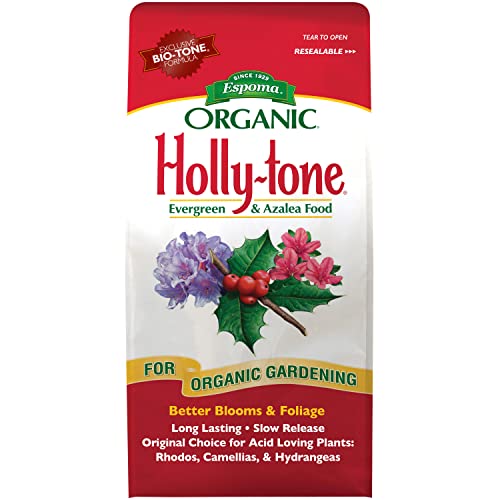
The original organic holly food since 1929, now a 2-pack with 128.0 ounces of slow-release granules.
If you want a true “low-maintenance” organic option, this pack of two 4-pound bags is the standard. Espoma Holly-Tone has a 4-3-4 analysis with 5% sulfur and their exclusive Bio-tone formula. You don’t mix anything — just sprinkle the granules around the drip line of the plant and water thoroughly. Apply in spring and fall for the best results on flowering and evergreen shrubs. One buyer whose hydrangeas and azaleas were struggling noted that the azalea seemed much happier after feeding, and the blueberry bushes definitely liked it.
Reviewers point out that their tree expert recommended Holly-Tone for year-round good health. The granules are ready to use and require no mixing at all. The honest catch? Several buyers mention the smell: “It does have one heck of a smell” and “The bag smells horrific.” The odor dissipates after a few waterings, but for a couple of days your yard will have a distinct organic fertilizer aroma. That is the trade-off for a product that is approved for organic gardening and registered as an Organic Input Material. Unlike the FoxFarm Happy Frog which uses soil microbes, Holly-Tone relies on its slow-release organic breakdown and sulfur content for acidification.
With 128.0 ounces total, this pack covers a lot of ground. If you value organic certification and zero mixing, this is your pick.
Truly organic: OMRI and Non-GMO standards met; no mixing, just toss and water.
Strong smell: The organic ingredients produce a notable odor for a few days after application.
Reach for this if: You want a certified organic, low-effort granular feed for spring and fall application.
Look elsewhere if: You are scent-sensitive or need the instant results of a water-soluble formula.
5. ENVY Plant Foods Acid-Loving Special Water Soluble Fertilizer (1.5 lb)
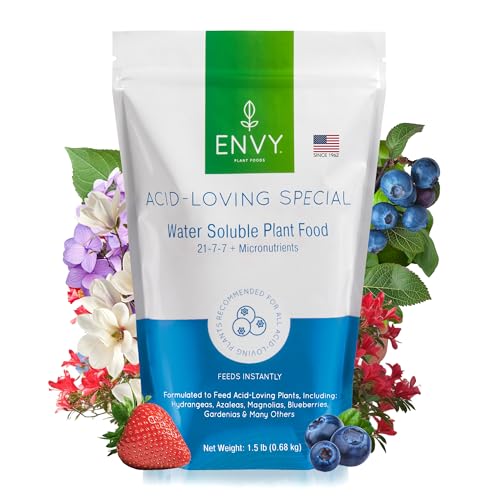
The water-soluble pouch with a measuring scoop that covers hydrangeas, azaleas, and blueberries in one mix.
ENVY’s Acid-Loving Special is a 100% water-soluble powder in a resealable pouch, and it includes a measuring scoop so there is no guesswork. The mixing ratio is 21:7:7, and the formula targets azaleas, hydrangeas, magnolias, gardenias, camellias, rhododendrons, blueberries, and citrus. Shoppers say that applied in spring, their hydrangeas bloomed more than expected. One Florida reviewer noted that their east-facing hydrangeas in too much sun were thriving 4 weeks after using this, and they appreciated the resealable bag and included scoop.
With 24.0 ounces of powder, this has significantly less product than the 80.0-ounce Miracle-Gro bag above (at 24.0 ounces compared to the Miracle-Gro’s 80.0 ounces). But the scoop and resealable pouch make it a more convenient option for someone with a smaller yard or a few container plants. The formula is versatile — it works for citrus too, so you can use the same bag for your lemon tree and your burning bush.
One buyer called it good value compared to popular brands. If you want a tidy, no-hassle water-soluble option without buying a huge bag, this fits well.
All-in-one kit: Measuring scoop and resealable pouch eliminate the need for separate tools.
Less volume: 24.0 ounces is modest; for large beds, the 80.0-ounce Miracle-Gro bag goes further per dollar.
Who it suits: The casual gardener with a few acid-loving shrubs and a preference for tidy, scoop-included packaging.
Who it doesn’t: Budget-focused buyers needing bulk value — the unit cost per ounce is higher here.
6. Bloom City Acid-Loving Plant Fertilizer (32 oz Liquid)

The liquid concentrate that revived eight-year-old blueberry bushes and brought them back to full fruit production.
This is the only liquid option in the list, and it serves a specific purpose: fast-acting root drenching for container plants or shrubs that need an immediate pH correction. Bloom City Acid-Loving comes as a 32-fluid-ounce liquid concentrate. You mix 2 to 4 teaspoons per gallon of water, making it very easy to measure and apply. One customer observed it revived their stressed 8-year-old blueberry bushes with a dramatic turnaround in health, vigor, leaf quality, and fruit production. Another noted that their azaleas showed a noticeable difference after just one application.
The liquid form absorbs faster than any powder or granule, so you see results in days rather than weeks. It is formulated for blueberries, azaleas, rhododendrons, grapes, and raspberries — all acid-lovers. The catch is that the mixing ratio is not specified on the product data, so you need to check the packaging directions carefully. Also, like all liquid concentrates, you are paying for water weight — the 32-ounce bottle contains less actual nutrient than a 5-pound powder bag.
For a small number of container-grown burning bushes or a quick correction for a stressed shrub, this liquid works fast. For large in-ground beds, the powder options are more economical.
Absorbs instantly: Liquid form delivers nutrients to roots faster than any granular or powder option.
Higher cost per feed: 32 ounces of concentrate feeds fewer plants than a 5-pound powder bag at a similar price.
Best for: Container plants or a single shrub needing an immediate boost without mixing much water.
pass on it if: You have a large landscape of in-ground shrubs — stick with powder for better value.
7. Dr. Earth Acid Lovers Azalea, Camellia, Rhododendron & Maple Fertilizer (1 lb)

The Non-GMO Project Verified organic granular that revived sad camellias with just a toss and water.
This is the lightest bag in the lineup at 1 pound, but it packs a serious organic punch. Dr. Earth Acid Lovers is the only Non-GMO Project Verified fertilizer in the U.S.A. according to the manufacturer. It is handcrafted from human and feed grade ingredients, enriched with multi-minerals, proteins, carbohydrates, humic acids and trace elements. There are no synthetic chemicals, GMO infested chicken manure or toxic ingredients — it is people and pet safe. One user highlighted it revived their sad camellias with no digging or tea, just toss and water; the camellias greened up, grew new leaves, and the nearby agapanthus flowered a month early.
Another reviewer said their gardenia bloomed the best it ever had after using this, and a third noted that a rhododendron which hadn’t bloomed for two years sprang to life with huge pink flowers. The granules are tiny and easy to spread. The big trade-off is the 1-pound bag size at 1 pound versus the Miracle-Gro’s 5 pounds, so you will need multiple bags for a large planting. Dr. Earth is also OMRI, OIM, CCOF, and NOP certified for organic production, so the purity standards are high.
For the price, this is the best entry-level organic option for gardeners with just one or two bushes.
Pure organics: Non-GMO Project Verified with multiple organic certifications — the cleanest ingredient profile.
Small bag: 1 pound covers only a few plants; buy multiple bags for larger beds.
Reach for this if: You want the highest organic purity for a small number of acid-loving plants.
Look elsewhere if: You need bulk coverage or want a faster water-soluble response — this is a slow granular.
Understanding the Specs
N-P-K Ratio
This is the three-number code on every fertilizer bag (for example, 17-6-6 on Jack’s Classic). It stands for nitrogen-phosphorus-potassium, and each number is a percentage by weight. Nitrogen (the first number) drives green leaf growth — important for burning bushes that you want to leaf out fully before fall. Phosphorus (the middle) supports root and flower development, but for foliage plants like burning bushes, you do not need a high middle number. Potassium (the last) helps overall plant health and disease resistance. For burning bushes, a ratio with a higher first number (like 17-6-6 or 21-7-7) is typical.
Water-Soluble vs. Slow-Release
A water-soluble powder (like Miracle-Gro or Jack’s Classic) dissolves in water and is available to the plant immediately. You see results in days but have to reapply every 1-2 weeks. A slow-release granular (like Espoma Holly-Tone or FoxFarm Happy Frog) breaks down over weeks or months, feeding steadily. Slow-release is less work but responds slower to immediate problems. Choose based on how often you want to be in the garden and how quickly your bush needs help.
Item Weight vs. Unit Count
Item weight is the raw weight of the bag or bottle. Unit count is the total volume or weight of the product inside expressed in a different unit (ounces, fluid ounces). The Miracle-Gro bag weighs 5 pounds and has 80.0 ounces of product, while the ENVY bag has 24.0 ounces. Compare unit counts to see which gives you more feedings per bag. A higher unit count with a similar price means better value for large yards.
Organic Certification
Several picks (Dr. Earth, Espoma Holly-Tone) carry OMRI (Organic Materials Review Institute) or Non-GMO Project Verified labels. These mean the ingredients meet standards for organic production — no synthetic chemicals or GMOs. If you are growing edibles like blueberries nearby, organic fertilizers are safer for the soil food web. The trade-off is that organic granules often have a stronger smell than synthetic powders and may take longer to show visible results.
FAQ
Can I use any fertilizer on burning bushes?
How often should I fertilize burning bushes?
Will fertilizer make my burning bushes turn red in fall?
What is the difference between water-soluble and granular fertilizer?
Is organic fertilizer better for burning bushes?
Can I over-fertilize burning bushes?
My burning bush has yellow leaves. Will acid fertilizer help?
Can I use these fertilizers on other acid-loving plants?
How much fertilizer does a burning bush need per application?
Is it safe to use these fertilizers around pets?
Final Thoughts: The Verdict
The FoxFarm Happy Frog Acid Loving Plants Fertilizer is also a great choice, as it combines slow-release feeding with beneficial soil microbes, giving your bushes steady nutrition without the risk of burn. If you want fast, visible results and have a larger yard, grab the Miracle-Gro Water Soluble Azalea, Camellia, Rhododendron Plant Food for its 80.0-ounce bag and proven performance. And for certified organic purity with zero mixing, the Espoma Organic Holly-Tone pack delivers 128.0 ounces of slow-release granules that keep feeding through the season.
How We Picked
We do not accept paid placement. Every pick is matched to a real buyer and a real use-case; we do not hands-on test units.
Sources & Methodology
Specifications: manufacturer listings and product documentation. Review insights: verified customer reviews, as of July 2026. Pricing: not shown on this page (it changes often); check the current price via the retailer link.
As an Amazon Associate, Lawn Gear Lab earns from qualifying purchases. This does not affect which products we feature.