
Specs are compiled from manufacturer listings and verified buyer reviews and can change over time — please confirm the key details on the product page before buying.
You walk through your backyard and see an ant hill. Or a tick. Or a patch of dead grass chewed up by grubs from below. You want one thing—a yard you can actually enjoy without worrying about what is biting you or eating your lawn. This guide sorts through the granular insecticides (the kind you spread with a spreader) that actually stop the problem above and below ground, so you can pick the right bag for your specific bug problem.
I’m Rikta — the founder and writer behind Lawn Gear Lab. This guide is built by comparing the manufacturers’ published specifications and the patterns across verified customer reviews, so you get each pick’s real strengths and trade-offs instead of marketing spin.
You need to match the active ingredient (the chemical that kills bugs) and the coverage area (how many square feet one bag treats) to the specific pests in your yard and the size of your lawn — not just grab the biggest bag on the shelf.
Our Picks at a Glance
How To Choose The Best Insect Killer For Yard
The right granular insecticide depends on what bugs you have, how big your yard is, and how long you want the protection to last. Here is what separates an effective treatment from one that leaves you disappointed.
Active Ingredient: Bifenthrin vs Imidacloprid
The active ingredient is the chemical that actually kills the bugs. Bifenthrin (found in Talstar and Bifen granules) works on contact and has a long residual (how long it stays active on the ground) of up to 3 months. Buyers report it is slow-acting because ants carry it back to the nest, which kills the whole colony. Imidacloprid (found in Bayer Merit) is a systemic insecticide—the plant absorbs it, and insects that feed on the plant die. It is very effective against grubs and tree borers, but you need to time the application correctly for grub season.
Coverage Area and Bag Size
Granules are sold by weight, but the coverage area matters more. A 20-pound bag can treat from 20,000 to 25,000 square feet, depending on the product’s recommended application rate. Measure your lawn area in square feet (length times width) to know which bag size fits your yard. A product that spreads thin over a bigger area might not have enough active ingredient per square foot to kill tough pests.
Residual Protection Timeline
Residual is the time the granules keep working after you apply them. Short residuals mean you reapply every few weeks during summer. Long residuals (up to 4 months) mean one application can cover most of the season. Products with a sand-core granule structure, like Talstar PL, release the active ingredient slowly so rain does not wash it away immediately. Owners mention that heavy rain can shorten the residual on some products, so check reviews for your climate.
Quick Comparison
| Model | Best For | Active Ingredient | Coverage | Bag Weight | Amazon |
|---|---|---|---|---|---|
| Talstar PL Granules★ Best Overall | Longest residual | Bifenthrin | — | 400 Ounce (25 lb) | Amazon |
| BioAdvanced Complete Insect KillerSeason Champion | Season-long lawn defense | — | Up to 25,000 sq ft | 20 Pounds | Amazon |
| Bifen Granules | Economical ant control | Bifenthrin 0.2% | — | 25 pounds | Amazon |
| Bayer Merit 0.5 Granular | Systemic grub & tree protection | Imidacloprid 0.5% | — | 30 Pound | Amazon |
| Ortho Bug B Gon Max | 100+ insects, 3-month control | — | Up to 10,000 sq ft | 10 lb | Amazon |
| Ortho BugClear Lawn Insect Killer | Fast-acting, broad yard coverage | — | Up to 20,000 sq ft | 20 lb | Amazon |
| Eco Defense Flea, Tick, and Mosquito Spray | Natural repellent | Plant-based oils | Up to 5,000 sq ft | 2.38 Pounds | Amazon |
In‑Depth Reviews
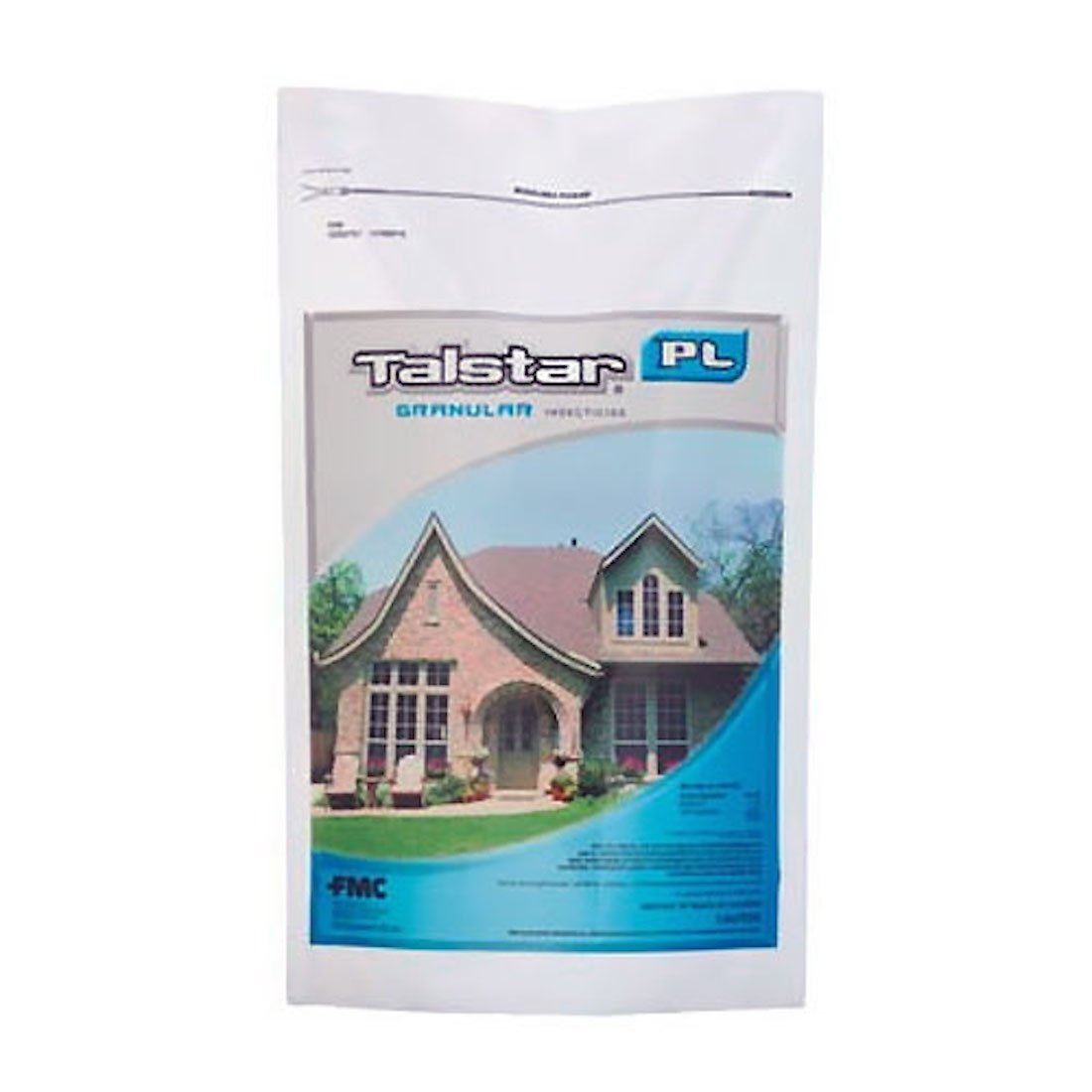
1. Talstar PL Granules Insecticide
Our pick — over 4.5★ from 750+ verified ratings; the strongest balance of quality and price.
The longest-lasting granular killer buyers trust for full-season ant control.
If you want to spread granules once and forget the bug problem for months, this is the bag to grab. Talstar PL uses a sand-core granule structure that releases bifenthrin (a broad-spectrum insecticide that kills on contact) slowly for a 2 to 4 month residual—the longest residual of any granule on the market, according to the manufacturer.
Customers note it penetrates mulch and grass without needing to be watered in immediately. One reviewer noted they “used granules and liquid Talstar (1 oz./gal) for ants inside/out” and became “ant-free for 2 months (first time in 20+ years),” noting it kills crickets, earwigs, fleas, and black widows as well. Unlike the Bifen Granules which reviewers point out lasts about three weeks, Talstar’s residual is closer to 2-4 months depending on your rainfall and pest pressure.
One trade-off: shoppers say it is slow-acting against heavy infestations because ants carry the poison back to the nest. For really bad problems, some customers suggest using a professional treatment first, then switching to this for maintenance. It also works well on fire ants when you broadcast it over the whole lawn with a spreader.
Longest Residual
- Lasts 2 to 4 months per application
- Penetrates mulch and grass without watering in
- Kills ants, fleas, crickets, earwigs, black widows
Slow Acting
- Can take up to 2 weeks to see full results on ant colonies
- Not recommended for severe infestations without prior treatment
Perfect for: Anyone who wants one application to handle most perimeter bugs for the whole season, especially ant and flea problems.
Consider instead if: You need immediate knockdown—the slow-acting mode means patience is required.
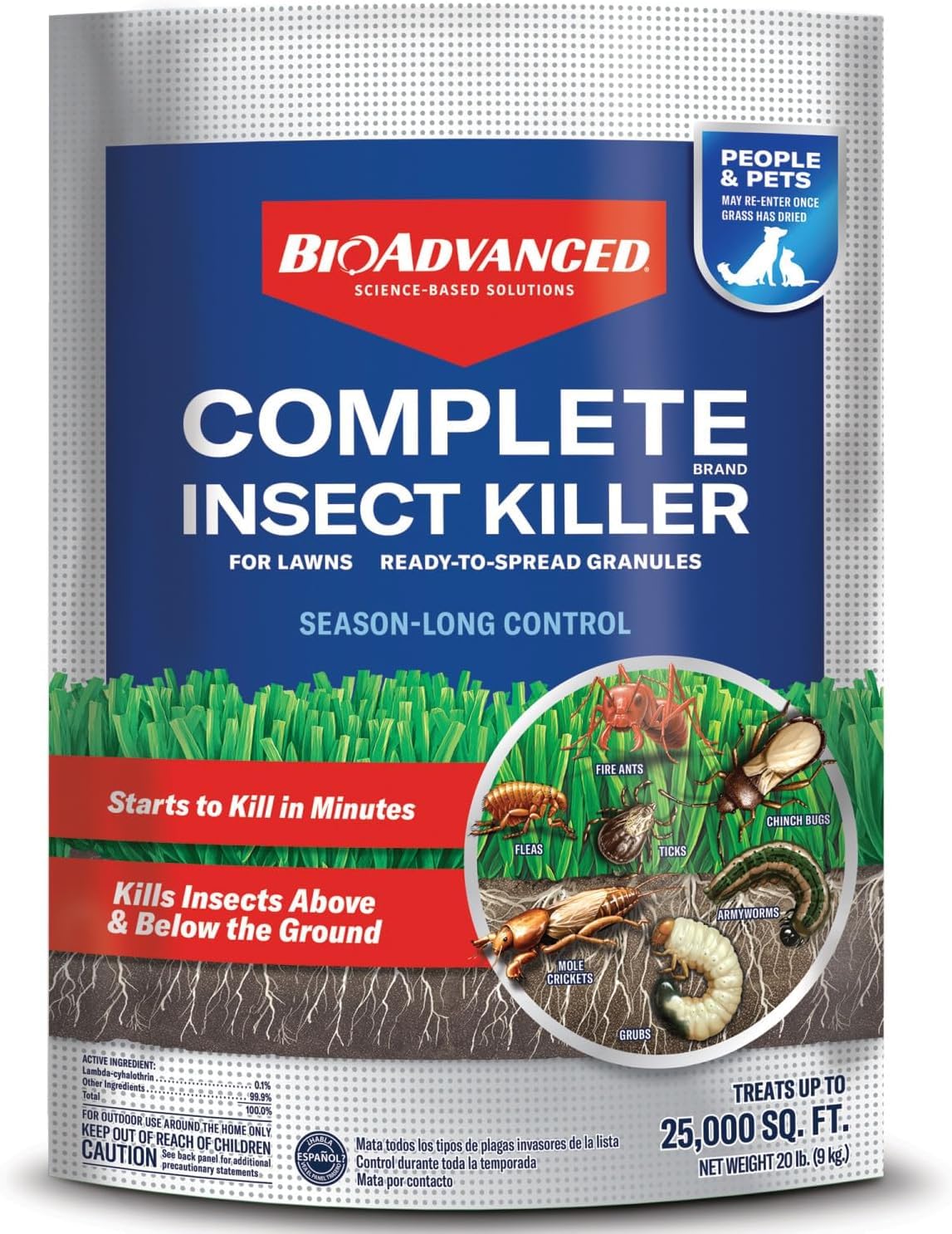
2. BioAdvanced Complete Brand Insect Killer for Lawns Granules
Spreads far and kills fast—a season-long solution for bigger lawns.
With a 20-pound bag that treats up to 25,000 square feet, this is the broadest coverage among the mid-range picks. That is at 25,000 square feet, compared to the Ortho Bug B Gon Max’s 10,000 square feet from a 10-pound bag, so it fits a larger yard without needing a second bag. The fast-acting formula kills listed insects on contact—including ants, fleas, ticks, chinch bugs, mole crickets, and grubs—and provides season-long protection when applied correctly.
Buyers consistently report it works year after year. One buyer mentioned it has been “effective for years” and is “easy to use with spreader,” giving “about 3 months of pest protection in warm climates.” Another noted it handles heavy tick infestations even in deep forest campsites. It is also safe for St. Augustine grass, a common warm-season turf that can be sensitive to some chemicals.
The catch: timing matters. Some buyers found heavy rain washed the granules away before they could activate, reducing effectiveness. You want to apply it when no rain is forecast for at least 24 hours so the granules settle into the soil.
Big Coverage, Big Results
- Treats up to 25,000 sq ft per bag
- Kills above and below ground on contact
- Safe for most lawn types including St. Augustine
Weather Dependent
- Heavy rain shortly after application reduces effectiveness
- Requires a broadcast or drop spreader for even coverage
Best for: Large lawns where you need broad-spectrum protection without buying multiple bags per season.
Skip if: You have a small yard—the coverage is overkill for anything under 5,000 sq ft.
3. Eco Defense Flea, Tick, and Mosquito Spray for Yard

A hose-end spray that goes on fast and stays safe around pets playing.
Unlike the granular picks above that need a spreader and watering in, this ready-to-spray formula attaches directly to a hose. You just turn on the water and walk the yard. It covers up to 5,000 square feet and uses plant-based, naturally-derived oils instead of synthetic chemicals, so you do not need to wait before letting kids or pets back outside. The maker claims it kills adults, larvae, and eggs of mosquitoes, ticks, and fleas.
Buyers have mixed feelings about mosquito control specifically. One reviewer from Louisiana said, “I tried this several times because mosquito companies are expensive, but there were still a lot of mosquitoes so I had to go back to the company.” Another found it helpful against fleas and ticks but noted “the product does not get rid of the mosquitos” — only diminished them. If you have year-round mosquito pressure, a synthetic granular (a man-made chemical pellet) might work better.
Where it shines is as a gentle perimeter barrier for families. One buyer uses it on bushes, trees, and patio, and their dogs have had no fleas or ticks for weeks. The natural oils have a fragrant scent rather than a chemical smell, and it serves well as monthly maintenance between stronger treatments.
Pets Can Stay
- No waiting time after spraying—safe for kids, dogs, and cats
- Easy hose-end application—no spreader required
- Plant-based oils with a natural scent
Mosquito Limits
- Does not eliminate heavy mosquito infestations
- Covers only 5,000 sq ft per bottle
- Needs reapplication every 30-45 days
Reach for this if: You have pets and kids who play on the lawn and want a non-toxic spray for weekly flea and tick prevention.
Look elsewhere if: Mosquitoes are your main enemy—the natural oils are not strong enough for high mosquito pressure.
4. Ortho Bug B Gon Max Insect Killer for Lawns

Kills 100+ bugs above and below ground for up to three straight months.
A 10-pound bag treats up to 10,000 square feet and claims to kill over 100 listed insects including ants, chinch bugs, fleas, and ticks. It works both on the surface and below ground, hitting grubs and other root-feeders. One buyer with a 7,600 sq ft lot said a single bag easily covered the grass, flower beds, vegetable garden, and a perimeter around the house, leaving some leftover.
Buyers who have used it for nearly a decade report it suppresses ant colonies and reduces ticks pulled off pets. However, one reviewer saw ants returning “after two months” despite the claim of 3-month control, noting heavy rain may have shortened the residual. The same buyer mentioned flying beetles and junebugs dropped dead from the stuff.
Uniquely among these picks, this product can be used in vegetable gardens and flower beds (on listed vegetables) and around home foundations. It is backed by a money-back guarantee if you are not satisfied. One caution: some buyers still saw lawn insects two weeks after applying, so it is not the fastest knockdown.
Versatile Application
- Safe for use on lawns, ornamentals, vegetable gardens, and flower beds
- Treats up to 10,000 sq ft per bag
- Money-back guarantee
Residual Can Vary
- Some buyers saw ants return after 2 months, not 3
- Heavy rain may reduce effectiveness
A solid all-rounder for: Medium yards where you want to treat the lawn plus flower beds and veggie patches with one bag.
Swap if: You need absolute 3-month control in rainy climates—the residual might fall short.
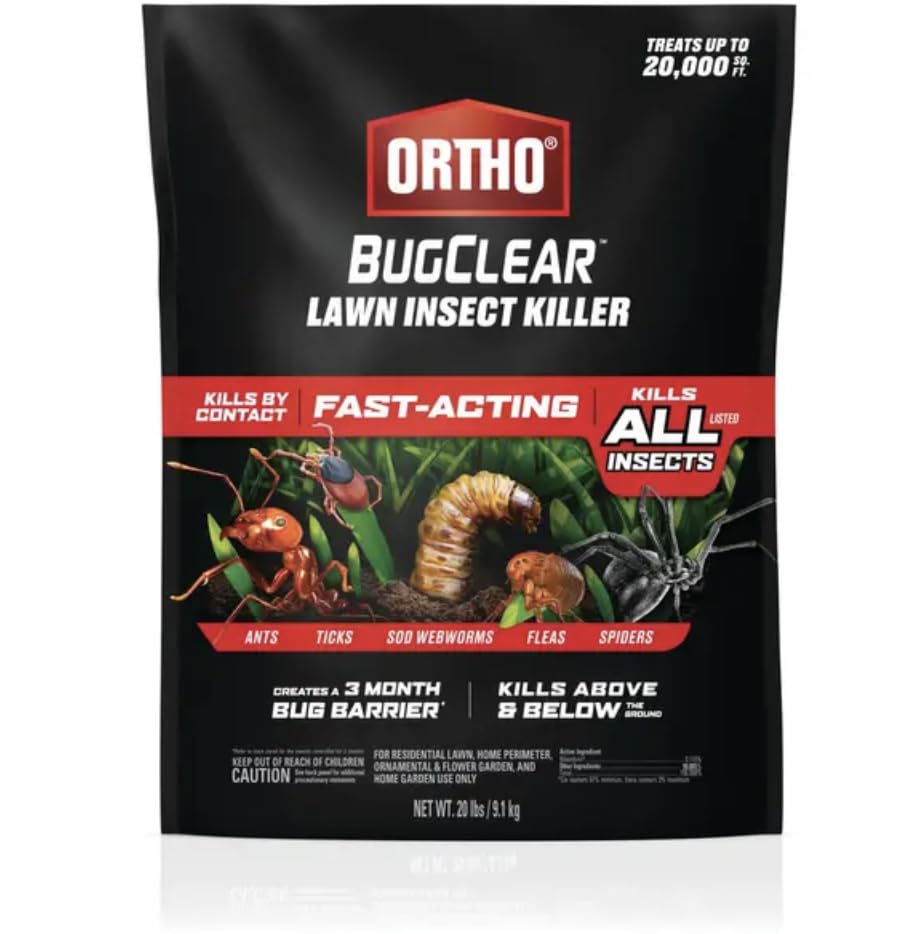
5. Ortho BugClear Lawn Insect Killer
Spreads over 20,000 square feet and clears bugs by the next morning.
This is the fast-acting hero for big lawns. A 20-pound bag provides up to 20,000 square feet of coverage, compared to the Ortho Bug B Gon Max’s 10,000 sq ft. It kills above and below ground and creates a barrier to keep bugs from migrating inside. Buyers report it works overnight. One owner reported, “the day after applying, the swarms of gnats and mosquitoes were gone,” and another noted it “significantly cut down” a crane fly infestation.
Reviewers also note it works as a mole deterrent by removing their food source. One buyer applied liberally in early and late spring and eliminated moles entirely by August after a previous severe infestation. Another long-term user in Florida reported it “seems to keep the bugs away” and spreads very easily with a Scotts Drop, SpeedyGreen, or EdgeGuard spreader.
One honest caveat: a buyer whose dogs had fleas found that after using this product for a year, fleas returned “despite applying every 2 months per directions.” They wondered if the formula changed or if Texas fleas grew resistant. If you have a persistent flea problem, you might need to rotate active ingredients (switch to a different chemical) across seasons.
Fast Knockdown
- Visible results the next day on gnats, mosquitoes, crane flies
- Covers up to 20,000 sq ft per bag
- Creates a barrier barrier to keep bugs out of the house
Flea Resistance
- Some owners mention fleas returning after regular use
- Requires watering in after application
A strong pick for: Large yards with gnats, mosquitoes, or mole problems where you need quick visible results.
Consider switching if: Fleas are your primary target—some evidence of resistance developing.
6. Bifen Granules — 25 Pounds

Sand-like granules that rain does not wash away—ant-free for weeks.
This is the granular insecticide that pest control technicians use. It contains 0.2% bifenthrin (the same active ingredient as Talstar PL) in a sand-core granule that is designed for outdoor application on lawns, turf farms, golf courses, parks, and sports fields. Unlike some other granular products that use large clunky particles, buyers describe these granules as “like sand,” which helps them settle into the soil better. The label says rain does not affect it and actually recommends wetting it down with a hose if it doesn’t rain within a few days.
Customers note impressive results on ants. One reviewer who has used it for years says there is “never an ant pile, ever” and it “works for a long time.” Another noted it lasted about three weeks on ants in the yard and driveway — shorter than Talstar PL’s 2-4 month residual (how long the chemical stays active) but longer than any off-the-shelf spray. A former pest control technician verified it is effective for controlling fleas, ticks, and ants near the lawn and perimeter.
Compared to the Talstar PL, the Bifen Granules have a similar active ingredient but the residual falls shorter (about 3 weeks vs 2-4 months). However, at 25 pounds for the same bifenthrin concentration, this is the more economical choice if you are willing to reapply monthly. One note: the target species listed on the label includes “Fish,” so keep it away from ponds and water features.
Technician Grade
- Sand-like granules resist rain wash-off
- Economical—a little goes a long way for large yards
- Proven effective for ants, fleas, ticks, and perimeter pests
Shorter Residual
- Lasts about 3 weeks on ants vs Talstar’s 2-4 months
- Not recommended for use near fish or water bodies
Ideal for budget-conscious buyers who: Want professional-grade bifenthrin at a lower cost and do not mind reapplying every few weeks.
Pass if: You want a single application to last the whole season—Talstar PL has the longer residual.
7. Bayer Merit 0.5 Granular Systemic Insect Control — 30 Pound Bag

The grub killer that takes down mole problems by removing their food source.
This uses imidacloprid at 0.5% concentration, a systemic insecticide (the plant absorbs the chemical so insects that eat the plant die). It is designed for use on turfgrasses, trees, shrubs, evergreens, flowers, foliage plants, and ground covers. The 30-pound bag is one of the heaviest in this roundup, and the EPA-registered label restricts total application to 80 pounds per acre per year. It is best known for eliminating grubs, which then removes the food source for moles and birds that dig up your lawn.
Multiple buyers confirm it fixes grub problems that cause brown, easy-to-pull-up grass. One reviewer specifically emphasized that correct timing is everything—if you apply too late in the grub lifecycle, the product appears to fail. Another user noted it “eliminated spittle bugs covering mower” and kept bugs gone for months. However, the same user called it “expensive but effective.”
Unlike the bifenthrin-based granulars (Talstar and Bifen) which kill on contact, Merit works systemically—it needs to be taken up by the plant. This makes it less effective for quick knockdown of surface pests like ants and fleas, but superior for grubs, tree borers, and root-feeders. If you have a grub infestation that is attracting moles, this is the right active ingredient.
Grub Expert
- Systemic action eliminates grubs at the root zone
- Effective against emerald ash borer, elm leaf beetle, and pine borer
- 30-pound bag covers large areas
Specific Use
- Requires precise timing for grub control—apply before grubs hatch
- Not designed for surface insects like ants or mosquitoes
- Expensive per bag vs bifenthrin alternatives
Your go-to if: Grubs have turned your lawn into a spongey mess and moles are digging it up—this kills the food chain.
Avoid if: You need broad-spectrum surface control for ants, ticks, and mosquitoes—bifenthrin granules are a better fit.
Understanding the Specs
Active Ingredient: Bifenthrin vs Imidacloprid
These two chemicals work very differently. Bifenthrin (used in Talstar PL and Bifen Granules) is a contact insecticide—bugs die when they walk over the treated granules. It gives you a visible knockdown within days. Imidacloprid (used in Bayer Merit) is systemic: the grass and plants absorb it into their tissues, and bugs die when they eat the treated plant. This makes it ideal for grubs, but less useful for ants walking across the surface. Choosing between them means matching the chemical to the bug’s behavior.
Residual Timeline
Residual is the length of time the insecticide stays active in your yard after you apply it. Talstar PL claims a 2 to 4 month residual (the longest on the market). Bifen Granules lasts about 3 weeks according to buyers. Bayer Merit’s residual depends on the soil and weather. A longer residual means fewer applications, but heavy rain can shorten the effective window for any granular product. Checking local rainfall patterns helps you decide whether a long-residual product is worth its price.
FAQ
How long does a granular insecticide take to start killing bugs?
Can I use a granular insect killer on my vegetable garden?
How do I apply granules evenly across my lawn?
Will rain ruin the granules before they work?
What is the difference between granular and spray insect killers?
How often should I reapply a granular insect killer?
Is a granular insect killer safe for pets and kids?
Will granular insecticide kill fire ants?
What insects will bifenthrin and imidacloprid not kill?
Can I mix granular and spray insecticides for better coverage?
Final Thoughts: The Verdict
For the majority of shoppers, the insect killer for yard winner is the Talstar PL Granules because it delivers the longest residual (2 to 4 months) with the most reliable bifenthrin formula for ants, fleas, and perimeter pests. If you have a large lawn and want fast knockdown plus wide coverage, grab the Ortho BugClear. And for precise grub control that eliminates moles by starving them out, the Bayer Merit 0.5 Granular is your specialist.
How We Picked
We do not accept paid placement. Every pick is matched to a real buyer and a real use-case; we do not hands-on test units.
Sources & Methodology
Specifications: manufacturer listings and product documentation. Review insights: verified customer reviews, as of July 2026. Pricing: not shown on this page (it changes often); check the current price via the retailer link.
As an Amazon Associate, Lawn Gear Lab earns from qualifying purchases. This does not affect which products we feature.