
Specs are compiled from manufacturer listings and verified buyer reviews and can change over time — please confirm the key details on the product page before buying.
Cutting trees and thick branches with a reciprocating saw depends on one thing: enough power to drive the blade through without bogging down, and a design that does not shake your hands numb during a long afternoon of pruning. The right saw turns a back-aching demolition into a controlled, predictable chore—the wrong one leaves you fighting vibration and a dead battery halfway up a limb.
I’m Rikta — the founder and writer behind Lawn Gear Lab. This guide is built by comparing the manufacturers’ published specifications and the patterns across verified customer reviews, so you get each pick’s real strengths and trade-offs instead of marketing spin.
Whether you are clearing storm-felled limbs or maintaining an orchard, the trade-offs between corded power and cordless convenience are sharp. Here is the decision-simplifying list of the best reciprocating saw for cutting trees to match your actual workload.
Our Picks at a Glance
How To Choose The Best Reciprocating Saw For Cutting Trees
Choosing a reciprocating saw for tree work is not the same as picking one for demolition. Green, living wood grabs the blade differently than dry lumber, so you need a saw with enough power and the right features to keep you cutting without fighting the tool. Here are the four specs that separate a tree-cutting machine from a general-purpose hack.
Amperage or Voltage (Corded vs. Cordless Power)
Corded saws use amps to measure their motor’s grunt—more amps mean more torque to muscle a long blade through a thick branch. Cordless saws use volts (18V, 20V, or 60V) as a rough power indicator, but the real story is the battery’s capacity (amp-hours, or Ah) since that determines how long you can cut before recharging. For tree work, a corded saw with 7.5 to 13 amps delivers consistent, non-stop power, while a cordless saw with 18V and at least a 4.0Ah battery gives you a solid runtime for a few hours of limbing.
Stroke Length
This is the distance the blade travels back and forth in each stroke, measured in inches. A longer stroke—around 1-1/8 inches—removes more material per pass, making it faster at cutting through thick trunks. Shorter strokes are fine for plumbing cuts but will feel slow when you are trying to chew through a six-inch limb. For trees, you want a stroke length of at least an inch.
Vibration Control
An hour of cutting branches with a poorly balanced saw can make your hands feel like they are buzzing for hours afterward. Some saws use counterbalance mechanisms (often called “Buzzkill” or similar tech) to cancel out the worst of the shake. This matters intensely for tree work—when you are holding the saw in awkward, overhead positions, every bit of vibration reduction keeps you accurate and reduces fatigue. Look for saws that specifically mention counterbalance or low-vibration construction.
Blade Length and Tool-Free Change
A longer blade is the only way to cut thick tree limbs without the saw’s body getting in the way. A standard 8-inch blade is fine for branches up to about four inches, but for six-inch or larger limbs, you will want a saw that accepts 12-inch or longer blades. A tool-less blade change lets you swap to a fresh or longer blade in seconds without hunting for an Allen wrench—handy when you are on a ladder or kneeling in wet grass.
Quick Comparison
| Model | Best For | Power | Stroke | Item Weight | Amazon |
|---|---|---|---|---|---|
| SKIL 13 Amp Corded★ Best Overall | Heavy branch cutting, non-stop | 13 Amps | 1-1/8 in | 9 lbs | Amazon |
| DEWALT FLEXVOLT 60VPowerhouse Cordless | Cord-free power matching corded | 60V Max | 1-1/8 in | 7.43 lbs | Amazon |
| CRAFTSMAN 7.5 Amp Corded | Reliable corded value | 7.5 Amps | 1-1/8 in | 7 lbs | Amazon |
| RYOBI ONE+ HP Compact | One-handed limb trimming | 18V Brushless | — | 3.8 lbs | Amazon |
| Cordless w/ 2×4000mAh | Light cordless tree work kit | 18V Brushless | 1.1 in | 3 lbs | Amazon |
| DEWALT 20V MAX Compact Kit | Compact pruning & yard work | 20V Max | 1-1/8 in | 7 lbs | Amazon |
| HYCHIKA 18V Cordless | Budget entry for light limbs | 18V / 2 Amps | — | — | Amazon |
In‑Depth Reviews
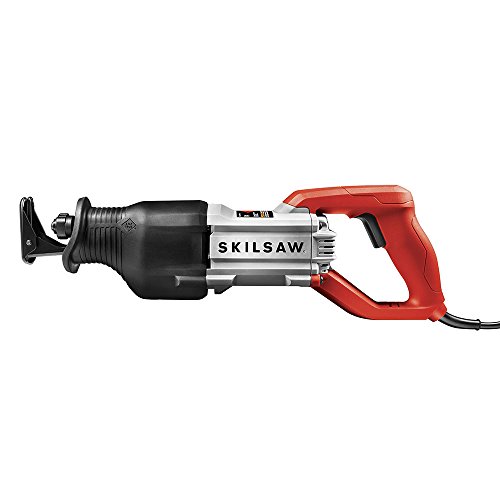
1. SKIL 13 Amp Corded Reciprocating Saw with Buzzkill Technology – SPT44A-00
Our pick — over 4.5★ from 950+ verified ratings; the strongest balance of quality and price.
You get uninterrupted cutting power with the 13-amp motor and dramatically less hand fatigue thanks to the Buzzkill counterbalance system.
If your idea of tree trimming involves cutting thick limbs for an hour or more without stopping to recharge, this SKIL is your answer. Its 13 amp motor—the highest current rating in this lineup by a wide margin—delivers the consistent torque needed to rip through dense, green wood without bogging down. Unlike the HYCHIKA’s 2-amp motor, this saw provides more than six times the power draw, meaning you can bury an 8-inch blade into a trunk and keep it chewing without the motor struggling.
The patented Buzzkill Technology is not just a marketing name—it uses a counterbalance mechanism (a set of weights that move in opposition to the blade) to suppress vibration measurably better than comparable saws. Buyers report that after owning the saw for 1.5 years, there is “virtually zero vibration,” which makes long cutting sessions far less taxing on your hands and wrists. The trade-off is weight: at 9 pounds, it is 2 pounds heavier than the CRAFTSMAN and significantly portlier than any cordless model, so it is less suitable for overhead or one-handed pruning.
Where this saw really shines is in the sheer ability to keep cutting as long as your arms can hold it—no battery anxiety, no waiting for a recharge. It is heavy, but that weight also helps the blade stay planted on the cut line when you are boring through a stubborn branch.
Why it excels for tree work
- 13-amp motor gives uninterrupted power for heavy limb cutting
- Buzzkill anti-vibration system keeps fatigue low during long sessions
- Accepts long blades for cutting branches over six inches thick
The honest limits
- Weighs 9 pounds—tiring for overhead trimming
- Cord keeps you tethered to an outlet
- Tool-less blade lock takes some practice to master one-handed
Reach for this if: you want to cut large branches all afternoon with zero battery concern and the lowest vibration in the test group.
Look elsewhere if: you need a saw to carry up a ladder or to use in the middle of a yard far from an outlet.
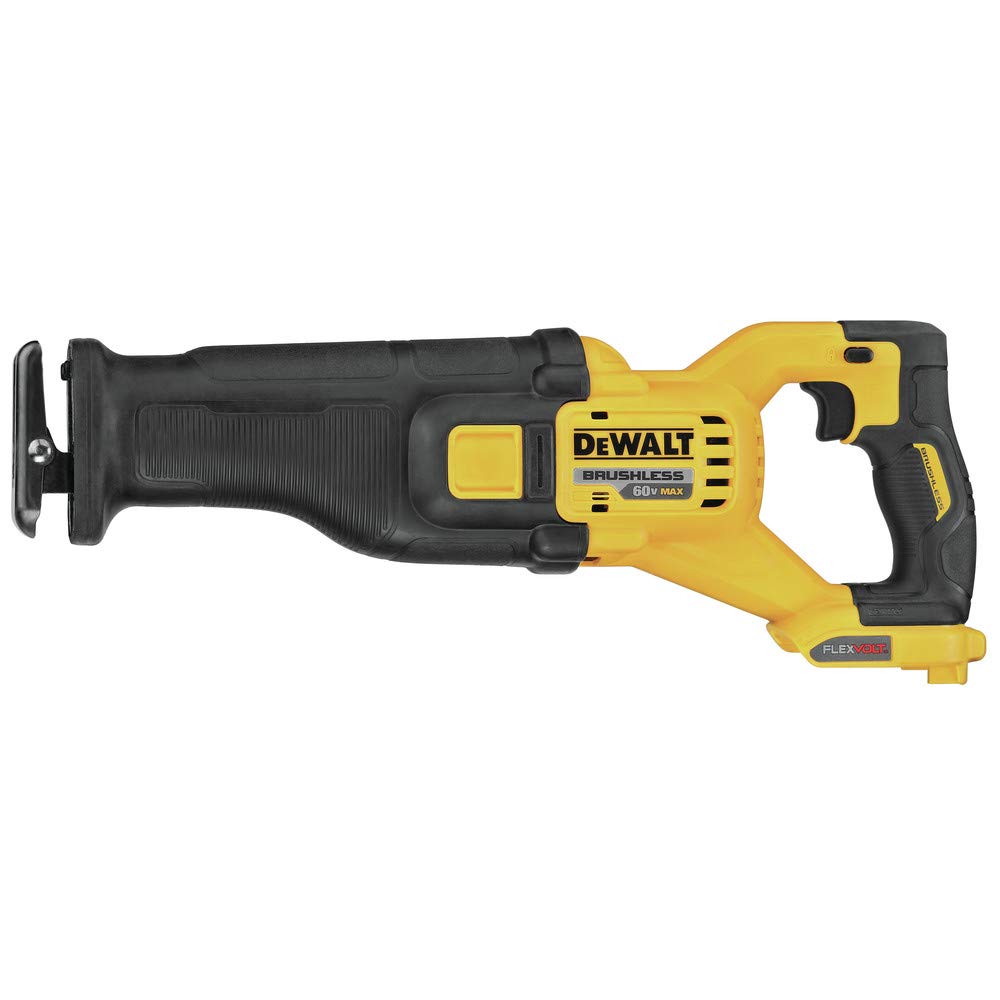
2. DEWALT FLEXVOLT 60V MAX Reciprocating Saw, Cordless, Tool Only (DCS389B)
The 60V motor gives you corded-level aggression that roams free across your whole property, without dragging a cord.
This DEWALT FLEXVOLT is the saw that asks “what if we just put corded power in a battery-powered body?” And then does it. The 60V motor delivers the kind of grunt that makes cutting through a six-inch limb feel like a controlled, predictable event rather than a struggle. With 0-3000 strokes per minute (SPM) and a 1-1/8-inch stroke length, it chews through material as fast as the SKIL, but without the 9-pound weight penalty—this one sits at a more manageable 7.43 pounds, a 17% weight reduction that makes overhead pruning far less punishing.
The keyless lever-action blade clamp lets you swap to a longer branch-cutting blade in seconds without needing a tool or removing your gloves. The pivoting shoe gives you leverage against the branch as you cut, helping the saw bite deeper without skating. Owners mention it feels “very powerful, sturdy, and strong,” though the FLEXVOLT battery platform is an investment if you are not already in the DEWALT ecosystem.
The honest catch is the tool-only format—you need to supply your own battery, which means a higher upfront cost if you are not already on the DEWALT platform. But if you are, this saw replaces a corded unit entirely for tree work.
What makes it a top competitor
- 60V motor offers corded-level power without a cord
- 1-1/8-inch stroke clears material fast per pass
- Keyless blade clamp and pivoting shoe improve control
Considerations before buying
- Tool only—battery and charger add significant cost
- At 7.43 lbs, still heavy for extended one-handed use
Perfect for: property owners with existing DEWALT FLEXVOLT batteries who need cordless cutting power that rivals a corded saw.
Not your saw if: you are starting from scratch with no battery system and want the lowest entry cost.
3. CRAFTSMAN Reciprocating Saw, 7.5 Amp, 3,200 RPM, Corded (CMES300)

You save 2 pounds compared to the top-pick SKIL and still get the same 1-1/8-inch stroke for fast branch cuts.
This CRAFTSMAN proves you do not always need a 13-amp bruiser to handle tree work. With 7.5 amps on tap and the same 1-1/8-inch stroke as the SKIL, it cuts through branches efficiently—just not quite as aggressively when the wood gets really dense. What it loses in raw power versus the SKIL it gains in usability: at 7 pounds, it is 2 pounds lighter, which makes a noticeable difference when you are reaching up to prune a limb or working through a pile of fallen branches for an hour.
The variable speed trigger (0-3200 RPM) gives you precise control—squeeze gently to start the cut and then open it up once the blade is seated, rather than having it jump or grab. The tool-free blade release is straightforward: flip the lever, swap in a longer 12-inch pruning blade, and you are back to cutting in seconds. One thing buyers consistently mention is that the saw has “some weight to it” and that you will want to take breaks on big jobs, but that is more a reflection of its honest design than a flaw.
Compared to the lighter cordless options below, this CRAFTSMAN never runs out of battery—as long as you have a generator or extension cord, you can keep cutting until the job is done. It comes with a single wood blade, so budget for a quality pruning blade if thick branches are your main target.
Strengths for branch cutting
- 1-1/8-inch stroke matches more expensive saws for speed
- 7 lbs is a manageable weight for a corded model
- Tool-free blade changes keep you moving quickly
Things to note
- 7.5 amps has less reserve power than 13-amp competitors for very dense wood
- Only one blade included—plan to buy a dedicated tree-cutting blade
Your pick if: you want a solid, reliably powered corded saw at a mid-range price and prefer 2 less pounds over a few more amps.
Pass if: your primary job is cutting thick hardwood stumps where every extra amp counts.
4. RYOBI ONE+ HP 18V Brushless Compact One-Handed Reciprocating Saw (Tool Only) PSBRS01B

At 3.8 pounds, this one-handed design turns tedious limbing into a nimble, fatigue-free chore that cuts branches up to 4×4 fence posts.
This RYOBI is the reciprocating saw you grab when the job involves reaching up into a tree canopy or wedging between tight branches, not demolishing a stump. It is a compact, one-handed design that weighs just 3.8 pounds—less than half the weight of the SKIL—and delivers up to 3,000 strokes per minute from its brushless motor. That weight difference is transformative for overhead work: you can hold it with one hand while the other steadies the branch, something that feels clumsy with a full-size 9-pound saw.
The rapid blade change system is tool-free, and the saw works with the massive RYOBI ONE+ battery ecosystem—if you already own any of over 300 ONE+ tools, this saw slides right into your existing battery collection. Reviewers love that it is “so easy my wife took it over for yard work” and that it handles “branches up to 4×4 fence posts” without complaint. You will need to use it with a 4Ah or higher battery for tree work—a standard 2Ah pack runs out too fast for serious cutting.
The limitation is simple physics: a one-handed saw has less leverage and a shorter stroke than a full-size model, so it will struggle with thick trunks over 5 inches. It is a pruning tool, not a felling tool, and within that role it is excellent.
Why it is a yard favorite
- 3.8 lbs makes one-handed overhead cutting easy
- Brushless motor delivers 3,000 SPM from a compact body
- Works with the RYOBI ONE+ battery platform
Where it gives ground
- Struggles with branches thicker than 4-5 inches
- Tool only—battery and charger sold separately
Grab this for: light limbing, pruning, and jobs where portability and one-handed control matter more than raw power.
Skip it for: cutting thick tree trunks or any job that demands a full-size stroke.
5. Cordless Reciprocating Saw With 8 Blades – 2×4000mAh Batteries, Brushless Motor (Olmlmo)
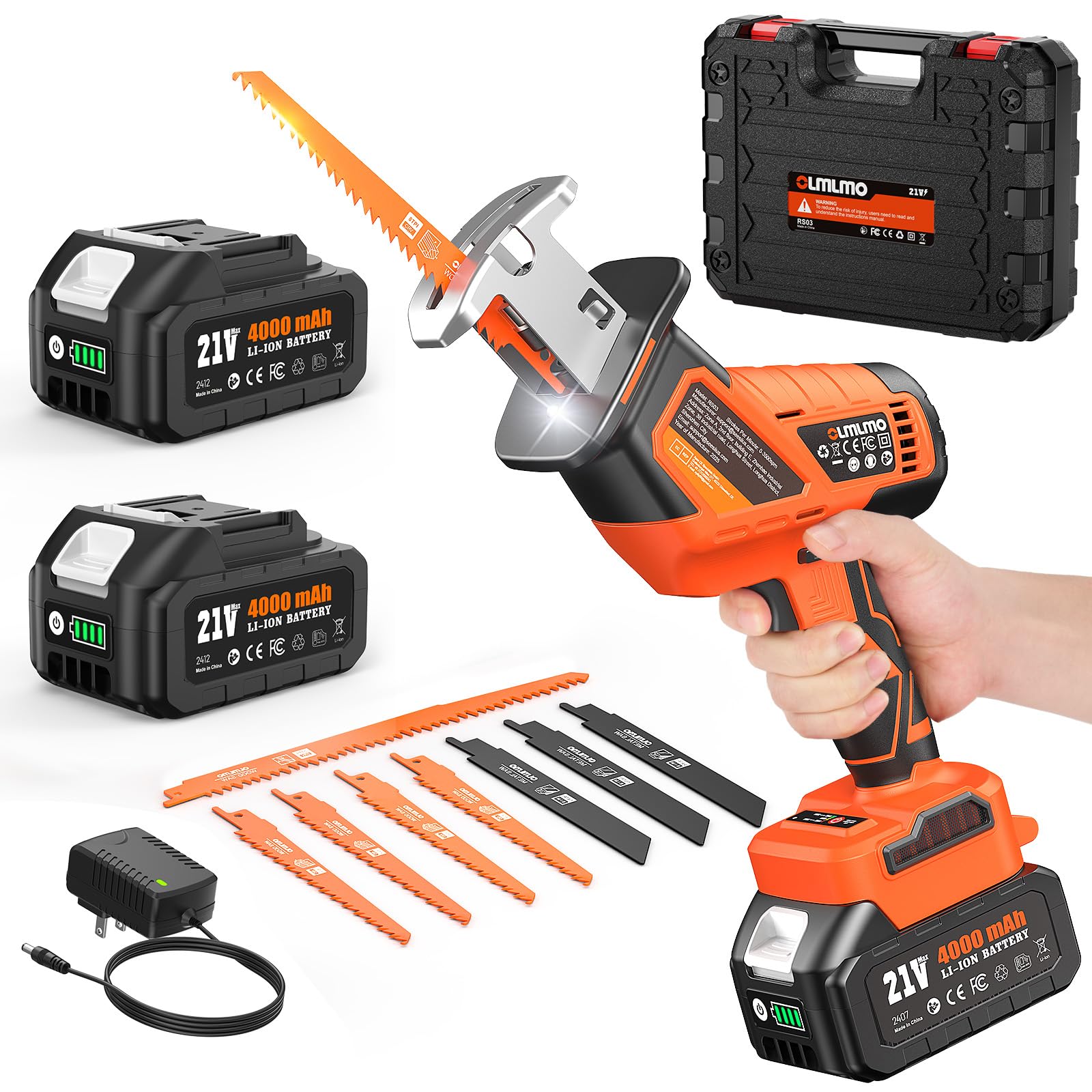
This 3-pound bundle comes ready to work with two 4.0Ah batteries and eight carbide blades, making it the lightest and most complete kit here.
This Olmlmo saw is a bundle that thinks of everything: the saw itself, two 4.0Ah batteries, eight carbide blades, a charger, and a carrying case. At just 3 pounds, it is the lightest saw in this review—even lighter than the RYOBI by 0.8 pounds—and that weight makes it a joy to carry around the yard. The 500W brushless motor delivers 0-3200 RPM variable speed with a 1.1-inch stroke, so it cuts through 2×4 lumber in about 5 seconds according to the maker. Buyers confirm it “cuts small to medium tree stumps” effectively and that the batteries last impressively long for a cordless tool in this price tier.
The tool-free blade change system works in about 5 seconds, and the kit includes blades specifically for wood and metal, though you will want to invest in a longer pruning blade for larger limbs. The saw’s dimensions are notably compact—at 14.1 inches long, it is 64% shorter than the CRAFTSMAN, making it easy to maneuver in tight spots between bushes or fence lines.
The honest trade-off is that while this saw is a fantastic value for basic cutting, it does not match the power of a corded 13-amp or even a 7.5-amp saw when the wood gets very dense. It is a great entry-level or backup tool for a homeowner who needs to trim branches, not a primary saw for heavy demolition.
What makes it a complete package
- 3 lbs is the lightest in the group, ideal for fatigue-free work
- Two included 4Ah batteries provide long runtime
- Eight carbide blades and carrying case included
Limitations to know
- Power lags behind corded saws for thick, dense wood
- Carrying case is plastic without foam inserts to secure tools
Best suited for: the homeowner who wants a lightweight, ready-to-go cordless saw for trimming limbs and does not need to cut thick stumps daily.
Not the one for: professionals or anyone who regularly cuts hardwood branches over 5 inches thick.
6. DEWALT 20V MAX Cordless Reciprocating Saw Kit, 5 Amp-Hour Battery (DCS387P1)
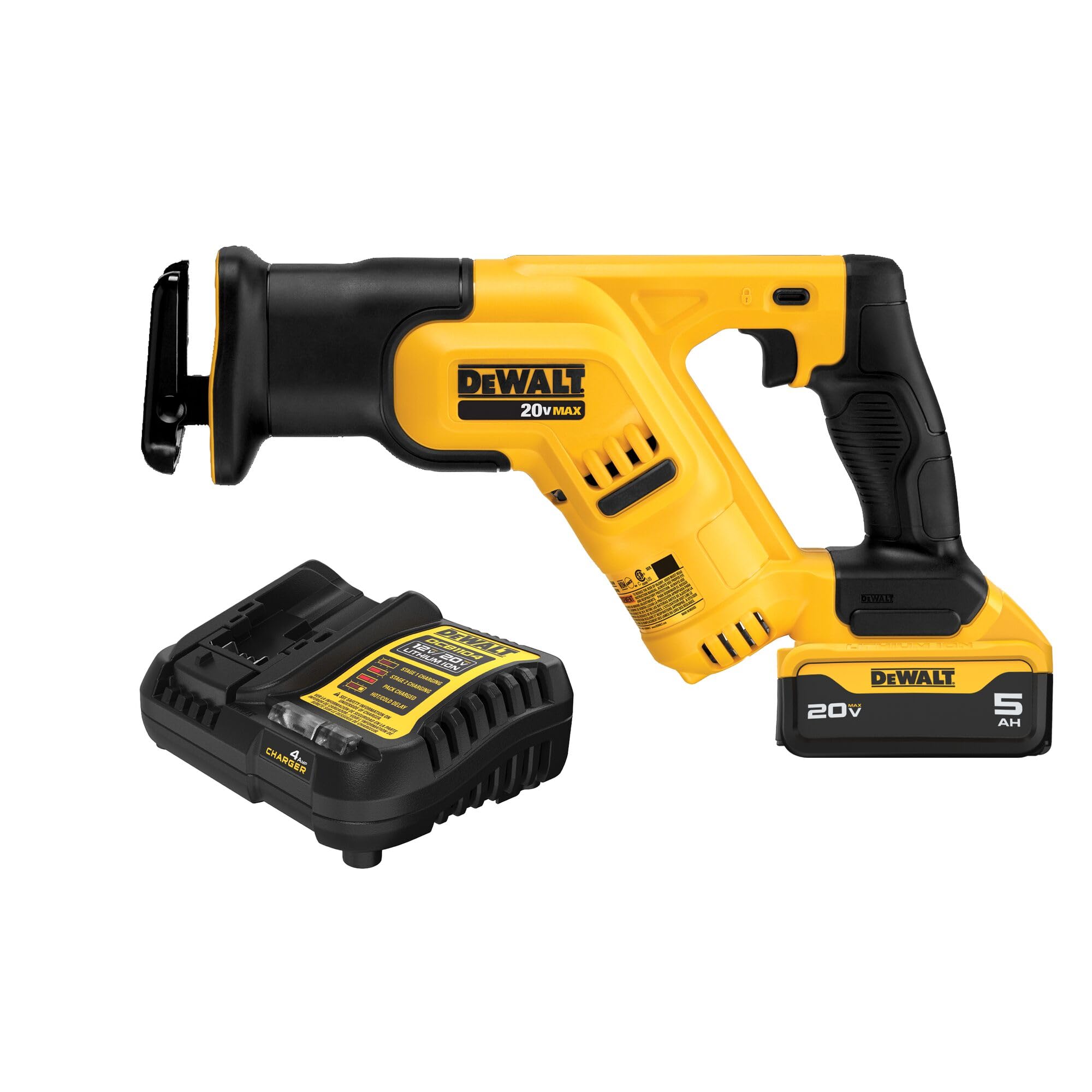
This compact 20V kit, built for pruning branches, is 14.75 inches long to fit into tight tree crotches where longer saws jam.
This DEWALT kit comes as a complete package with the DCS387 saw, a 5.0Ah XR battery, and a charger—everything you need except the blade choice. At just 14.75 inches in total length, it is designed to fit between studs and tight tree crotches where a longer saw would jam. The 4-position blade clamp allows you to orient the blade for flush cutting—handy when you need to trim a branch right against the trunk without scarring it.
The variable speed trigger runs from 0-2900 SPM with a 1-1/8-inch stroke, so it has the same stroke length as the beefier corded saws but in a far more compact body. Customers note that it is “excellent for pruning trees, replacing a chainsaw” and that with the included 5Ah battery, it “rarely needs charging” during normal yard work. The bright LED light is a genuinely useful feature if you find yourself finishing up a branch-cutting job as dusk settles in.
Where this saw falls short versus the FLEXVOLT model is raw torque: the 20V platform cannot match the 60V motor’s sustained power for thick, wet wood. It is a superb saw for branches up to 4-5 inches, but if you regularly cut limbs thicker than that, you will want the FLEXVOLT or a corded saw. The included 3-year warranty adds confidence for a tool that will see regular weekend use.
Highlights for tree care
- Compact 14.75-inch length reaches into tight branch crotches
- 4-position blade clamp enables flush cuts against the trunk
- Kit includes 5.0Ah battery and charger; 3-year warranty
Trade-offs to consider
- 20V motor has less sustained power than 60V or corded options
- Not ideal for branches over 5 inches in diameter
Choose this if: you already own 20V DEWALT tools and want a compact, reliable saw for pruning branches and general yard cutting.
Pass it up for: heavy-duty limbing where the extra voltage of a 60V saw makes a real difference.
7. HYCHIKA Reciprocating Saw, 18V Cordless Electric Saw with Battery, Variable Speed, 4 Blades (RS22D)
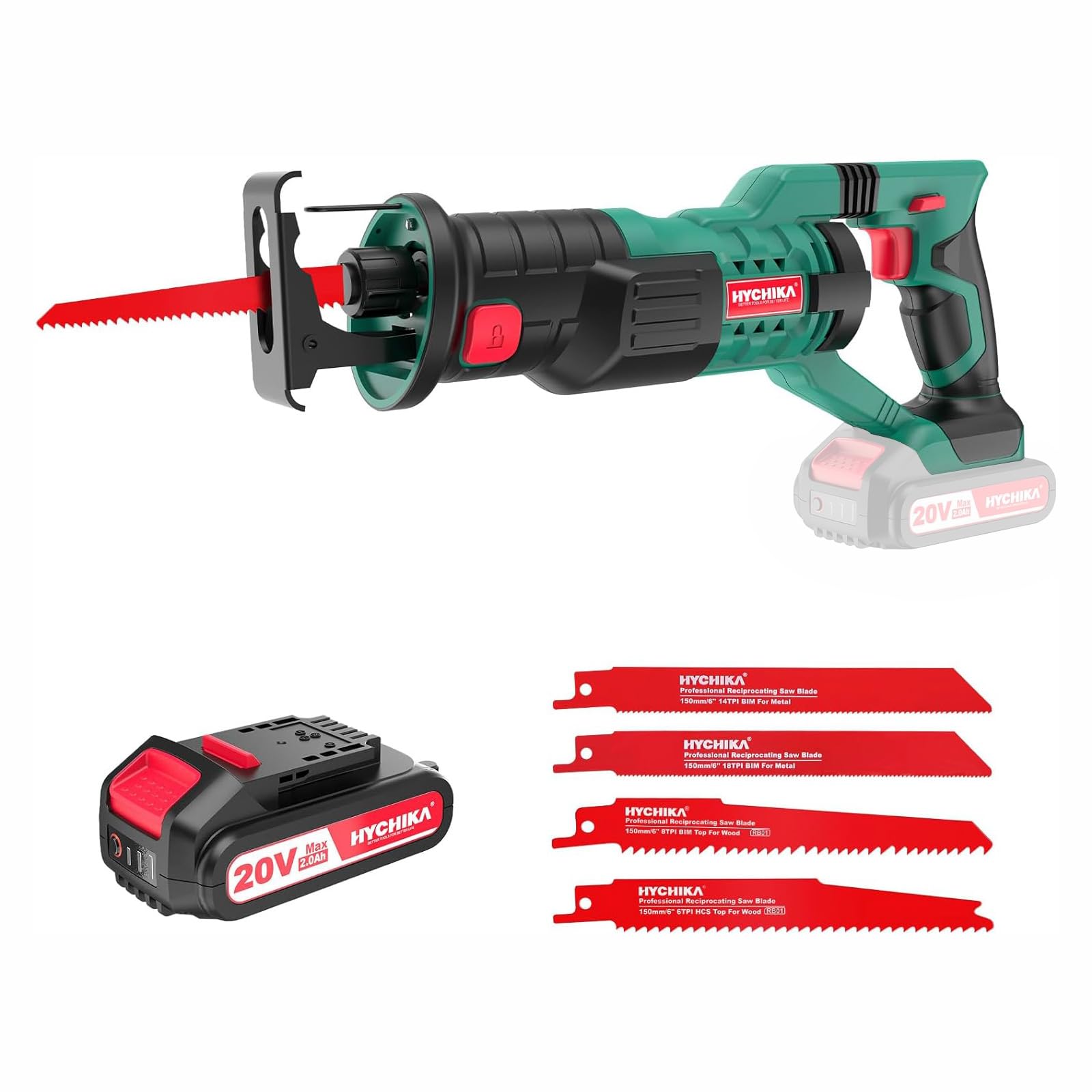
For the occasional cutter who needs to hack through a few fallen branches, this 18V saw offers a low-cost way with its 2.0Ah battery and four included blades.
For the occasional cutter who just needs to hack through a few fallen branches or trim some saplings, this HYCHIKA provides a very low barrier to entry. The 18V motor delivers variable speed from 0-2800 SPM, and the included 2.0Ah battery can handle light limbing—though buyers are straightforward that “one hour job need recharge,” which means you will want a second battery for any serious session. The saw includes four blades (for wood, metal, and PVC) from the start, plus a built-in LED light for working in dim corners of the yard.
The maximum cutting thickness is listed at 30cm (about 12 inches) for wood, but in practice, with a 2-amp motor, you are going to feel that saw slow down significantly on anything over 3-4 inches of green wood. The difference here versus the SKIL’s 13-amp motor is stark: a 6.5x gap in current draw means this HYCHIKA is really designed for pruning cuts and light trimming, not heavy tree work. Reviewers point out it is “powerful, easy to control” for its size, and the ergonomic handle with a safety lock adds confidence for newer users.
The key drawback is the battery runtime: the single 2.0Ah pack will run out faster than you expect, and replacement batteries from the manufacturer are about half the cost of the entire tool kit. If you are only cutting a few branches per session, this is a fine tool. If your weekend involves a pile of storm debris, you will quickly outgrow it.
What works for light work
- Low cost includes saw, battery, charger, and four blades
- Adjustable speed from 0-2800 SPM for controlled cuts
- Safety lock and LED light are nice touches for beginners
Reality checks
- 2.0Ah battery runs out quickly—shoppers say needing to recharge mid-job
- 2-amp motor struggles with anything beyond light branches
Perfect for: the budget-conscious homeowner who needs a basic saw for trimming a few thin branches and does not want to spend over.
Not enough saw for: anyone who cuts limbs regularly or needs to make more than 10 minutes of continuous cuts per session.
Understanding the Specs
Amps vs. Volts (The Power Source Trade-off)
Corded saws list their motor strength in amps—this is the electrical current the motor draws. Higher amps (like 13) mean more torque to keep the blade moving through dense green wood without stopping. Cordless saws list volts (18V, 20V, 60V) as the nominal battery voltage, and the real-world power comes from both the voltage and the battery’s amp-hours (Ah) capacity, which determines runtime. A 60V saw with a 5.0Ah battery has roughly the same sustained power as a 7.5-amp corded saw, but for a limited time before the battery drains.
Stroke Length and SPM
Stroke length is how far the blade moves forward and back in each cycle—measured in inches. A longer stroke (1-1/8 inches or more) pulls the blade deeper into the wood on each pass, making the saw cut faster through thick limbs. Strokes per minute (SPM) is how fast it cycles; a saw that can reach 3,000 SPM delivers more cuts per minute, but stroke length matters more for thick material. For tree cutting, prioritize stroke length over pure SPM.
FAQ
Will a standard 8-inch blade cut through a 6-inch tree limb?
Can I use a reciprocating saw to cut down a whole tree?
What is the difference between a reciprocating saw and a chainsaw for tree work?
How long does a cordless reciprocating saw battery last when cutting tree limbs?
Is a corded or cordless reciprocating saw better for tree trimming?
How do I reduce vibration when using a reciprocating saw on tree branches?
What is the best blade type for cutting tree limbs with a reciprocating saw?
Will a 7.5-amp reciprocating saw cut through tree stumps?
How do I maintain a reciprocating saw used for tree cutting?
Can a reciprocating saw replace a chainsaw for pruning trees?
Final Thoughts: The Verdict
For most buyers, the best reciprocating saw for cutting trees winner is the SKIL 13 Amp Corded because its 13-amp motor and Buzzkill vibration control turn heavy limb cutting into a manageable, fatigue-free task that never stops for a battery recharge. If you want cordless freedom that still delivers corded-level power, grab the DEWALT FLEXVOLT 60V. And for light pruning and tight overhead trimming where every pound counts, the standout is the <