
Specs are compiled from manufacturer listings and verified buyer reviews and can change over time — please confirm the key details on the product page before buying.
You grab a bag of plant food, but the label is a jumble of numbers, words like “NPK” (Nitrogen-Phosphorus-Potassium — the three key nutrients your plant needs), and “OMRI” (the Organic Materials Review Institute, a stamp that verifies a product meets organic standards). You just want your snake plant to grow a new leaf and your pothos to trail longer without risking harsh synthetic salts. The easier path is an organic fertilizer, which feeds the soil’s beneficial life along with your plant. But picking the right one from a lineup of bottles, powders, and bags of worm castings is its own challenge. This guide breaks down what the NPK numbers actually mean for your plant, which form fits your watering routine, and which products regular buyers actually use repeatedly.
I’m Rikta — the founder and writer behind Lawn Gear Lab. This guide is built by comparing the manufacturers’ published specifications and the patterns across verified customer reviews, so you get each pick’s real strengths and trade-offs instead of marketing spin.
Whether you are coaxing a bloom from a goldfish plant or keeping a collection of pothos and peace lilies consistently green, the right organic fertilizer for indoor plants depends on matching the NPK ratio, the form (liquid versus dry), and the scent tolerance of your home — because not all organic options are odor-free.
How To Choose The Best Organic Fertilizer For Indoor Plants
Choosing an organic fertilizer for your indoor plants is less about chasing the biggest numbers and more about matching the product to your plant’s needs and your own lifestyle. A busy plant parent who waters weekly will want something different from someone who prefers a “low-maintenance” approach. Here is what to weigh before you buy.
NPK Ratio — What Your Plant Actually Eats
The three numbers on the label, like 5-5-5 or 3-1-2, stand for Nitrogen-Phosphorus-Potassium. Nitrogen is the fuel for lush, green leaves. Phosphorus supports roots and blooms. Potassium is the overall health booster that helps plants handle stress. For most foliage-heavy houseplants like pothos, snake plants, and monstera, a balanced or slightly nitrogen-leaning formula works great. If you are trying to get a peace lily or an orchid to flower, look for a phosphorus number (the middle digit) that is not the lowest of the three.
Liquid vs. Granular — Your Watering Routine Decides
Liquid fertilizers are mixed into your watering can and deliver nutrients quickly. They are ideal if you already water your plants on a schedule and want to feed them with nearly every watering or once a month. Granular fertilizers and powders are sprinkled onto the soil surface and break down slowly over weeks. This is a lower-maintenance choice for forgetful waterers, but you need to make sure the granules get some moisture to activate. Worm castings are a third category: you mix them into the potting soil as a gentle, slow-release soil amendment that rarely burns roots.
The Smell Factor — It Matters More Than You Think
Because you are using these products indoors, scent is a real consideration. Fish emulsion is a powerhouse of organic nitrogen, but buyers consistently warn that the smell is strong and can linger for a day in your home. Kelp-based and plant-based fertilizers (alfalfa, soybean meal) are generally odorless or have a mild earthy scent. Worm castings smell like rich soil. Read the “about this item” and “ingredients” sections carefully: a product marked “deodorized” or based on plant meals will be far more pleasant in a living room or bedroom.
Quick Comparison
| Model | Best For | Form | NPK Ratio | Weight / Volume | Amazon |
|---|---|---|---|---|---|
| Dr. Earth Pump & Grow | Premium convenience | Liquid | — | 16 fl. oz | Amazon |
| Alaska Fish Fertilizer 5-1-1 | Best nitrogen boost | Liquid | 5-1-1 | 115 fl. oz | Amazon |
| Grow Queen Organic Liquid 5-5-5 | Balanced all-purpose | Liquid | 5-5-5 | 12 fl. oz | Amazon |
| Houseplant Resource Center 3-1-2 | Targeted houseplant ratio | Liquid | 3-1-2 | 8 fl. oz | Amazon |
| Back to the Roots All-Purpose 5lb | Vegan slow-release | Powder | — | 5 Pounds | Amazon |
| Grow Queen All-in-One 7-Pack | Travel & convenience | Powder | — | 0.33 Pounds | Amazon |
| Back to the Roots Worm Castings 5lb | Soil amendment | Granules | — | 5 Pounds | Amazon |
In‑Depth Reviews
1. Dr. Earth Organic & Natural Pump & Grow House Liquid Plant Food 16 oz

The two-pump wonder that turns feeding into a five-second habit.
This is the closest you will get to a “no thought required” organic liquid feed. Dr. Earth’s formula is made from human-grade whole foods like seafood, raw meats, fruits, and vegetables — the same ingredients you might buy for your own kitchen, according to the manufacturer. The pump top makes it simple: two pumps into the watering can feed your houseplants for two weeks. That simplicity is a real time-saver compared to measuring teaspoons or mixing ratios from a bottle.
Being OMRI listed (verified for organic use), OIM, CCOF, and NOP (all different organic certification programs) certified gives you a paper trail of organic integrity that few other products on this list can match. The 16-ounce bottle is bigger than most premium liquid options. Buyers report seeing perky plants after just one application. Unlike the Alaska fish emulsion, this one has less of a reputation for a heavy indoor odor, though a few owners mention that if you use it outside, it can attract flies — so stick to indoor application.
One important trade-off: the pump mechanism leaked for one buyer after the first use, so you may want to store the bottle upright in a tray. But for anyone who wants a certified-organic, whole-food feed with the easiest possible application, this is the top-tier choice.
What stands out
- Pump dispenser for no-mess measuring — just 2 pumps per feeding
- Made from human-grade whole foods (seafood, fruits, grains) with multiple organic certifications
- Feeds for two weeks per application, reducing routine workload
Before you buy
- Can attract flies if used outdoors; best kept to indoor application
- Pump mechanism had a leaking report; store upright to be safe
- Odor reported by some buyers, though less intense than fish emulsion
The trade-off for convenience: The pump top is not perfectly leak-proof for everyone, and the smell, while mild, is still present. If you want the absolute easiest organic routine — pump, water, and go — with the confidence of whole-food ingredients and multiple organic certifications, this is the pick.
2. Alaska Fish Fertilizer OMRI Listed 5-1-1

The legendary fish emulsion that delivers a wallop of nitrogen without burning roots.
If you have a houseplant that is looking pale, leggy, or just not pushing out new leaves, the 5-1-1 ratio in this liquid fertilizer is straight nitrogen fuel — the kind of boost that turns a sad plant around fast. The brand claims it is OMRI listed for organic use and has been a trusted product for generations. One buyer who revived sad houseplants in January swears by it, and another noted that tomatoes blossomed quickly after just a few feedings.
This is a very large jug at 115 fluid ounces, which covers roughly 1,000 square feet. That volume makes it a far better value per feeding than the smaller liquid bottles on this list. For example, you get about 14 times the volume of the 8-ounce Houseplant Resource Center bottle for a similar price range, but the sheer size means you will have it around for a long time. The cold-processing method used by the manufacturer is designed to preserve micronutrients from the fish, and the formula feeds soil microbes, which is a bonus for your potting mix’s ecosystem.
The catch is the smell. Buyers are blunt about it: the fishy odor is pungent and can linger indoors for about a day. One reviewer called it “pungent” and recommended using it in a ventilated area and keeping an air freshener handy. If you have a well-ventilated living space or a tolerance for earthy scents, the results are undeniable. The smell dissipates after it dries, so it is a temporary trade-off for a very effective feed.
Why it works
- High nitrogen (5-1-1) for strong vegetative growth and greener leaves
- OMRI listed and cold-processed to preserve natural micronutrients
- Massive 115 fl. oz jug offers excellent value per feeding; covers 1,000 sq. ft.
The reality
- Strong fish odor lingers for about a day; not ideal for scent-sensitive homes
- Low phosphorus and potassium means you may need a separate bloom booster (a fertilizer with higher phosphorus) for flowering plants
- Large size can be cumbersome to store if you only have a few small pots
Reach for this if: You want the most effective organic nitrogen kick for leafy growth and you don’t mind a temporary fishy smell in exchange for dramatic plant recovery. It’s a better nitrogen punch than the balanced Grow Queen 5-5-5, but skip it if you have a small, unventilated apartment.
3. Organic Liquid Indoor Plant Food (Grow Queen) 5-5-5
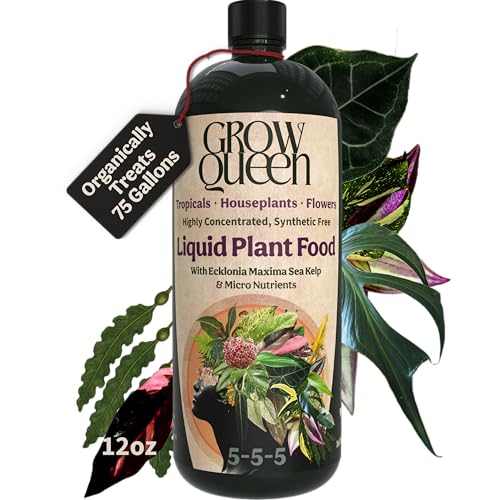
The balanced bottle that feeds 75 gallons from just 12 ounces.
This liquid concentrate is a true 5-5-5 NPK (Nitrogen-Phosphorus-Potassium) formula, which means it gives equal weight to leaves, roots, and overall plant health — a balanced approach that works for nearly any indoor plant. It is built around cold-processed Ecklonia maxima sea kelp (a specific species of kelp from South Africa), which delivers auxins (plant growth hormones) and trace minerals that promote root expansion and faster recovery. The brand claims it is the strongest true 5-5-5 organic liquid fertilizer available, and the mixing ratio of 1:625 means that small bottle treats a massive 75 gallons of water.
Customers note dramatic results. One reviewer who manages roughly 300 indoor plants saw “dramatic growth and health improvement” and noted the bottle lasted a long time. Another who uses just “the tiniest of drops for 4 plants in a container of water” said their plants are “growing like crazy.” Unlike the Alaska fish fertilizer, this one is odorless, so it works beautifully in a living room or bedroom without any fishy after-effects.
It is a premium-price concentrate, but the math works in your favor: because you only use a tiny amount per watering, the cost per feeding is very low. The brand says the formula is also 100% biodegradable and safe around pets and kids once watered in. This is the best all-around liquid feed for anyone who wants balanced nutrition without any smell. If you don’t mind measuring a few drops versus the two-pump ease of the Dr. Earth, this saves you money long-term.
The strengths
- True 5-5-5 NPK with sea kelp for balanced leaf, root, and bloom support
- Treats 75 gallons from one bottle; cost per feeding is extremely low
- Odorless formula — no lingering fish or earth smell indoors
The limits
- Concentrate ratio (1:625) requires measuring, not as easy as a pump dispenser
- Premium initial cost per bottle, even if it lasts a long time
- No slow-release action; you need to mix it with every watering or maintenance schedule
Stick with this if: You want a versatile, balanced, and completely odorless liquid feed that can handle a large plant collection while staying affordable per feeding. The one trade-off: you need to be comfortable mixing a tiny concentrate into your watering can.
4. Indoor Plant Food by Houseplant Resource Center 3-1-2
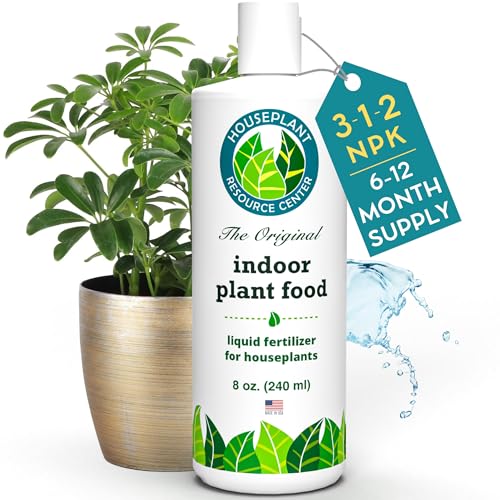
The scientifically dialed 3-1-2 ratio formulated for the way houseplants actually eat.
Most all-purpose fertilizers land on a balanced NPK like 5-5-5, but this product from Houseplant Resource Center deliberately uses a 3-1-2 ratio. That means 3 parts nitrogen for leaf growth, 1 part phosphorus for roots, and 2 parts potassium for general health — close to what many common houseplants (pothos, peace lily, monstera, snake plants, ZZ plants) need for steady foliage growth without excess phosphorus that can build up in pots. The nitrogen is urea-free (no urea, a synthetic compound that can burn roots), and the formula uses chelated micronutrients, meaning the minerals stay bioavailable in the soil longer so your plants can actually absorb them.
Buyers are loyal. One reviewer who purchased three separate times reported new growth on pothos, fiddle leaf fig, and monstera. Another revived a 29-year-old dracaena that was struggling. The application is simple: add a few drops to your watering can and feed as you normally water. The brand says it is gentle enough not to burn sensitive roots, and because it is urea-free, there is no risk of salt buildup over time.
The main drawback is the volume. At 8 fluid ounces, this is the smallest bottle on the list. Reviewers point out that it feels expensive for the size, even though a little goes a long way. It is also not OMRI listed in the way the Dr. Earth or Alaska products are, so if you absolutely need a certified organic seal, check the label. For a plant parent who wants a species-specific ratio and a gentle, non-burning formula for a prized collection, this is a precise tool — but the larger Grow Queen 5-5-5 gives you more feedings for the same price.
What makes it different
- 3-1-2 NPK ratio tune for common houseplants like pothos, monstera, and peace lilies
- Urea-free and non-burning; no risk of salt buildup or overfeeding damage
- Chelated micronutrients for long-term soil bioavailability
What to consider
- Small 8 fl. oz bottle looks expensive per ounce compared to larger value options
- No organic certification seal like OMRI; verify label if certification is a must
- Requires measuring drops, not as convenient as a pump or single-serve packet
Designed for: The indoor plant enthusiast who wants a gentle, species-matched formula that avoids synthetic urea and salt buildup — particularly good for a curated collection of houseplants. Be aware of the small bottle size and lack of organic certification.
5. Back to The Roots Organic All-Purpose Plant Food (5 lb. Value Size)

The 5-pound vegan powerhouse that feeds without a trace of animal waste.
This is a real standout for anyone who wants an organic fertilizer that is both potent and ethically clean. The formula is 100% plant and mineral based — alfalfa meal, soybean meal, kelp, and rock phosphate — with no synthetic chemicals and no factory-farmed animal waste. Buyers call it a “good value and convenient ‘all-in-one’ vegan fertilizer.” The 5-pound bag weighs the same as the worm castings below but serves a completely different purpose: a slow-release powder that you sprinkle on the soil surface and water in.
One of the best features is the addition of mycorrhizae, a beneficial fungus that forms a partnership with plant roots to help them absorb water and nutrients more effectively. This is something the liquid fertilizers on this list do not offer. The mixing ratio listed is 1 tablespoon per gallon of water, though some shoppers say that the bag itself says to simply sprinkle over the surface. Either way, it is easy to apply and buyers report it “never burns crops.”
The main caution from buyers is about ingredient sourcing: the seed meals (alfalfa and soybean) may not be certified organic or non-GMO (genetically modified organisms), so if you are a stickler for 100% certified organic inputs, you may want to verify with the company. The packaging is also not recyclable. But for the price and the sheer volume, this is the best dry organic option for feeding a whole windowsill of plants or a small garden — a far bigger value per feeding than the Grow Queen All-in-One 7-pack.
The highlight features
- Vegan formula — no animal waste, just alfalfa, kelp, soybean meal, and rock phosphate
- Includes mycorrhizae to improve root nutrient uptake
- Large 5-pound bag with no burn risk; buyers use it on vegetables, flowers, and roses
The honest trade-offs
- Seed meal ingredients may not be certified organic or non-GMO
- Non-recyclable packaging is not eco-friendly
- Slow-release action means you won’t see results as fast as with a liquid feed
Grab this for: A large plant collection where you want a gentle, vegan, slow-release feed that you can sprinkle and forget — the mycorrhizae bonus is a unique advantage no liquid on this list offers. pass on it if you need 100% certified organic ingredients on every label.
6. All-in-One Complete Organic Plant Food by Grow Queen (7 Pack)
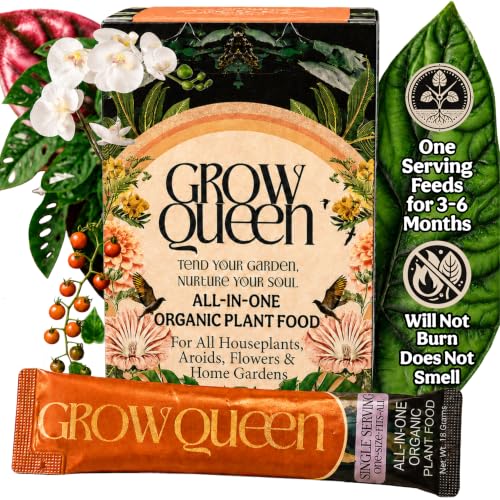
The 7-serving starter kit that takes the measuring out of organic feeding.
If you are new to fertilizing or just want a no-fuss way to try organic feeding, this 7-pack of single-serving packets takes all the guesswork away. Each packet feeds 1-2 plants and treats up to 14 gallons of soil total. You simply pour the powder onto the soil, water it in, and the slow-release formula feeds your plant for 1-3 months. One buyer called it “super easy to use and NO complicated measurements.”
At just 0.33 pounds, this is the lightest product on the list — a 15.2x weight gap compared to the 5-pound bags from Back to the Roots. That makes it a fantastic choice for travel, gifting to a friend, or trying out an organic feed without committing to a massive bag. The formula is designed for a wide range of plants including snake plant, spider plant, peace lily, ZZ plant, monstera, and even herbs like basil and tomatoes. Owners mention pretty dramatic results: one used it on a goldfish plant that “had never bloomed” and said “now it is budding at every node.”
The downside is that you get only 7 feedings. For a person with a large collection, you will run through this pack quickly. And because it is a dry powder, you need to make sure the soil stays moist after application so the granules can break down. But for a beginner, a gift, or someone who wants to test an organic fertilizer without a big investment, this is the perfect entry point.
Why it shines
- Single-serve packets: no measuring, no mixing — just pour and water
- Slow-release formula feeds for 1-3 months per application
- Very lightweight (0.33 lbs) and portable; great for gifts or travel
Its limits
- Only 7 feedings total; not economical for a large plant collection
- Powder must stay moist to activate; not ideal for very dry soil conditions
- Fewer reviews (422 ratings) compared to more established brands on this list
Perfect for: A new plant parent who wants a low-commitment, high-convenience way to see if organic slow-release feeding works for them — or as a thoughtful gift for a plant-loving friend. If you have more than a handful of plants, you will run out of packets in under a week, so the larger Back to the Roots powder or the Grow Queen liquid will serve you better.
7. Back to the Roots Organic Worm Castings (5 lb)

The “good worm poo” that brings beneficial microbes into your potting mix.
Worm castings are the gold standard for gentle, soil-building organic amendments. This 5-pound bag from Back to the Roots is pure vermicompost — no fillers, no added chemicals. It has a natural earthy smell (not the fishy odor of Alaska or the cooked-food scent of Dr. Earth) and it will not burn your plants, even if you use a generous amount. One buyer simply called it “high quality worm castings for the money,” comparing it favorably to what they get at Costco.
The bag includes beneficial microbes that enhance your soil and help protect seedlings from pathogens. It works as a top dressing (sprinkle a layer on the soil) or you can mix it directly into your potting blend. The granules do not compact the soil, so they work well in chunky mixes with coco chips, perlite, and charcoal — a favorite among aroid growers. Buyers use it on milkweed for monarchs, vegetables, flowers, and houseplants alike.
The catch is that worm castings are a soil amendment, not a concentrated fertilizer with a high NPK punch. They release nutrients slowly and gently. If your plant is severely nutrient-starved, a liquid feed like the Grow Queen 5-5-5 or the Alaska fish fertilizer will deliver faster results. But if your goal is to build a healthy, living soil that reduces the need for frequent fertilizing, this is the most natural choice available. The 5-pound bag is a generous size, and one reviewer noted, “my garden is thriving and this is the first year I’ve used it.”
What it does best
- Pure worm castings with beneficial microbes for lasting soil health
- No burn, no odor; safe for all plants including seedlings and sensitive species
- Works beautifully in chunky soil mixes without compacting the substrate
What to know
- Slow-release action means it is not for quick green-ups or dramatic recovery
- Lower concentrated nutrient punch than liquid or granular fertilizers
- Some buyers find Costco castings drier, but this bag is reported as fresh and moist
Best for: Anyone who wants to build a sturdy soil microbiome and prefers a “feed the soil, not just the plant” approach — ideal for routine maintenance and preventing nutrient deficiencies before they start. Hold off if you have a plant that looks sick or pale right now and you need fast, visible results; in that case, grab the liquid Grow Queen 5-5-5 instead.
Understanding the Specs
NPK Ratio — The Three‑Number Code
The trio on the label — for example 5-5-5 or 3-1-2 — stands for Nitrogen (drives green leaves and growth), Phosphorus (supports roots and blooms), and Potassium (boosts overall health and stress resistance). A balanced ratio like 5-5-5 works as a general-purpose feed for most indoor plants. A 3-1-2 ratio is deliberately low in phosphorus, which matches what many foliage houseplants actually need without salt buildup in pots. A 5-1-1 ratio is a nitrogen bomb for pushing leafy growth but low in bloom support.
Liquid vs. Granular vs. Worm Castings
Liquid fertilizers are mixed into water and absorbed quickly; they offer precise control and fast results but require regular application. Granular and powder types are sprinkled on the soil and break down over weeks, releasing nutrients slowly with less effort. Worm castings are a soil amendment, not a concentrated feed — they enrich the soil microbiome and release gentle nutrients over a very long time without any risk of burning roots. The best choice depends entirely on your watering habits and how much hands-on time you want.
FAQ
Can I use outdoor organic fertilizer on my indoor plants?
How often should I fertilize my indoor plants with organic fertilizer?
Will organic fertilizer for indoor plants attract bugs or pests?
What is the difference between OMRI listed and “organic” on the label?
What is the best NPK ratio for common houseplants like pothos, monstera, and snake plants?
Can I mix organic liquid fertilizer with worm castings?
How long does a bottle of liquid organic fertilizer last?
Is organic fertilizer safe around pets and children?
Why does my organic fertilizer smell bad?
Can I use organic fertilizer on succulents and cacti?
Final Thoughts: The Verdict
For the majority of shoppers, the organic fertilizer for indoor plants winner is the Back to the Roots Organic All-Purpose Plant Food because it delivers a large, vegan, mycorrhizae-enhanced slow-release feed that handles a