
Specs are compiled from manufacturer listings and verified buyer reviews and can change over time — please confirm the key details on the product page before buying.
You spot the fine webbing and speckled leaves, and you know: spider mites have moved in. The hard part isn’t spotting them — it’s picking a treatment for spider mites that actually stops the cycle without harming your plant or your family. Some treatments kill on contact, others work from the inside out, and a few use living predators to hunt them down. This guide breaks down the seven most effective options on the market right now, so you can match the right weapon to your outbreak.
I’m Rikta — the founder and writer behind Lawn Gear Lab. This guide is built by comparing the manufacturers’ published specifications and the patterns across verified customer reviews, so you get each pick’s real strengths and trade-offs instead of marketing spin.
Whether you are dealing with a mild infestation on a houseplant or a full-blown takeover in a greenhouse, the right approach depends on the severity of the problem, the type of plant, and your tolerance for chemicals. Below, you will find the most effective treatments available to knock out these stubborn pests for good.
Our Picks at a Glance

How To Choose The Best Treatment For Spider Mites
Picking the right mite treatment depends on where your plant lives, how bad the infestation is, and how much risk you are willing to take with chemicals or live bugs. Here are the three most important factors to consider before you buy.
Contact Poison vs. Systemic Action
A contact spray kills mites only when it directly hits them. That means you must coat every leaf, stem, and crevice, and reapply when eggs hatch. A systemic treatment, on the other hand, is absorbed into the plant’s tissue so mites die when they bite. Systemics last longer but are often too harsh for edible crops.
Chemical Strength and Safety
Some miticides are mild enough for weekly use on vegetables with zero withdrawal period, while others are so potent they require a hazmat suit and respirator to apply safely. The buyer’s own tolerance for handling strong chemicals matters here. Lighter options (like botanical oils) are safer around kids and pets but may need more frequent applications to stay effective.
Biological vs. Synthetic Control
Live predatory mites hunt and eat spider mites without any chemicals. This is a natural, self-sustaining solution, but it takes patience and ideal conditions (temperature and humidity) to work. Synthetic miticides deliver faster, more predictable results but may harm beneficial insects and require careful handling. Your choice depends on if you want a quick fix or a long-term ecosystem balance.
Quick Comparison
| Model | Best For | Active Ingredient | Form | Unit Size | Amazon |
|---|---|---|---|---|---|
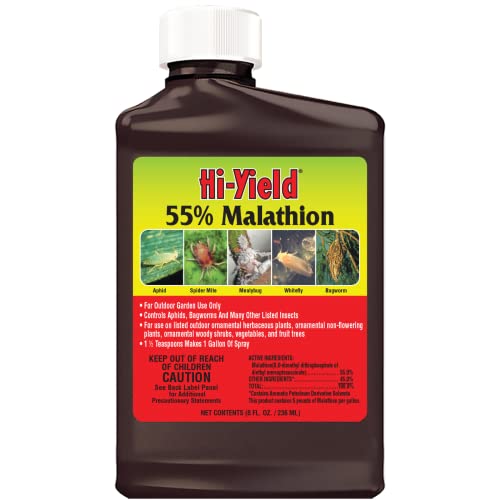
| Hi-Yield 55% Malathion Spray★ Best Overall | Last Resort | 55% Malathion | Liquid | 8 oz | Amazon |
| Syngenta Avid 0.15ECNuclear Option | Severe Outbreaks | Abamectin | Spray | 8 oz | Amazon |
| General Hydroponics Azamax | Organic Prevention | Azadirachtin A & B | Liquid | 16 oz | Amazon |
| Bonide Systemic Insect Control | Long-lasting Control | Not specified | Spray (Concentrate) | 16 oz | Amazon |
| Summit Year-Round Spray Oil | Gentle Contact Control | Paraffinic Oil | Oil, Spray | 32 oz | Amazon |
| Grower’s Ally Crop Defender 3 | Organic Maintenance | Botanical Oils | Spray | 24 oz | Amazon |
| 2,000 Live Predatory Mites | Biological Control | N/A (Live mites) | Live Culture | 2000 Count | Amazon |
In‑Depth Reviews
1. Hi-Yield 55% Malathion Spray
Our pick — over 4.5★ from 600+ verified ratings; the strongest balance of quality and price.
An old-school, high-concentration chemical that works — but comes with a serious health warning.
This 8-ounce bottle packs 55% Malathion, an organophosphate insecticide that kills spider mites, aphids, thrips, lace bugs, and more on contact. It works on herbaceous plants, ornamental non-flowering plants, shrubs, vegetables, and fruit trees, making it fairly versatile for the garden. The high concentration means a little goes a long way, and the 8.1-ounce item weight reflects a small bottle that you dilute into a larger sprayer.
The honest feedback from buyers is cautious. One user posted a 5-star review but warned it is a “strong insecticide, suspected carcinogen” and said they only used it as a last resort for stubborn scale and red spider mites, with full protective gear (clothing, respirator) and caution around kids, pets, and beneficial insects. Another reviewer simply said “it’s bug spray and it kills” — which it does, but you should weigh that against the safety concerns. The product holds a 4.7/5 rating from 649 reviews, making it one of the highest-rated options here, but the “use with caution” theme is hard to ignore. This is the only product on the list that buyers describe as a suspected carcinogen — a sharper safety warning than even the Syngenta Avid.
Effective but Risky: A powerful chemical miticide with a huge following (4.7 stars, 649 ratings) and a track record for killing tough bugs. But the real-world feedback labels it a suspected carcinogen that requires protective gear and careful handling.
The Catch: This is not a gentle maintenance spray — it is a last-resort chemical that demands respect for safety and should not be the first thing you reach for on a light infestation.
Use this when: every other treatment has failed on a severe outdoor infestation of red spider mites or scale, and you are willing to wear full protective gear including a respirator.
Stay away if: you are treating plants near children or pets, or you prefer a lower-toxicity option that is safer for beneficial insects.
2. Syngenta Avid 0.15EC
The professional-grade miticide that growers reach for when nothing else works.
This 8-ounce bottle is the fastest killer of a severe mite outbreak on this list. It uses abamectin, a compound that rapidly moves through the entire leaf (translaminar movement) to protect hidden surfaces that a simple spray might miss. If your spider mites have shrugged off every organic spray you have tried, this is the likely cure. One reviewer with a major indoor grow called it “the nuclear option for mites” and confirmed it works on tough spider mites, broad mites, and russet mites.
The power comes with serious safety precautions. Multiple buyers emphasize that you need a hazmat suit, goggles, gloves, and a respirator to apply it, and you should not re-enter the treated area for at least 4 hours. The label warns that as little as 10 drops of the concentrate can be lethal to humans. You should not use this on flowering plants if you plan to consume the fruits, since the half-life means it stays detectable for about 28 days according to one experienced grower. For an active outbreak where cheaper products have failed, this is the treatment that actually eliminates mites with a single application, backed by a 4.6/5 rating from over 500 reviewers.
Hammer It Home: Easily the most effective miticide here for wiping out a severe infestation fast, and the only one that growers say solves the problem with one application in vegetative growth. The trade-off is handling a product that requires full hazmat gear.
The Catch: This is not a weekly maintenance spray—it is a last-resort tool for when all else has failed, and it demands serious respect for safety protocols.
Pick this when: you have a heavy infestation of resistant spider mites on non-edible ornamentals or plants in vegetative stage and you are confident using strong chemicals with full protective gear.
Look elsewhere if: you are treating edible crops, flowering plants close to harvest, or you lack the proper safety equipment (hazmat suit, respirator).
3. General Hydroponics Azamax

An organic concentrate that works as both a miticide and a preventative maintenance tool.
Azamax is a natural extract from the neem tree, but unlike DIY neem oil mixes, it uses Azadirachtin A & B as active ingredients along with over 100 limonoids — and it is formulated with food-grade ingredients instead of hard chemical solvents. Buyers report it kills spider mites, aphids, thrips, and even fungus gnats on contact and also works as an antifeedant (an agent that makes the plant taste bad to pests) to prevent future outbreaks. One reviewer with a summer-long vegetable garden said it “outperforms neem oil” because it leaves no glassy residue behind.
It is OMRI listed for organic gardening and carries a zero-day withdrawal period, meaning you can spray it on vegetables and harvest the same day. The catch, mentioned by several long-term users, is that spider mites can gradually build resistance if you use only this product. One buyer advised alternating Azamax with a different treatment every few applications to keep the mites guessing. At 16 fluid ounces, it is more expensive than the entry-level oils, but one reviewer summed it up plainly: “Can’t be a plant lover without it.” Unlike the Syngenta Avid, which requires hazmat gear, Azamax is safe enough to use on vegetables up to harvest day.
Best of Both Worlds: An organic miticide with real active ingredients that works as an antifeedant and insect growth regulator (a substance that stops pests from maturing and reproducing) — not just a smothering oil. It is food-grade formulated and safe to use right up to the day you harvest.
The Catch: Mites can build resistance after repeated use, so you will need to rotate it with other products, and it requires thorough coverage to be effective.
Reach for this if: you want an organic, food-grade treatment you can use on vegetables and herbs all the way up to harvest day, and you are diligent about rotating miticides to prevent resistance.
Skip if: you need a cheap one-time spray for a minor outbreak, or you prefer a contact killer that does not require strategic rotation.
4. Bonide Systemic Insect Control
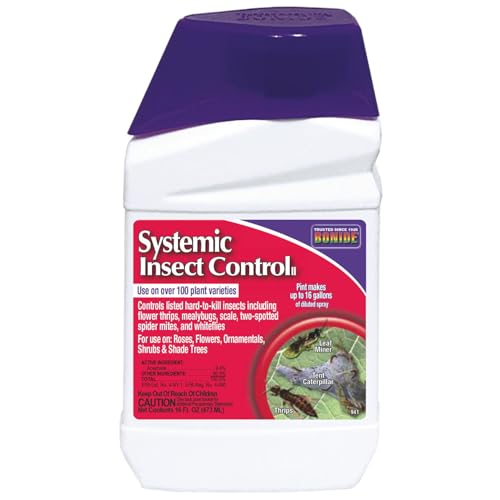
A systemic concentrate that turns your plant into a defense system from the inside out.
Unlike contact sprays that only kill mites they hit directly, this Bonide formula is a systemic insecticide — the plant absorbs it, and mites die when they feed. It is designed for outdoor ornamental plants (roses, shrubs, flower beds) and targets two-spotted spider mites, thrips, scale, mealybugs, and whiteflies. Each 16-ounce bottle of concentrate makes 16 gallons of mixed spray, so the 16 oz vs 32 oz liquid volume comparison with the Summit oil shows you are getting a far more concentrated product that stretches further per bottle.
One reviewer noted it “eliminated scale on indoor Majestic Palm after one soil/leaf treatment” and said the plant stayed bug-free for two months. The major catch — echoed in multiple reviews — is the smell, which one reviewer described as “actual poop” and noted is noticeable indoors. The product is not intended for vegetables or fruit plants, so keep it on your ornamentals. The 1-pound item weight is lighter than the Summit oil at 2 pounds, which makes sense since the systemic concentrate is denser and you dilute it before use.
What Works
- Systemic action means mites die when they bite — no need for perfect coverage
- One bottle of 16 oz concentrate makes 16 gallons of finished spray
- Owners mention a single treatment can keep plants bug-free for months
What Holds It Back
- Strong odor — do not use indoors
- Not labeled for vegetables or fruit plants
- Requires mixing with water before each use
Grab this for: outdoor ornamentals with stubborn mites that survive contact sprays — the systemic action keeps working even on new growth. The long residual control is ideal for preventing re-infestations.
Pass on it if: you need a treatment for edible plants or an indoor garden where the odor would be a problem.
5. Summit Year-Round Spray Oil

A concentrated horticultural oil that conks out mites by smothering them — no harsh chemicals needed.
This is a paraffinic oil that kills mites (and their eggs), aphids, scale, whitefly, and even powdery mildew by coating them and cutting off their air supply. It is OMRI-listed, so it qualifies for organic gardening, and the 32-fluid-ounce bottle is a concentrate that makes a very large amount of ready-to-use spray. One buyer raved that it “killed white fly infestation on first spray” and called it “superior to other products” on Sago Palms. Another noted it worked wonders on roses and hydrangeas for powdery mildew with “next to no scent.”
Unlike synthetic chemical treatments, this oil adds a “shiny luster to your plants’ leaves” according to the label, and you can use it right up to the day of harvest on garden plants, fruit trees, and ornamentals. However, one reviewer did report that the bottle arrived with some leakage due to poor packaging (it came in a simple bag), so the 2-pound item weight includes the glass bottle that needs careful shipping. For the money, you are getting a versatile, low-odor option that treats mites and mildew without synthetic toxins — a gentler approach than the 55% Malathion spray, but it requires direct contact with every mite.
Gentle and Effective: A concentrated oil that smothers spider mites on contact without synthetic toxins, and it also controls fungus problems like powdery mildew. Multiple buyers confirm it works on the first spray, sometimes better than synthetic alternatives.
The Catch: The oil must coat the pests directly to kill them, so you need thorough leaf coverage, and the bottle is known to leak during shipping if not packed carefully.
Best for: gardeners who want an organic, low-toxicity option that handles both mites and mildew, and who prefer a contact killer that leaves no harsh chemical residue on edible plants.
Not for: heavy infestations on plants with very fine hairs (like African violets) where oil can cause leaf burn, or anyone who needs a systemic solution for hard-to-reach leaf undersides.
6. Grower’s Ally Crop Defender 3
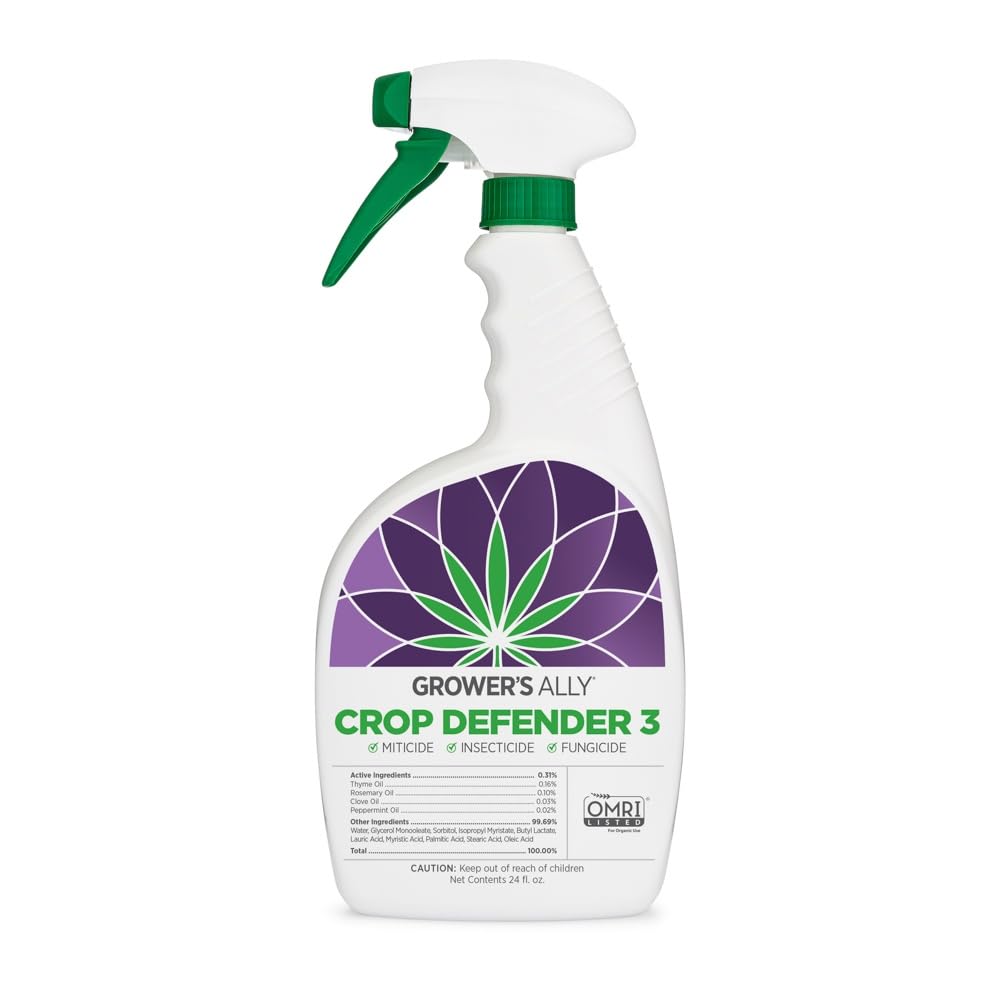
A triple-action organic formula that kills mites, mildew, and soft-bodied insects on contact.
This 24-ounce ready-to-use spray combines botanical oils with a built-in surfactant (a substance that helps the spray spread evenly across waxy leaves instead of beading up) to hit spider mites, russet mites, thrips, aphids, and powdery mildew. It is OMRI Listed and 25(b) exempt, meaning it uses no synthetic pesticides, and you can harvest the same day you spray. One frustrated buyer who had “tried multiple organic & DIY solutions which helped but never really eradicated them” finally found success with this product.
It is designed for weekly use as a preventative, so you do not wait for an outbreak — you spray regularly to keep mites from ever building up. The smell is a big plus: multiple reviewers mention it “smells sooooo good” compared to the sulfur-like odor of other organic options. At 1.7 pounds, the bottle is larger than the chemical concentrates but you do not need to mix anything. The only drawback is the cost per spray compared to mixing your own concentrate, but for the convenience and safety, it is a favorite among indoor and greenhouse growers (4.4/5, 925 ratings). It is the easiest grab-and-go option here — no mixing, no hazmat gear.
High Points
- Ready-to-use spray — no mixing required, just pump and spray
- Triple-action: kills mites, insects, and fungus on contact
- Bee-safe and safe around kids and pets when used as directed
- Harvest same day — zero-day withdrawal period
Low Points
- More expensive per application than mixing your own concentrate
- Requires weekly application for best preventative results
- Contact-only action means you must spray the mites directly
Reach for this if: you are maintaining a small-to-medium indoor or outdoor garden and want a ready-to-use organic spray that smells pleasant and is safe for daily use around your home.
skip it if: you have a massive infestation that needs heavy-duty systemic chemicals, or you prefer to mix your own concentrate to save money per spray.
7. 2,000 Live Adult Predatory Mites

A box of 2,000 tiny hunters that eat spider mites so you do not have to spray.
This is a biological control: you get a mix of live predatory mite species that naturally prey on two-spotted spider mites, broad mites, russet mites, and more. The recommended release rate is 5–10 predators per square foot, and you should release them every other week until the infestation is under control. Unlike chemical sprays that kill everything in their path, these mites are natural biological control agents that continue hunting and reproducing as long as food is available.
The buyer feedback is mixed but informative. Several customers received dead-on-arrival shipments — one review said “first shipment DOA (dead with curled legs)” — though the company replaced the shipment, and the live replacements “ate spider mites within 48 hours.” Another long-term grower noted that the process takes 3–4 weeks to fully clear mites and that you need patience, as the predators do not eliminate pests overnight. It is a gentler approach than chemicals, but it requires the right environment (65–75°F, 50–70% humidity according to one reviewer) and may not work as fast as a strong miticide. The 2000 count is a different approach compared to the Bonide concentrate at 16 ounces, reflecting the fundamentally different nature of the product: living organisms versus a chemical bottle. It is the only option that keeps working without you reapplying, as the predators reproduce on their own.
The Biological Alternative: A self-sustaining control method that does not involve any chemicals. When it works, it works elegantly — the predators eat mites and keep reproducing. But shipping logistics are critical, and the results take time.
The Catch: You are betting on live organisms surviving shipping and your specific environment. If the shipment arrives late or too cold, the mites arrive dead, and you are left with no control at all while your plant infestation gets worse.
Choose this for: an organic, hands-off approach in a greenhouse or indoor grow where you can control temperature and humidity, and you are comfortable waiting 3–4 weeks for results.
Avoid if: you need fast, guaranteed eradication of a bad outbreak, or you cannot guarantee the mites will arrive alive and the environment will support them.
Understanding the Specs
Active Ingredient Strength
The most important factor in any mite treatment is what actually kills them. Products like Hi-Yield’s 55% Malathion are pure chemical weapons that work fast but carry significant toxicity risk. On the organic side, Azamax uses Azadirachtin A & B — powerful plant-based compounds that interfere with mite growth and feeding without the same safety concerns. The higher the percentage of active ingredient in a concentrate, the more diluted spray you can make, but also the more dangerous the handling.
Contact vs. Systemic Action
A contact treatment (like the Summit Year-Round Spray Oil or Grower’s Ally) must physically hit the mite to kill it. That means you need to spray every leaf surface, including the undersides where mites hide. A systemic treatment (like Bonide Systemic Insect Control) is absorbed into the plant’s vascular system, so mites die when they bite any part of the plant. Systemics are more convenient but often cannot be used on edible crops and may harm beneficial insects that feed on treated plants.
FAQ
What is the fastest way to get rid of spider mites?
Can I use the same treatment on indoor and outdoor plants?
How often should I reapply spider mite treatment?
What does “systemic” mean in a mite treatment?
Will miticides harm my plants?
How do I know which mite stage I am dealing with?
Is it safe to eat vegetables sprayed with mite treatment?
What is the difference between a miticide and an insecticide?
How do I apply a liquid concentrate safely?
Can I use multiple mite treatments together?
Final Thoughts: The Verdict
If you want an organic, harvest-friendly option, grab the General Hydroponics Azamax. And for a no-spray biological approach that works with nature instead of against it, the standout is the 2,000 Live Predatory Mites in a controlled greenhouse environment.
How We Picked
We do not accept paid placement. Every pick is matched to a real buyer and a real use-case; we do not hands-on test units.
Sources & Methodology
Specifications: manufacturer listings and product documentation. Review insights: verified customer reviews, as of July 2026. Pricing: not shown on this page (it changes often); check the current price via the retailer link.
As an Amazon Associate, Lawn Gear Lab earns from qualifying purchases. This does not affect which products we feature.